
Automotive Balance Shaft Market Demand, Size & Forecast by 2034
Coverage: By Manufacturing Type (Forging, Casting); Engine Type (Inline 3 Cylinder, Inline 4 Cylinder, Inline 5 Cylinder, V6 Engine); Vehicle Type (Passenger Vehicle, Light Commercial Vehicle, Heavy Commercial Vehicle); Sales Channel (OEMs, Aftermarket) , and Geography (North America, Europe, Asia Pacific, and South and Central America)
- Status : Data Released
- Report Code : TIPRE00005937
- Category : Automotive and Transportation
- No. of Pages : 150
- Available Report Formats :


- Last update date : August 12, 2026


2025 Market Size
US$ 3.59 Bn
Base year value
2034 Forecast
US$ 4.73 Bn
Projected by 2034
CAGR 2026-2034
3.11 %
Growth rate
Addressable Market
US$ 37.77 Bn
(2026-2034)
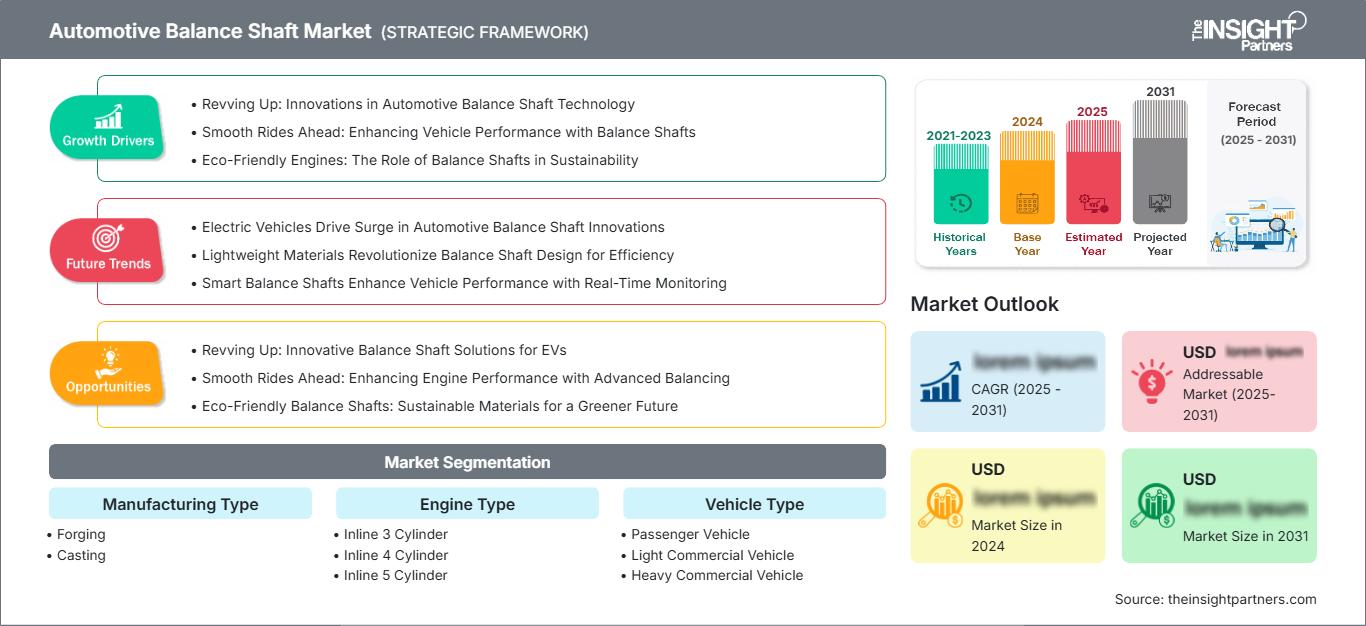
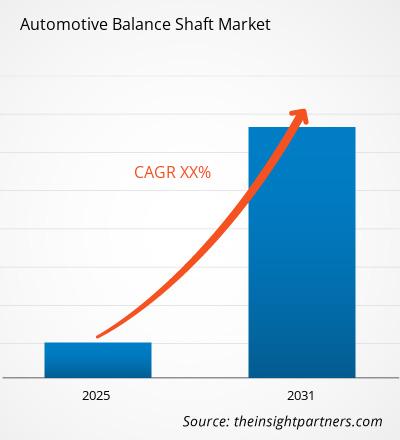
The automotive balance shaft market was valued at US$ 3.59 Billion in 2025 and is projected to reach US$ 4.73 Billion by 2034, registering a CAGR of 3.11% during 2026–2034. Demand is supported by continued internal combustion engine production, compact engine architectures, hybrid powertrain refinement, and OEM efforts to reduce noise, vibration, and harshness in passenger and commercial vehicles.
North America remains a stable demand base as SUVs, pickup trucks, hybrid models, and premium light vehicles continue using refined four-cylinder and V6 engines. The automotive balance shaft market size in the region is supported by replacement engine programs, localization of powertrain manufacturing, and consumer preference for smoother drivability, with regional growth expected to track a CAGR range of 2.8–3.4% during 2026–2034.
Automotive Balance Shaft Market Assessment and Insights
- North America: Held 22–25% share in 2025 and is expected to grow at a CAGR between 2.8–3.4% during 2026–2034, supported by light truck demand and hybrid ICE platforms.
- US: Accounted for 78–82% of North America in 2025 and is forecast to grow at a CAGR between 2.9–3.5% during 2026–2034, led by SUV and pickup applications.
- Europe: Represented 21–24% share in 2025 and is projected to grow at a CAGR between 2.6–3.2% during 2026–2034, with Germany, the UK, France, Italy, and Spain leading adoption.
- Asia Pacific: Captured 44–48% share in 2025 and is expected to grow at a CAGR between 3.3–4.0% during 2026–2034, led by China, Japan, South Korea, India, and Australia.
- Largest Segment: Forging held 64–68% market share in 2025 and is projected to grow at a CAGR between 3.0–3.6% during 2026–2034 due to strength and durability advantages.
- High Growth Segment: Inline 3 Cylinder held 16–20% share in 2025 and is expected to grow at a CAGR between 3.8–4.5% during 2026–2034 as downsized engines expand.
- Key companies analyzed in detail: American Axle & Manufacturing Holdings, Inc., Engine Power Components, Inc., Les Arbres à Cames de l’Ondaine LACO, MITEC Automotive AG, Musashi Seimitsu Industry Co., Ltd., Ningbo Jingda Hardware Manufacture Co., Ltd., OTICS Corporation, Sansera Engineering Limited, SHW AG, AB SKF.
Source: The Insight Partners' analysis based on proprietary research, government publications, company annual reports, investor presentations, industry databases, and expert interviews.
Balance shafts have evolved from simple vibration-control components into precision-engineered systems aligned with compact engine packaging, tighter emissions targets, and improved cabin refinement expectations. The automotive balance shaft market is shaped by engine downsizing, higher combustion pressures, and broader use of turbocharged three- and four-cylinder engines. Forged components remain preferred where fatigue strength, dimensional stability, and compact geometry are critical.
Future demand will be influenced by hybrid adoption, regional ICE production, and stricter customer expectations for quieter vehicles. Emerging markets will support volume through compact passenger cars, while mature markets will focus on refined SUVs, light trucks, and hybridized engines. Suppliers investing in low-friction machining, lightweight designs, and localized manufacturing are better positioned to offset gradual pressure from battery electric powertrains.
Automotive Balance Shaft Market Report Scope
| Report Attribute | Details |
|---|---|
| Market size in 2025 | US$ 3.59 Billion |
| Market Size by 2034 | US$ 4.73 Billion |
| Global CAGR (2026 - 2034) | 3.11% |
| Historical Data | 2021-2024 |
| Forecast period | 2026-2034 |
Automotive Balance Shaft Market Analysis
The automotive balance shaft market growth is driven by the need to control second-order vibration in compact internal combustion engines. Downsized inline engines improve fuel economy but create refinement challenges that automakers address through counter-rotating balance shaft systems. Demand is also linked to hybrid platforms, where engine start-stop cycles make vibration control more noticeable to drivers.
The value chain depends on forging, casting, precision machining, heat treatment, bearings, gears, and final engine integration. The automotive balance shaft market analysis shows that suppliers must meet strict dimensional tolerances because even small deviations can affect engine smoothness, bearing load, and long-term durability. OEMs therefore, prioritize proven process control and stable regional supply.
There are global drivetrain specialists, precision machinists, and regional parts suppliers. Some key competitors include American Axle & Manufacturing Holdings, Inc., Musashi Seimitsu Industry Co., Ltd., OTICS Corporation, Sansera Engineering Limited, SHW AG, AB SKF, MITEC Automotive AG, Engine Power Components, Inc., Ningbo Jingda Hardware Manufacture Co., Ltd., and Les Arbres à Cames de l’Ondaine LACO for various levels of component hierarchy.
Investment is in forging shafts, automation for machining, noise testing, and hybrid-engine compatible parts. Suppliers are focusing on long-term OEM contracts, cost-efficient localization, and low-friction systems expertise. Resilience will be based on supplying parts for the remainder of ICE and hybrid programs while gradually converting machining assets to other drivetrain parts.
● REPORT CUSTOMIZATION
Tailor This Report To Align With Your Specific Business Requirements
This report can be customized to align precisely with your business objectives, scope, and target markets. Customization options include tailored segmentation, geography, competitive analysis, and strategic insights to support informed decision-making.
Customize This Report →WHAT YOU CAN ADJUST
- ● Segmentations
- ● Geography
- ● Competitive Analysis
- ● Language Preferences
Automotive Balance Shaft Market: Strategic Insights
Regional Insights
North America automotive balance shaft market
North America held 22–25% automotive balance shaft market share in 2025 and is expected to grow at a CAGR of 2.8–3.4% during 2026–2034. The demand is driven by pickup trucks, sport utility vehicles, crossovers, and hybridized light vehicles, where the performance of the engine smoothness is critical. The demand for four-cylinder turbocharged engines in bigger vehicles creates an additional demand for refinement technologies aimed at vibration reduction without increasing the vehicle's weight.
Regional growth is slow due to the limited scope for development of components for ICEs, driven by limited adoption of battery electric vehicles, but the hybrid and plug-in hybrid systems maintain the balance shaft demand. Regional opportunities arise from powertrain production, engine re-manufacturing and after-sales.
U.S. automotive balance shaft Market
The US accounted for 78–82% of North America in 2025 and is forecast to grow at a CAGR of 2.9–3.5% during 2026–2034. Demand is concentrated in SUVs, pickups, light commercial vehicles, and hybrid models using inline four-cylinder and V6 engines. Engine refinement is especially relevant where smaller turbocharged units replace larger naturally aspirated engines.
American Axle & Manufacturing Holdings, Inc., Engine Power Components, Inc., AB SKF, and Musashi Seimitsu Industry Co., Ltd. strengthen the domestic ecosystem through drivetrain engineering, precision manufacturing, and bearing-related expertise. OEMs prioritize regional sourcing to reduce logistics exposure and maintain a stable supply for high-volume powertrain programs.
Europe automotive balance shaft Market
Europe represented 21–24% share in 2025 and is projected to grow at a CAGR of 2.6–3.2% during 2026–2034. Germany leads because of premium powertrain engineering, hybrid adoption, and strong supplier networks. The UK supports performance and specialist manufacturing, while France, Italy, and Spain contribute through compact vehicle production and light commercial applications.
European demand is shaped by CO2 targets, engine downsizing, and NVH requirements in smaller turbocharged platforms. Although faster electrification constrains long-term ICE component growth, hybrids maintain demand for high-quality shafts. Suppliers with low-friction designs, recyclable materials, and traceable manufacturing processes are better aligned with regional sustainability and compliance expectations.
APAC automotive balance shaft Market
APAC held 44–48% share in 2025 and is expected to grow at a CAGR of 3.3–4.0% during 2026–2034. China leads through vehicle production scale, while Japan and South Korea contribute advanced engine engineering and precision manufacturing. India adds growth as compact passenger vehicles increasingly adopt smoother three- and four-cylinder engines.
Australia supports demand through SUVs and imported light commercial vehicles. Regional suppliers benefit from high-volume production, cost-efficient machining, and proximity to OEM assembly plants. Hybrid adoption in Japan, China, and South Korea supports continued balance shaft use despite rising battery electric penetration.
Middle East & Africa automotive balance shaft Market
The Middle East and Africa market is expected to grow at a CAGR of 2.4–3.1% during 2026–2034. Demand in Saudi Arabia and the UAE is driven by SUVs, luxury cars, and engines needing smooth operation in hot climatic environments. South Africa drives replacement and assembly-related demand via vehicle manufacturing and servicing processes.
ROMEA demand is varied since factors such as affordability and vehicle imports affect component replacement cycles. Long journeys, hot climate, and utility vehicle use drive demand for durable engine components. Component providers with good distribution and replacement processes can benefit from demand.
Segmentation Analysis
Manufacturing Type
Manufacturing Type is expected to grow at a CAGR of 3.0–3.6% during 2026–2034. The automotive balance shaft market scope is shaped by durability, dimensional accuracy, cost, and production scale. OEMs select manufacturing routes based on fatigue strength, weight, machining complexity, and engine architecture.
- Forging remains the leading process because forged shafts provide superior strength-to-weight performance, grain-flow integrity, and fatigue resistance in high-speed engine environments.
- Casting supports cost-sensitive applications where complex geometries, medium volumes, and lower machining intensity help suppliers balance affordability with acceptable durability.
Engine Type
Engine Type is projected to grow at a CAGR of 3.2–3.9% during 2026–2034 as compact and downsized engines continue to require vibration compensation. Inline four-cylinder engines provide the largest installed base, while inline three-cylinder engines create faster incremental demand.
- Inline 3 Cylinder engines require strong vibration control because inherent imbalance becomes more noticeable in compact cars, hybrids, and urban vehicles with frequent start-stop operation.
- Inline 4 Cylinder engines remain the core demand base because their global production scale and second-order vibration characteristics make balance shafts common in refined passenger vehicles.
- Inline 5 Cylinder applications are niche but relevant in performance and specialty vehicles where smoothness, packaging, and distinctive engine character require careful balancing.
- V6 Engine applications use balance solutions selectively to improve refinement in SUVs, premium vehicles, and light trucks, where torque delivery and cabin smoothness remain important.
Vehicle Type
Vehicle Type is forecast to grow at a CAGR of 3.0–3.7% during 2026–2034 as balance shaft demand follows ICE and hybrid vehicle production. Passenger vehicles dominate volume, while commercial vehicles contribute durability-led demand.
- Passenger Vehicle demand is highest because compact cars, crossovers, SUVs, and hybrids use balance shafts to improve engine refinement and perceived vehicle quality.
- Light Commercial Vehicle demand is supported by delivery vans, pickups, and utility vehicles where engine smoothness, durability, and driver comfort matter during high-mileage use.
- Heavy Commercial Vehicle applications are more selective but require robust components where vibration control improves engine durability, mounting performance, and operator comfort.
Sales Channel
Sales Channel is expected to grow at a CAGR of 2.9–3.5% during 2026–2034 as OEM programs account for most balance shaft procurement, while aftermarket demand is tied to engine repair and remanufacturing cycles.
- OEMs dominate because balance shafts are integrated during engine design, requiring validation with crankshafts, bearings, gears, lubrication systems, and NVH targets.
- Aftermarket demand is smaller but important for engine rebuilds, remanufactured powertrains, and replacement programs in high-mileage vehicles.
Opportunity Snapshot
| Vehicle Type | Revenue Contribution | Trend Tag | Adoption Stage |
| Passenger Vehicle | High | Compact Engines | Mature |
| Light Commercial Vehicle | Medium | Fleet Refinement | Scaling |
| Heavy Commercial Vehicle | Low | Durability Need | Emerging |
Automotive Balance Shaft Market Growth Drivers and Impact Analysis
Engine Downsizing and Turbocharging
Turbocharged smaller engines are still being used by automakers to provide greater fuel efficiency and keep up performance. Turbocharged engines work under greater combustion pressures and usually produce vibrations that are more pronounced compared to those produced by larger displacement engines. The balance shaft addresses this problem as it helps to enhance smoothness without having to go with a bigger engine. The effects are felt most acutely in small cars, crossovers, and hybrid vehicles where consumers' demands for quieter vehicles are growing.
Hybrid Powertrain Refinement Requirements
Hybrid engines present unique vibration issues, with their engines constantly stopping, starting, and running within narrower efficiency ranges. If the switch from the electric to the internal combustion system is not seamless, vibrations can be felt by the driver. Balance shafts will enable a reduction of vibrations upon restarting and during low-speed operation of the engine, offering premium drivability. This driver maintains the demand despite the increasing popularity of full battery-electric powertrains. The business case is particularly compelling for those suppliers who have knowledge of hybrid calibrations, lubricants, and compact engines.
Passenger Vehicle Production in APAC
Asia Pacific continues to be the largest region where compact passenger car models with three- and four-cylinder engines are produced. China, India, Japan, and South Korea drive demand by having a large production volume of engine programs and local suppliers' networks. Since the customers in such regions have the desire for smoother cars at a reduced price level, the trend towards more balance shafts has become more common due to their need for more effective vibration control methods.
Automotive Balance Shaft Market Future Trends
Low-Friction Balance Shaft Systems
Automotive balance shaft market trends are moving toward lower-friction shaft assemblies that reduce parasitic losses while preserving vibration control. Future designs will employ optimized bearing systems, coatings, gear geometry, and lubricant routing systems in order to minimize energy consumption within smaller engines. This is significant because automotive manufacturers are constantly striving to improve their fuel efficiency in any way possible. Those companies that can prove themselves to be successful in reducing friction without affecting durability will have an advantage.
Repurposing Machining Capacity for Electrified Drivelines
With BEV penetration increasing, balance shaft manufacturers are going to make more use of their precision forging and machining capabilities for complementary products like motor shafts, e-axle gears, and hybrid transmission parts. While this doesn’t mean an immediate end of the need for balance shafts, it does alter the direction of future investment. Companies that have the capability to support ICEs and electrics both will be less at risk during this process.
Automotive Balance Shaft Market Opportunities
Localized Supply for Compact Engine Platforms
Automotive balance shaft market Forecasts point to an opportunity in localized production for compact passenger engines across India, China, Southeast Asia, and Eastern Europe. OEMs want lower logistics costs, shorter lead times, and suppliers capable of rapid engineering changes. Balance shaft producers can strengthen contracts by offering regional forging, machining, heat treatment, and quality testing. Localized supply also supports aftermarket and remanufacturing channels as vehicle parc expands. Companies that combine cost discipline with consistent tolerance control can win high-volume engine programs.
Hybrid-Compatible Shaft Design
Hybrid platforms create an opportunity for balance shaft designs optimized around frequent start-stop cycles, low-speed engine operation, and tighter packaging. Suppliers can develop low-noise gear interfaces, improved lubrication behavior, and lighter assemblies that support fuel efficiency and cabin refinement. This opportunity is action-oriented because OEMs are extending hybrid lineups while battery charging infrastructure varies by region. Vendors that validate components under hybrid duty cycles can differentiate themselves from suppliers focused only on conventional ICE applications.
Frequently Asked Questions

- Comprehensive Market Sizing and Forecast Analysis
- Detailed Segmentation Analysis
- In-Depth Market Dynamics Assessment
- Regional and Country-Level Insights
- Competitive Landscape and Company Benchmarking
- Strategic Business Intelligence
Recent Reports
Testimonials

The Insight Partners' SCADA System Market report is comprehensive, with valuable insights on current trends and future forecasts. The team was highly professional, responsive, and supportive throughout. We are very satisfied and highly recommend their services.
RAN KEDEM Partner, Reali Technologies LTDs
I requested a report on a very specific software market and the team produced the report in a few days. The information was very relevant and well presented. I then requested some changes and additions to the report. The team was again very responsive and I got the final report in less than a week.
JEAN-HERVE JENN Chairman, Future Analytica
We worked with The Insight Partners for an important market study and forecast. They gave us clear insights into opportunities and risks, which helped shape our plans. Their research was easy to use and based on solid data. It helped us make smart, confident decisions. We highly recommend them.
PIYUSH NAGPAL Sr. Vice President, High Beam Global
The Insight Partners delivered insightful, well-structured market research with strong domain expertise. Their team was professional and responsive throughout. The user-friendly website made accessing industry reports seamless. We highly recommend them for reliable, high-quality research services
YUKIHIKO ADACHI CEO, Deep Blue, LLC.
This is the first time I have purchased a market report from The Insight Partners.While I was unsure at first, I visited their web site and felt more comfortable to take the risk and purchase a market report.I am completely satisfied with the quality of the report and customer service. I had several questions and comments with the initial report, but after a couple of dialogs over email with their analyst I believe I have a report that I can use as input to our strategic planning process.Thank you so much for taking the extra time and making this a positive experience.I will definitely recommend your service to others and you will be my first call when we need further market data.
JOHN SUZUKI President and Chief Executive Officer, Board Director, BK Technologies
I wish to appreciate your support and the professionalism you displayed in the course of attending to my request for information regarding to infectious disease IVD market in Nigeria. I appreciate your patience, your guidance, and the fact that you were willing to offer a discount, which eventually made it possible for us to close a deal. I look forward to engaging The Insight Partners in the future, all thanks to the impression you have created in me as a result of this first encounter.
DR CHIJIOKE ONYIA MANAGING DIRECTOR, PineCrest Healthcare Ltd.Reason to Buy
- Informed Decision-Making
- Understanding Market Dynamics
- Competitive Analysis
- Identifying Emerging Markets
- Customer Insights
- Market Forecasts
- Risk Mitigation
- Boosting Operational Efficiency
- Strategic Planning
- Investment Justification
- Tracking Industry Innovations
- Aligning with Regulatory Trends





 Get Free Sample for