
Automotive Carbon Ceramic Brakes Market Demand, Size & Forecast by 2034
Coverage: Type (Single Disc Brake, Multiple Disc Brake), By Vehicle Type (Passenger Car, Light Commercial Vehicle (LCV), Heavy Commercial Vehicle (HCV)) and Distribution Channel (Original Equipment Manufacturer (OEM), and Aftermarket), and Geography
- Status : Data Released
- Report Code : TIPTE100000499
- Category : Automotive and Transportation
- No. of Pages : 150
- Available Report Formats :


- Last update date : August 19, 2026


2025 Market Size
US$ 716.38 Mn
Base year value
2034 Forecast
US$ 1,662.82 Mn
Projected by 2034
CAGR 2026-2034
9.81 %
Growth rate
Addressable Market
US$ 10,597.37 Mn
(2026-2034)
The automotive carbon ceramic brakes market was valued at US$ 716.38 Million in 2025 and is projected to reach US$ 1662.82 Million by 2034, registering a CAGR of 9.81% during 2026–2034. Demand is concentrated in premium performance cars, luxury SUVs, motorsport-derived platforms, and emerging electric vehicles, where lightweight braking, high thermal stability, and lower fade improve vehicle control.
North America is expected to grow at a CAGR of 8.7–9.3% during 2026–2034, supported by high-value performance models, aftermarket brake upgrades, and electrified premium vehicles. The automotive carbon ceramic brakes market size in the region is also shaped by customer preference for reduced unsprung mass, longer disc life, and consistent braking under repeated high-load driving.
Automotive Carbon Ceramic Brakes Market Assessment and Insights
- North America: The region is estimated to hold 24–28% share in 2025 and grow at a CAGR of 8.7–9.3% during 2026–2034, led by premium cars, track-oriented models, and brake upgrade demand.
- US: The US is estimated to represent 76–80% of North America in 2025 and grow at a CAGR of 8.6–9.2% during 2026–2034, supported by performance vehicle ownership and aftermarket customization.
- Europe: Europe is estimated to hold 36–40% share in 2025 and grow at a CAGR of 8.9–9.5% during 2026–2034, with Germany, Italy, the UK, France, and Spain leading premium vehicle adoption.
- Asia Pacific: Asia Pacific is estimated to hold 25–29% share in 2025 and grow at a CAGR of 10.2–10.8% during 2026–2034, led by China, Japan, South Korea, India, and Australia.
- Largest Segment: Passenger Car is estimated to hold 78–82% market share in 2025 and grow at a CAGR of 9.3–9.9% during 2026–2034 due to luxury and sports vehicle penetration.
- High Growth Segment: Aftermarket is estimated to hold 26–30% market share in 2025 and grow at a CAGR of 10.5–11.1% during 2026–2034 as retrofit kits and performance upgrades expand.
- Key companies analyzed in detail: Brembo SGL Carbon Ceramic Brakes S.p.A., Surface Transforms Plc, Carbon Ceramics Ltd, Rotora Inc., Akebono Brake Industry Co., Ltd., Fusion Brakes LLC, Brembo N.V., SGL Carbon SE, EBC Brakes, and StopTech.
Source: The Insight Partners' analysis based on proprietary research, government publications, company annual reports, investor presentations, industry databases, and expert interviews.
Material engineering has moved carbon ceramic braking from limited supercar use toward a wider premium ecosystem. Early systems focused on motorsport heat resistance, while current platforms prioritize ceramic matrix composites, carbon fiber reinforcement, precision machining, and compatibility with electronic stability control. The automotive carbon ceramic brakes market now reflects closer coordination among disc producers, caliper suppliers, OEM chassis engineers, and aftermarket specialists serving performance-focused owners.
Future demand will be influenced by electric performance cars, lightweighting regulations, and increased manufacturing efficiencies. Europe will be a hub of technologies, whereas North America and the Asia Pacific will deliver incremental demand due to premium EV launches. Investments are likely in automation, friction layer consistency, and cost-cutting, which will enable suppliers to cater to luxury SUVs, high-performance sedans, and certain commercial applications.
Automotive Carbon Ceramic Brakes Market Report Scope
| Report Attribute | Details |
|---|---|
| Market size in 2025 | US$ 716.38 Million |
| Market Size by 2034 | US$ 1,662.82 Million |
| Global CAGR (2026 - 2034) | 9.81% |
| Historical Data | 2021-2024 |
| Forecast period | 2026-2034 |
Automotive Carbon Ceramic Brakes Market Analysis
Automotive carbon ceramic brakes market growth is driven by the need for braking systems that remain stable at high temperatures while reducing rotating mass. These technologies are used by Premium OEMs for better stopping power, wheel reaction, and differentiation. This chain relies on carbon fiber preforms, silicon carbide technology, high temperature furnaces, drilling, balancing, and a verified frictional surface.
Availability will be more specialized compared to traditional brake systems since these carbon ceramic discs have to go through long processes with rigorous quality checks. The uptake is more common in expensive platforms where customers can pay a premium price. The aftermarket availability is growing, but not without some issues related to installation, fitting, and consumer education.
According to the Automotive Carbon Ceramic Brakes Market Report, the market analysis shows a supplier base led by Brembo SGL Carbon Ceramic Brakes S.p.A., Surface Transforms Plc, Akebono Brake Industry Co., Ltd., Rotora Inc., Carbon Ceramics Ltd, and Fusion Brakes LLC. Brembo N.V. and SGL Carbon SE strengthen upstream credibility, while EBC Brakes and StopTech support performance aftermarket visibility. The competition in the market lies in the performance of the braking system, weight reduction, heat resistance, and longevity, especially among high-end, luxury, and motorsport applications. Suppliers who have capabilities in materials technology, manufacturing capability, and OEM relationships can leverage growing opportunities in premium brakes to increase the safety, efficiency, and performance of vehicles.
The strategic positioning is moving from providing exotic components to developing premium braking programs that are scalable. The investment themes include capacity expansions, automation, and disc life validation. Suppliers who have knowledge of materials technology, OEM programs, and aftermarket sales capability can capitalize on the growing use of premium light brakes by premium electric vehicles, luxury sport utility vehicles, and sport variants.
● REPORT CUSTOMIZATION
Tailor This Report To Align With Your Specific Business Requirements
This report can be customized to align precisely with your business objectives, scope, and target markets. Customization options include tailored segmentation, geography, competitive analysis, and strategic insights to support informed decision-making.
Customize This Report →WHAT YOU CAN ADJUST
- ● Segmentations
- ● Geography
- ● Competitive Analysis
- ● Language Preferences
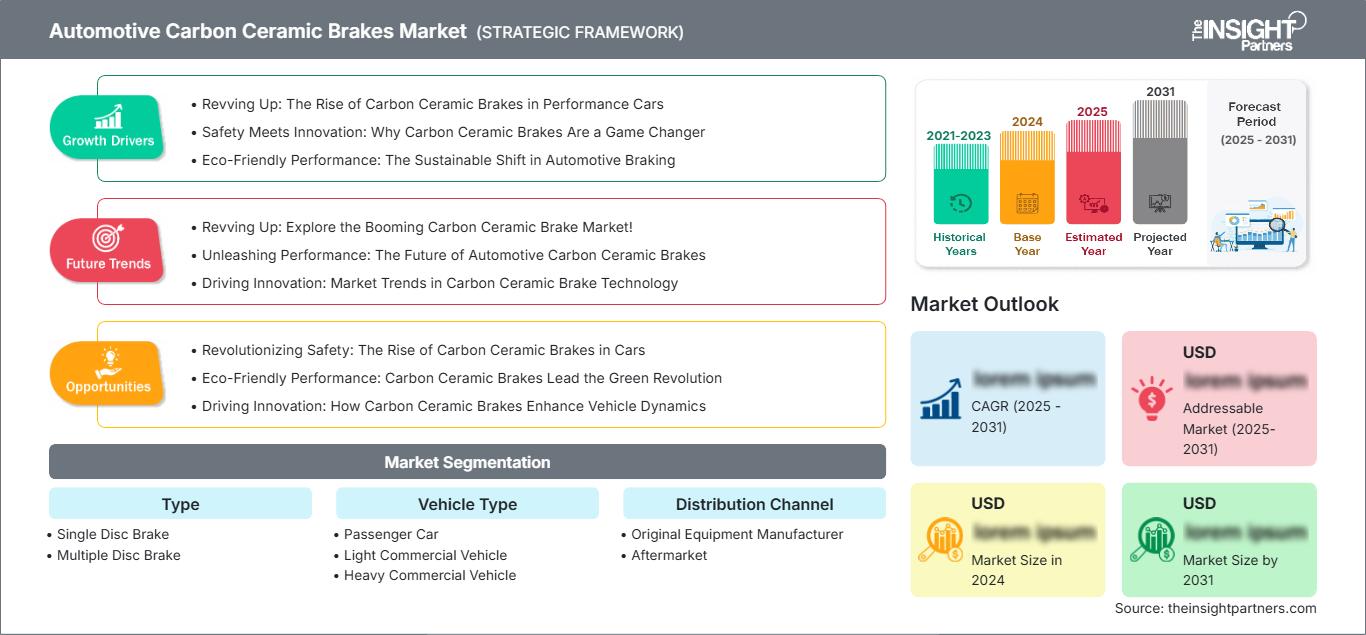
Automotive Carbon Ceramic Brakes Market: Strategic Insights
Regional Insights
North America automotive carbon ceramic brakes market
North America is estimated to hold 24–28% automotive carbon ceramic brakes market share in 2025 and grow at a CAGR of 8.7–9.3% during 2026–2034. Demand is led by premium performance cars, high-output SUVs, motorsport culture, and aftermarket retrofit interest in the US and Canada.
Structural growth is supported by electrified luxury vehicles, where lower unsprung mass can offset battery weight. Regional buyers also value long service life and fade resistance. Adoption remains selective because high system cost limits penetration in mainstream vehicles, but performance-focused trims continue to expand addressable demand.
U.S. automotive carbon ceramic brakes Market
The US is estimated to represent 76–80% of North America in 2025 and grow at a CAGR of 8.6–9.2% during 2026–2034. Demand is concentrated in sports cars, luxury SUVs, track-day vehicles, and EV performance variants.
Company presence is supported by aftermarket specialists, premium brake distributors, and OEM import channels. Application trends favor multiple disc brake packages for high-speed use, while single disc brake demand remains tied to selective replacement programs. Buyer willingness is highest where braking durability and vehicle dynamics justify premium pricing.
Europe automotive carbon ceramic brakes Market
Europe is estimated to hold 36–40% share in 2025 and grow at a CAGR of 8.9–9.5% during 2026–2034. Germany leads through premium OEM engineering, motorsport-linked braking validation, and high-performance EV programs. Italy follows through with supercar brands and specialized disc production capacity.
The UK supports technology development through motorsport suppliers and specialist brake manufacturers, while France, Spain, and the wider region contribute through luxury imports, track-focused models, and replacement demand. The region benefits from established composite expertise, stringent performance expectations, and strong customer acceptance of premium safety components.
APAC automotive carbon ceramic brakes Market
APAC is estimated to hold 25–29% share in 2025 and grow at a CAGR of 10.2–10.8% during 2026–2034. China is the leading country in premium EVs, luxury imports, and domestic performance brands, increasing adoption.
Japan and South Korea support high-specification engineering demand, India remains nascent but expanding in luxury vehicles, and Australia contributes through performance aftermarket channels. Regional growth depends on local premium vehicle launches, service capability, and consumer awareness of lightweight braking benefits.
Middle East & Africa automotive carbon ceramic brakes Market
The Middle East & Africa is expected to grow at a CAGR of 7.4–8.0% during 2026–2034. The UAE leads demand through luxury cars, supercars, and premium aftermarket services, followed by Saudi Arabia and South Africa.
High ambient temperatures, long-distance driving, and premium vehicle ownership support interest in heat-resistant braking. The rest of MEA demand remains limited, but service-led growth is possible as luxury vehicle fleets mature and specialized workshops expand component availability.
Segmentation Analysis
Type
Type is expected to grow at a CAGR of 9.4–10.0% during 2026–2034. The automotive carbon ceramic brakes market scope across types is shaped by single disc brake applications in selective fitments and multiple disc brake packages in high-performance platforms where front and rear thermal balance, stopping consistency, and system-level calibration matter.
- Single Disc Brake: Single disc brake demand is linked to selective replacement, lighter-duty performance upgrades, and cost-sensitive applications where buyers seek carbon ceramic benefits without full-vehicle system conversion.
- Multiple Disc Brake: Multiple disc brake packages dominate premium performance programs because balanced braking across axles improves thermal control, pedal consistency, and vehicle dynamics during repeated high-speed deceleration.
Vehicle Type
Vehicle Type is expected to grow at a CAGR of 9.5–10.1% during 2026–2034. Passenger cars account for the largest adoption base, while light commercial and heavy commercial vehicles remain selective because cost justification depends on duty cycle, payload sensitivity, braking heat, and fleet willingness to invest in longer-life components.
- Passenger Car: Passenger car demand is strongest in sports cars, luxury sedans, premium SUVs, and EV performance models, where braking response, weight reduction, and ownership prestige support adoption.
- Light Commercial Vehicle: Light commercial vehicle use remains limited but relevant for premium vans, specialty mobility fleets, and high-load applications where brake durability can reduce downtime.
- Heavy Commercial Vehicle: Heavy commercial vehicle adoption is emerging in niche high-performance or specialized duty cases, but high component cost and maintenance complexity slow broad fleet penetration.
Distribution Channel
Distribution Channel is expected to grow at a CAGR of 9.6–10.2% during 2026–2034. OEM demand remains dominant because carbon ceramic brakes are engineered into vehicle chassis packages, while aftermarket channels are expanding through retrofit kits, replacement discs, track upgrades, and specialized service networks.
- Original Equipment Manufacturer: OEM demand is driven by factory-fit braking systems on luxury, supercar, and performance EV models, where integration with calipers, sensors, and stability systems is validated.
- Aftermarket: Aftermarket demand is rising as owners retrofit carbon ceramic systems for track use, lower unsprung weight, longer service intervals, and visual differentiation.
Opportunity Snapshot
| Distribution Channel | Revenue Contribution | Trend Tag | Adoption Stage |
| Original Equipment Manufacturer | High | Factory Fit | Mature |
| Aftermarket | Medium | Track Retrofit | Scaling |
Automotive Carbon Ceramic Brakes Market Growth Drivers and Impact Analysis
Premium Vehicle Lightweighting and Braking Stability
In luxury and performance vehicles, the application of carbon ceramics is meant to decrease the unsprung weight while ensuring stability during multiple high-speed brake events. Compared to cast iron, the use of carbon ceramic brake disks helps decrease the axle weight as well as deliver better fade resistance, ensuring better steerability, thermal stability, and durability on the track. This technology has an effect on the consumer directly through its evaluation by potential customers as an important component of the dynamic offer of luxury and performance cars.
Electric Performance Vehicles Requiring Heat-Resistant Systems
It provides a more compelling rationale for their usage since battery weight increases the kinetic energy associated with braking when operating in an aggressive manner. While regenerative braking helps reduce conventional frictional use, repeated high-speed braking calls for brake rotors that can handle thermal shocks and corrosion. This need is seen in the plans made by suppliers, who direct production and development programs toward luxury electric cars and high-performance SUVs, as well as halo models that require state-of-the-art braking systems.
Aftermarket Retrofit Demand from Performance Owners
"Owners of performance cars and specialty workshops are expanding their appeal from systems supplied in factories." Race day drivers, owners of premium vehicles, and fans of motorsports appreciate carbon ceramic discs for their longevity, fade resistance, reduced dust generation, and aesthetic appeal. Market implications include increased channel diversity, as suppliers now provide kits for specific models, replacement discs, and matching pads. Installation requires skill and price acceptance, but the retrofitting trend builds sales resilience since it is less dependent on the launch schedule of new vehicles.
Automotive Carbon Ceramic Brakes Market Future Trends
Automated Composite Disc Manufacturing
Automotive carbon ceramic brakes market trends point toward higher automation in forming, machining, coating, and inspection. Automation helps in reducing the variations in the structural formation of fibers, the thickness of the friction layer, drilling of holes and balancing, which are all essential for durability and noise control. In case efficiency is increased, then it becomes possible for the suppliers to reduce the cost per piece and supply components to higher-end models.
EV-Specific Brake System Calibration
Future usage will require braking systems that are fine-tuned for regenerative braking, corrosion resistance, and periodic high-energy friction. Electric vehicles have the potential to avoid any use of friction brakes during their normal operations, leading to unique wear and disc conditioning considerations. It is very likely that the suppliers of carbon ceramics will collaborate even more closely with the chassis software engineers on optimizing the brake blending, pedal feel, and disc temperature considerations. Such developments offer scope for combined hardware and software testing.
Automotive Carbon Ceramic Brakes Market Opportunities
Scaling Premium EV Factory-Fit Programs
Automotive carbon ceramic brakes market Forecasts indicate a strong opportunity in factory-fit EV programs that combine high torque, heavy battery packs, and premium positioning. The suppliers should target the development of lightweight disc brakes, optimally selected pads, and brake-by-wire capability validation in performance-oriented SUVs, grand tourers, and limited edition electric vehicles. The commercial viability of the product will depend on demonstrating reduced wear, consistent pedal feel, and noise level. Collaborations with OEM chassis engineering teams will make the carbon ceramic brakes unique to premium electrics.
Expanding Certified Aftermarket Retrofit Networks
AFT Suppliers can tap into latent demand through certification of installers, fitment information, and warranty-based replacement programs. Carbon Ceramic brakes need proper pad matching, sensor compatibility, torque guidelines, and break-in process information, meaning that installation is crucial to customer satisfaction. Such a structured retrofitting program can be implemented for people looking for track-day performance on their luxury cars, where no option was available from the original manufacturer. This is particularly applicable in North America, the Middle East, and APAC markets.
Frequently Asked Questions

- Comprehensive Market Sizing and Forecast Analysis
- Detailed Segmentation Analysis
- In-Depth Market Dynamics Assessment
- Regional and Country-Level Insights
- Competitive Landscape and Company Benchmarking
- Strategic Business Intelligence
Recent Reports
Testimonials

The Insight Partners' SCADA System Market report is comprehensive, with valuable insights on current trends and future forecasts. The team was highly professional, responsive, and supportive throughout. We are very satisfied and highly recommend their services.
RAN KEDEM Partner, Reali Technologies LTDs
I requested a report on a very specific software market and the team produced the report in a few days. The information was very relevant and well presented. I then requested some changes and additions to the report. The team was again very responsive and I got the final report in less than a week.
JEAN-HERVE JENN Chairman, Future Analytica
We worked with The Insight Partners for an important market study and forecast. They gave us clear insights into opportunities and risks, which helped shape our plans. Their research was easy to use and based on solid data. It helped us make smart, confident decisions. We highly recommend them.
PIYUSH NAGPAL Sr. Vice President, High Beam Global
The Insight Partners delivered insightful, well-structured market research with strong domain expertise. Their team was professional and responsive throughout. The user-friendly website made accessing industry reports seamless. We highly recommend them for reliable, high-quality research services
YUKIHIKO ADACHI CEO, Deep Blue, LLC.
This is the first time I have purchased a market report from The Insight Partners.While I was unsure at first, I visited their web site and felt more comfortable to take the risk and purchase a market report.I am completely satisfied with the quality of the report and customer service. I had several questions and comments with the initial report, but after a couple of dialogs over email with their analyst I believe I have a report that I can use as input to our strategic planning process.Thank you so much for taking the extra time and making this a positive experience.I will definitely recommend your service to others and you will be my first call when we need further market data.
JOHN SUZUKI President and Chief Executive Officer, Board Director, BK Technologies
I wish to appreciate your support and the professionalism you displayed in the course of attending to my request for information regarding to infectious disease IVD market in Nigeria. I appreciate your patience, your guidance, and the fact that you were willing to offer a discount, which eventually made it possible for us to close a deal. I look forward to engaging The Insight Partners in the future, all thanks to the impression you have created in me as a result of this first encounter.
DR CHIJIOKE ONYIA MANAGING DIRECTOR, PineCrest Healthcare Ltd.Reason to Buy
- Informed Decision-Making
- Understanding Market Dynamics
- Competitive Analysis
- Identifying Emerging Markets
- Customer Insights
- Market Forecasts
- Risk Mitigation
- Boosting Operational Efficiency
- Strategic Planning
- Investment Justification
- Tracking Industry Innovations
- Aligning with Regulatory Trends





 Get Free Sample for