
Automotive Climate Control Seats Market Share, Demand & Growth by 2034
Coverage: By Component (Electronic Control Units, Seat Heating Solutions, Seat Ventilation Solutions); Surface Material (Cloth, Leather, Others); Vehicle Type (Passenger Cars, Light Commercial Vehicles, Heavy Commercial Vehicles) , and Geography (North America, Europe, Asia Pacific, and South and Central America)
- Status : Data Released
- Report Code : TIPRE00006777
- Category : Automotive and Transportation
- No. of Pages : 150
- Available Report Formats :


- Last update date : August 26, 2026


2025 Market Size
US$ 1,560.74 Mn
Base year value
2034 Forecast
US$ 2,291.31 Mn
Projected by 2034
CAGR 2026-2034
4.36 %
Growth rate
Addressable Market
US$ 17,493.50 Mn
(2026-2034)
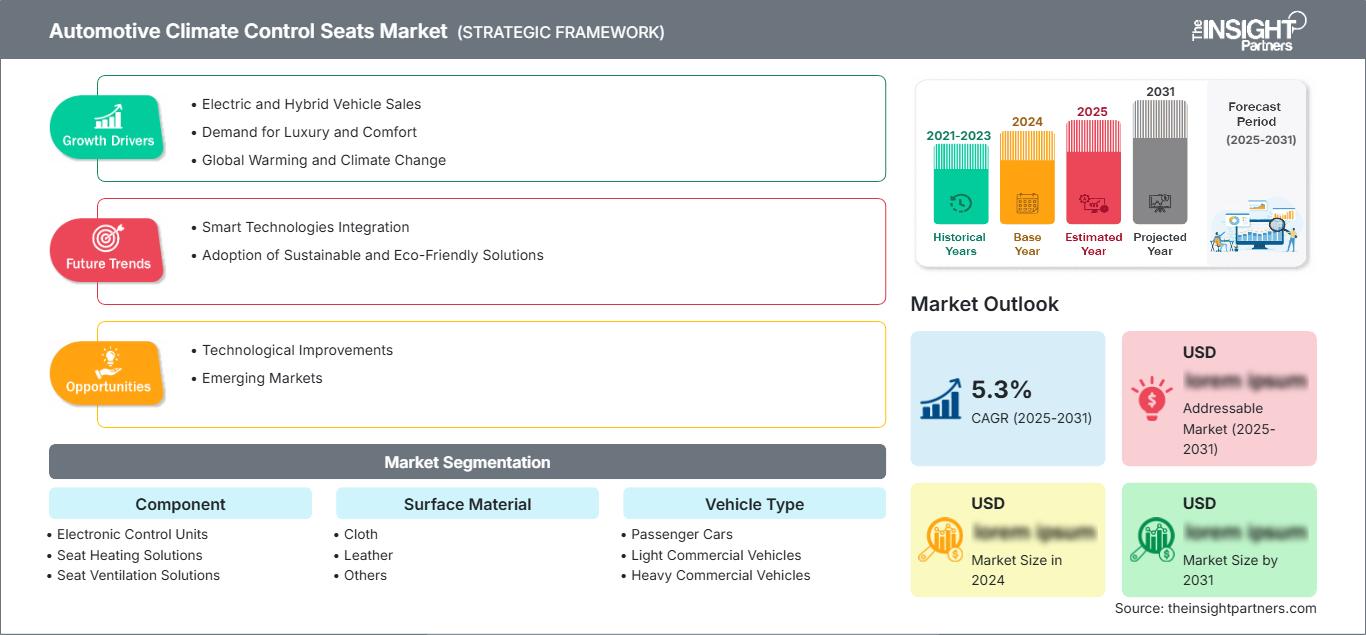
The automotive climate control seats market was valued at US$ 1,560.74 million in 2025 and is projected to reach US$ 2,291.31 million by 2034, registering a CAGR of 4.36% during 2026–2034. Growth is supported by increasing consumer preference for premium in-cabin comfort features, rising production of luxury and mid-range passenger vehicles, and continuous advancements in intelligent seating technologies. Automakers are increasingly integrating heated and ventilated seating systems to improve occupant comfort across varying climatic conditions.
Across North America, the automotive climate control seats market size continues to expand as vehicle manufacturers incorporate premium seating technologies into a broader range of vehicle segments. The regional market is expected to register a CAGR of 3.9–4.4% during 2026–2034, supported by strong consumer demand for premium SUVs and pickup trucks, increasing adoption of electric vehicles, and continuous innovation in electronic seat comfort systems.
Automotive Climate Control Seats Market Assessment and Insights
- North America: North America accounted for 31–35% share in 2025 and is expected to grow at a CAGR of 3.9–4.4% during 2026–2034. Premium vehicle sales, consumer preference for advanced cabin comfort, and widespread adoption of intelligent seating technologies continue to support regional demand.
- US: The U.S. represented 77–81% of the North American market in 2025 and is projected to register a CAGR of 4.0–4.5% during 2026–2034, driven by high penetration of premium vehicles, electric mobility, and advanced automotive seating innovations.
- Europe: Europe held 26–30% share in 2025 and is anticipated to expand at a CAGR of 3.8–4.3% during 2026–2034. Germany, the UK, France, Italy, and Spain continue leading regional demand owing to their established automotive manufacturing ecosystems and growing luxury vehicle production.
- Asia Pacific: Asia Pacific captured 34–38% share in 2025 and is forecast to record the fastest regional growth with a CAGR of 5.0–5.5% during 2026–2034. China, Japan, South Korea, and India remain key contributors through expanding passenger vehicle production and increasing consumer demand for premium interior features.
- Largest Segment: Seat Heating Solutions accounted for a market share of 44–48% in 2025 and is expected to expand at a CAGR of 4.4–4.9% during 2026–2034, supported by widespread adoption across passenger vehicles in colder climates.
- High Growth Segment: Seat Ventilation Solutions represented 27–31% market share in 2025 and is projected to grow at a CAGR of 5.5–6.0% during 2026–2034, driven by increasing demand for premium comfort features and rising electric vehicle production.
- Key companies analyzed in detail: Coherent Corp. (formerly II-VI Incorporated), Adient plc, Continental AG, Forvia SE, Gentherm Incorporated, Kongsberg Automotive ASA, Lear Corporation, Magna International Inc., Tata AutoComp Systems Limited, Toyota Boshoku Corporation.
Source: The Insight Partners' analysis based on proprietary research, government publications, company annual reports, investor presentations, industry databases, and expert interviews.
Continuous developments in the technologies used in vehicle interiors are transforming the industry through the introduction of advanced thermal management systems, efficient electronic control systems, and lightweight seat systems. Carmakers are now fitting mid-level vehicle models with both heated and ventilated seats due to shifting customer demands for comfort. The increasing electrification of cars is also contributing to the creation of efficient climate control seats, which use minimal power but provide the required thermal comfort for the occupants.
Factors such as the rising number of premium vehicle platforms, electric and hybrid vehicles, as well as changing customer demands for personalized experiences in vehicle cabins, are likely to shape the future growth of the industry. Manufacturers are scaling up their production capacities in the Asia Pacific region as well as partnering with auto OEMs in order to produce innovative seat comfort systems.
Automotive Climate Control Seats Market Report Scope
| Report Attribute | Details |
|---|---|
| Market size in 2025 | US$ 1,560.74 Million |
| Market Size by 2034 | US$ 2,291.31 Million |
| Global CAGR (2026 - 2034) | 4.36% |
| Historical Data | 2021-2024 |
| Forecast period | 2026-2034 |
Automotive Climate Control Seats Market Analysis
Growing consumer expectations for enhanced in-cabin comfort, combined with rising production of premium passenger vehicles, continue to strengthen the automotive climate control seats market growth. Automotive manufacturers increasingly integrate heating and ventilation technologies into standard vehicle configurations rather than limiting them to luxury models. Increase in demand for electric vehicles, improvement in disposable income of consumers in developing countries, and increasing demand for premium seating features further contribute to the growing demand for premium automotive seats globally. On the other hand, manufacturers of premium seats are increasing thermal efficiency and lowering the weight of seats through new advancements in electronics controls and new seat materials.
There are changes happening in the supply chain of the automotive industry because of increased collaboration among seat manufacturers, electronics suppliers, and vehicle OEMs. The usage of intelligent sensors, electronic controls, and energy-efficient air flow systems helps manufacturers in improving product performance and enhancing production efficiency.
Competition remains dynamic as manufacturers invest in advanced thermal management technologies, intelligent seating electronics, and lightweight materials. The automotive climate control seats market analysis highlights how Lear Corporation, Gentherm Incorporated, Adient plc, Magna International Inc., Continental AG, Toyota Boshoku Corporation, Forvia SE, and Kongsberg Automotive ASA continue expanding product portfolios through innovation, strategic partnerships, and regional manufacturing investments. The emphasis on the integration of energy-efficient heating and ventilation technologies in scalable seating systems aids competitive positioning for the future among passenger and commercial vehicle customers.
Investments are increasingly being made in technologies associated with automated seat production, smart heating and cooling systems, and sustainable production technologies. Automotive OEMs will keep working with suppliers of seating systems to create modular seating systems that help increase passenger comfort and minimize energy usage. Electric vehicle production growth and consumer interest in connected car interiors will create new opportunities for technology providers in the forecast period.
● REPORT CUSTOMIZATION
Tailor This Report To Align With Your Specific Business Requirements
This report can be customized to align precisely with your business objectives, scope, and target markets. Customization options include tailored segmentation, geography, competitive analysis, and strategic insights to support informed decision-making.
Customize This Report →WHAT YOU CAN ADJUST
- ● Segmentations
- ● Geography
- ● Competitive Analysis
- ● Language Preferences
Automotive Climate Control Seats Market: Strategic Insights
Regional Insights
North America Automotive Climate Control Seats Market
North America accounted for 31–35% of the automotive climate control seats market share in 2025 and is projected to expand at a CAGR of 3.9–4.4% during 2026–2034. The region is favored by high demands for luxury passenger cars, consumer preferences for comfort-oriented cabin technology, and the continuous development of automotive seating systems. Modern vehicle manufacturers are increasingly incorporating heated and ventilated seats into SUVs, pickup trucks, and electric vehicles in order to increase the comfort of their driving experience and increase energy efficiency. The increased adoption of intelligent seat control technologies will be another catalyst for market growth.
The U.S., Canada, and Mexico have a well-developed automotive manufacturing ecosystem that includes advanced seating component providers and OEM manufacturing facilities in the region. Consistent investments in electronic seating technologies, light weighting, and automated manufacturing allow companies to increase product quality and decrease costs of production. Increased production of electric vehicles will increase the use of energy-efficient climate-controlled seating technology in the region.
U.S. Automotive Climate Control Seats Market
The U.S. represented 77–81% of the North American automotive climate control seats market in 2025 and is expected to register a CAGR of 4.0–4.5% during 2026–2034. High penetration of premium vehicles, growing electric vehicle adoption, and increasing consumer preference for advanced interior comfort features continue to support steady market expansion. Heated and ventilated seats have become a regular inclusion in automotive designs, with major automakers integrating such features as the customer requirements change and companies use them as a form of product differentiation from competitors.
Key industry players like Lear Corporation, Gentherm Incorporated, Adient plc, Magna International Inc., Continental AG, and Toyota Boshoku Corporation have been increasing their research, development, and manufacturing capacity in the USA. By using intelligent thermal management systems, electronic control systems, and lightweight seats, manufacturers can increase comfort and decrease energy usage in the car.
Europe Automotive Climate Control Seats Market
Europe accounted for 26–30% of the global automotive climate control seats market in 2025 and is anticipated to register a CAGR of 3.8–4.3% during 2026–2034. Germany remains the leading regional market because of its premium automotive manufacturing base, advanced engineering capabilities, and strong consumer demand for luxury vehicle features. Increasing regulatory emphasis on vehicle efficiency and sustainable manufacturing continues to encourage innovation in intelligent seating technologies.
There is an increase in demand for high-end car interiors in the United Kingdom due to the increasing adoption of electric cars, as well as increased investments in smart automotive manufacturing. The incorporation of climate-controlled seats in luxury as well as medium-range car models has helped in improving comfort levels as well as maximizing energy efficiency.
Germany has maintained its lead regionally due to the presence of high-quality car production, sustained investment in smart cabin technologies, and the existence of globally recognized auto manufacturers. An increase in the use of heated and ventilated seats in luxury car models has helped enhance demand for high-end climate-controlled seats.
France, Italy, and Spain have helped maintain regional growth owing to vehicle production, consumer demand for high-end seats, and the modernization of automotive plants. Ongoing investments in sustainable mobility and advanced seat technologies have helped maintain market growth in Southern Europe.
APAC Automotive Climate Control Seats Market
Asia Pacific captured 34–38% of the global automotive climate control seats market in 2025 and is projected to register the highest regional growth at a CAGR of 5.0–5.5% during 2026–2034. China leads regional demand owing to its large automotive manufacturing base, expanding electric vehicle production, and rising consumer spending on premium vehicle features.
Japan, South Korea, India, and Australia continue supporting market expansion through increasing passenger vehicle production, technological innovation, and favorable industrial policies. Growing middle-class income and rapid adoption of connected vehicle technologies continue driving demand for advanced automotive seating systems across the region.
Middle East & Africa Automotive Climate Control Seats Market
The Middle East & Africa automotive climate control seats market is expected to register a CAGR of 3.6–4.1% during 2026–2034, supported by rising premium vehicle sales, expanding automotive distribution networks, and increasing investment in regional vehicle assembly operations. Saudi Arabia remains the leading market, followed by the UAE and South Africa.
Growing urbanization, infrastructure investment, and increasing consumer preference for premium passenger vehicles continue supporting demand for advanced seating technologies. Expansion of automotive retail networks and improving purchasing power are expected to create additional opportunities for climate-controlled seating solutions across the region.
Segmentation Analysis
Component
The Component segment is anticipated to register a CAGR of 4.7–5.2% during 2026–2034. Continuous advancements in thermal management technologies, intelligent electronic controls, and energy-efficient seating systems are reshaping product development across vehicle categories. Manufacturers are focusing on integrating multiple comfort functions within compact seat architectures while minimizing power consumption, particularly for electric vehicles. The automotive climate control seats market scope continues expanding as OEMs introduce premium seating features across mid-range passenger vehicles and enhance occupant comfort through intelligent temperature regulation technologies.
- Electronic Control Units – Electronic control units serve as the central operating platform for seat heating and ventilation functions, enabling precise temperature management, sensor integration, and efficient communication with vehicle electronic systems to enhance passenger comfort.
- Seat Heating Solutions – Seat heating solutions represent the most established product category, benefiting from widespread integration across passenger cars and premium SUVs. Continuous improvements in energy efficiency and rapid heating performance strengthen long-term adoption across global vehicle platforms.
- Seat Ventilation Solutions – Seat ventilation solutions continue gaining momentum owing to rising consumer demand for enhanced thermal comfort, particularly in warmer climates. Increasing adoption across electric vehicles and premium passenger cars supports expanding commercial opportunities.
Surface Material
The Surface Material segment is expected to grow at a CAGR of 4.2–4.7% during 2026–2034. Surface materials significantly influence thermal performance, passenger comfort, durability, and overall seating efficiency. Manufacturers increasingly optimize material selection to improve airflow, heat distribution, and long-term durability while supporting premium vehicle interior designs and sustainability objectives.
- Cloth – Cloth upholstery remains widely utilized across the economy and mid-range vehicle segments because of its affordability, comfort, and compatibility with integrated heating technologies while maintaining cost-effective manufacturing.
- Leather – Leather continues dominating premium vehicle applications owing to its superior aesthetics, durability, and compatibility with advanced heating and ventilation systems that provide enhanced passenger comfort throughout varying climatic conditions.
Vehicle Type
The Vehicle Type segment is projected to expand at a CAGR of 4.4–4.9% during 2026–2034. Growing production of premium passenger vehicles, increasing electric vehicle adoption, and rising consumer preference for enhanced cabin comfort continue supporting the installation of climate-controlled seating systems across multiple vehicle categories. Manufacturers are expanding feature availability beyond luxury vehicles to strengthen competitive differentiation and improve customer satisfaction.
- Passenger Cars – Passenger cars account for the largest demand owing to high global production volumes, increasing consumer preference for premium interior comfort, and expanding integration of climate-controlled seating technologies across both premium and mainstream vehicle models.
- Light Commercial Vehicles – Light commercial vehicles increasingly adopt heated and ventilated seating systems to improve driver comfort, reduce fatigue during extended operations, and support fleet operators seeking enhanced employee productivity and vehicle value.
- Heavy Commercial Vehicles – Heavy commercial vehicles continue incorporating advanced seating technologies to improve long-haul driver comfort, reduce physical fatigue, and enhance overall operational efficiency in commercial transportation applications.
Opportunity Snapshot
| Vehicle Type | Revenue Contribution | Trend Tag | Adoption Stage |
|---|---|---|---|
| Passenger Cars | High | Premium Comfort | Mature |
| Light Commercial Vehicles | Medium | Fleet Comfort | Scaling |
| Heavy Commercial Vehicles | Low | Driver Wellness | Emerging |
Automotive Climate Control Seats Market Growth Drivers and Impact Analysis
Rising Demand for Premium Vehicle Comfort Features
The evolving need for more comfortable cabin conditions is contributing to the rapid implementation of advanced seat systems technology across automotive lines worldwide. No longer restricted to premium class cars, climate-controlled seats now come in more affordable passenger vehicles thanks to the addition of heating and ventilation capabilities to improve product offerings. The increase in disposable incomes, increased awareness of comfort-related technology, and longer time spent inside personal cars all remain drivers of demand. Car manufacturers are working together with seating systems providers to implement intelligent thermal control systems that will ensure passenger comfort without compromising on energy efficiency. Premium car interior components are becoming one of the critical purchase factors, prompting further growth in automotive product lines.
Expansion of Electric Vehicle Production Worldwide
Rapid growth in electric vehicle manufacturing continues to create strong demand for energy-efficient seat climate control technologies. Battery-powered vehicles require cabin comfort systems that consume less power while maintaining consistent heating and cooling performance to preserve driving range. Manufacturers are developing lightweight seat structures, advanced electronic control units, and low-energy heating elements that reduce electricity consumption without compromising passenger comfort. Increasing investments in dedicated electric vehicle platforms across North America, Europe, and the Asia Pacific further encourage the adoption of intelligent seating technologies. Collaboration between automotive manufacturers and component suppliers is accelerating innovation in thermal management systems capable of supporting next-generation electric mobility while meeting increasingly stringent efficiency and sustainability requirements.
Advancements in Intelligent Thermal Management Technologies
Technological innovation in electronic controls, sensors, airflow management, and smart materials continues transforming automotive seating systems. Modern climate-controlled seats incorporate intelligent temperature sensing, zonal thermal regulation, and adaptive airflow technologies that automatically respond to passenger preferences and environmental conditions. Integration with connected vehicle platforms further enhances user experience by enabling personalized seat settings and remote activation through digital interfaces. Manufacturers continue investing in advanced materials that improve heat transfer efficiency while reducing component weight and production complexity. These innovations strengthen product competitiveness, improve passenger satisfaction, and create additional opportunities for advanced seating technologies across passenger cars and commercial vehicle applications.
Automotive Climate Control Seats Market Future Trends
Expansion of Personalized Smart Seating Technologies
The automotive climate control seats market trends indicate growing adoption of intelligent seating systems capable of automatically adjusting heating, ventilation, and thermal comfort based on passenger preferences, biometric sensing, and environmental conditions. Artificial intelligence, connected vehicle ecosystems, and integrated sensor technologies are enabling more personalized cabin experiences while improving energy efficiency. Future vehicle platforms are expected to incorporate predictive thermal management functions that optimize comfort before occupants enter the vehicle. Continuous software integration and digital cockpit development will further enhance interaction between seat climate control systems and broader vehicle comfort technologies.
Increasing Adoption of Sustainable Seating Materials
Automotive manufacturers are accelerating the use of sustainable upholstery materials, recyclable seat components, and environmentally responsible production processes without compromising comfort or durability. Growing regulatory emphasis on carbon reduction and circular manufacturing practices is encouraging suppliers to develop lightweight materials that improve thermal performance while reducing environmental impact. Integration of bio-based textiles, recycled polymers, and energy-efficient heating elements is expected to support long-term sustainability objectives while meeting consumer expectations for environmentally conscious vehicle interiors.
Automotive Climate Control Seats Market Opportunities
Growing Integration Across Mid-Range Passenger Vehicles
The automotive climate control seats market Forecasts indicate significant opportunities through expansion beyond luxury vehicles into high-volume mid-range passenger cars. Automotive manufacturers are increasingly introducing heated and ventilated seating systems as optional or standard equipment to strengthen competitive positioning and enhance customer satisfaction. Declining component costs, improvements in manufacturing efficiency, and increasing consumer willingness to pay for enhanced comfort are encouraging broader adoption. Suppliers capable of delivering compact, energy-efficient, and cost-effective seating technologies are expected to benefit from expanding production volumes across both developed and emerging automotive markets.
Investment in Energy-Efficient Seat Thermal Technologies
Growing emphasis on vehicle efficiency creates substantial opportunities for companies developing low-power climate control seating systems suitable for electric and hybrid vehicles. Manufacturers investing in advanced airflow technologies, intelligent electronic controls, lightweight heating elements, and sustainable manufacturing processes can strengthen relationships with automotive OEMs seeking improved battery performance and reduced energy consumption. Strategic partnerships, regional manufacturing expansion, and continuous innovation in thermal management solutions are expected to create new revenue opportunities while supporting long-term competitiveness throughout the evolving automotive seating industry.
Frequently Asked Questions

- Comprehensive Market Sizing and Forecast Analysis
- Detailed Segmentation Analysis
- In-Depth Market Dynamics Assessment
- Regional and Country-Level Insights
- Competitive Landscape and Company Benchmarking
- Strategic Business Intelligence
Recent Reports
Testimonials

The Insight Partners provided valuable market intelligence that supported our global go-to-market strategy. Their team was professional, responsive, and attentive to our feedback, providing thoughtful analysis and helpful methodological clarifications throughout the project.
Junmo Kim Chief Financial Officer (CFO), Enertech Co., Ltd.
The Insight Partners' SCADA System Market report is comprehensive, with valuable insights on current trends and future forecasts. The team was highly professional, responsive, and supportive throughout. We are very satisfied and highly recommend their services.
RAN KEDEM Partner, Reali Technologies LTDs
I requested a report on a very specific software market and the team produced the report in a few days. The information was very relevant and well presented. I then requested some changes and additions to the report. The team was again very responsive and I got the final report in less than a week.
JEAN-HERVE JENN Chairman, Future Analytica
We worked with The Insight Partners for an important market study and forecast. They gave us clear insights into opportunities and risks, which helped shape our plans. Their research was easy to use and based on solid data. It helped us make smart, confident decisions. We highly recommend them.
PIYUSH NAGPAL Sr. Vice President, High Beam Global
The Insight Partners delivered insightful, well-structured market research with strong domain expertise. Their team was professional and responsive throughout. The user-friendly website made accessing industry reports seamless. We highly recommend them for reliable, high-quality research services
YUKIHIKO ADACHI CEO, Deep Blue, LLC.
This is the first time I have purchased a market report from The Insight Partners.While I was unsure at first, I visited their web site and felt more comfortable to take the risk and purchase a market report.I am completely satisfied with the quality of the report and customer service. I had several questions and comments with the initial report, but after a couple of dialogs over email with their analyst I believe I have a report that I can use as input to our strategic planning process.Thank you so much for taking the extra time and making this a positive experience.I will definitely recommend your service to others and you will be my first call when we need further market data.
JOHN SUZUKI President and Chief Executive Officer, Board Director, BK Technologies
I wish to appreciate your support and the professionalism you displayed in the course of attending to my request for information regarding to infectious disease IVD market in Nigeria. I appreciate your patience, your guidance, and the fact that you were willing to offer a discount, which eventually made it possible for us to close a deal. I look forward to engaging The Insight Partners in the future, all thanks to the impression you have created in me as a result of this first encounter.
DR CHIJIOKE ONYIA MANAGING DIRECTOR, PineCrest Healthcare Ltd.Reason to Buy
- Informed Decision-Making
- Understanding Market Dynamics
- Competitive Analysis
- Identifying Emerging Markets
- Customer Insights
- Market Forecasts
- Risk Mitigation
- Boosting Operational Efficiency
- Strategic Planning
- Investment Justification
- Tracking Industry Innovations
- Aligning with Regulatory Trends





 Get Free Sample for