
Automotive Collision Avoidance Systems Market Growth and Forecast by 2031
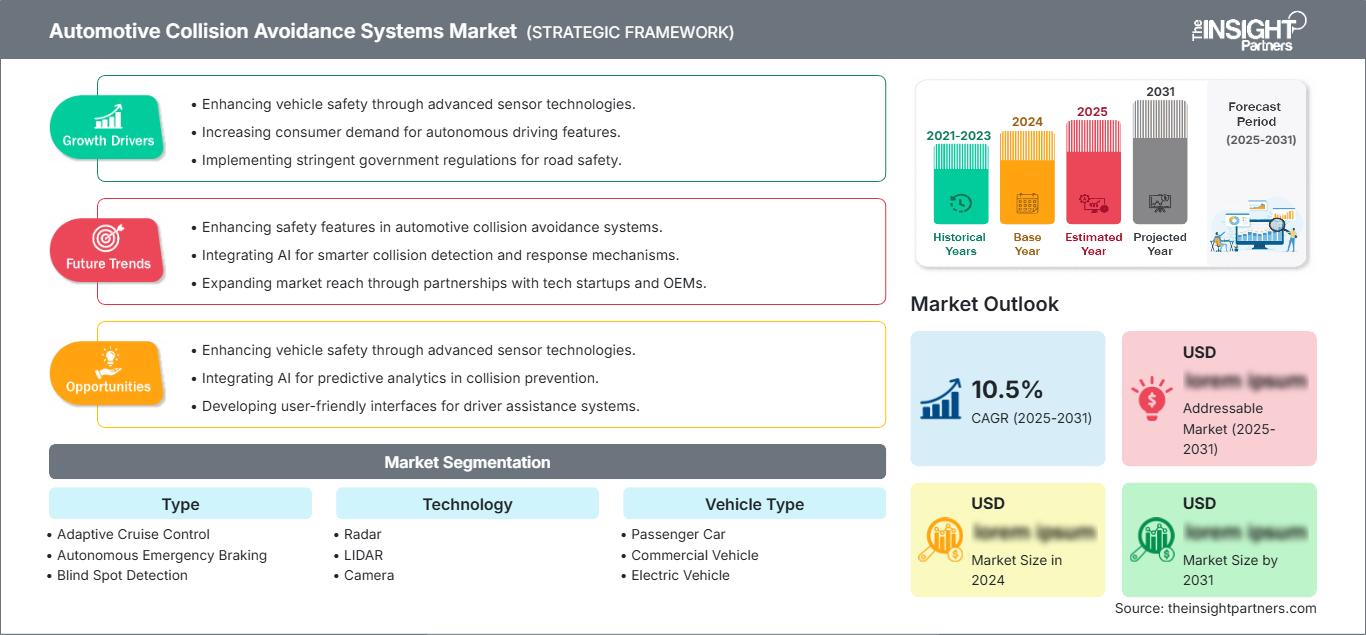
Coverage: by Type (Adaptive Cruise Control, Autonomous Emergency Braking (AEB), Blind Spot Detection, Lane Departure Warning, Others); Technology (Radar, LIDAR, Camera, Others); Vehicle Type (Passenger Car, Commercial Vehicle, Electric Vehicle) , and Geography (North America, Europe, Asia Pacific, and South and Central America)
- Status : Data Released
- Report Code : TIPRE00004620
- Category : Automotive and Transportation
- No. of Pages : 150
- Available Report Formats :


- Last update date : August 12, 2026


2024 Market Size
US$ 11.24 Bn
Base year value
2031 Forecast
US$ 20.95 Bn
Projected by 2031
CAGR 2025-2031
9.3 %
Growth rate
Addressable Market
US$ 114.08 Bn
(2025-2031)
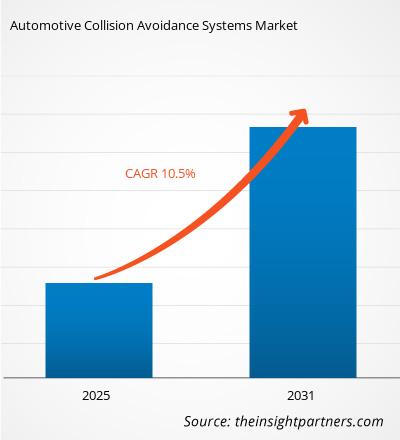
The automotive collision avoidance systems market was valued at US$ 11.24 Billion in 2025 and is projected to reach US$ 20.95 Billion by 2034, registering a CAGR of 9.3 % from 2026 to 2034. Demand is rising as automakers integrate sensing, braking, steering alerts, and driver assistance functions into broader vehicle safety architectures across passenger cars, commercial fleets, and electric vehicle platforms.
North America's automotive collision avoidance systems market size is supported by regulatory momentum, insurance cost pressure, and rising fitment of automatic emergency braking, blind spot detection, adaptive cruise control, and lane departure warning features. The region is projected to grow at a CAGR of 8.2–8.8% during 2026–2034 as OEMs prepare for stricter safety performance expectations and fleet operators prioritize crash-reduction technologies.
Automotive Collision Avoidance Systems Market Assessment and Insights
- North America: Accounted for an estimated 25–28% share in 2025 and is expected to grow at a CAGR between 8.2–8.8% during 2026–2034, supported by safety mandates, premium vehicle penetration, and strong ADAS supplier presence.
- US: Represented about 76–80% of North America demand in 2025 and is projected to grow at a CAGR between 8.1–8.7% during 2026–2034, led by AEB compliance planning and pickup, SUV, and fleet applications.
- Europe: Held an estimated 27–30% share in 2025 and is likely to expand at a CAGR between 8.4–9.0%, with Germany, the UK, France, Italy, and Spain leading adoption through regulation and safety-rating programs.
- Asia Pacific: Led with an estimated 34–38% share in 2025 and is expected to grow at a CAGR between 10.1–10.8%, driven by China, Japan, South Korea, India, and Australia.
- Largest Segment: Autonomous emergency braking estimated 31–35% market share in 2025 and a CAGR between 9.4–10.0% during 2026–2034.
- High Growth Segment: Electric vehicle estimated 18–22% share in 2025 and a CAGR between 12.2–13.0% during 2026–2034.
- Key companies analyzed in detail: Aptiv PLC, Autoliv Inc., Continental AG, DENSO Corporation, General Electric Company, Honeywell International Inc., Robert Bosch GmbH, Siemens AG, Valeo SE, and ZF Friedrichshafen AG.
Source: The Insight Partners' analysis based on proprietary research, government publications, company annual reports, investor presentations, industry databases, and expert interviews.
Advancements in technology have helped the industry move away from warning-based collision avoidance to a more sophisticated system of perception, prediction, and actuation. Radar-camera fusion is currently enabling automated braking, lane guidance, and blind-spot detection on standard vehicles instead of high-end trim lines. Production trends are becoming more connected to software-defined vehicles, centralized computing power, and scalable sensors, which allow OEMs to use the same hardware for different safety functions based on vehicle type and location.
Looking forward, investment will concentrate on sensor fusion, embedded artificial intelligence, validation tools, and compliance-ready ADAS platforms. As highlighted in the Automotive Collision Avoidance Systems Market report, emerging geographies will add volume as safety ratings increasingly influence consumer choice, while mature markets will continue to raise performance thresholds. Regulatory tailwinds, insurer interest in crash reduction, and EV platform redesigns are expected to keep supplier pipelines active, even as cost discipline remains important for mass-market adoption.
Automotive Collision Avoidance Systems Market Report Scope
| Report Attribute | Details |
|---|---|
| Market size in 2024 | US$ 11.24 Billion |
| Market Size by 2031 | US$ 20.95 Billion |
| Global CAGR (2025 - 2031) | 9.3% |
| Historical Data | 2021-2023 |
| Forecast period | 2025-2031 |
Automotive Collision Avoidance Systems Market Analysis
The automotive collision avoidance systems market growth is driven by tighter safety rules, consumer demand for driver assistance, and the rising cost of vehicle repairs after crashes. An NHTSA final rule mandating AEB and pedestrian AEB on light vehicles was issued by September 2029, thereby ensuring a definitive path to compliance for US OEM programs. The European General Safety Regulation and Euro NCAP guidelines also mandate lane, braking, speed, and vulnerable road user protection features in standard equipment consideration.
The supply chain consists of semiconductor companies, radar/camera manufacturers, lidar technology firms, software companies, electronic control units providers, braking and steering systems integrators, OEM validation centers, and after-market calibration companies. Supply chain considerations include semiconductor availability, sensor cost reduction, testing facilities, and safety case documentation. With architectures converging, suppliers of perception software, computing, and sensing can gain more content per car.
Automotive collision avoidance systems market analysis shows intense competition among global Tier 1 suppliers and industrial technology firms. Aptiv PLC, Continental AG, DENSO Corporation, Robert Bosch GmbH, Valeo SE, and ZF Friedrichshafen AG compete through radar, camera, compute, and software portfolios. Autoliv Inc. adds safety-system integration expertise, while Siemens AG, Honeywell International Inc., and General Electric Company support automation, sensing, and industrial-grade electronics capabilities relevant to connected mobility ecosystems.
Investment trends are shifting from individual sensors toward scalable ADAS platforms that can support multiple autonomy levels. Automotive Collision Avoidance Systems Market forecast projections indicate that solutions such as Aptiv’s Gen 6 ADAS architecture, ZF’s electronics and ADAS portfolio, and ongoing sensor innovations from Bosch, Continental, DENSO, and Valeo will continue to drive market development. Strategic positioning increasingly depends on validation speed, software upgradeability, energy efficiency, cybersecurity, and the ability to support OEM programs across North America, Europe, and Asia Pacific.
● REPORT CUSTOMIZATION
Tailor This Report To Align With Your Specific Business Requirements
This report can be customized to align precisely with your business objectives, scope, and target markets. Customization options include tailored segmentation, geography, competitive analysis, and strategic insights to support informed decision-making.
Customize This Report →WHAT YOU CAN ADJUST
- ● Segmentations
- ● Geography
- ● Competitive Analysis
- ● Language Preferences
Automotive Collision Avoidance Systems Market: Strategic Insights
Regional Insights
North America automotive collision avoidance systems market
North America held an estimated 25–28% automotive collision avoidance systems market share in 2025 and is forecast to expand at a CAGR of 8.2–8.8% from 2026 to 2034. Demand is strengthened by US automatic emergency braking rulemaking, insurance interest in claim reduction, and high penetration of SUVs, pickups, and premium trims with advanced safety packages.
OEMs and suppliers are preparing systems that meet higher-speed vehicle detection, pedestrian detection, and low-light performance expectations. Commercial fleets are also adopting blind spot detection and emergency braking to reduce liability and downtime. Canada and Mexico follow the US platform decisions because many vehicles are engineered and sourced for the integrated North American production base.
U.S. automotive collision avoidance systems market
The US represented an estimated 76–80% of North American demand in 2025 and is expected to grow at a CAGR of 8.1–8.7% through 2034. The Automotive Collision Avoidance Systems Market in the country is shaped by NHTSA’s FMVSS No. 127 implementation timeline, growing consumer demand for advanced safety packages, and increasing insurer focus on reducing rear-end collisions and pedestrian-related accidents.
Supplier presence is broad, with Aptiv PLC, Robert Bosch GmbH, Continental AG, Valeo SE, and ZF Friedrichshafen AG serving OEM programs through sensors, compute, and integrated ADAS functions. Application demand is strongest in passenger vehicles, light trucks, electric vehicles, and fleet models, where collision mitigation can reduce repair cost, injury exposure, and vehicle downtime.
Europe automotive collision avoidance systems market
Europe accounted for an estimated 27–30% share in 2025 and is projected to grow at a CAGR of 8.4–9.0% during 2026–2034. The Automotive Collision Avoidance Systems Market in the region is led by Germany, where premium OEMs, Tier 1 engineering centers, and safety-focused vehicle platforms accelerate sensor fusion and braking integration. The UK also contributes significantly, supported by insurance telematics adoption, fleet safety programs, and strong consumer awareness of advanced vehicle safety technologies.
France, Italy, and Spain add steady demand through passenger car replacement cycles, commercial vans, and regulatory alignment with EU safety requirements. Euro NCAP protocols continue to influence equipment strategies by rewarding vehicles with stronger emergency braking, lane support, and vulnerable-road-user detection. Electrification also raises adoption because new platforms can package cameras, radar, and compute more efficiently.
APAC automotive collision avoidance systems market
APAC held the leading 34–38% share in 2025 and is expected to grow at a 10.1–10.8% CAGR during 2026–2034. China’s strength comes from its high vehicle manufacturing, fast launch of electric vehicles, and strong supply chain for electronics within the region. The strengths of Japan and South Korea are their advanced sensors, software, and OEMs with safety leadership.
India has been shifting from fitting premium ADAS to wider adoption of ADAS because of increasing road safety awareness and improvements in their vehicle fleets. Meanwhile, Australia helps with demand creation through safety ratings and fleet needs.
Middle East & Africa automotive collision avoidance systems Market
The Middle East and Africa are projected to grow at a 7.6–8.2% CAGR during 2026–2034. Saudi Arabia leads in support for infrastructure development, fleet renewal, and the import of quality cars. On the other hand, the UAE offers contributions through mobility solutions and high-end passenger vehicles.
South Africa provides additional value through recalibration and replacement because of ADAS-equipped vehicles entering the parc. As far as the rest of the MEA region is concerned, adoption varies, but increased adoption can be expected from commercial fleets, mining transportation, oilfields, and road safety schemes for government vehicles.
Segmentation Analysis
Type
Type is expected to grow at a CAGR of 8.8–9.6% during 2026–2034. The automotive collision avoidance systems market scope across this segment is shaped by regulatory relevance, crash scenario coverage, and OEM ability to integrate braking, steering, and warning functions into cohesive safety packages.
- Adaptive Cruise Control supports comfort and safety by maintaining distance from lead vehicles, making it important for highway driving, premium trims, long-distance commuters, and commercial fleet applications.
- Autonomous Emergency Braking is the largest function because regulators increasingly require collision mitigation with vehicle and pedestrian detection, making it central to compliance, safety ratings, and OEM standard-fit strategies.
- Blind Spot Detection addresses lane-change and merging risks, with demand rising in SUVs, pickups, vans, and urban delivery fleets where vehicle size and visibility limitations increase side-impact exposure.
- Lane Departure Warning remains a key preventive feature for fatigue-related and distraction-related road departures, especially when paired with lane keeping assistance and camera-based road-edge detection.
Technology
Technology is forecast to grow at a CAGR of 9.0–9.8% during 2026–2034. Radar remains important for all-weather ranging, camera systems provide classification and lane interpretation, and lidar adoption increases where higher-resolution perception is required for premium automation and redundant sensing.
- Radar holds strong demand because it detects range and velocity in rain, fog, darkness, and glare, supporting emergency braking, adaptive cruise control, and blind spot monitoring.
- LIDAR is strategically important for high-resolution object mapping, premium automation, and redundancy, although cost reduction and packaging remain central to broader adoption.
- Camera technology is widely adopted because it interprets lanes, signs, pedestrians, cyclists, and traffic context, making it essential for lane warning and vision-based emergency braking.
Vehicle Type
Automotive Collision Avoidance Systems Market trends indicate that the Vehicle Type segment is projected to grow at a CAGR of 9.2–10.0% during 2026–2034. Passenger cars account for the largest installed base, while commercial vehicles emphasize liability reduction and operational uptime. Electric vehicles are demonstrating faster integration rates, as new vehicle platforms can be designed around optimal sensor placement, centralized computing architectures, and over-the-air software update capabilities.
- Passenger Car demand is led by safety ratings, consumer awareness, and rising standard fitment of AEB, lane warning, blind spot detection, and adaptive cruise functions across mainstream models.
- Commercial Vehicle adoption is driven by fleet safety, driver assistance, insurance exposure, and the need to reduce crash-related downtime in logistics, construction, public transport, and delivery operations.
- Electric Vehicle platforms create faster adoption because OEMs combine software-defined architectures, centralized compute, over-the-air updates, and premium safety positioning in new model launches.
Opportunity Snapshot
| Vehicle Type | Revenue Contribution | Trend Tag | Adoption Stage |
| Passenger Car | High | Safety Fitment | Mature |
| Commercial Vehicle | Medium | Fleet Safety | Scaling |
| Electric Vehicle | Medium | ADAS Native | Scaling |
Automotive Collision Avoidance Systems Market Growth Drivers and Impact Analysis
Regulatory Push for Automatic Emergency Braking
Regulatory pressure will prove to be the most potent driver in the short term as autonomous emergency braking (AEB) transitions from being an optional feature to becoming safety content. The rule mandating AEB, as well as pedestrian AEB by 2029 in the United States, provides OEMs with clear engineering and supply chain timelines. Regulations in Europe around vehicle safety are also rewarding braking, lane, and vulnerable road user safety. There is therefore demand created for radar sensors, cameras, control units, braking systems integration, and testing services.
Rising Consumer Demand for ADAS Safety Packages
Collision avoidance technologies are increasingly being considered by consumers as a useful safety technology rather than a luxury one. Collision prevention from behind, lane assist, blind spot detection, and adaptive cruise control technology can actually help reduce accidents while driving in city traffic conditions, on highways, and while parking. These technologies are used by car makers as a means to enhance the safety score of their models, for branding purposes, and as an offering in technology packages. This trend can be seen in the proliferation of such technology in SUVs, crossovers, passenger cars, and EVs.
Fleet Economics and Crash-Cost Reduction
Collision avoidance is incorporated in commercial fleets due to the expense that crashes entail in terms of vehicle repair costs, insurance costs, legal liabilities, disruptions to cargo, and the loss of time on the part of drivers. One prevented collision is enough to warrant an increased cost in technology for delivery vans, buses, trucks, and other service vehicles. The technologies that would be particularly pertinent for commercial fleets would include blind spot detection, forward collision warnings, AEB, and lane departure warnings. This is due not only to the safety benefits but also to the services involved in maintenance.
Automotive Collision Avoidance Systems Market Future Trends
Software-Defined Sensor Fusion Platforms
Automotive collision avoidance systems market trends are moving toward software-defined platforms that combine radar, camera, lidar, and ultrasonic inputs through centralized compute. It makes it easier for OEMs to save hardware and to use software to vary levels of functionality. The suppliers will have to compete with each other in terms of their perception algorithms, datasets for validation, energy efficiency, and update capability. Modular platforms will eventually allow a faster development process and will make regional compliance updates possible. There is an increased need for cybersecurity, functional safety, and cloud simulation capabilities.
Pedestrian and Cyclist Detection Enhancement
Detection of vulnerable road users is one of the criteria for future systems because more and more regulations will require that systems perform well in pedestrian, cyclist, and nighttime conditions. Image recognition, radar resolution, and AI-based classification will be improved, resulting in better pedestrian and cyclist detection. Also, there will be an improvement in braking thresholds in order to reduce false positives. In addition, markets with many urban scenarios would benefit the most from this trend.
Automotive Collision Avoidance Systems Market Opportunities
ADAS Calibration and Service Networks
The growing installed base creates a service opportunity for calibration after windshield replacement, bumper repair, suspension work, or sensor damage. Workshops need diagnostic tools, alignment equipment, software access, and technician training to restore system performance. Automotive collision avoidance systems. Forecasts therefore point beyond OEM sales toward recurring service revenue. Insurers and fleet operators can support certified calibration networks because incorrect sensor alignment can weaken braking, lane, and blind spot performance. Suppliers that package parts, procedures, and digital calibration support can strengthen aftermarket relationships.
Cost-Optimized Safety Packages for Emerging Markets
Emerging markets provide a chance for affordable collision avoidance systems built around scenarios of heavy usage as opposed to comprehensive premium automation. The combination of radar and cameras for AEB, lane warning, and blind spot detection could provide safety benefits while keeping the bill of materials low. India, Southeast Asia, Latin America, and some areas of MEA look promising because of the increased buying power of vehicle owners and heightened requirements for safety. Localization of sensors, software, and validation by OEMs would lead to cost-effective solutions that could be scaled.
Frequently Asked Questions

- Comprehensive Market Sizing and Forecast Analysis
- Detailed Segmentation Analysis
- In-Depth Market Dynamics Assessment
- Regional and Country-Level Insights
- Competitive Landscape and Company Benchmarking
- Strategic Business Intelligence
Recent Reports
Testimonials

The Insight Partners provided valuable market intelligence that supported our global go-to-market strategy. Their team was professional, responsive, and attentive to our feedback, providing thoughtful analysis and helpful methodological clarifications throughout the project.
Junmo Kim Chief Financial Officer (CFO), Enertech Co., Ltd.
The Insight Partners' SCADA System Market report is comprehensive, with valuable insights on current trends and future forecasts. The team was highly professional, responsive, and supportive throughout. We are very satisfied and highly recommend their services.
RAN KEDEM Partner, Reali Technologies LTDs
I requested a report on a very specific software market and the team produced the report in a few days. The information was very relevant and well presented. I then requested some changes and additions to the report. The team was again very responsive and I got the final report in less than a week.
JEAN-HERVE JENN Chairman, Future Analytica
We worked with The Insight Partners for an important market study and forecast. They gave us clear insights into opportunities and risks, which helped shape our plans. Their research was easy to use and based on solid data. It helped us make smart, confident decisions. We highly recommend them.
PIYUSH NAGPAL Sr. Vice President, High Beam Global
The Insight Partners delivered insightful, well-structured market research with strong domain expertise. Their team was professional and responsive throughout. The user-friendly website made accessing industry reports seamless. We highly recommend them for reliable, high-quality research services
YUKIHIKO ADACHI CEO, Deep Blue, LLC.
This is the first time I have purchased a market report from The Insight Partners.While I was unsure at first, I visited their web site and felt more comfortable to take the risk and purchase a market report.I am completely satisfied with the quality of the report and customer service. I had several questions and comments with the initial report, but after a couple of dialogs over email with their analyst I believe I have a report that I can use as input to our strategic planning process.Thank you so much for taking the extra time and making this a positive experience.I will definitely recommend your service to others and you will be my first call when we need further market data.
JOHN SUZUKI President and Chief Executive Officer, Board Director, BK Technologies
I wish to appreciate your support and the professionalism you displayed in the course of attending to my request for information regarding to infectious disease IVD market in Nigeria. I appreciate your patience, your guidance, and the fact that you were willing to offer a discount, which eventually made it possible for us to close a deal. I look forward to engaging The Insight Partners in the future, all thanks to the impression you have created in me as a result of this first encounter.
DR CHIJIOKE ONYIA MANAGING DIRECTOR, PineCrest Healthcare Ltd.Reason to Buy
- Informed Decision-Making
- Understanding Market Dynamics
- Competitive Analysis
- Identifying Emerging Markets
- Customer Insights
- Market Forecasts
- Risk Mitigation
- Boosting Operational Efficiency
- Strategic Planning
- Investment Justification
- Tracking Industry Innovations
- Aligning with Regulatory Trends





 Get Free Sample for