
Automotive Control Arm Market Trends, Size & Growth by 2034
Coverage: By Type (Upper Control Arm, Lower Control Arm); Position (Front Controller, Rear Controller); Vehicle Type (Passenger Vehicle, Commercial Vehicle), and Geography (North America, Europe, Asia Pacific, and South and Central America)
- Status : Data Released
- Report Code : TIPRE00017711
- Category : Automotive and Transportation
- No. of Pages : 150
- Available Report Formats :


- Last update date : August 13, 2026


2025 Market Size
US$ 30.28 Bn
Base year value
2034 Forecast
US$ 39.13 Bn
Projected by 2034
CAGR 2026-2034
2.89 %
Growth rate
Addressable Market
US$ 315.09 Bn
(2026-2034)
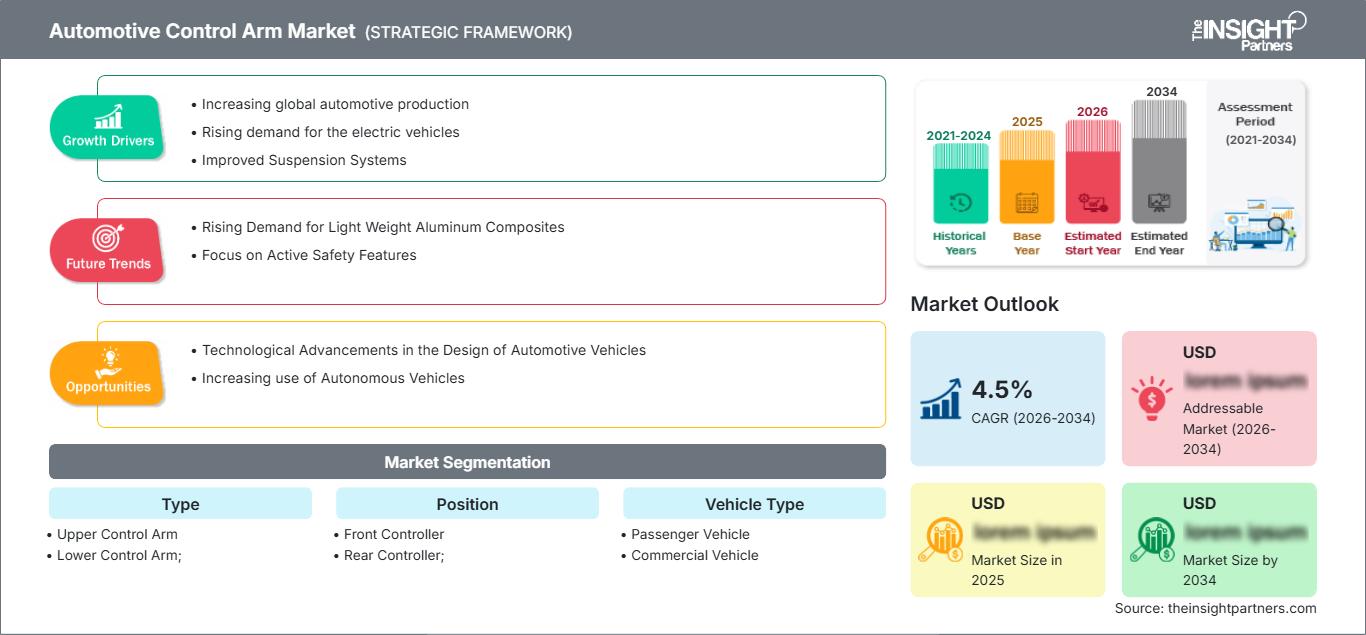
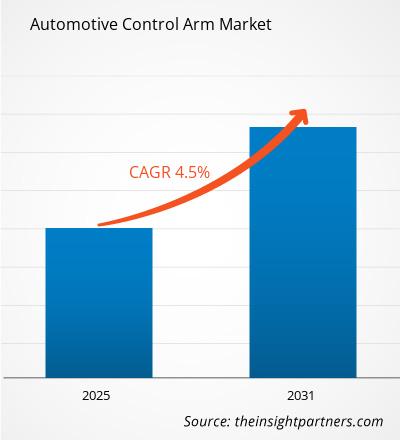
The automotive control arm market was valued at US$ 30.28 Billion in 2025 and is projected to reach US$ 39.13 Billion by 2034, registering a CAGR of 2.89% from 2026 to 2034. Control arms remain critical suspension links that connect the chassis to the wheel assembly, support wheel alignment, absorb road forces, and enable stable handling across passenger cars, light commercial vehicles, and heavy-duty applications.
North America automotive control arm market size is expected to grow at a CAGR of 2.4–2.8% during 2026–2034, supported by aging vehicle fleets, pickup and SUV demand, and steady replacement of worn suspension parts. The region benefits from strong aftermarket distribution, high vehicle miles traveled, and expanded chassis product coverage by suppliers serving workshops, distributors, and repair chains.
Automotive Control Arm Market Assessment and Insights
- North America: Accounted for an estimated 23–26% share in 2025 and is expected to grow at a CAGR between 2.4–2.8% during 2026–2034, driven by aftermarket repairs, SUVs, pickups, and suspension durability upgrades.
- US: Represented about 76–80% of North America demand in 2025 and is projected to grow at a CAGR between 2.3–2.7% during 2026–2034, supported by vehicle parc aging and repair-channel penetration.
- Europe: Held an estimated 25–28% share in 2025 and is likely to expand at a CAGR between 2.5–2.9%, led by Germany, the UK, France, Italy, and Spain.
- Asia Pacific: Led with an estimated 39–43% share in 2025 and is expected to grow at a CAGR between 3.2–3.7%, driven by China, Japan, India, South Korea, and Australia.
- Largest Segment: Lower Control Arm estimated 61–65% market share in 2025 and a CAGR between 2.8–3.2% during 2026–2034.
- High Growth Segment: Front Controller estimated 66–70% share in 2025 and a CAGR between 3.0–3.5% during 2026–2034.
- Key companies analyzed in detail: A ONE Parts Co., Ltd., Alltech Automotive, CCYS Hi-Tech International Ltd., Lemdor Control Arm Co., Ltd., Marelli Holdings Co., Ltd., MZW Motor, Nalbro Auto Parts Pvt. Ltd., RTS S.A., TRW Automotive Holdings Corp., and ZF Friedrichshafen AG.
Source: The Insight Partners' analysis based on proprietary research, government publications, company annual reports, investor presentations, industry databases, and expert interviews.
Technology development in the automotive control arm market has moved from basic stamped steel parts toward stronger, lighter, and more application-specific assemblies. Aluminum arms, optimized bushings, integrated ball joints, corrosion-resistant coatings, and precision welding help suppliers meet ride, noise, vibration, harshness, and alignment expectations. Production dynamics are shaped by OEM platform qualification, aftermarket catalog breadth, and the need to match left-right and upper-lower geometry across thousands of vehicle variants.
Future growth will be moderate but resilient because suspension wear is unavoidable across high-mileage vehicles. Automotive Control Arm Market forecast projections indicate that emerging markets will add replacement volume as vehicle ownership expands, while mature markets will prioritize premium aftermarket kits and OE-quality fitment. Investment will focus on automated welding, forging, coatings, e-commerce fitment data, and lightweight control arms that support fuel efficiency, electric vehicle range, and improved chassis tuning.
Automotive Control Arm Market Report Scope
| Report Attribute | Details |
|---|---|
| Market size in 2025 | US$ 30.28 Billion |
| Market Size by 2034 | US$ 39.13 Billion |
| Global CAGR (2026 - 2034) | 2.89% |
| Historical Data | 2021-2024 |
| Forecast period | 2026-2034 |
Automotive Control Arm Market Analysis
The Automotive control arm market growth is supported by vehicle parc expansion, road-quality variation, accident repair, and periodic replacement of bushings, ball joints, and complete arms. Where passenger cars, SUVs, pickups and light commercial vehicles are driven at high kilometers per year, demand will be greatest. The control arm is an important component in terms of vehicle safety as it affects camber, caster, toe, steering performance, stability and wear of tires.
The value chain consists of manufacturers of steel and aluminum, forging and stamping companies, makers of rubber bushings, ball joints, coating services, first-tier chassis suppliers, distributors, e-commerce websites and independent service centers. Automotive control arm market analysis shows that suppliers compete on geometry accuracy, corrosion protection, bearing durability, packaging completeness, and model coverage. Aftermarket buyers value parts that arrive with bushings and ball joints pre-installed to reduce labor time.
Competition is fragmented into global chassis players and regional replacement-part providers. ZF Friedrichshafen AG and TRW Automotive Holdings Corp. provide aftermarket coverage in line with their OEM designs, whereas RTS S.A. has an emphasis on Europe, comprehensive references in steering and suspension, and often introduces new products. Marelli Holdings Co., Ltd. offers suspension systems engineering, including knowledge about the lower control arm and light-weight components, whereas MZW Motor, Alltech Automotive, CCYS Hi-Tech International Ltd., and Nalbro Auto Parts Pvt. Ltd. compete using efficient catalogs.
Trends of investment include product range extension, improved fitment data, testing capabilities, and materials efficiency. The 2025 TRW chassis extension by ZF Aftermarket in North America is a case in point, illustrating the way in which suppliers enlarge coverage for more vehicles to be served. Strategy includes speed-to-catalog, OE validation, distribution access, and capacity to cater to older vehicles and new platforms using complicated suspension systems.
● REPORT CUSTOMIZATION
Tailor This Report To Align With Your Specific Business Requirements
This report can be customized to align precisely with your business objectives, scope, and target markets. Customization options include tailored segmentation, geography, competitive analysis, and strategic insights to support informed decision-making.
Customize This Report →WHAT YOU CAN ADJUST
- ● Segmentations
- ● Geography
- ● Competitive Analysis
- ● Language Preferences
Automotive Control Arm Market: Strategic Insights
Regional Insights
North America automotive control arm market
North America held an estimated 23–26% automotive control arm market share in 2025 and is forecast to grow at a 2.4–2.8% CAGR through 2034. Demand is supported by a large vehicle parc, high mileage, pickup and SUV usage, winter corrosion, road impacts, and workshop replacement of worn bushings, ball joints, and complete assemblies.
The region’s supplier base is heavily aftermarket-oriented because many vehicles remain in service beyond warranty. ZF Friedrichshafen AG expanded TRW chassis coverage in 2025, adding control arm and tie rod assemblies for millions of additional vehicles in operation. This supports distributors and repair chains that need OE-style components for broad domestic and import vehicle coverage.
U.S. automotive control arm market Market
The US represented an estimated 76–80% of North American demand in 2025 and is expected to grow at a 2.3–2.7% CAGR through 2034. The high light-truck density in the country, long average vehicle age, and dense independent repair shops ensure replacement opportunities for the front lower arms, upper arms, bushings, and full suspension sets.
SUVs, pickups, crossovers, and pothole-damaged passenger cars are the vehicles that tend to see usage of the application. ZF Friedrichshafen AG, TRW Automotive Holdings Corp., Alltech Automotive, and MZW Motor are visible players in the aftermarket segment, and catalog accuracy, installation parts, and warranty play an important role in workshop buying decisions.
Europe automotive control arm market Market
Europe accounted for an estimated 25–28% share in 2025 and is projected to grow at a 2.5–2.9% CAGR from 2026 to 2034. Germany is leading the pack on account of its OEM engineering capabilities, high-end car parc, and advanced suspension supplier network. The UK provides aftermarket demand from aged passenger cars and small vans.
The countries France, Italy, and Spain provide additional aftermarket volume on account of the high stress caused by dense urban traffic, curb strikes, and road surface variance. RTS S.A. provides support to the European independent aftermarket with its steering and suspension production in Spain, while Marelli Holdings Co., Ltd. provides suspension expertise and weight reduction parts technology for European platforms.
APAC automotive control arm market Market
APAC held the leading 39–43% share in 2025 and is expected to grow at a 3.2–3.7% CAGR during 2026–2034. China leads due to large vehicle production, domestic replacement demand, and broad component manufacturing capacity.
Japan and South Korea contribute through quality-oriented OEM supply chains, while India adds growth from vehicle ownership, road expansion, and aftermarket formalization. Australia supports SUV, pickup, and utility vehicle replacement demand. Regional production scale allows suppliers to serve both domestic platforms and export aftermarket channels.
Middle East & Africa automotive control arm market Market
The Middle East and Africa are projected to grow at a 2.6–3.1% CAGR during 2026–2034. Saudi Arabia is the leading country, supported by utility vehicles, logistics fleets, construction activity, and harsh operating conditions.
The UAE contributes through vehicle imports and parts trading, while South Africa supports both assembly and replacement channels. The rest of the MEA demand is fragmented, but heat, dust, rough roads, and high payload use increase wear on bushings, ball joints, and suspension links.
Segmentation Analysis
Type
Type is expected to grow at a CAGR of 2.7–3.1% during 2026–2034. The automotive control arm market scope across this segment is shaped by suspension geometry, axle load, steering function, and whether the platform uses MacPherson strut, double wishbone, or multi-link layouts. Replacement demand is strongest for assemblies exposed to road impacts and bushing fatigue.
- Upper Control Arm applications are important in double wishbone and selected truck suspensions where camber control, alignment precision, and load stability are central to steering response.
- Lower Control Arm remains the largest type because it carries major wheel loads, supports ball joint integration, and is frequently replaced during front suspension service.
Position
Position is forecast to grow at a CAGR of 2.8–3.3% during 2026–2034. Front applications dominate because steering forces, braking loads, pothole impacts, and alignment sensitivity are concentrated at the front axle. Rear control arms remain important in multi-link suspensions, especially for ride comfort, wheel tracking, and stability.
- Front Controller generates a higher replacement frequency because front suspension links absorb steering, braking, curb, and road-impact forces in passenger cars, SUVs, pickups, and vans.
- Rear Controller supports wheel location and ride stability in multi-link rear suspensions, with demand rising as vehicles adopt more refined rear axle layouts.
Opportunity Snapshot
| Segments | Revenue Contribution | Trend Tag | Adoption Stage |
| Upper Control Arm | Medium | Alignment Precision | Mature |
| Lower Control Arm | High | Load Bearing | Mature |
| Front Controller | High | Repair Volume | Mature |
| Rear Controller | Medium | Ride Stability | Scaling |
Automotive Control Arm Market Growth Drivers and Impact Analysis
Aging Vehicle Parc and Recurring Suspension Repairs
Higher longevity of vehicles provides a strong rationale for control arm replacement since bushings, ball joints, and forged or stamped parts tend to wear out due to repeated road loads. It is typical for workshops to replace the whole control arm and not just the bushing due to the time involved in labor, alignment problems, and corrosion, making the process uneconomic at the component level. This driver is most prominent in North America, Europe, and advanced Asian countries, where vehicles operate for a long time.
SUV, Pickup, and Light Commercial Vehicle Load Requirements
SUVs, pickups, and light trucks have more loading of the front and rear suspension links because of their capacity for towing, payload, curb weight, and varied road surface conditions. Such vehicles may need sturdier lower control arms, robust ball joints, and bushings that can withstand vertical and lateral loads. With consumers turning towards crossovers and utility vehicles, the control arm manufacturers stand to gain from an increase in content value and replacement specifications.
Lightweighting and EV Chassis Optimization
Electrification drives the automotive industry to save weight on the chassis due to the weight of batteries, which affects the driving range. Lightweight components such as aluminum, optimized stamped steel, and hybrid control arms could be considered to achieve a reduced unsprung weight while achieving targets for alignment and durability. An important requirement for electric vehicles is tuning of the suspension system since batteries affect the vehicle’s weight balance. This effect is selective but very important, as companies that can certify lightweight control arms for NVH, strength, and corrosion will have more value-added programs.
Automotive Control Arm Market Future Trends
Integrated Control Arm Assemblies with Longer Service Life
Automotive control arm market trends are shifting toward complete assemblies that combine the arm, bushings, ball joints, coatings, and mounting hardware in a ready-to-install package. Workshops prefer integrated kits because they reduce installation time, minimize fitment errors, and improve first-time repair success. Future designs will emphasize sealed joints, higher-quality rubber or polyurethane compounds, corrosion protection, and pre-calibrated geometry. This trend should strengthen branded aftermarket suppliers that can prove durability through testing and provide accurate application data across older and newer vehicle platforms.
Material Diversification for Platform-Specific Suspension Tuning
In terms of material composition, future designs of the control arms will take into consideration the type of vehicle class and will continue to combine different materials such as aluminum and steel, where the latter is mainly used for budget-friendly vehicles and the former is used more for high-end vehicles. In this case, simulation, forging, casting, and hydroforming are methods that can be used to achieve a good balance between stiffness, strength, noise reduction, and weight reduction.
Automotive Control Arm Market Opportunities
Premium Aftermarket Kits for High-Mileage Vehicles
The Automotive control arm forecasts point to a strong opportunity in premium aftermarket kits that include arms, bushings, ball joints, fasteners, and fitment guidance. Repair shops want fewer returns, faster installation, and reliable alignment outcomes, especially for older SUVs, pickups, and European vehicles. Suppliers can differentiate through OE-style geometry, corrosion-resistant coatings, and digital catalog accuracy. This opportunity is practical because aftermarket buyers already replace control arms regularly, but they increasingly value complete solutions that reduce repeat labor and warranty claims.
Localized Manufacturing for Emerging Market Replacement Demand
Emerging markets offer opportunity as vehicle ownership expands and road conditions accelerate suspension wear. Local production in India, China, Southeast Asia, and parts of MEA can reduce logistics costs, improve model coverage, and meet price expectations. Manufacturers can pair steel control arms for mass-market vehicles with selective aluminum parts for premium and EV platforms. The opportunity is action-oriented because distributors need fast-moving stock, workshops need fitment certainty, and OEMs need suppliers that can support local content requirements.
Frequently Asked Questions

- Comprehensive Market Sizing and Forecast Analysis
- Detailed Segmentation Analysis
- In-Depth Market Dynamics Assessment
- Regional and Country-Level Insights
- Competitive Landscape and Company Benchmarking
- Strategic Business Intelligence
Recent Reports
Testimonials

The Insight Partners' SCADA System Market report is comprehensive, with valuable insights on current trends and future forecasts. The team was highly professional, responsive, and supportive throughout. We are very satisfied and highly recommend their services.
RAN KEDEM Partner, Reali Technologies LTDs
I requested a report on a very specific software market and the team produced the report in a few days. The information was very relevant and well presented. I then requested some changes and additions to the report. The team was again very responsive and I got the final report in less than a week.
JEAN-HERVE JENN Chairman, Future Analytica
We worked with The Insight Partners for an important market study and forecast. They gave us clear insights into opportunities and risks, which helped shape our plans. Their research was easy to use and based on solid data. It helped us make smart, confident decisions. We highly recommend them.
PIYUSH NAGPAL Sr. Vice President, High Beam Global
The Insight Partners delivered insightful, well-structured market research with strong domain expertise. Their team was professional and responsive throughout. The user-friendly website made accessing industry reports seamless. We highly recommend them for reliable, high-quality research services
YUKIHIKO ADACHI CEO, Deep Blue, LLC.
This is the first time I have purchased a market report from The Insight Partners.While I was unsure at first, I visited their web site and felt more comfortable to take the risk and purchase a market report.I am completely satisfied with the quality of the report and customer service. I had several questions and comments with the initial report, but after a couple of dialogs over email with their analyst I believe I have a report that I can use as input to our strategic planning process.Thank you so much for taking the extra time and making this a positive experience.I will definitely recommend your service to others and you will be my first call when we need further market data.
JOHN SUZUKI President and Chief Executive Officer, Board Director, BK Technologies
I wish to appreciate your support and the professionalism you displayed in the course of attending to my request for information regarding to infectious disease IVD market in Nigeria. I appreciate your patience, your guidance, and the fact that you were willing to offer a discount, which eventually made it possible for us to close a deal. I look forward to engaging The Insight Partners in the future, all thanks to the impression you have created in me as a result of this first encounter.
DR CHIJIOKE ONYIA MANAGING DIRECTOR, PineCrest Healthcare Ltd.Reason to Buy
- Informed Decision-Making
- Understanding Market Dynamics
- Competitive Analysis
- Identifying Emerging Markets
- Customer Insights
- Market Forecasts
- Risk Mitigation
- Boosting Operational Efficiency
- Strategic Planning
- Investment Justification
- Tracking Industry Innovations
- Aligning with Regulatory Trends





 Get Free Sample for