
Automotive Control Panel Market Size, Share & Forecast by 2034
Coverage: By Component (Rotary Switch, Roof and Door Panel Light, Touch Pad, Driver Monitoring Camera, Others); Control Switch Type (Manual, Touch Screen); Vehicle Type (Passenger Cars, Commercial Vehicles) , and Geography (North America, Europe, Asia Pacific, and South and Central America)
- Status : Data Released
- Report Code : TIPRE00007008
- Category : Automotive and Transportation
- No. of Pages : 150
- Available Report Formats :


- Last update date : August 12, 2026


2025 Market Size
US$ 147.62 Bn
Base year value
2034 Forecast
US$ 243.42 Bn
Projected by 2034
CAGR 2026-2034
5.71 %
Growth rate
Addressable Market
US$ 1,771.83 Bn
(2026-2034)
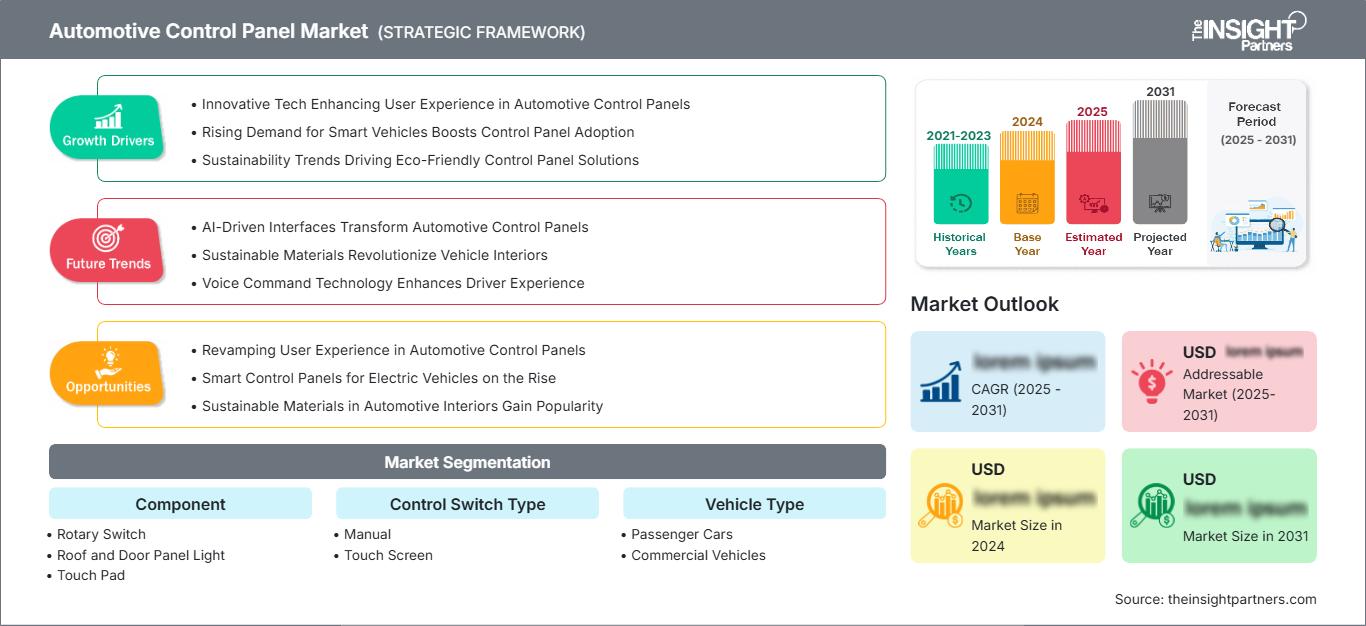
The automotive control panel market was valued at US$ 147.62 Billion in 2025 and is projected to reach US$ 243.42 Billion by 2034, registering a CAGR of 5.71 % from 2026 to 2034. Growth is supported by digital cockpit integration, in-cabin personalization, ADAS display requirements, and the shift from scattered physical switches toward software-configurable human–machine interfaces.
The North America automotive control panel market size is expected to expand at a CAGR of 4.8–5.4% during 2026–2034, supported by premium vehicle electronics, electric SUV launches, and strong consumer demand for connected cabin functions. Automakers are using larger displays, haptic interfaces, and driver monitoring integration to improve safety, usability, and brand differentiation across passenger and commercial vehicle platforms.
Automotive Control Panel Market Assessment and Insights
- North America: Accounted for an estimated 24–27% share in 2025 and is expected to grow at a CAGR between 4.8–5.4% during 2026–2034, supported by digital cockpit investment and EV adoption.
- US: Represented about 76–80% of North America demand in 2025 and is projected to grow at a CAGR between 4.7–5.3% during 2026–2034.
- Europe: Held an estimated 25–28% share in 2025 and is likely to expand at a CAGR between 5.0–5.6%, led by Germany, the UK, France, Italy, and Spain.
- Asia Pacific: Led with an estimated 39–43% share in 2025 and is expected to grow at a CAGR between 6.2–6.9%, driven by China, Japan, South Korea, India, and Australia.
- Largest Segment: Touch screen control switch type estimated 54–58% market share in 2025 and a CAGR between 6.0–6.7% during 2026–2034.
- High Growth Segment: Driver monitoring camera estimated 11–15% share in 2025 and a CAGR between 8.1–8.9% during 2026–2034.
- Key companies analyzed in detail: Marelli Holdings Co., Ltd., Continental AG, PHINIA Inc., FORVIA SE, Hyundai Mobis Co., Ltd., Adient plc, Lear Corporation, Magna International Inc., Toyota Boshoku Corporation, and Valeo SE.
Source: The Insight Partners' analysis based on proprietary research, government publications, company annual reports, investor presentations, industry databases, and expert interviews.
Technology evolution in the automotive control panel market has shifted from mechanical knobs and hard-wired switches toward integrated displays, capacitive touch surfaces, roof and door lighting panels, camera-based monitoring, and tactile feedback systems. Production dynamics are shaped by display availability, semiconductor content, software validation, interior module integration, and safety expectations for low-distraction interaction. Suppliers now combine trim design, electronics, lighting, and sensing to create control panels that operate as part of the wider cockpit domain.
Future demand will be strongest where electrification, connected services, and safety regulations converge. Automotive Control Panel Market forecast projections indicate that China and South Korea will accelerate smart cockpit adoption, while Europe will emphasize driver monitoring and safe interface design. Investment will focus on curved displays, hidden-until-lit surfaces, haptic feedback, and modular center consoles that allow OEMs to differentiate interiors without rebuilding full vehicle architectures.
Automotive Control Panel Market Report Scope
| Report Attribute | Details |
|---|---|
| Market size in 2025 | US$ 147.62 Billion |
| Market Size by 2034 | US$ 243.42 Billion |
| Global CAGR (2026 - 2034) | 5.71% |
| Historical Data | 2021-2024 |
| Forecast period | 2026-2034 |
Automotive Control Panel Market Analysis
The automotive control panel market growth is being driven by the transition from conventional instrument panels to intelligent cockpit systems. Consumers expect infotainment, climate, navigation, lighting, seating, and safety alerts to be controlled through intuitive interfaces. OEMs also need panels that can support over-the-air feature updates, EV energy displays, and ADAS warnings without adding visual clutter. This makes interface design a strategic element of vehicle perceived quality.
The value chain includes display suppliers, sensor makers, printed electronics specialists, interior trim manufacturers, software developers, Tier 1 cockpit integrators, and OEM user-experience teams. Automotive control panel market analysis shows that supplier capability increasingly depends on combining physical durability with software responsiveness. The following factors affect the ability of a control panel to be up-to-date for the cockpit:
There is competition between those firms that are able to integrate the interior with electronic and safety solutions. Continental AG, FORVIA SE, Hyundai Mobis Co., Ltd., Valeo SE, Lear Corporation, Magna International Inc., Toyota Boshoku Corporation, and Marelli Holdings Co., Ltd. have capabilities in cockpit modules, display systems, HMI, seats, lighting, and electronics. PHINIA Inc. and Adient plc provide additional capabilities within their networks of suppliers.
Investment trends point toward software-defined cockpit platforms, modular consoles, driver monitoring integration, and display-rich dashboards. The Automotive Control Panel Market is being shaped by innovations such as Continental’s 2025 Emotional Cockpit concept, FORVIA’s cockpit user-experience software, Hyundai Mobis’ holographic windshield display, and Valeo’s Panovision and interior cocoon technologies, demonstrating how suppliers are moving beyond traditional hardware-centric panels. Strategic positioning now depends on safety, personalization, cost control, and scalable cockpit architecture.
● REPORT CUSTOMIZATION
Tailor This Report To Align With Your Specific Business Requirements
This report can be customized to align precisely with your business objectives, scope, and target markets. Customization options include tailored segmentation, geography, competitive analysis, and strategic insights to support informed decision-making.
Customize This Report →WHAT YOU CAN ADJUST
- ● Segmentations
- ● Geography
- ● Competitive Analysis
- ● Language Preferences
Automotive Control Panel Market: Strategic Insights
Regional Insights
North America automotive control panel market
North America held an estimated 24–27% automotive control panel market share in 2025 and is forecast to expand at a 4.8–5.4% CAGR through 2034. Demand is strengthened by electric SUVs, pickup upgrades, premium infotainment packages, driver monitoring features, and consumer preference for larger touch displays.
OEMs in the region are prioritizing controls that reduce distraction while supporting connected services and software-defined vehicle functions. Suppliers benefit from EV platform redesigns and high-value interior content. Haptic controls, configurable center stacks, roof lighting panels, and camera-based monitoring will remain central to new model launches.
U.S. automotive control panel Market
The US represented an estimated 76–80% of North American demand in 2025 and is expected to grow at a CAGR of 4.7–5.3% through 2034. The Automotive Control Panel Market in the country is shaped by connected vehicle services, premium SUVs, pickup trucks, and electric vehicles that require advanced displays, integrated infotainment systems, and intuitive cockpit controls.
Continental AG, Lear Corporation, Magna International Inc., Adient plc, FORVIA SE, and Valeo SE maintain strong regional relationships with OEMs and interior programs. Application trends favor touch screen control switch type interfaces, driver monitoring camera integration, and modular center consoles that combine comfort, safety, and digital functionality.
Europe automotive control panel Market
Europe accounted for an estimated 25–28% share in 2025 and is projected to grow at a 5.0–5.6% CAGR during 2026–2034. Germany is the dominant nation due to innovations from premium OEMs, cockpit component makers, and electronic experts in display integration, haptic technologies, and driver safety systems.
UK is helping to create demand by virtue of its vehicle engineering and fleet connectivity initiatives. France, Italy, and Spain are assisting with interior modules, electric vehicle platform design, and mass market cockpit innovations. EU demands in safety technologies include driver monitoring, distraction mitigation, and flow of ADAS information.
APAC automotive control panel Market
APAC held the leading 39–43% share in 2025 and is expected to grow at a CAGR of 6.2–6.9% during 2026–2034. The Automotive Control Panel Market in the region is led by China, supported by its large-scale EV production, rapid smart cockpit deployment, and increasing adoption of advanced display technologies across passenger and premium vehicle segments.
Japan and South Korea contribute through Hyundai Mobis Co., Ltd., Toyota Boshoku Corporation, and electronics-led cockpit engineering. India adds growth from passenger car upgrades and connected infotainment adoption, while Australia supports demand through imported SUVs and premium vehicle trims.
Middle East & Africa automotive control panel Market
The Middle East and Africa are projected to grow at a 4.3–4.9% CAGR during 2026–2034. Saudi Arabia is the leading country, supported by premium vehicle imports, fleet modernization, and connected mobility investments.
The UAE contributes high-end vehicle demand and technology-rich cabin adoption, while South Africa adds assembly and aftermarket electronics channels. The rest of MEA adoption remains uneven, but commercial fleets and urban mobility projects will increase demand for durable control switches and display panels.
Segmentation Analysis
Component
Component is expected to grow at a CAGR of 5.5–6.2% during 2026–2034. Automotive control panel market scope in this segment is shaped by physical interaction, interior lighting, user monitoring, and the need to balance touch-based digital surfaces with tactile controls that support safer operation while driving.
- Rotary Switch remains relevant for climate, drive modes, volume, and terrain functions where tactile feedback, quick adjustment, and low visual distraction are valued by drivers.
- Roof and Door Panel Light supports ambient lighting, access visibility, personalization, and premium interior differentiation as OEMs use light as both functional control and brand identity.
- Touch Pad enables compact interaction for infotainment, navigation, and menu selection, especially where OEMs want reduced button count without relying only on large central screens.
- Driver Monitoring Camera is the high-growth component because regulation, ADAS readiness, and safety scoring increase demand for gaze, distraction, drowsiness, and occupant-state detection.
Control Switch Type
Control Switch Type is forecast to grow at a CAGR of 5.8–6.5% during 2026–2034. Manual controls retain importance for safety-critical and high-frequency functions, while touch screen interfaces dominate new cockpit designs because software menus, personalization, and connected services require flexible interaction surfaces.
- Manual control switches remain important for hazards, defrost, volume, window, seat, and drive functions where immediate response and tactile confirmation reduce operational uncertainty.
- Touch Screen is the largest segment because central displays increasingly consolidate infotainment, climate, navigation, EV information, camera views, and configurable vehicle settings.
Vehicle Type
Vehicle Type is projected to grow at a CAGR of 5.4–6.1% during 2026–2034. Passenger cars lead adoption because buyers compare cabin technology closely, while commercial vehicles increasingly require durable interfaces for fleet diagnostics, telematics, safety alerts, and driver comfort.
- Passenger Cars generate the greatest demand as OEMs use digital displays, ambient lighting, haptic controls, and driver monitoring to differentiate trims and improve perceived cabin quality.
- Commercial Vehicles require robust panels for frequent operation, fleet connectivity, climate control, camera monitoring, and driver assistance functions in delivery, logistics, bus, and vocational use.
Opportunity Snapshot
| Vehicle Type | Revenue Contribution | Trend Tag | Adoption Stage |
| Passenger Cars | High | Digital Cabin | Mature |
| Commercial Vehicles | Medium | Fleet HMI | Scaling |
Automotive Control Panel Market Growth Drivers and Impact Analysis
Digital Cockpit Consolidation Across Vehicle Classes
Automakers are combining the infotainment system, climate control, navigation, lights, seating and other vehicle settings into an integrated cockpit interface to streamline hardware and enable software updates. This trend has implications since there is an increased need for touchscreens, touchpads, haptic surfaces, and display-compatible panel structures. The effect cuts across the board as even medium-end passenger cars need sophisticated control logic compared to earlier premium automobiles.
Driver Monitoring and Distraction-Reduction Requirements
Driver monitoring systems and assessments are contributing towards higher requirements for cameras that monitor drivers, attention alerts, and better interface designs. Control units must not increase distractions but must be able to present information to the user, thus promoting haptic feedback and physical backup systems. This effect is felt by both passengers and commercial car manufacturers as fleets require less risk and OEMs require systems that work with ADAS technology. Providers with capabilities in cameras, lighting, and UX software design will benefit from this shift in focus on safety.
Electric Vehicle Interior Redesign and Brand Differentiation
EVs provide OEMs additional flexibility in rethinking dashboard design, center console, roof module, and door panels due to the platform architecture being different from traditional internal combustion engines. With wide screens, ambient lighting, invisible controls, and individualized user interfaces, automakers can create an impression that the cabin of their electric cars is high-tech and software-oriented. This trend adds to the significance of control panels as the interface is the key to energy management, charging, route navigation, and connectivity services. Its market influence is felt most strongly in China, North America, South Korea, and Europe.
Automotive Control Panel Market Future Trends
Haptic and Hidden-Until-Lit Surface Interfaces
Automotive control panel market trends are moving toward surfaces that remain visually clean until activated, then provide tactile, illuminated, or localized feedback. This design philosophy could lead to less cluttered cockpits while ensuring that necessary controls are still easy to reach. The haptic feedback system would be crucial as doubts about screen-based interfaces arise from regulators and consumers. Suppliers would create decorative panels with built-in sensors, lights, force sensing, and software for logic processing underneath sturdy finishes.
AI-Personalized Cockpit Control Layouts
Going forward, display panels will be increasingly able to change in accordance with the profile of the driver, the environment of the journey, light levels, and the presence of occupants in the cabin. An AI-based system would be able to focus on climate, navigation, media, or safety settings according to usage behavior, while ensuring compliance with regulatory standards for essential functions at all times. Such technology would require closer integration of driver monitoring cameras, infotainment systems, lighting, and controls.
Automotive Control Panel Market Opportunities
Modular Control Panels for EV and SUV Platforms
Automotive control panel Forecasts point to an opportunity in modular panels that can serve multiple EV and SUV variants with different display sizes, lighting packages, and switch content. OEMs want faster launch cycles and lower tooling burden while preserving trim differentiation. Suppliers can offer scalable center stacks, door panels, and roof modules with shared electronic foundations. This creates value by reducing engineering duplication, supporting regional customization, and improving software update readiness across high-volume global vehicle platforms.
Commercial Vehicle HMI Upgrade Packages
Commercial vehicles offer an underdeveloped opportunity for rugged control panels that combine telematics, diagnostics, camera views, climate, driver assistance alerts, and lighting controls. Fleet operators value durable interfaces that reduce driver workload and support uptime. Suppliers can develop panels with glove-friendly switches, simplified touch menus, and easy service access. The opportunity is practical because electrified delivery vehicles, buses, and vocational trucks need a modern HMI without the fragile feel of consumer-style screens alone.
Frequently Asked Questions

- Comprehensive Market Sizing and Forecast Analysis
- Detailed Segmentation Analysis
- In-Depth Market Dynamics Assessment
- Regional and Country-Level Insights
- Competitive Landscape and Company Benchmarking
- Strategic Business Intelligence
Recent Reports
Testimonials

The Insight Partners provided valuable market intelligence that supported our global go-to-market strategy. Their team was professional, responsive, and attentive to our feedback, providing thoughtful analysis and helpful methodological clarifications throughout the project.
Junmo Kim Chief Financial Officer (CFO), Enertech Co., Ltd.
The Insight Partners' SCADA System Market report is comprehensive, with valuable insights on current trends and future forecasts. The team was highly professional, responsive, and supportive throughout. We are very satisfied and highly recommend their services.
RAN KEDEM Partner, Reali Technologies LTDs
I requested a report on a very specific software market and the team produced the report in a few days. The information was very relevant and well presented. I then requested some changes and additions to the report. The team was again very responsive and I got the final report in less than a week.
JEAN-HERVE JENN Chairman, Future Analytica
We worked with The Insight Partners for an important market study and forecast. They gave us clear insights into opportunities and risks, which helped shape our plans. Their research was easy to use and based on solid data. It helped us make smart, confident decisions. We highly recommend them.
PIYUSH NAGPAL Sr. Vice President, High Beam Global
The Insight Partners delivered insightful, well-structured market research with strong domain expertise. Their team was professional and responsive throughout. The user-friendly website made accessing industry reports seamless. We highly recommend them for reliable, high-quality research services
YUKIHIKO ADACHI CEO, Deep Blue, LLC.
This is the first time I have purchased a market report from The Insight Partners.While I was unsure at first, I visited their web site and felt more comfortable to take the risk and purchase a market report.I am completely satisfied with the quality of the report and customer service. I had several questions and comments with the initial report, but after a couple of dialogs over email with their analyst I believe I have a report that I can use as input to our strategic planning process.Thank you so much for taking the extra time and making this a positive experience.I will definitely recommend your service to others and you will be my first call when we need further market data.
JOHN SUZUKI President and Chief Executive Officer, Board Director, BK Technologies
I wish to appreciate your support and the professionalism you displayed in the course of attending to my request for information regarding to infectious disease IVD market in Nigeria. I appreciate your patience, your guidance, and the fact that you were willing to offer a discount, which eventually made it possible for us to close a deal. I look forward to engaging The Insight Partners in the future, all thanks to the impression you have created in me as a result of this first encounter.
DR CHIJIOKE ONYIA MANAGING DIRECTOR, PineCrest Healthcare Ltd.Reason to Buy
- Informed Decision-Making
- Understanding Market Dynamics
- Competitive Analysis
- Identifying Emerging Markets
- Customer Insights
- Market Forecasts
- Risk Mitigation
- Boosting Operational Efficiency
- Strategic Planning
- Investment Justification
- Tracking Industry Innovations
- Aligning with Regulatory Trends





 Get Free Sample for