
Automotive Dashboard Market Size, Share & Demand by 2034
Coverage: By Material Type (PVC, Wood); Components (Speedometer, Tachometer, Odometer, Fuel Meter); Platform (Analog, Digital) , and Geography (North America, Europe, Asia Pacific, and South and Central America)
- Status : Data Released
- Report Code : TIPAT00002405
- Category : Automotive and Transportation
- No. of Pages : 150
- Available Report Formats :


- Last update date : August 12, 2026


2025 Market Size
US$ 29.47 Bn
Base year value
2034 Forecast
US$ 39.71 Bn
Projected by 2034
CAGR 2026-2034
3.37 %
Growth rate
Addressable Market
US$ 314.18 Bn
(2026-2034)
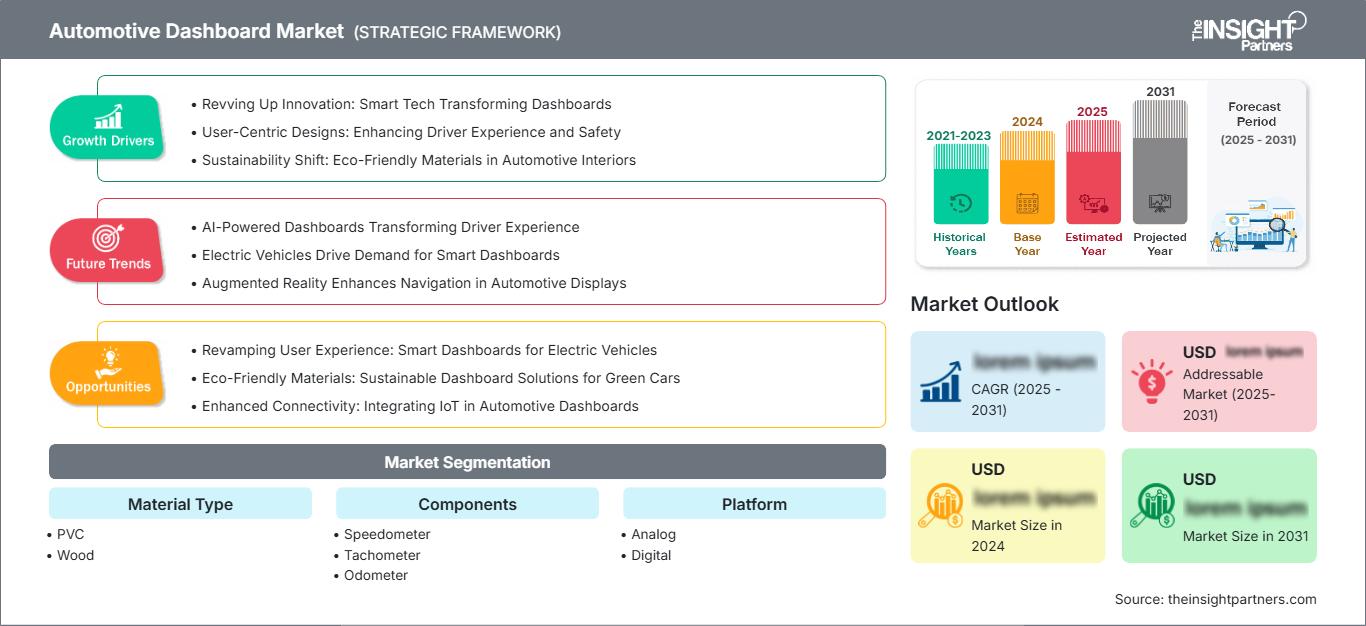
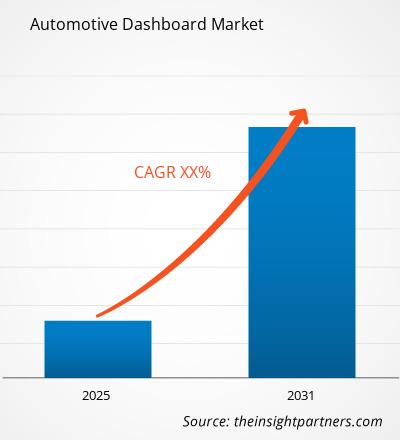
The Automotive dashboard market size was valued at US$ 29.47 Billion in 2025 and is forecast to achieve a value of US$ 39.71 Billion by 2034, growing at a CAGR of 3.37%. Increasing automobile production, rising adoption of digital cockpits, and the popularity of luxury cars are some of the trends impacting the development of dashboards. Suppliers of these components are focused on using lightweight materials, ergonomic designs, and electronic integration in the manufacture of such parts to cater to current design trends.
The North American Automotive dashboard market share has witnessed consistent growth as OEMs have made increased investments in connected cars, instrument clusters, and light-weight interiors. The market in the region is driven by the growth in production of SUVs and pickup trucks, growing adoption of ADAS technologies, and stringent vehicle safety standards. The future growth of the market is likely to be moderate and grow at a CAGR of 3.4%-3.8% up to 2034.
Automotive Dashboard Market Assessment and Insights
- North America: Accounted for 31–34% share in 2025 and is projected to register a CAGR of 3.4–3.8% during 2026–2034, supported by premium vehicle production, digital cockpit integration, and continuous investments in intelligent interior technologies.
- US: Represented approximately 78–82% of the North American market in 2025 and is anticipated to grow at a CAGR of 3.5–3.9% owing to high production of technologically advanced passenger vehicles.
- Europe: Held 25–28% share in 2025 while advancing at a CAGR of 3.0–3.4%. Germany, France, Italy, and the UK remain the principal manufacturing hubs emphasizing lightweight interior systems and sustainable dashboard materials.
- Asia Pacific: Captured 34–37% share in 2025 and is forecast to expand at a CAGR of 3.8–4.3%, led by China, Japan, South Korea, and India through increasing automotive manufacturing capacity and digital cockpit adoption.
- Largest Segment: Digital Platform represented 58–62% market share in 2025 and is expected to grow at a CAGR of 3.8–4.2%, supported by increasing penetration of connected vehicles and integrated infotainment systems.
- High Growth Segment: Digital Platform is projected to remain the fastest-growing segment with a 2025 market share of 58–62% and a CAGR of 3.8–4.2%, reflecting accelerating adoption of software-defined vehicle architectures.
- Key companies analyzed in detail: ACTIA Group, American Dash, Brace Automotive, Diametric Technical Ltd., JBM Auto Limited (JP Minda Group), Prestige Autowood, SAS Autosystemtechnik Verwaltungs GmbH, Sherwood Innovations, So.F.Ter S.r.l., Sterling Technologies Inc.
Source: The Insight Partners' analysis based on proprietary research, government publications, company annual reports, investor presentations, industry databases, and expert interviews.
There have been changes in the automotive dashboard market as vehicle interiors have transitioned from being merely functional to becoming highly intelligent man-machine interfaces. More manufacturers have started integrating structural polymers, cosmetic trims, built-in displays, illumination systems, and electronic control units into one compact dashboard system. Advancements in technology in moldings, light-weighted composite materials, and integration of display units have contributed to durability while cutting down the weight and complexity of the vehicles. The OEMs now focus on having modularity dashboards, which help ease up manufacturing processes, and multiple variants can be created from the same platform.
Future growth in the industry would largely be driven by technologies of electrification and self-driving cars, and software-based vehicle platforms. Investments in eco-friendly interior materials, bigger display screens, voice-controlled interfaces, and custom-built cockpits will drive the suppliers' strategies. There is a growing trend in establishing new manufacturing sites for the auto sector in Southeast Asia, Eastern Europe, and Latin America.
Automotive Dashboard Market Report Scope
| Report Attribute | Details |
|---|---|
| Market size in 2025 | US$ 29.47 Billion |
| Market Size by 2034 | US$ 39.71 Billion |
| Global CAGR (2026 - 2034) | 3.37% |
| Historical Data | 2021-2024 |
| Forecast period | 2026-2034 |
Automotive Dashboard Market Analysis
The electrification of automobiles, their cockpit digitalization, and changes in consumer demands are further driving the demand for automotive dashboards across the globe. Modern dashboards incorporate features like infotainment systems, driver assistance systems, HVAC, connectivity components, and structural materials in one piece. Collaboration between suppliers, electronic companies, software providers, polymer companies, and OEMs is gaining importance to enhance manufacturing efficiency along with customization and occupants' experience.
The availability of raw materials, semiconductors, and electronics manufacturing capabilities are significant factors on the supply side. The trend of diversifying the procurement process to mitigate production disruption and increase geographical manufacturing footprint has been increasing among dashboard manufacturers. Injection molding, automated assembly, laser surface treatment, and precise electronics integration help in consistent manufacturing and low waste generation.
Market Analysis for Positioning in the Automotive Dashboard Sector is becoming more dependent on innovations, manufacturing flexibility, and long-term relationships with vehicle manufacturers. ACTIA Group, the interior technology partner of Dayco; Diametric Technical Ltd.; SAS Autosystemtechnik Verwaltungs GmbH; Prestige Autowood; and Sterling Technologies Inc. all remain committed to designing modular dashboards capable of accommodating analog and digital cockpits across various vehicle types.
Increasingly, strategic investments are being made in sustainable interior materials, intelligent displays, embedded electronics, and automation processes. Firms are ramping up their regional production capabilities and engineering capacities in order to help manufacturers of electric vehicles. Collaborations among material providers, electronics companies, and automobile OEMs are resulting in rapid development of advanced dashboard systems.
● REPORT CUSTOMIZATION
Tailor This Report To Align With Your Specific Business Requirements
This report can be customized to align precisely with your business objectives, scope, and target markets. Customization options include tailored segmentation, geography, competitive analysis, and strategic insights to support informed decision-making.
Customize This Report →WHAT YOU CAN ADJUST
- ● Segmentations
- ● Geography
- ● Competitive Analysis
- ● Language Preferences
Automotive Dashboard Market: Strategic Insights
Regional Insights
North America Automotive Dashboard Market
The North American region is estimated to have contributed towards 31%-34% of the market share of the automotive dashboard market in 2025. It is expected that the region will grow at a CAGR of 3.4%-3.8% till 2034. This region is driven by factors such as high demand for technologically advanced passenger cars, preference for luxury interior features, and continuous investment in connected mobility.
This region includes the USA, Canada, and Mexico, which together constitute an ecosystem for manufacturing automobiles. There is high production of electric vehicles in the region along with advanced driver assistance systems, which demands dashboard architecture with the capability to support multiple modules and also be light in weight.
U.S. Automotive Dashboard Market
The U.S. was responsible for about 78–82% of the North American market in 2025, with a projected CAGR of 3.5–3.9% for the analysis period. The local automobile manufacturers are increasingly focusing on fully digitized instrument clusters, customization of the user interface, and integration of connectivity functionalities. The increase in manufacturing of luxury SUVs, pickups, and EVs has been ensuring stable demand for advanced dashboard components.
The top-notch suppliers have their engineering and manufacturing facilities throughout the country, which cater to the vehicle assembly plants with modular dashboards. Investments in automotive electronics, software-defined vehicle architecture, and intelligent cockpits are creating lucrative prospects for the dashboard manufacturers.
Europe Automotive Dashboard Market
Europe contributed 25-28% share of the revenue in 2025 and is projected to grow at CAGR of 3.0-3.4% during 2034. The leadership position held by Germany is due to its robust premium car manufacturing sector and high engineering competencies. Automakers have been making investments in eco-friendly material applications for interiors, weight reduction for dashboard assembly and implementation of digital cockpits.
The UK has been focusing on the development of vehicle connectivity solutions and premium automotive interior technologies, while Germany is excelling in innovations related to the premium dashboard and smart manufacturing. France, Italy, and Spain together participate in the process via advanced parts manufacturing, decorative interior solutions, and higher volume of electric vehicle manufacturing.
APAC Automotive Dashboard Market
Asia Pacific held 34–37% market share in 2025 and is anticipated to register the fastest regional expansion at a CAGR of 3.8–4.3%. China remains the dominant manufacturing hub, while Japan, South Korea, and India continue expanding production of passenger vehicles and electric mobility platforms supported by strong domestic demand.
Government incentives promoting vehicle electrification, increasing investments in smart manufacturing, and expanding automotive exports continue strengthening dashboard production across the region. Australia contributes primarily through advanced automotive engineering and aftermarket demand for premium interior components.
Middle East & Africa Automotive Dashboard Market
The Middle East & Africa automotive dashboard market is projected to grow at a CAGR of 2.8–3.2% through 2034. Saudi Arabia and the United Arab Emirates continue investing in industrial diversification initiatives that encourage local automotive component manufacturing, while South Africa remains the region's largest established automotive production base.
Infrastructure development, gradual vehicle fleet modernization, and increasing regional assembly activities support demand for dashboard components. Although overall market size remains comparatively smaller than other regions, long-term investments in manufacturing capability and logistics infrastructure continue creating opportunities for international suppliers.
Segmentation Analysis
Material Type
The Material Type segment is anticipated to expand at a CAGR of 3.2–3.6% during 2026–2034. The automotive dashboard market scope continues expanding as manufacturers increasingly adopt lightweight, durable, and recyclable materials that improve fuel efficiency while supporting premium interior aesthetics. Material innovation also enables better integration of electronics, improved impact resistance, and enhanced thermal stability across modern vehicle platforms.
- PVC: PVC remains widely utilized because of its cost efficiency, design flexibility, durability, and compatibility with various decorative finishes. Manufacturers continue improving recyclable formulations while maintaining high production efficiency.
- Wood: Wood-based decorative dashboard trims primarily serve premium and luxury vehicle segments where natural aesthetics, craftsmanship, and customized interior finishes remain significant competitive differentiators.
Components
The Components segment is projected to record a CAGR of 3.5–3.9% during the forecast period. Continuous advancements in vehicle electronics, driver information systems, and integrated displays are increasing component sophistication while supporting improved safety, connectivity, and user experience throughout modern automotive interiors.
- Speedometer: Digital and hybrid speedometers increasingly replace conventional analog units by providing configurable displays, improved readability, and seamless integration with connected vehicle platforms.
- Tachometer: Modern tachometers support engine performance monitoring while integrating efficiently into multifunctional digital instrument clusters for improved driver information management.
- Odometer: Electronic odometers deliver accurate mileage tracking, maintenance scheduling support, and compatibility with advanced fleet management and connected vehicle applications.
- Fuel Meter: Intelligent fuel monitoring systems increasingly incorporate predictive algorithms and real-time vehicle diagnostics, improving operational efficiency and enhancing driver awareness.
Platform
The Platform segment is expected to grow at a CAGR of 3.8–4.2% throughout 2026–2034. Increasing deployment of digital cockpits, software-defined vehicle architectures, and customizable user interfaces continues accelerating adoption of advanced dashboard platforms across both conventional and electric vehicles.
- Analog: Analog dashboard platforms remain relevant within entry-level and commercial vehicle segments because of their proven reliability, cost effectiveness, and simplified maintenance requirements.
- Digital: Digital platforms enable high-resolution displays, over-the-air software updates, personalized driver interfaces, integrated navigation, and seamless connectivity, making them the fastest-evolving dashboard architecture across modern automotive applications.
Opportunity Snapshot
| Components | Revenue Contribution | Trend Tag | Adoption Stage |
| Speedometer | High | Digital Cluster | Mature |
| Tachometer | Medium | Smart Display | Scaling |
| Odometer | Medium | Connected Fleet | Scaling |
| Fuel Meter | High | Real-Time Monitoring | Mature |
Automotive Dashboard Market Growth Drivers and Impact Analysis
Increasing Adoption of Connected and Intelligent Cockpit Systems
The growing deployment of connected vehicle technologies continues to reshape dashboard architecture worldwide. Automotive manufacturers are integrating digital instrument clusters, infotainment displays, navigation systems, voice recognition interfaces, and advanced driver assistance functions into centralized dashboard assemblies. Rising consumer expectations for seamless connectivity, smartphone integration, and personalized driving experiences further accelerate dashboard innovation. Government regulations encouraging vehicle safety technologies also support deployment of larger digital displays capable of presenting critical driving information. As software-defined vehicles become increasingly common, dashboard suppliers continue expanding investments in electronics integration, lightweight materials, and modular production techniques that improve scalability while reducing manufacturing complexity across global automotive platforms.
Expansion of Electric Vehicle Manufacturing Worldwide
Rapid expansion of battery electric and hybrid vehicle production is increasing demand for next-generation dashboard systems designed around digital interfaces rather than conventional mechanical instrumentation. Electric vehicles require integrated energy monitoring, battery management visualization, regenerative braking indicators, and intelligent driver information systems, creating new opportunities for dashboard manufacturers. Automotive OEMs increasingly prioritize lightweight interior structures to improve driving range while incorporating larger display panels and advanced human-machine interfaces. Continued investments in EV manufacturing facilities across Asia Pacific, Europe, and North America strengthen long-term demand for technologically advanced dashboard assemblies capable of supporting evolving vehicle electronics.
Growing Demand for Lightweight and Sustainable Interior Materials
Automotive manufacturers continue pursuing weight reduction strategies to improve fuel efficiency and extend electric vehicle range, increasing adoption of lightweight dashboard materials including engineered polymers, recyclable composites, and bio-based interior components. Environmental regulations promoting sustainability encourage suppliers to reduce carbon emissions throughout manufacturing operations while expanding recyclable material utilization. Material innovations also improve impact resistance, thermal stability, and design flexibility without compromising structural performance. These developments enable manufacturers to satisfy regulatory requirements while enhancing interior aesthetics, manufacturing efficiency, and long-term product durability across passenger and commercial vehicle applications.
Automotive Dashboard Market Future Trends
Expansion of AI-Enabled Digital Cockpit Technologies
Artificial intelligence is becoming increasingly integrated into modern dashboard platforms through predictive navigation, intelligent voice assistants, driver monitoring systems, and personalized interface customization. These automotive dashboard market trends reflect the industry's transition toward software-driven cockpit ecosystems capable of adapting display layouts according to driver behavior and real-time operating conditions. Future dashboard development will increasingly combine cloud connectivity, machine learning algorithms, augmented reality displays, and over-the-air software updates to enhance both convenience and operational safety.
Greater Adoption of Sustainable Dashboard Manufacturing
Manufacturers continue increasing investments in recycled polymers, natural fiber composites, water-based coatings, and energy-efficient production processes to reduce environmental impact. Future dashboard systems will emphasize lifecycle sustainability while maintaining durability, lightweight performance, and premium aesthetics. Digital manufacturing technologies, including automated quality inspection and smart factory operations, are expected to further improve production efficiency while supporting increasingly stringent environmental regulations across major automotive manufacturing regions.
Automotive Dashboard Market Opportunities
Increasing Investments in Software-Defined Vehicle Platforms
The transition toward software-defined vehicles creates substantial opportunities for dashboard manufacturers capable of delivering integrated electronic architectures supporting configurable displays, connected services, and continuous software upgrades. Automotive dashboard market Forecasts indicate growing investments by OEMs in centralized computing platforms that simplify dashboard hardware while expanding software functionality. Suppliers developing scalable digital cockpit solutions, cybersecurity capabilities, and advanced user interface technologies are expected to strengthen long-term competitive positioning as intelligent vehicle ecosystems continue evolving.
Emerging Manufacturing Opportunities Across Developing Economies
Growing automotive production capacity across India, Southeast Asia, Eastern Europe, and Latin America presents attractive investment opportunities for dashboard manufacturers seeking diversified production footprints. Rising disposable income, expanding vehicle ownership, and supportive industrial policies continue encouraging OEM investments within these regions. Companies establishing localized manufacturing facilities, engineering centers, and supplier partnerships can improve cost competitiveness while reducing logistics risks. Regional expansion strategies are expected to strengthen long-term market resilience and improve responsiveness to changing customer requirements across multiple vehicle segments.
Frequently Asked Questions

- Comprehensive Market Sizing and Forecast Analysis
- Detailed Segmentation Analysis
- In-Depth Market Dynamics Assessment
- Regional and Country-Level Insights
- Competitive Landscape and Company Benchmarking
- Strategic Business Intelligence
Recent Reports
Testimonials

The Insight Partners' SCADA System Market report is comprehensive, with valuable insights on current trends and future forecasts. The team was highly professional, responsive, and supportive throughout. We are very satisfied and highly recommend their services.
RAN KEDEM Partner, Reali Technologies LTDs
I requested a report on a very specific software market and the team produced the report in a few days. The information was very relevant and well presented. I then requested some changes and additions to the report. The team was again very responsive and I got the final report in less than a week.
JEAN-HERVE JENN Chairman, Future Analytica
We worked with The Insight Partners for an important market study and forecast. They gave us clear insights into opportunities and risks, which helped shape our plans. Their research was easy to use and based on solid data. It helped us make smart, confident decisions. We highly recommend them.
PIYUSH NAGPAL Sr. Vice President, High Beam Global
The Insight Partners delivered insightful, well-structured market research with strong domain expertise. Their team was professional and responsive throughout. The user-friendly website made accessing industry reports seamless. We highly recommend them for reliable, high-quality research services
YUKIHIKO ADACHI CEO, Deep Blue, LLC.
This is the first time I have purchased a market report from The Insight Partners.While I was unsure at first, I visited their web site and felt more comfortable to take the risk and purchase a market report.I am completely satisfied with the quality of the report and customer service. I had several questions and comments with the initial report, but after a couple of dialogs over email with their analyst I believe I have a report that I can use as input to our strategic planning process.Thank you so much for taking the extra time and making this a positive experience.I will definitely recommend your service to others and you will be my first call when we need further market data.
JOHN SUZUKI President and Chief Executive Officer, Board Director, BK Technologies
I wish to appreciate your support and the professionalism you displayed in the course of attending to my request for information regarding to infectious disease IVD market in Nigeria. I appreciate your patience, your guidance, and the fact that you were willing to offer a discount, which eventually made it possible for us to close a deal. I look forward to engaging The Insight Partners in the future, all thanks to the impression you have created in me as a result of this first encounter.
DR CHIJIOKE ONYIA MANAGING DIRECTOR, PineCrest Healthcare Ltd.Reason to Buy
- Informed Decision-Making
- Understanding Market Dynamics
- Competitive Analysis
- Identifying Emerging Markets
- Customer Insights
- Market Forecasts
- Risk Mitigation
- Boosting Operational Efficiency
- Strategic Planning
- Investment Justification
- Tracking Industry Innovations
- Aligning with Regulatory Trends





 Get Free Sample for