
Automotive Electric Oil Pump Market Size, Share & Demand by 2034
Coverage: by Application (Transmission Oil Pump, Engine Oil Pump, Brake Oil Pump); Electric Vehicle Type (Battery Electric Vehicle (BEV), Hybrid Electric Vehicle (HEV), Plug-in Hybrid Electric Vehicle (PHEV)); Vehicle Type (Passenger Cars, Commercial Vehicles), and Geography (North America, Europe, Asia Pacific, and South and Central America)
- Status : Data Released
- Report Code : TIPRE00013522
- Category : Automotive and Transportation
- No. of Pages : 150
- Available Report Formats :


- Last update date : August 14, 2026


2025 Market Size
US$ 2.85 Bn
Base year value
2034 Forecast
US$ 10.23 Bn
Projected by 2034
CAGR 2026-2034
15.26 %
Growth rate
Addressable Market
US$ 55.76 Bn
(2026-2034)
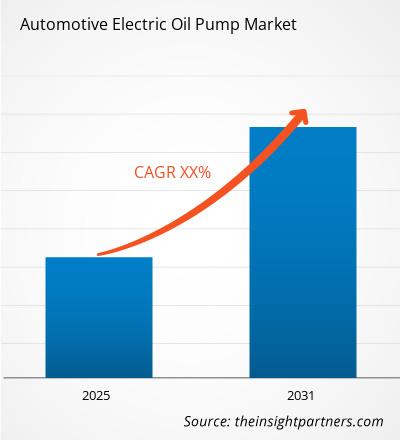
The global Automotive Electric Oil Pump market was valued at US$ 2.85 billion in 2025 and is expected to reach US$ 10.23 billion by 2034; it is estimated to record a CAGR of 15.26% during 2026-2034.
Automotive Electric Oil Pump Market Assessment and Insights
- North America: North America accounted for an estimated 29–33% share in 2025 and is anticipated to register a CAGR between 16.8–17.5% during 2026–2034. Strong electric vehicle production, technological innovation, and investments by Tier 1 automotive suppliers continue supporting sustained market expansion.
- US: The United States represented approximately 76–80% of the North American market in 2025 and is expected to grow at a CAGR between 16.9–17.6% through 2034, driven by increasing hybrid vehicle adoption, domestic EV manufacturing investments, and expanding automotive electronics production.
- Europe: Europe held an estimated 27–31% share in 2025 and is projected to expand at a CAGR between 16.5–17.3% during the forecast period. Germany leads regional demand, followed by France, the United Kingdom, Italy, and Spain owing to strong automotive manufacturing capabilities and aggressive vehicle electrification strategies.
- Asia Pacific: Asia Pacific accounted for approximately 35–39% share in 2025 and is anticipated to record the fastest CAGR between 18.2–18.9% from 2026 to 2034. China, Japan, South Korea, and India remain the principal manufacturing hubs benefiting from expanding electric vehicle production and supportive industrial policies.
- Largest Segment: Transmission Oil Pump remained the leading application segment with an estimated 42–46% market share in 2025 and is expected to grow at a CAGR between 17.1–17.8%, supported by increasing adoption of automatic transmissions and electrified drivetrain architectures.
- High Growth Segment: Battery Electric Vehicle is projected to be the fastest-growing segment with an estimated 31–35% market share in 2025 and a CAGR between 18.8–19.5% through 2034, driven by accelerating global battery electric vehicle production and continuous investments in electric mobility.
- Key companies analyzed in detail: AISIN Corporation, Hitachi, Ltd., Johnson Electric Holdings Limited, MAHLE GmbH, Mikuni Corporation, Mitsubishi Electric Corporation, Nidec Corporation, Rheinmetall AG, Robert Bosch GmbH, Valeo SE
Source: The Insight Partners' analysis based on proprietary research, government publications, company annual reports, investor presentations, industry databases, and expert interviews.
Development of the automotive electric oil pump industry has been seen in parallel with the growth of vehicle electrification and increased use of electronically controlled lubrication systems. Traditional mechanical oil pumps have increasingly been replaced with the electric variety which is able to produce variable flow regardless of engine speed in order to optimize performance and efficiency of hybrid, plug-in hybrid, and all-electric vehicles. Continuous innovations in the area of small motors, electronic control units, and intelligent cooling systems have additionally fueled the use of products within this space.
In the future, continued investment in the development of electric vehicles, semiconductors, and intelligent drives is likely to change competitive landscape within the global market for automotive electric oil pumps. Companies are concentrating efforts on producing lightweight products and developing energy efficient solutions based on electronically controlled systems which will contribute to the improvement of vehicle reliability and decrease of emissions. Increasing production of automotive equipment in Asia Pacific, localization policies, and environmental regulations are likely to generate good prospects for existing players and newcomers.
Automotive Electric Oil Pump Market Report Scope
| Report Attribute | Details |
|---|---|
| Market size in 2025 | US$ 2.85 Billion |
| Market Size by 2034 | US$ 10.23 Billion |
| Global CAGR (2026 - 2034) | 15.26% |
| Historical Data | 2021-2024 |
| Forecast period | 2026-2034 |
Automotive Electric Oil Pump Market Analysis
The growth in automotive electric oil pump market has been driven by the increasing electrification of automotive powertrains, rising fuel economy regulations, and rising use of electronically controlled lubrication systems in both passenger and commercial vehicles. Electric oil pumps help achieve lubrication independent of the engine speed, increase the efficiency of the transmission system, minimize mechanical losses, and enable start-stop features in hybrid vehicles. Rising investments in electric vehicles and advanced transmissions technology have been boosting the demand in OEMs, Tier 1 suppliers, motor producers, semiconductor vendors, and electronic control systems.
There has been a greater level of integration of the value chain in the automotive electric oil pump market due to increased collaboration between the automakers and component manufacturers to design compact, light-weighted, and energy efficient lubrication systems. There have been improvements in brushless DC motors, precision gears, electronic control system, and thermal management system, which have improved efficiency while lowering the vehicle emissions. There has been an increase in localization of the electric vehicle production and increasing capacity of the electrified drivetrain.
An analysis of the automotive electric oil pump market reveals that there is increased competition as global automotive component suppliers concentrate on innovation, production capabilities, and partnership. Some of the top companies in the automotive industry are continuing their investments in pump products that are electronically controlled and suitable for both hybrid and battery electric automobiles. This includes companies like AISIN Corporation, Robert Bosch GmbH, MAHLE GmbH, Hitachi, Ltd., Mitsubishi Electric Corporation, Nidec Corporation, Johnson Electric Holdings Limited, Mikuni Corporation, Rheinmetall AG, and Valeo SE.
Capital is still being invested in the expansion of the electric mobility supply chain, local production capacity, and advanced manufacturing equipment. In order to guarantee the acquisition of vital electrical drive train components, as well as increase product reliability and lower production costs, automobile manufacturers are developing partnerships with component makers. The use of engineering computer-aided design programs and automation systems is playing a big part in making the business competitive as the world prepares for more demand in electric automobiles.
● REPORT CUSTOMIZATION
Tailor This Report To Align With Your Specific Business Requirements
This report can be customized to align precisely with your business objectives, scope, and target markets. Customization options include tailored segmentation, geography, competitive analysis, and strategic insights to support informed decision-making.
Customize This Report →WHAT YOU CAN ADJUST
- ● Segmentations
- ● Geography
- ● Competitive Analysis
- ● Language Preferences
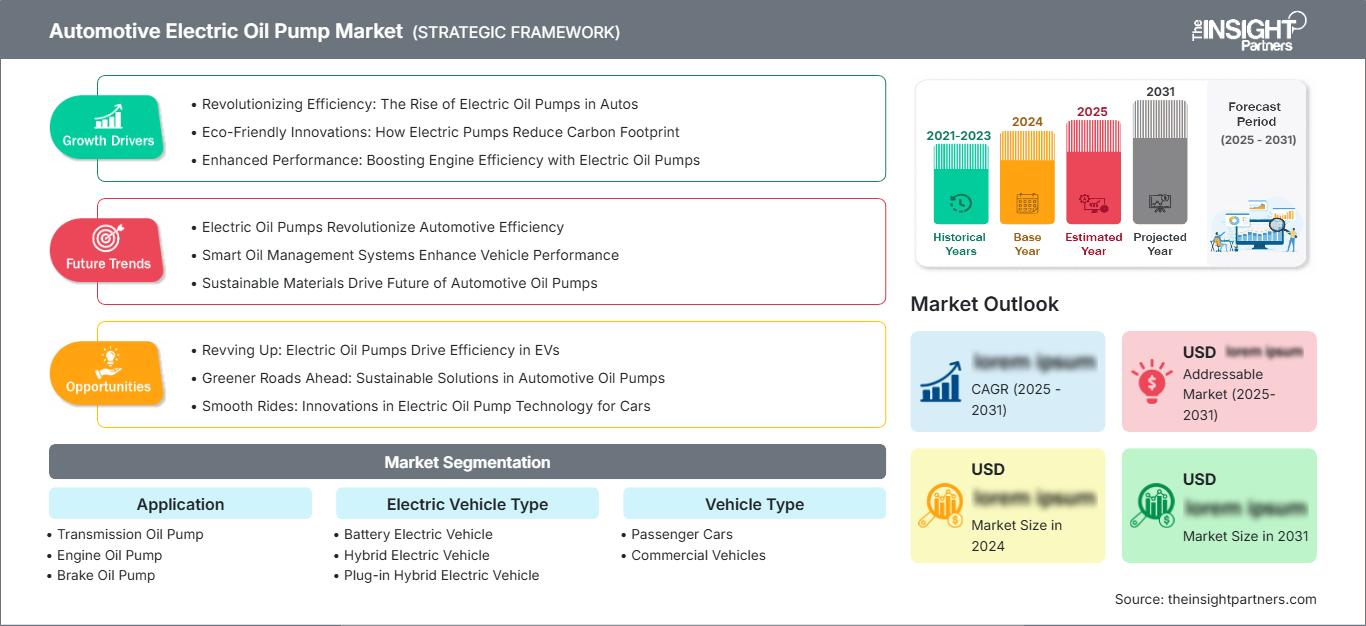
Automotive Electric Oil Pump Market: Strategic Insights
Regional Insights
North America Automotive Electric Oil Pump Market
North America accounted for an estimated 29–33% of the global market in 2025 and is projected to register a CAGR of 16.8–17.5% through 2034. The automotive electric oil pump market share in the region continues to expand with increasing production of electric and hybrid vehicles, growing investments in advanced transmission technologies, and strong research activities supporting intelligent drivetrain systems. Government incentives encouraging vehicle electrification and domestic battery manufacturing are strengthening regional demand for electronically controlled lubrication components.
The United States, Canada, and Mexico collectively support a well-established automotive manufacturing ecosystem with strong supplier networks and advanced production capabilities. Continued investment in electric vehicle assembly plants, semiconductor manufacturing, and intelligent mobility technologies is encouraging broader adoption of electric oil pumps across passenger and commercial vehicle applications while improving regional supply chain resilience.
U.S. Automotive Electric Oil Pump Market
In 2025, the U.S. accounted for around 76%-80% of the market share of North America and is expected to grow at a CAGR of 16.9%-17.6% over the forecast period. The increasing domestic production of battery electric and hybrid vehicles along with the rising investments of global automobile companies is fueling demand for advanced technology of electric oil pumps. The high rate of installation of automatic transmission and electrification is driving the market growth.
The major automotive companies and Tier 1 suppliers are increasing their manufacturing and engineering capacities in the country. The increased utilization of intelligent thermal management systems, software powertrain control, and advanced vehicle electronics is generating demand for advanced electric oil pumps that are capable of enhancing drivetrain efficiency.
Europe Automotive Electric Oil Pump Market
In 2025, Europe represented around 27-31% of the worldwide market share and is estimated to grow with a CAGR of 16.5-17.3% up until 2034. Germany continues to be the leading region with respect to the market because of its robust automotive manufacturing capabilities and dominance in the manufacturing of premium vehicles. UK continues making significant investments into electric vehicle manufacturing and battery technology, whereas France, Italy, and Spain are improving their domestic efforts to electrify their economy using government-funded industrial development programs.
The German automakers continue innovating in the domain of software-driven powertrain and highly efficient transmission system which needs intelligent lubrication technology. UK continues growing in localization of EV components manufacturing, while France, Italy, and Spain are growing in electronics manufacturing and hybrid vehicles assembling. These developments together lead to the growing demand for electric oil pumps in Europe.
APAC Automotive Electric Oil Pump Market
Asia Pacific accounted for approximately 35–39% of the global market in 2025 and is expected to register the fastest CAGR of 18.2–18.9% through 2034. China remains the regional leader, followed by Japan, South Korea, and India, supported by strong electric vehicle manufacturing capabilities and expanding automotive supply chains.
Government incentives, expanding battery manufacturing capacity, and rising investments in advanced automotive electronics continue strengthening demand for electric oil pumps throughout the region. Growing exports of electrified vehicles further reinforce Asia Pacific's leadership position.
Middle East & Africa Automotive Electric Oil Pump Market
The Middle East & Africa market is projected to expand at a CAGR of 15.2–15.9% during 2026–2034. Saudi Arabia, the United Arab Emirates, and South Africa continue investing in automotive manufacturing diversification while supporting gradual adoption of electric mobility and advanced vehicle technologies.
Increasing infrastructure investment, industrial diversification programs, and growing interest in sustainable transportation are encouraging wider deployment of electrified vehicle technologies across the region. Although adoption remains comparatively lower than other major markets, long-term government initiatives are expected to support steady market growth.
Segmentation Analysis
Application
The Application segment represents the largest revenue contributor within the automotive electric oil pump market and is expected to expand at a CAGR of 17.2–18.0% between 2026 and 2034. Increasing adoption of electric lubrication systems across transmissions, engines, and braking systems supports long-term expansion. The automotive electric oil pump market scope continues expanding as manufacturers develop application-specific pumps capable of improving efficiency while reducing parasitic energy losses across multiple drivetrain configurations.
- Transmission Oil Pump – Widely adopted in automatic transmissions, dual-clutch systems, and electrified drivetrains where independent lubrication improves transmission durability, efficiency, and smoother gear shifting under varying operating conditions.
- Engine Oil Pump – Continues supporting hybrid engines requiring variable lubrication independent of engine speed while improving fuel economy, reducing emissions, and ensuring optimized lubrication during start-stop operation.
- Brake Oil Pump – Increasingly integrated into brake-by-wire and regenerative braking systems to provide consistent hydraulic pressure, enhance braking response, and improve vehicle safety within advanced electric mobility platforms.
Electric Vehicle Type
The Electric Vehicle Type segment is projected to register the highest CAGR of 18.6–19.4% through 2034 as global electrification accelerates. Continuous investments in battery electric vehicles and hybrid technologies require highly efficient oil circulation systems that operate independently from conventional engine-driven mechanisms.
- Battery Electric Vehicle – Represents rapidly increasing demand because electric drivetrains require dedicated cooling and lubrication systems supporting e-axles, reduction gearboxes, and thermal management applications.
- Hybrid Electric Vehicle – Maintains strong adoption owing to simultaneous operation of electric motors and internal combustion engines requiring flexible lubrication under varying operating conditions.
- Plug-in Hybrid Electric Vehicle – Continues expanding as manufacturers develop longer electric driving ranges while maintaining combustion engine capability, creating greater demand for electronically controlled lubrication systems.
Opportunity Snapshot
| Electric Vehicle Type | Revenue Contribution | Trend Tag | Adoption Stage |
|---|---|---|---|
| Battery Electric Vehicle | High | E-Axle Cooling | Scaling |
| Hybrid Electric Vehicle | High | Hybrid Drivetrain | Mature |
| Plug-in Hybrid Electric Vehicle | Medium | Thermal Control | Scaling |
Automotive Electric Oil Pump Market Growth Drivers and Impact Analysis
Rising Production of Electric and Hybrid Vehicles
Increasing use of battery electric vehicles, hybrid electric vehicles, and plug-in hybrid electric vehicles continues to create new demands on the lubrication systems of automotive manufacturing on a global scale. Unlike mechanical oil pumps used in internal combustion engines, electric oil pumps deliver precise control of oil distribution that is not dependent on engine speed, thus increasing the efficiency of drivetrains. Policies aimed at the development of vehicle electrification in North America, Europe, China, Japan, and South Korea encourage automotive makers to incorporate electronically controlled lubrication systems into their future vehicle platforms. Increasing investments in manufacturing plants producing only electric vehicles and batteries also increase the demand for efficient oil pumps to be used with electric drive units and transmissions, among other systems.
Increasing Demand for Energy-Efficient Powertrain Technologies
Car makers have been emphasizing the importance of efficiency within the drivetrain in order to satisfy tougher standards set up with regard to fuel efficiency and emissions around the world. The use of electric oil pumps allows variable speed lubrication which is based on optimizing oil flows according to driving conditions and not on the number of revolutions of the engine, thus saving unnecessary energy. More efficient transmissions, start-stop mechanisms and hybrid drive systems rely more and more on electronically-controlled lubrication for greater efficiency and durability. The development of light weight pumps, brushless electric motors, electronic controllers and hydraulic design will lead to saving electrical energy.
Expansion of Integrated Thermal Management Systems
Modern electric vehicles require sophisticated thermal management solutions to maintain batteries, electric motors, power electronics, and transmissions within optimal operating temperatures. Electric oil pumps have become essential components supporting these integrated cooling architectures because they provide accurate lubricant circulation regardless of vehicle operating conditions. Increasing battery capacities, higher charging speeds, and more powerful electric drive systems continue raising thermal management requirements across the automotive industry. Manufacturers increasingly integrate electric pumps into centralized thermal management platforms that simultaneously support multiple vehicle subsystems. This evolution encourages suppliers to develop compact, high-efficiency, electronically controlled pump technologies capable of delivering higher reliability, reduced energy consumption, and improved vehicle safety throughout increasingly complex electric vehicle architectures.
Automotive Electric Oil Pump Market Future Trends
Software-Controlled Intelligent Lubrication Systems
Automotive manufacturers are increasingly integrating software-defined vehicle architectures with intelligent lubrication management systems capable of continuously adjusting pump performance according to driving conditions. The automotive electric oil pump market trends increasingly reflect demand for predictive control algorithms, integrated electronic control units, and vehicle-wide communication networks that improve energy efficiency while extending drivetrain durability. Artificial intelligence, digital diagnostics, and over-the-air software updates are expected to enhance predictive maintenance capabilities, enabling manufacturers to optimize lubrication performance throughout the vehicle lifecycle while supporting future autonomous and connected mobility platforms.
Higher Integration with Electric Drive Modules
Vehicle manufacturers are progressively integrating electric oil pumps directly into e-axles, electric drive units, and compact transmission assemblies to reduce packaging requirements while improving system efficiency. Future vehicle platforms are expected to utilize multifunctional thermal management systems combining lubrication, cooling, and electronic control within highly integrated modules. This approach reduces component count, minimizes wiring complexity, improves manufacturing efficiency, and supports lightweight vehicle development. Continued innovation in integrated drive systems will encourage suppliers to design compact, high-performance pump technologies capable of supporting increasingly sophisticated electrified powertrain architectures.
Automotive Electric Oil Pump Market Opportunities
Expansion of Localized EV Component Manufacturing
Global automotive manufacturers continue investing heavily in localized production facilities for batteries, electric motors, power electronics, and drivetrain systems across North America, Europe, and Asia Pacific. These investments create significant opportunities for regional suppliers producing electric oil pumps, electronic controllers, precision motors, and thermal management components. The Automotive electric oil pump market Forecasts indicate that localized sourcing strategies will reduce supply chain risks while improving production flexibility and lowering logistics costs. Companies capable of establishing regional manufacturing operations, strategic partnerships, and vertically integrated production capabilities are expected to strengthen long-term competitiveness while supporting government localization initiatives and expanding electrified vehicle production worldwide.
Development of Next-Generation Commercial Electric Mobility
Commercial vehicle electrification remains at an earlier stage than passenger vehicle adoption, creating substantial long-term investment opportunities for electric oil pump manufacturers. Heavy-duty trucks, buses, delivery fleets, and construction vehicles require highly durable lubrication systems capable of supporting demanding operating conditions and extended service intervals. Increasing electrification of logistics fleets, supported by government decarbonization policies and fleet sustainability targets, is expected to accelerate demand for advanced electric lubrication technologies. Manufacturers developing heavy-duty pump solutions with enhanced durability, intelligent monitoring, and improved thermal efficiency are well positioned to capitalize on this emerging growth opportunity across global commercial transportation markets.
Frequently Asked Questions

- Comprehensive Market Sizing and Forecast Analysis
- Detailed Segmentation Analysis
- In-Depth Market Dynamics Assessment
- Regional and Country-Level Insights
- Competitive Landscape and Company Benchmarking
- Strategic Business Intelligence
Recent Reports
Testimonials

The Insight Partners provided valuable market intelligence that supported our global go-to-market strategy. Their team was professional, responsive, and attentive to our feedback, providing thoughtful analysis and helpful methodological clarifications throughout the project.
Junmo Kim Chief Financial Officer (CFO), Enertech Co., Ltd.
The Insight Partners' SCADA System Market report is comprehensive, with valuable insights on current trends and future forecasts. The team was highly professional, responsive, and supportive throughout. We are very satisfied and highly recommend their services.
RAN KEDEM Partner, Reali Technologies LTDs
I requested a report on a very specific software market and the team produced the report in a few days. The information was very relevant and well presented. I then requested some changes and additions to the report. The team was again very responsive and I got the final report in less than a week.
JEAN-HERVE JENN Chairman, Future Analytica
We worked with The Insight Partners for an important market study and forecast. They gave us clear insights into opportunities and risks, which helped shape our plans. Their research was easy to use and based on solid data. It helped us make smart, confident decisions. We highly recommend them.
PIYUSH NAGPAL Sr. Vice President, High Beam Global
The Insight Partners delivered insightful, well-structured market research with strong domain expertise. Their team was professional and responsive throughout. The user-friendly website made accessing industry reports seamless. We highly recommend them for reliable, high-quality research services
YUKIHIKO ADACHI CEO, Deep Blue, LLC.
This is the first time I have purchased a market report from The Insight Partners.While I was unsure at first, I visited their web site and felt more comfortable to take the risk and purchase a market report.I am completely satisfied with the quality of the report and customer service. I had several questions and comments with the initial report, but after a couple of dialogs over email with their analyst I believe I have a report that I can use as input to our strategic planning process.Thank you so much for taking the extra time and making this a positive experience.I will definitely recommend your service to others and you will be my first call when we need further market data.
JOHN SUZUKI President and Chief Executive Officer, Board Director, BK Technologies
I wish to appreciate your support and the professionalism you displayed in the course of attending to my request for information regarding to infectious disease IVD market in Nigeria. I appreciate your patience, your guidance, and the fact that you were willing to offer a discount, which eventually made it possible for us to close a deal. I look forward to engaging The Insight Partners in the future, all thanks to the impression you have created in me as a result of this first encounter.
DR CHIJIOKE ONYIA MANAGING DIRECTOR, PineCrest Healthcare Ltd.Reason to Buy
- Informed Decision-Making
- Understanding Market Dynamics
- Competitive Analysis
- Identifying Emerging Markets
- Customer Insights
- Market Forecasts
- Risk Mitigation
- Boosting Operational Efficiency
- Strategic Planning
- Investment Justification
- Tracking Industry Innovations
- Aligning with Regulatory Trends





 Get Free Sample for