
Automotive Emission Analyzer Market Growth, Trends & Forecast by 2034
Coverage: By Technology (Non-dispersive Infrared (NDIR), Fourier Transform Infrared (FTIR), Chemiluminescence Analyzer (CLA), Constant Volume Sampler (CVS), Condensation Particle Counter, Flame Ionization Detector, And Others); Type (Stationary, Portable); Application (Compliance Testing, Emission-based Maintenance and Control, General Testing and Tuning); End User (Automobile and Component Manufacturer, Automobile Service Factory, And Government Agency) , and Geography (North America, Europe, Asia Pacific, and South and Central America)
- Status : Data Released
- Report Code : TIPRE00007854
- Category : Automotive and Transportation
- No. of Pages : 150
- Available Report Formats :


- Last update date : August 12, 2026


2025 Market Size
US$ 7.63 Bn
Base year value
2034 Forecast
US$ 11.86 Bn
Projected by 2034
CAGR 2026-2034
5.03 %
Growth rate
Addressable Market
US$ 88.47 Bn
(2026-2034)
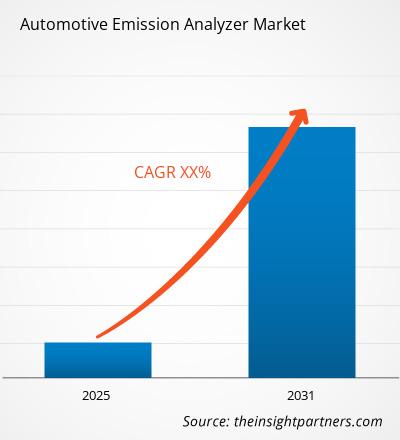
The automotive emission analyzer market is projected to grow from US$ 7.63 Billion in 2025 to US$ 11.86 Billion by 2034, registering a CAGR of 5.03 % during 2026–2034. Demand is supported by tighter emission inspection programs, multi-gas measurement requirements, and wider use of diagnostic equipment across vehicle manufacturing, service workshops, regulatory laboratories, and government-operated compliance networks.
North America remains a high-value market because state inspection programs, federal emission thresholds, and fleet maintenance requirements support recurring analyzer demand. The automotive emission analyzer market size in the region is reinforced by portable diagnostic adoption, workshop upgrades, and OEM test-bench investment, with growth expected to remain steady as gasoline, diesel, hybrid, and heavy-duty vehicle testing requirements become more data-driven.
Automotive Emission Analyzer Market Assessment and Insights
- North America: Accounted for an estimated 25–28% share in 2025 and is expected to grow at a CAGR of 4.6–5.2% during 2026–2034, supported by inspection programs, fleet testing, and analyzer replacement cycles.
- US: Represented nearly 78–82% of North America demand in 2025 and is projected to expand at a CAGR of 4.5–5.1% through 2034.
- Europe: Held an estimated 29–32% share in 2025 and is forecast to grow at 4.7–5.3%, led by Germany, the UK, France, Italy, and Spain.
- Asia Pacific: Captured about 30–34% share in 2025 and is projected to grow at 5.6–6.3%, led by China, Japan, South Korea, India, and Australia.
- Largest Segment: Stationary held 54–58% share in 2025 and is expected to expand at 4.4–5.0% during 2026–2034.
- High Growth Segment: Portable held 42–46% share in 2025 and is expected to grow at 5.8–6.5% through 2034.
- Key companies analyzed in detail: Atmoservice; E Instruments International, LLC; ECOM America Ltd.; Eco-Rental Solutions LLC; Enerac Inc.; Eurotron Instruments UK Ltd.; Fuji Electric Co., Ltd.; Keika Ventures, LLC; Pine Environmental Services, Inc.; HORIBA, Ltd.; AVL List GmbH; Robert Bosch GmbH.
Source: The Insight Partners' analysis based on proprietary research, government publications, company annual reports, investor presentations, industry databases, and expert interviews.
Markets have transitioned from mere exhaust gas measurement to digital connectivity, incorporating non-dispersive infrared sensors, chemiluminescence, particulates and reporting via software. Inspection organizations require reliable test results, whereas workshops require fast diagnostic systems for multi-fuel fleets. Manufacturing plants also make use of analyzer systems to ensure conformity, calibrating engines and conducting quality control. Thus, a well-balanced demand base exists in terms of regulatory requirements, after-market applications and original equipment manufacture.
Future developments in this market will be driven by the need for hybrid diagnostics, field portable analysis and stricter standards of inspections in developing nations. Analyzer manufacturers will probably look into ensuring better calibration, wireless data transmission and lower downtime at test centers. With the need to upgrade compliance documentation by regulatory organizations, cloud-based reporting and a tamper-proof measuring system will be key acquisition criteria.
Automotive Emission Analyzer Market Report Scope
| Report Attribute | Details |
|---|---|
| Market size in 2025 | US$ 7.63 Billion |
| Market Size by 2034 | US$ 11.86 Billion |
| Global CAGR (2026 - 2034) | 5.03% |
| Historical Data | 2021-2024 |
| Forecast period | 2026-2034 |
Automotive Emission Analyzer Market Analysis
The market growth is driven by inspection mandates, aging internal combustion vehicle fleets, and increasing demand for accurate measurement of CO, CO₂, HC, NOx, oxygen, smoke opacity, and particulate matter. Service centers use analyzers to diagnose inefficient combustion and support vehicle maintenance, while government laboratories and OEMs rely on advanced systems to validate compliance with increasingly stringent emission standards. The Automotive Emission Analyzer Market Report highlights that rising environmental regulations, periodic vehicle inspection programs, and growing awareness of air quality are further supporting demand for emission testing equipment across both developed and emerging markets.
The value chain includes gas sensors, sampling systems, calibration gases, software platforms, rental services, and technical maintenance. Supply dynamics are shaped by sensor accuracy, certification requirements, and the need for reliable after-sales support. Buyers increasingly prefer analyzers that combine low maintenance, fast warm-up, automated reporting, and compatibility with both gasoline and diesel testing protocols.
The automotive emission analyzer market analysis has shown that the major players competing on account of the accuracy of measurements, their knowledge about the regulations and the range of products include HORIBA, Ltd., AVL List GmbH, Robert Bosch GmbH, Fuji Electric Co., Ltd., ECOM America Ltd., and Enerac Inc. The companies providing access through rental, distribution, service and specialized instrumentation include E Instruments International, LLC, Atmoservice, Eco-Rental Solutions LLC, Eurotron Instruments UK Ltd., Keika Ventures, LLC, and Pine Environmental Services, Inc.
Capital is currently flowing into portable analyzers, interconnected inspection stations, and instruments able to perform hybrid powertrain testing. The suppliers with certified calibration capabilities and local service coverage have more advantages, as analyzer downtime has a direct impact on the efficiency of the inspection process.
● REPORT CUSTOMIZATION
Tailor This Report To Align With Your Specific Business Requirements
This report can be customized to align precisely with your business objectives, scope, and target markets. Customization options include tailored segmentation, geography, competitive analysis, and strategic insights to support informed decision-making.
Customize This Report →WHAT YOU CAN ADJUST
- ● Segmentations
- ● Geography
- ● Competitive Analysis
- ● Language Preferences
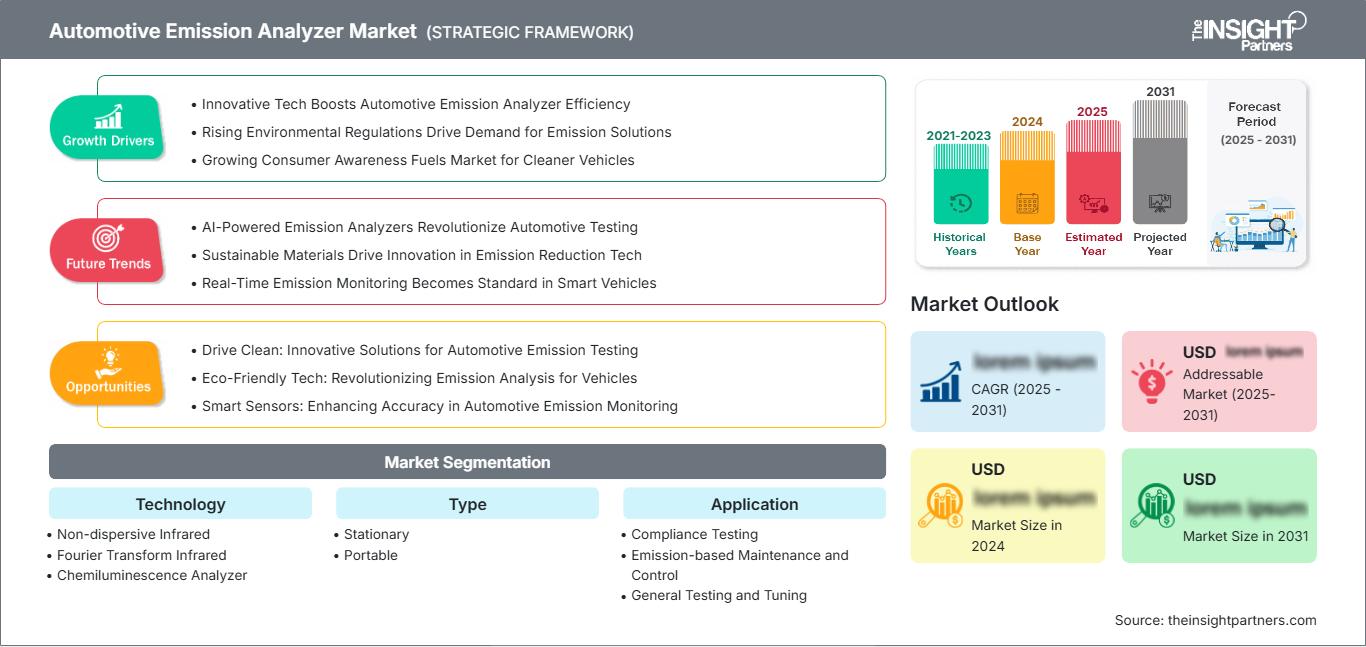
Automotive Emission Analyzer Market: Strategic Insights
Regional Insights
North America automotive emission analyzer market
North America accounted for 25–28% automotive emission analyzer market share in 2025 and is expected to grow at a 4.6–5.2% CAGR during 2026–2034. Demand is supported by inspection and maintenance programs, state-level enforcement, workshop modernization, and fleet operators that use analyzers for preventive maintenance and emissions documentation.
Replacement demand is important because older equipment must meet updated test procedures, digital reporting expectations, and multi-gas accuracy requirements. Portable units are gaining attention among mobile service providers and fleet garages, while stationary systems remain essential for centralized inspection lanes, OEM laboratories, and high-throughput testing locations.
U.S. automotive emission analyzer Market
The US represented 78–82% of North American demand in 2025 and is projected to grow at a 4.5–5.1% CAGR through 2034. Analyzers will continue to be bought because of state inspection services, large commercial truck checks, and requirements from workshops.
The presence of companies in the market is ensured due to their networks of distribution, rentals, and service centers, such as ECOM America Ltd., Enerac Inc., E Instruments International, LLC, Eco-Rental Solutions LLC, Pine Environmental Services, Inc., and other worldwide suppliers. The most needed analyzers are those that help in improving the work process of technicians and provide repeatable readings.
Europe automotive emission analyzer Market
Europe held 29–32% share in 2025 and is projected to grow at a 4.7–5.3% CAGR during 2026–2034. Germany excels in OEM test laboratories, component testing, and high-end vehicle design, whereas the UK ensures demand by virtue of periodic testing, service centers, and equipment purchasers independent of compliance.
France, Italy, and Spain make their contributions via inspection systems, repairs, and fleet management processes. Euro emissions regulation, urban air quality initiatives, and hybrid vehicle expansion are driving up the requirement for analyzers that exhibit repeatability and have traceable calibration and reporting capabilities.
APAC automotive emission analyzer Market
APAC held 30–34% share in 2025 and is expected to grow at a 5.6–6.3% CAGR during 2026–2034. China leads regional volume because of vehicle parc size, manufacturing scale, and emission enforcement, while Japan and South Korea add advanced testing demand through OEM and supplier laboratories.
India and Australia support expansion through inspection reform, fleet servicing, and air quality initiatives. Localized manufacturing, lower-cost portable analyzers, and stricter urban emission policies are expanding adoption beyond large laboratories into workshops, roadside testing units, and regional inspection centers.
Middle East & Africa automotive emission analyzer Market
Middle East & Africa is expected to grow at a 4.9–5.6% CAGR during 2026–2034. Saudi Arabia and the UAE lead demand through vehicle inspection modernization, commercial fleet growth, and infrastructure-linked transport activity, while South Africa contributes through service networks and regulatory vehicle testing.
Harsh operating conditions, imported vehicle diversity, and expanding logistics fleets create demand for rugged analyzers with easy calibration and field support. Adoption remains smaller than in mature markets, but government-led inspection upgrades and industrial air quality priorities are creating incremental opportunities for portable and stationary testing systems.
Segmentation Analysis
Technology
The technology segment is expected to grow at a CAGR of 4.8–5.5% during 2026–2034. The automotive emission analyzer market scope includes technologies that measure gases, hydrocarbons, nitrogen oxides, flow dilution, and particulate emissions. Buyers select technologies based on regulatory protocol, pollutant target, sensitivity, test environment, and required certification level.
- Non-dispersive Infrared remains widely used for CO and CO2 measurement because it offers dependable readings, reasonable cost, and practical use in workshops, inspection lanes, and portable diagnostic instruments.
- Fourier Transform Infrared supports broader gas analysis by capturing multiple compounds in one measurement cycle, making it valuable for laboratories, OEM validation, and advanced engine development programs.
- The Chemiluminescence Analyzer is important for NOx measurement where regulatory accuracy is essential, especially in diesel engine testing, heavy-duty vehicle programs, and controlled laboratory environments.
- Constant Volume Sampler supports standardized dilution and sampling for certification-style testing, making it central to OEM laboratories, regulatory facilities, and high-precision emissions development programs.
- The Condensation Particle Counter measures ultrafine particle concentration and is increasingly relevant as regulations pay closer attention to particulate number limits from modern engines and aftertreatment systems.
- The Flame Ionization Detector measures hydrocarbons with high sensitivity, supporting engine calibration, fuel system diagnostics, and certification tests where hydrocarbon slip must be quantified accurately.
Type
The type segment is expected to grow at a CAGR of 4.9–5.6% during 2026–2034. Stationary systems dominate high-throughput inspection lanes and laboratories, while portable systems are expanding quickly as workshops, mobile technicians, fleet operators, and rental providers prioritize flexible deployment and rapid testing.
- Stationary analyzers remain preferred for centralized inspection centers, OEM labs, and government facilities because they offer stable operation, controlled sampling, and stronger alignment with repeatable compliance protocols.
- Portable analyzers are gaining adoption among mobile service teams, independent garages, and fleet maintenance units because they reduce testing delays and allow diagnostics closer to vehicle operating locations.
Application
The application segment is expected to grow at a CAGR of 4.7–5.4% during 2026–2034. Compliance testing remains essential, while maintenance-focused use is increasing as service centers rely on analyzer readings to diagnose fuel efficiency, aftertreatment performance, combustion quality, and recurring fault conditions.
- Compliance Testing generates steady demand because regulatory programs require traceable emission measurements, standardized procedures, and dependable records for passenger, commercial, gasoline, diesel, and hybrid vehicles.
- Emission-based Maintenance and Control is expanding as workshops use gas readings to identify combustion issues, catalytic converter degradation, exhaust leaks, and sensor problems before vehicles fail official tests.
- General Testing and Tuning supports garages, training centers, and tuning specialists that need practical exhaust data to improve drivability, engine performance, and repair verification after component replacement.
End User
The end user segment is expected to grow at a CAGR of 4.8–5.5% during 2026–2034. Automobile and component manufacturers require laboratory-grade systems, service factories need durable diagnostic tools, and government agencies procure certified analyzers for inspection programs, enforcement units, and public-sector testing facilities.
- Automobile and Component Manufacturer demand is linked to engine development, exhaust aftertreatment validation, production conformity, and supplier quality programs, where repeatable measurements support compliance and product release.
- Automobile Service Factory users value practical analyzers that support repair decisions, reduce retesting, and improve customer service by identifying emission faults before official inspection failure.
- Government Agency procurement is shaped by public inspection programs, roadside enforcement, laboratory modernization, and air-quality initiatives that require certified equipment and auditable reporting workflows.
Opportunity Snapshot
| Application | Revenue Contribution | Trend Tag | Adoption Stage |
| Compliance Testing | High | Digital Records | Mature |
| Emission-based Maintenance and Control | Medium | Fault Diagnostics | Scaling |
| General Testing and Tuning | Medium | Workshop Tools | Scaling |
Automotive Emission Analyzer Market Growth Drivers and Impact Analysis
Tighter vehicle emission inspection and compliance enforcement
In terms of structural drivers, the inspection program will continue to hold the most influence because government officials will require objective evidence to confirm that the on-road vehicles comply with the emission regulations. The demand for the analyzers increases as testing intervals increase, as inspections for heavy-duty vehicles become more rigorous, and as digital reporting systems reduce the margin of error from manual recording. This driver impacts both the stationary and portable analyzers as the former will require more throughput capacity, while the latter will require small-sized instruments.
Growth in service diagnostics for aging combustion fleets
There will continue to be many vehicles that use gasoline and diesel engines that will require maintenance in the projected timeline. It is necessary for workshops to have analyzers for checking how effective their catalytic converters are, problems related to fuel mixture, leaks in the exhaust, particulate matter emissions, and the performance of the aftertreatment system. It is especially applicable to the independent workshops and fleet maintenance centers.
Hybrid powertrain complexity and advanced pollutant measurement
Emission tests remain necessary for hybrid cars because the combustion engine operates occasionally and may exhibit varied emissions in cold start, load shift, and charging-related modes of operation. The sophisticated analyzers of several gases, hydrocarbons, NOx, and particles are useful in providing laboratories and testing centers with varied information on the varying emission profiles. This new application increases the need for FTIR, chemiluminescence, condensation particle counters, and computerized systems.
Automotive Emission Analyzer Market Future Trends
Connected analyzers and automated compliance reporting
The automotive emission analyzer market trends point toward connected instruments that automatically capture test results, calibration status, technician identity, and vehicle information. The use of digital documents reduces manual errors and helps in providing audit-ready inspection processes. Dashboarding systems linked to cloud services will assist in enabling fleet owners to compare the testing history of their vehicles and facilities. The suppliers offering certification for measuring accuracy, along with data exchange and diagnostics, will have the upper hand.
Portable field testing for fleets and roadside programs
There is an increased likelihood of portable analyzers gaining more traction as those in charge of fleets, enforcers, and service providers bring testing nearer to the vehicles being operated. There are reduced chances of downtime when there is a use of portable analyzers are used because they enable roadside testing and verification of repairs at the workshops without necessarily having to wait for scheduled testing slots at the testing centers.
Automotive Emission Analyzer Market Opportunities
Localized analyzer platforms for emerging inspection networks
Automotive emission analyzer market Forecasts highlight opportunities in countries with expanding periodic vehicle inspection and urban air-quality enforcement. Buyers in India, Southeast Asia, Latin America, and parts of the Middle East need reliable equipment at a practical ownership cost. Suppliers can capture demand through localized calibration support, rugged portable models, and training packages for inspection staff. Partnerships with service chains and government testing centers can reduce adoption barriers while building long-term recurring revenue from maintenance, software, and certification services.
Rental and calibration services for high-utilization users
The rental, leasing, and calibration-as-a-service business models provide a realistic solution to workshops, fleets, and labs requiring certified analyzers without heavy initial investments. Equipment downtime may result in losses in terms of inspection income; thus, fast equipment replacement, calibration schedule, and technical assistance are key factors for users. A specialist company should be able to distinguish itself by providing traceable calibration services, multi-brand solutions, and the availability of equipment.
Frequently Asked Questions

- Comprehensive Market Sizing and Forecast Analysis
- Detailed Segmentation Analysis
- In-Depth Market Dynamics Assessment
- Regional and Country-Level Insights
- Competitive Landscape and Company Benchmarking
- Strategic Business Intelligence
Recent Reports
Testimonials

The Insight Partners provided valuable market intelligence that supported our global go-to-market strategy. Their team was professional, responsive, and attentive to our feedback, providing thoughtful analysis and helpful methodological clarifications throughout the project.
Junmo Kim Chief Financial Officer (CFO), Enertech Co., Ltd.
The Insight Partners' SCADA System Market report is comprehensive, with valuable insights on current trends and future forecasts. The team was highly professional, responsive, and supportive throughout. We are very satisfied and highly recommend their services.
RAN KEDEM Partner, Reali Technologies LTDs
I requested a report on a very specific software market and the team produced the report in a few days. The information was very relevant and well presented. I then requested some changes and additions to the report. The team was again very responsive and I got the final report in less than a week.
JEAN-HERVE JENN Chairman, Future Analytica
We worked with The Insight Partners for an important market study and forecast. They gave us clear insights into opportunities and risks, which helped shape our plans. Their research was easy to use and based on solid data. It helped us make smart, confident decisions. We highly recommend them.
PIYUSH NAGPAL Sr. Vice President, High Beam Global
The Insight Partners delivered insightful, well-structured market research with strong domain expertise. Their team was professional and responsive throughout. The user-friendly website made accessing industry reports seamless. We highly recommend them for reliable, high-quality research services
YUKIHIKO ADACHI CEO, Deep Blue, LLC.
This is the first time I have purchased a market report from The Insight Partners.While I was unsure at first, I visited their web site and felt more comfortable to take the risk and purchase a market report.I am completely satisfied with the quality of the report and customer service. I had several questions and comments with the initial report, but after a couple of dialogs over email with their analyst I believe I have a report that I can use as input to our strategic planning process.Thank you so much for taking the extra time and making this a positive experience.I will definitely recommend your service to others and you will be my first call when we need further market data.
JOHN SUZUKI President and Chief Executive Officer, Board Director, BK Technologies
I wish to appreciate your support and the professionalism you displayed in the course of attending to my request for information regarding to infectious disease IVD market in Nigeria. I appreciate your patience, your guidance, and the fact that you were willing to offer a discount, which eventually made it possible for us to close a deal. I look forward to engaging The Insight Partners in the future, all thanks to the impression you have created in me as a result of this first encounter.
DR CHIJIOKE ONYIA MANAGING DIRECTOR, PineCrest Healthcare Ltd.Reason to Buy
- Informed Decision-Making
- Understanding Market Dynamics
- Competitive Analysis
- Identifying Emerging Markets
- Customer Insights
- Market Forecasts
- Risk Mitigation
- Boosting Operational Efficiency
- Strategic Planning
- Investment Justification
- Tracking Industry Innovations
- Aligning with Regulatory Trends





 Get Free Sample for