
Automotive Engine Air Filter Market Growth, Trends & Demand by 2034
Coverage: By Material Type (Paper, Cotton Gauze, Foam (Polyurethane), Others); Vehicle Type (Passenger Vehicle, Commercial Vehicle); Sales Channel (OEM, Aftermarket), and Geography (North America, Europe, Asia Pacific, and South and Central America)
- Status : Data Released
- Report Code : TIPRE00015988
- Category : Automotive and Transportation
- No. of Pages : 150
- Available Report Formats :


- Last update date : September 07, 2026


2025 Market Size
US$ 4.62 Bn
Base year value
2034 Forecast
US$ 8.02 Bn
Projected by 2034
CAGR 2026-2034
6.33 %
Growth rate
Addressable Market
US$ 57.23 Bn
(2026-2034)
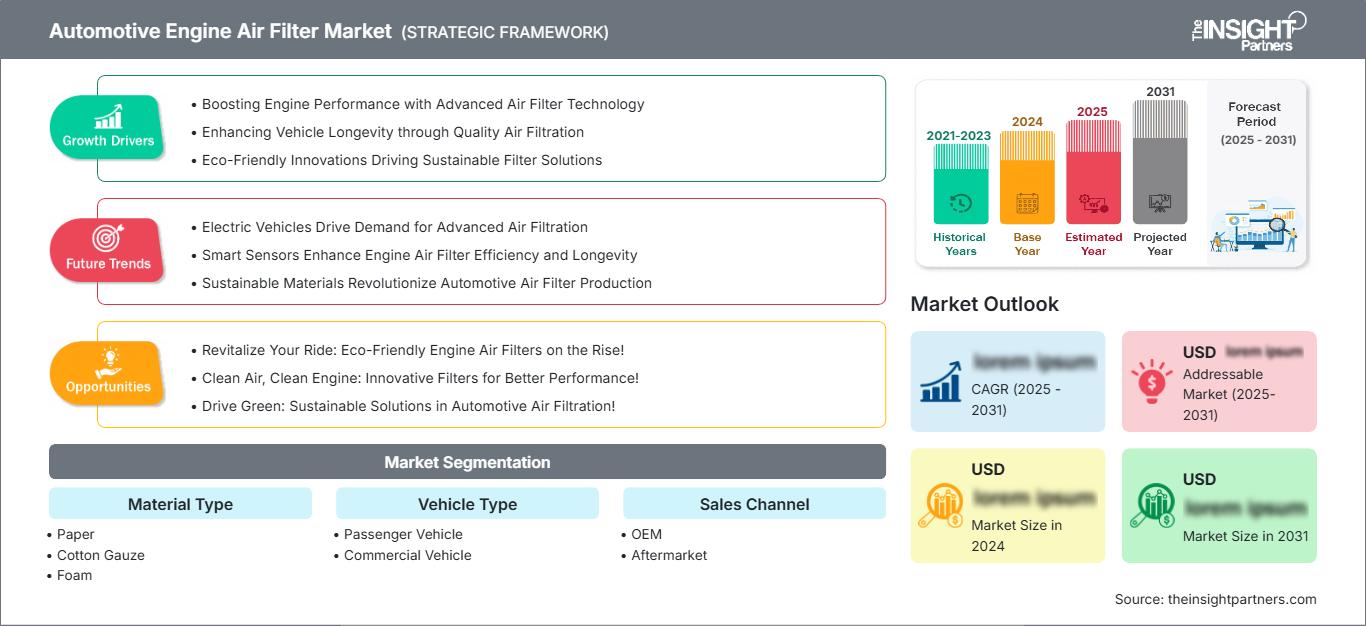
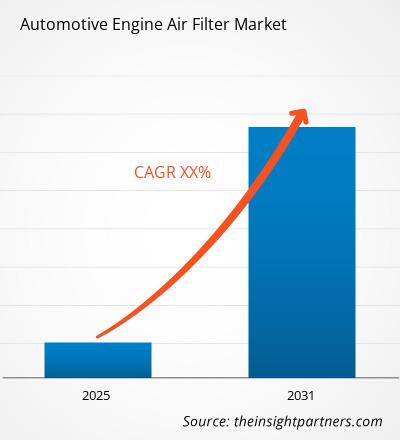
The automotive engine air filter market is projected to grow from US$ 4.62 Billion in 2025 to US$ 8.02 Billion by 2034, registering a CAGR of 6.33% during 2026–2034. Growth is supported by rising vehicle parc, stricter emission expectations, replacement-led aftermarket demand, and filtration upgrades that protect combustion engines, hybrid powertrains, and auxiliary intake systems from particulate contamination.
North America remains a resilient demand center as inspection culture, organized service networks, pickup and light truck ownership, and long average vehicle age support recurring filter replacement. The automotive engine air filter market size in the region is reinforced by aftermarket retail depth, commercial fleet maintenance, and OEM interest in higher-efficiency media, with growth expected to remain steady through 2034.
Automotive Engine Air Filter Market Assessment and Insights
- North America: Accounted for an estimated 25–29% share in 2025 and is expected to grow at a CAGR of 5.7–6.4% during 2026–2034, supported by aftermarket replacement cycles, high vehicle ownership, and fleet maintenance discipline.
- US: Represented nearly 78–82% of North America demand in 2025 and is projected to expand at a CAGR of 5.6–6.3% through 2034.
- Europe: Held an estimated 24–28% share in 2025 and is forecast to grow at 5.8–6.5%, led by Germany, the UK, France, Italy, and Spain.
- Asia Pacific: Captured about 34–38% share in 2025 and is projected to grow at 6.8–7.5%, led by China, India, Japan, South Korea, and Australia.
- Largest Segment: Paper held 55–59% share in 2025 and is expected to expand at 5.8–6.4% during 2026–2034.
- High Growth Segment: Aftermarket held 52–56% share in 2025 and is expected to grow at 6.7–7.4% through 2034.
- Key companies analyzed in detail: A. L. Filter; ALCO Filters Ltd.; Baldwin Filters, Inc.; Cummins Inc.; DENSO Corporation; Donaldson Company, Inc.; Fildex Filters Canada Corporation; Filtrak BrandT GmbH; MAHLE GmbH; MANN+HUMMEL International GmbH & Co. KG.
Source: The Insight Partners' analysis based on proprietary research, government publications, company annual reports, investor presentations, industry databases, and expert interviews.
The market has moved from basic pleated intake protection to engineered filtration media that maximize airflow efficiency, dust holding capabilities, and life expectancy. The balance between filter performance and engine breathing continues to play a role in OEMs, and the after-market suppliers differentiate themselves based on breadth of coverage, cross-referencing capability, and ease of packaging. Hybrid engines have not diminished the intake filtration need, as there are still combustion engines, range extender engines, and heat management systems to protect.
The future growth is likely to be highest in the Asia Pacific and structured aftermarket channels, where ownership, high levels of dust in the city, and the increased structure in the service network drive demand for replacements. Innovation in sustainable media, nanofibers, and better sealing techniques will fuel the premiumization trend. The regulatory pressure related to emissions and fuel economy will maintain the importance of filtration performance.
Automotive Engine Air Filter Market Report Scope
| Report Attribute | Details |
|---|---|
| Market size in 2025 | US$ 4.62 Billion |
| Market Size by 2034 | US$ 8.02 Billion |
| Global CAGR (2026 - 2034) | 6.33% |
| Historical Data | 2021-2024 |
| Forecast period | 2026-2034 |
Automotive Engine Air Filter Market Analysis
The automotive engine air filter market growth is driven by the direct link between clean intake air, combustion efficiency, engine durability, and emission control. Filters keep dust, pollen, soot, and other abrasives from contaminating cylinders to preserve pistons, valves, turbochargers, and sensors. Filter replacement intervals vary based on mileage, climate, usage, and maintenance discipline.
The value chain involves media manufacturers, filter manufacturers, OEM procurement departments, aftermarket distributors, retail chains, workshops, and fleet servicing companies. Media paper is economical, while gauze and foam filters cater to high-end reusable filters and rough terrain filters. The supply chain is impacted by cellulose costs, synthetic fibers availability, mold tools, SKUs, and local vehicle model availability.
The automotive engine air filter market analysis shows that MANN+HUMMEL International GmbH & Co. KG, MAHLE GmbH, Donaldson Company, Inc., DENSO Corporation, Cummins Inc., and Baldwin Filters, Inc. compete through OE relationships, filtration engineering, global catalogs, and commercial vehicle coverage. A. L. Filter, ALCO Filters Ltd., Fildex Filters Canada Corporation, and Filtrak BrandT GmbH strengthen regional specialization and aftermarket access.
Investment is moving toward longer-life filters, compact housings, low-pressure-drop media, recyclable materials, and digital catalog systems that reduce fitment errors. Strategic positioning depends on broad vehicle coverage, reliable cross-references, distributor availability, and the ability to support both combustion vehicles and hybrid platforms during the transition to lower-emission mobility.
● REPORT CUSTOMIZATION
Tailor This Report To Align With Your Specific Business Requirements
This report can be customized to align precisely with your business objectives, scope, and target markets. Customization options include tailored segmentation, geography, competitive analysis, and strategic insights to support informed decision-making.
Customize This Report →WHAT YOU CAN ADJUST
- ● Segmentations
- ● Geography
- ● Competitive Analysis
- ● Language Preferences
Automotive Engine Air Filter Market: Strategic Insights
Regional Insights
North America automotive engine air filter market
North America accounted for 25–29% automotive engine air filter market share in 2025 and is expected to grow at a 5.7–6.4% CAGR during 2026–2034. Demand is supported by high vehicle ownership, long replacement cycles for older cars, pickup and SUV use, and commercial fleets that prioritize preventive maintenance.
Dust exposure in construction, agriculture, logistics, and off-road applications raises replacement intensity. Organized retailers and service chains improve availability, while fleet software and maintenance reminders make filter replacement more consistent. OEM demand remains stable, but aftermarket channels create the larger recurring revenue opportunity.
U.S. automotive engine air filter Market
The US represented 78–82% of North American demand in 2025 and is projected to grow at a 5.6–6.3% CAGR through 2034. Large light truck, SUV, agricultural, and heavy-duty vehicle populations increase demand for durable filters with broad model coverage and quick distributor access.
Donaldson Company, Inc., Cummins Inc., Baldwin Filters, Inc., DENSO Corporation, and MANN+HUMMEL International GmbH & Co. KG have strong relevance through replacement products, OE supply, commercial vehicle servicing, and catalog depth. Workshop chains favor filters that reduce installation errors and support fast turnover.
Europe automotive engine air filter Market
Europe held 24–28% share in 2025 and is projected to grow at a 5.8–6.5% CAGR during 2026–2034. Germany leads through automotive production and supplier concentration, while the UK supports replacement demand through independent garages, fleet operators, and mature parts distribution.
France, Italy, and Spain contribute through passenger car service networks, commercial vehicle fleets, and urban emission policies that encourage proper maintenance. European buyers increasingly prefer filters with low pressure drop, reliable sealing, and sustainable material content as OEMs align filtration design with fuel efficiency and circularity goals.
APAC automotive engine air filter Market
APAC held 34–38% share in 2025 and is expected to grow at a 6.8–7.5% CAGR during 2026–2034. China leads regional volume through vehicle parc, domestic manufacturing, and e-commerce-supported aftermarket sales, while India is gaining from two-wheeler, passenger car, and commercial fleet expansion.
Japan and South Korea add advanced manufacturing and OE-grade quality expectations, while Australia supports severe-duty demand across mining, agriculture, and off-road applications. Rising dust exposure, urban congestion, and organized servicing make replacement behavior more consistent across the region.
Middle East & Africa automotive engine air filter Market
Middle East & Africa is expected to grow at a 5.2–6.0% CAGR during 2026–2034. Saudi Arabia and the UAE lead demand because desert dust, premium imports, logistics fleets, and construction equipment increase replacement frequency and filter performance requirements.
South Africa contributes through assembly, commercial vehicle servicing, mining, and agricultural applications. The rest of MEA adoption is supported by used vehicle imports and expanding aftermarket distribution. Harsh operating conditions make sealing quality and dust-holding capacity central purchasing criteria.
Segmentation Analysis
Material Type
The Material Type segment is expected to grow at a CAGR of 6.0–6.7% during 2026–2034. automotive engine air filter market scope includes paper, cotton gauze, and foam media, each serving different cost, airflow, service interval, and durability needs across passenger vehicles, commercial fleets, and severe-duty applications.
- Paper remains the largest material because it offers low cost, strong dust capture, easy disposal, and broad OEM acceptance for standard passenger and commercial vehicle intake systems.
- Cotton Gauze serves performance and reusable-filter applications where airflow, cleanability, and longer service life are valued, especially among enthusiasts, premium models, and selected aftermarket channels.
- Foam is important in off-road, agricultural, and dusty environments because it can hold larger contaminant loads and provide layered protection in severe operating conditions.
Vehicle Type
The Vehicle Type segment is expected to grow at a CAGR of 6.1–6.8% during 2026–2034. Passenger vehicles dominate volume because of large parc size, recurring maintenance, and standardized filter replacement, while commercial vehicles generate higher value per unit through severe-duty filters and shorter service intervals.
- Passenger Vehicle demand is linked to regular maintenance, fuel economy awareness, and service reminders that encourage timely replacement across sedans, hatchbacks, SUVs, crossovers, and hybrid models.
- Commercial Vehicle filters face higher dust loads, longer operating hours, and fleet uptime expectations, making durability, availability, and quick replacement important for logistics and industrial users.
Sales Channel
The Sales Channel segment is expected to grow at a CAGR of 6.3–7.0% during 2026–2034. OEM demand follows vehicle production cycles, while the aftermarket benefits from installed vehicle base expansion, replacement intervals, e-commerce catalogs, and workshop networks. Aftermarket momentum is especially strong where aging vehicles remain in use longer.
- OEM channels require validated fitment, engine-specific airflow calibration, durability testing, and reliable supply programs that align filter design with intake architecture and warranty expectations.
- Aftermarket channels drive recurring revenue through replacement cycles, catalog breadth, private labels, fleet accounts, and consumer awareness of how filtration affects performance and maintenance costs.
Opportunity Snapshot
| Sales Channel | Revenue Contribution | Trend Tag | Adoption Stage |
| OEM | Medium | Fitment Quality | Mature |
| Aftermarket | High | Replacement Cycle | Scaling |
Automotive Engine Air Filter Market Growth Drivers and Impact Analysis
Expanding vehicle parc strengthens replacement demand
Despite fluctuations in the production of new cars, the installed base of combustion and hybrid cars continues to demand repeat purchase of air filters due to their need for regular replacement. Air filters of engines are consumable products and tend to be less efficient as the level of dust increases on them; thus, the behavior of consumers becomes more significant than one-off sales of new cars. The effect is most pronounced in the aftermarket segment since old cars need servicing at dealerships on a regular basis. Fleets replace air filters to avoid problems such as low power, high fuel consumption, and engine wear.
Emission and fuel efficiency pressure raises filtration standards
Proper air intake ensures that the engines will operate at the desired air-to-fuel ratio and proper combustion. Engines are bound to perform poorly, consume more fuel, and produce excessive emissions when filters are clogged or damaged due to leaks. It means that regulations will favor the use of better filters with good sealing and regular replacement. In this case, filter makers will be making use of filters that can capture dirt without interfering with the flow of air, while service suppliers are advocating for the replacement of filters.
Harsh-duty environments increase filter replacement intensity
The air pollution levels in the case of such vehicles used in construction, agricultural, mining, logistics, desert, and off-road applications tend to be high compared to those experienced by city passenger cars. Such filters have to work harder due to the increased dust loading capacity, and the engine operates in conditions of heavy duty, heat, vibration, and extended running time. The result is an increase in the commercial significance of foam, heavy-duty paper, and multistage filters with greater dust holding capacity.
Automotive Engine Air Filter Market Future Trends
Sustainable and bio-based filtration media
The automotive engine air filter market trends point toward media that reduce fossil-based resin content, improve recyclability, and maintain filtration performance under varied humidity and temperature conditions. Lignin-based impregnation, biodegradable components, and sustainable packaging are being tried by suppliers as OEMs integrate sustainability requirements for service parts. This move is unlikely to displace performance specifications but could certainly influence component selection among those who wish for a reduced environmental footprint. The earliest adopters will be in Europe, followed by global aftermarket premium lines.
Nanofiber layers for longer service intervals
Nanofiber filter media will become important in cases where fleet customers and commercial users need to extend maintenance intervals without sacrificing engine protection. The fine-fiber structure can help in trapping particles without reducing air flow, provided that they are engineered well. These filters will be important for heavy-duty trucks, construction equipment, and dusty regions, where downtime means loss of money. It will all come down to price tolerance and demonstration of proof in the field, along with the distributors' training.
Automotive Engine Air Filter Market Opportunities
Premium aftermarket programs for aging vehicles
The automotive engine air filter market Forecasts highlight an opportunity in aging vehicle fleets where owners seek affordable maintenance that protects engine life. Suppliers can create value through improved fitment information, service packages, private labeling programs, and replacement recommendations. Workshops can make use of filter inspection services to boost preventive maintenance rates and protect customers from expensive repair charges. There is a strong potential in this case in North America, Europe, India, and Latin America due to aging cars and a highly developed aftermarket network in those markets.
Severe-duty filters for dust-intensive regions
Dusty environments present an opportunity to market filters that have enhanced seals, layers of filtration medium, use pre-filters, and have a high capacity for contaminants. Mining industries, construction companies, agricultural enterprises, deserts, and rural logistics fleets need filters that work efficiently in dusty environments. They can do so by ensuring that the products they provide have been tested in such environments, are available locally, and that their technicians are knowledgeable about the effects of filtration on the efficiency of the engines and fuel consumption.
Frequently Asked Questions

- Comprehensive Market Sizing and Forecast Analysis
- Detailed Segmentation Analysis
- In-Depth Market Dynamics Assessment
- Regional and Country-Level Insights
- Competitive Landscape and Company Benchmarking
- Strategic Business Intelligence
Recent Reports
Testimonials

The Insight Partners' SCADA System Market report is comprehensive, with valuable insights on current trends and future forecasts. The team was highly professional, responsive, and supportive throughout. We are very satisfied and highly recommend their services.
RAN KEDEM Partner, Reali Technologies LTDs
I requested a report on a very specific software market and the team produced the report in a few days. The information was very relevant and well presented. I then requested some changes and additions to the report. The team was again very responsive and I got the final report in less than a week.
JEAN-HERVE JENN Chairman, Future Analytica
We worked with The Insight Partners for an important market study and forecast. They gave us clear insights into opportunities and risks, which helped shape our plans. Their research was easy to use and based on solid data. It helped us make smart, confident decisions. We highly recommend them.
PIYUSH NAGPAL Sr. Vice President, High Beam Global
The Insight Partners delivered insightful, well-structured market research with strong domain expertise. Their team was professional and responsive throughout. The user-friendly website made accessing industry reports seamless. We highly recommend them for reliable, high-quality research services
YUKIHIKO ADACHI CEO, Deep Blue, LLC.
This is the first time I have purchased a market report from The Insight Partners.While I was unsure at first, I visited their web site and felt more comfortable to take the risk and purchase a market report.I am completely satisfied with the quality of the report and customer service. I had several questions and comments with the initial report, but after a couple of dialogs over email with their analyst I believe I have a report that I can use as input to our strategic planning process.Thank you so much for taking the extra time and making this a positive experience.I will definitely recommend your service to others and you will be my first call when we need further market data.
JOHN SUZUKI President and Chief Executive Officer, Board Director, BK Technologies
I wish to appreciate your support and the professionalism you displayed in the course of attending to my request for information regarding to infectious disease IVD market in Nigeria. I appreciate your patience, your guidance, and the fact that you were willing to offer a discount, which eventually made it possible for us to close a deal. I look forward to engaging The Insight Partners in the future, all thanks to the impression you have created in me as a result of this first encounter.
DR CHIJIOKE ONYIA MANAGING DIRECTOR, PineCrest Healthcare Ltd.Reason to Buy
- Informed Decision-Making
- Understanding Market Dynamics
- Competitive Analysis
- Identifying Emerging Markets
- Customer Insights
- Market Forecasts
- Risk Mitigation
- Boosting Operational Efficiency
- Strategic Planning
- Investment Justification
- Tracking Industry Innovations
- Aligning with Regulatory Trends





 Get Free Sample for