
Automotive Gear Shift System Market Size, Share & Demand by 2034
Coverage: By Technology (Automatic Shifter, Shift-by-Wire); Component (CAN Module, Electronic Control Unit, Solenoid Actuator, Others) , and Geography (North America, Europe, Asia Pacific, and South and Central America)
- Status : Data Released
- Report Code : TIPRE00021717
- Category : Automotive and Transportation
- No. of Pages : 150
- Available Report Formats :


- Last update date : August 04, 2026


2025 Market Size
US$ 24.08 Bn
Base year value
2034 Forecast
US$ 37.28 Bn
Projected by 2034
CAGR 2026-2034
4.98 %
Growth rate
Addressable Market
US$ 278.51 Bn
(2026-2034)
The Automotive Gear Shift System Market is projected to grow from US$ 24.08 Billion in 2025 to US$ 37.28 Billion by 2034, registering a CAGR of 4.98% during 2026–2034. Demand is being shaped by broader adoption of automatic shifters, shift-by-wire architectures, compact selector modules, and electronic control integration across passenger cars, light commercial vehicles, hybrids, and electric vehicle platforms.
North America remains a technology-intensive market as automakers shift toward electronic selector interfaces, software-controlled transmission management, and cabin-space optimization. The Automotive Gear Shift System Market size in the region is supported by premium vehicle penetration, hybrid production, pickup and SUV demand, and regulatory emphasis on fuel efficiency, with regional growth expected to remain in the mid-single-digit range.
Automotive Gear Shift System Market Assessment and Insights
- North America: The region accounted for an estimated 27–30% share in 2025 and is expected to expand at a CAGR of 4.6–5.1% during 2026–2034, supported by automatic transmission penetration and shift-by-wire integration.
- US: The US represented nearly 78–82% of North American demand in 2025, with a CAGR range of 4.5–5.0% through 2034 due to strong SUV, pickup, and electrified vehicle output.
- Europe: Europe held an estimated 23–26% share in 2025 and is projected to grow at 4.2–4.8%, led by Germany, France, the UK, Italy, and Spain.
- Asia Pacific: Asia Pacific led with an estimated 35–39% share in 2025 and is forecast to grow at 5.2–5.8%, driven by China, Japan, South Korea, and India.
- Largest Segment: Automatic shifter systems held an estimated 64–68% market share in 2025 and are expected to grow at 4.7–5.2% during 2026–2034.
- High Growth Segment: Shift-by-wire held an estimated 22–26% share in 2025 and is projected to grow at 6.0–6.8% during 2026–2034.
- Key companies analyzed in detail: DURA Automotive Systems, Eissmann Automotive Deutschland GmbH, Ficosa International S.A., Fuji Kiko Co., Ltd., Kongsberg Automotive ASA, Leopold Kostal GmbH & Co. KG, Küster Holding GmbH, Orscheln Products LLC, Stoneridge, Inc., and ZF Friedrichshafen AG.
Source: The Insight Partners' analysis based on proprietary research, government publications, company annual reports, investor presentations, industry databases, and expert interviews.
Market evolution has moved from purely mechanical gear selection toward electronically assisted, sensor-based, and software-defined selector systems. The Automotive Gear Shift System Market growth is closely dependent on the increasing number of vehicles equipped with automatic transmission systems, hybrid, and EV drive-trains that use compact and electronically controlled selector modules. Automakers are looking for systems that simplify the mechanism and increase flexibility and diagnostics of the cockpit design.
The future trends in demand will be influenced by the formation of vehicle manufacturing centers, designs that will enhance the safety features of vehicles, and investments in electronically controlled transmission systems. Manufacturers who have competence in designing CAN modules, control units, and solenoid actuators can provide help in such cases. The Automotive Gear Shift System Market is also benefiting from regulatory pressure for efficiency and the growing use of intelligent drivetrain controls.
Automotive Gear Shift System Market Report Scope
| Report Attribute | Details |
|---|---|
| Market size in 2025 | US$ 24.08 Billion |
| Market Size by 2034 | US$ 37.28 Billion |
| Global CAGR (2026 - 2034) | 4.98% |
| Historical Data | 2021-2024 |
| Forecast period | 2026-2034 |
Automotive Gear Shift System Market Analysis
Demand drivers include higher automatic transmission adoption, premium interior redesign, and expanding electrified vehicle programs. The Automotive Gear Shift System Market analysis indicates that OEMs are moving toward compact selectors that reduce console space and enable differentiated cabin layouts. Supply chains are increasingly centered on electronic control capability, sensor reliability, actuator precision, and software validation rather than only mechanical durability.
The value chain is also changing as selector suppliers coordinate more closely with transmission manufacturers, cockpit electronics providers, and vehicle software teams. Shift-by-wire systems require redundancy, fail-safe logic, and robust communication with vehicle control networks. This makes engineering quality, cybersecurity readiness, and functional safety compliance important differentiators in supplier selection.
Competitive positioning is influenced by platform awards, regional manufacturing footprints, and proven relationships with global automakers. ZF Friedrichshafen AG, Kongsberg Automotive ASA, Ficosa International S.A., DURA Automotive Systems, and Stoneridge, Inc. compete through electronic modules, actuation systems, and interface design, while specialist suppliers such as Eissmann Automotive Deutschland GmbH and Küster Holding GmbH support interior-integrated solutions.
Investment trends favor suppliers that can combine hardware miniaturization with software-controlled shifting logic. The market is moderately consolidated, but regional specialists remain relevant where OEMs require cost-effective assemblies, localized manufacturing, and flexible engineering support. The Automotive Gear Shift System Market is therefore evolving into a technology-led supplier ecosystem rather than a conventional mechanical parts category.
● REPORT CUSTOMIZATION
Tailor This Report To Align With Your Specific Business Requirements
This report can be customized to align precisely with your business objectives, scope, and target markets. Customization options include tailored segmentation, geography, competitive analysis, and strategic insights to support informed decision-making.
Customize This Report →WHAT YOU CAN ADJUST
- ● Segmentations
- ● Geography
- ● Competitive Analysis
- ● Language Preferences
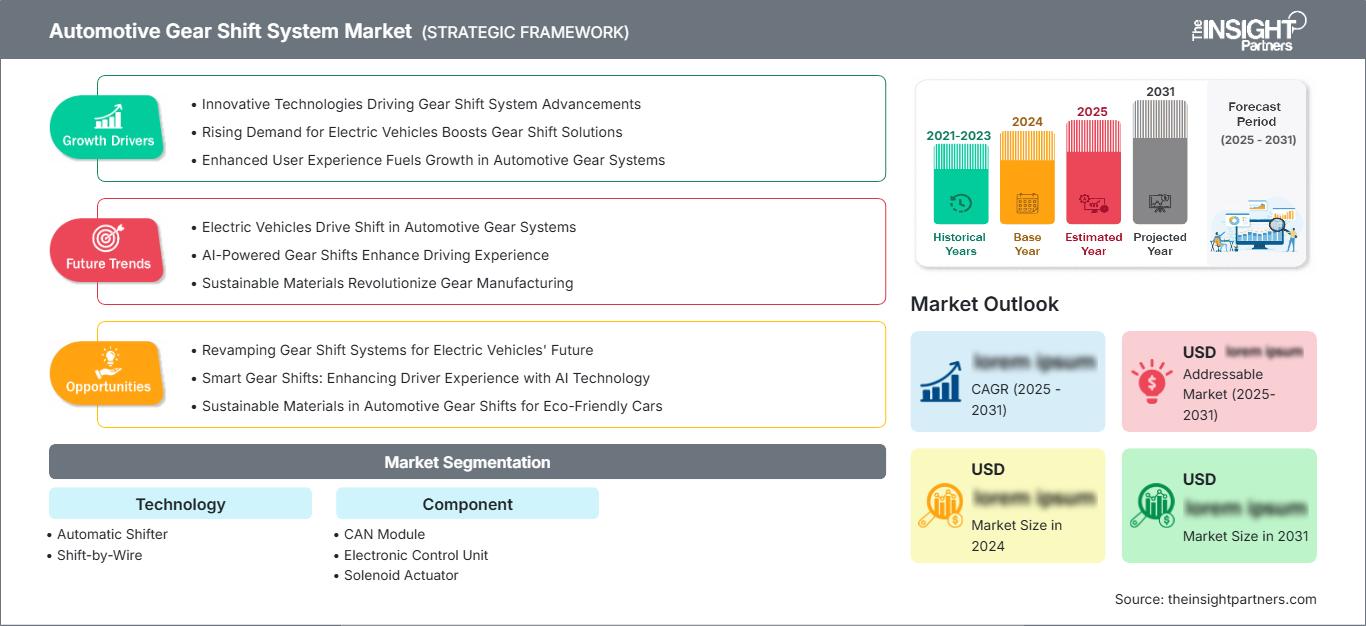
Automotive Gear Shift System Market: Strategic Insights
Regional Insights
North America Automotive Gear Shift System Market
North America accounted for an estimated 27–30% Automotive Gear Shift System Market share in 2025, supported by strong demand for automatic transmissions in SUVs, pickup trucks, and premium passenger vehicles. The region is expected to grow at a CAGR of 4.6–5.1% during 2026–2034 as OEMs integrate electronic selectors and shift-by-wire modules into hybrid and EV platforms.
Structural drivers include high consumer acceptance of automatic drivetrains, investment in vehicle electronics, and the need for compact cabin controls. Suppliers serving North American programs are focusing on durability, functional safety, and scalable electronics that can be deployed across combustion, hybrid, and battery-electric architectures.
U.S. Automotive Gear Shift System Market
The U.S. represented about 78–82% of North American demand in 2025 and is projected to expand at a CAGR of 4.5–5.0% through 2034. Demand is concentrated in light trucks, crossovers, performance vehicles, and electrified models, where automatic and electronic selector systems are increasingly standard.
Company presence is reinforced by established supplier relationships, engineering centers, and OEM procurement programs. Applications are shifting from traditional lever systems toward rotary selectors, monostable shifters, and compact electronic modules that support cabin differentiation and simplified drivetrain control.
Europe Automotive Gear Shift System Market
Europe held an estimated 23–26% share in 2025, with expected CAGR of 4.2–4.8% during 2026–2034. Germany remains the leading country because of premium vehicle production, transmission engineering capability, and strong supplier clusters. The UK and France support demand through hybrid programs, while Italy and Spain contribute through small and mid-sized passenger vehicle production.
The region’s shift toward lower-emission mobility is increasing demand for selector systems that integrate with hybrid transmissions and EV control units. Automakers are prioritizing lightweight designs, compact packaging, and reliable electronic interfaces, creating opportunities for suppliers with experience in software-compatible shifting components.
APAC Automotive Gear Shift System Market
APAC accounted for an estimated 35–39% share in 2025 and is expected to grow at 5.2–5.8% through 2034. China leads regional demand due to EV production scale and automatic transmission adoption, while Japan and South Korea remain important for advanced drivetrain engineering.
India and Australia add growth through rising passenger vehicle sales and gradual automatic transmission penetration. Regional production scale supports localized sourcing, while policy support for electrification accelerates demand for shift-by-wire and electronically controlled selector modules.
Middle East & Africa Automotive Gear Shift System Market
The Middle East & Africa market is smaller but is expected to grow at 3.8–4.4% during 2026–2034. Saudi Arabia and the UAE lead demand through premium vehicle imports, fleet modernization, and infrastructure-linked mobility investment, while South Africa supports regional assembly and aftermarket demand.
Growth is influenced by automatic transmission preference in harsh driving conditions, expanding logistics fleets, and the gradual introduction of hybrid and electric models. Suppliers benefit where systems offer durability, heat tolerance, and compatibility with global vehicle platforms.
Segmentation Analysis
Technology
Technology is central to Automotive Gear Shift System Market scope, with automatic shifters representing the larger installed base and shift-by-wire systems delivering faster growth. The overall technology segment is expected to expand at a CAGR range of 4.9–5.6% during 2026–2034 as OEMs combine electronic actuation, digital controls, and simplified cockpit layouts.
- Automatic Shifter: Automatic shifters dominate current demand because they align with consumer preference for convenience, smoother drivability, and broad deployment across passenger cars, SUVs, and light commercial vehicles.
- Shift-by-Wire: Shift-by-wire systems are gaining strategic importance as automakers pursue compact interiors, EV-ready platforms, and electronically controlled drivetrains that reduce mechanical linkage complexity.
Component
Component demand is expected to grow at a CAGR range of 4.7–5.4% during 2026–2034, supported by rising electronics content in transmission control. CAN modules, electronic control units, and solenoid actuators are increasingly designed as integrated systems to improve response, safety, and diagnostics.
- CAN Module: CAN modules enable communication between gear selectors, transmission controllers, and vehicle networks, making them important for diagnostics, fail-safe operation, and software-based control strategies.
- Electronic Control Unit: Electronic control units manage signal processing, shift logic, and integration with drivetrain systems, supporting more precise and adaptive gear selection across modern vehicle architectures.
- Solenoid Actuator: Solenoid actuators convert electronic commands into mechanical movement, supporting reliable gear engagement, compact packaging, and improved response in automatic and electronic shifting systems.
Opportunity Snapshot
| Technology | Revenue Contribution | Trend Tag | Adoption Stage |
| Automatic Shifter | High | Comfort Shift | Mature |
| Shift-by-Wire | Medium | Digital Control | Scaling |
Automotive Gear Shift System Market Growth Drivers and Impact Analysis
Rising Automatic Transmission Penetration
Automatic transmission adoption is expanding across passenger cars, SUVs, and light commercial vehicles as consumers prioritize convenience, smoother acceleration, and reduced driver fatigue. This change will positively influence the demand for selectors, electronic controllers, solenoids, and other modules. It is particularly important for the North American and Asia Pacific regions because in such environments with high urban traffic and high feature requirements, an automatic shifter becomes a necessity rather than an expensive addition.
Shift-by-Wire Integration in Electrified Platforms
Electrified vehicles require compact and electronically integrated selector systems that communicate reliably with drivetrain control units. The shift-by-wire system eliminates mechanical linkages, enhances cabin architecture design freedom, and facilitates software-based vehicle architectures. With growing hybrid and battery electric platforms, suppliers able to supply redundancy in electronics, safe actuation, and validated communication modules will continue to become increasingly valued by OEMs.
Cockpit Redesign and Space Optimization
Vehicle interiors are being redesigned around digital displays, flexible storage, and simplified control surfaces. Space-efficient gear selectors, rotary shifters, push-button mechanisms, and monostable switches enable car manufacturers to create space in the console and differentiate their vehicles. This ensures a continuing demand for those suppliers who can integrate mechanical reliability, excellent tactile feedback, electronics, and flexibility in designs for various applications.
Automotive Gear Shift System Market Future Trends
Software-Defined Shift Interfaces
Future Automotive Gear Shift System Market trends will increasingly center on software-defined control logic. Integration of selector systems with vehicle operational systems, diagnostic tools, driver profiles, and over-the-air update system is anticipated. This will enable manufacturers to tweak the shifting characteristics, safety alerts, and interface responses even after the launch of the vehicles, making the selector a component of the connected vehicle electronics ecosystem.
Minimalist and Multi-Format Selectors
Automakers are moving toward minimalist selector designs that support differentiated brand identity and improved cabin ergonomics. There will be an increase in the use of rotary knobs, stalk selectors, push buttons, and small monostables switches. This will mean that suppliers who can design modular switches with good surfaces and good electronic interfaces without adding any additional complexity will be favored.
Automotive Gear Shift System Market Opportunities
Platform-Level Supply for EV and Hybrid Programs
EV and hybrid programs create opportunities for suppliers to secure platform-level contracts covering multiple models and regions. The automotive gear shift system market Forecasts indicate that electronic modules with scalable software, compact design, and functional safety compliance will be favored. Suppliers that engage early in platform development can increase content per vehicle and strengthen long-term customer relationships.
Localized Manufacturing in High-Volume Markets
Localization offers a practical opportunity as OEMs manage cost, supply resilience, and regional content requirements. China, India, Mexico, and Eastern Europe offer prospects for suppliers to facilitate mass manufacturing through local assemblies and engineering expertise. Businesses that integrate globally accepted designs along with regional manufacturing capabilities can increase their competitive edge and safeguard themselves against logistical problems.
Frequently Asked Questions

- Comprehensive Market Sizing and Forecast Analysis
- Detailed Segmentation Analysis
- In-Depth Market Dynamics Assessment
- Regional and Country-Level Insights
- Competitive Landscape and Company Benchmarking
- Strategic Business Intelligence
Recent Reports
Testimonials

The Insight Partners' SCADA System Market report is comprehensive, with valuable insights on current trends and future forecasts. The team was highly professional, responsive, and supportive throughout. We are very satisfied and highly recommend their services.
RAN KEDEM Partner, Reali Technologies LTDs
I requested a report on a very specific software market and the team produced the report in a few days. The information was very relevant and well presented. I then requested some changes and additions to the report. The team was again very responsive and I got the final report in less than a week.
JEAN-HERVE JENN Chairman, Future Analytica
We worked with The Insight Partners for an important market study and forecast. They gave us clear insights into opportunities and risks, which helped shape our plans. Their research was easy to use and based on solid data. It helped us make smart, confident decisions. We highly recommend them.
PIYUSH NAGPAL Sr. Vice President, High Beam Global
The Insight Partners delivered insightful, well-structured market research with strong domain expertise. Their team was professional and responsive throughout. The user-friendly website made accessing industry reports seamless. We highly recommend them for reliable, high-quality research services
YUKIHIKO ADACHI CEO, Deep Blue, LLC.
This is the first time I have purchased a market report from The Insight Partners.While I was unsure at first, I visited their web site and felt more comfortable to take the risk and purchase a market report.I am completely satisfied with the quality of the report and customer service. I had several questions and comments with the initial report, but after a couple of dialogs over email with their analyst I believe I have a report that I can use as input to our strategic planning process.Thank you so much for taking the extra time and making this a positive experience.I will definitely recommend your service to others and you will be my first call when we need further market data.
JOHN SUZUKI President and Chief Executive Officer, Board Director, BK Technologies
I wish to appreciate your support and the professionalism you displayed in the course of attending to my request for information regarding to infectious disease IVD market in Nigeria. I appreciate your patience, your guidance, and the fact that you were willing to offer a discount, which eventually made it possible for us to close a deal. I look forward to engaging The Insight Partners in the future, all thanks to the impression you have created in me as a result of this first encounter.
DR CHIJIOKE ONYIA MANAGING DIRECTOR, PineCrest Healthcare Ltd.Reason to Buy
- Informed Decision-Making
- Understanding Market Dynamics
- Competitive Analysis
- Identifying Emerging Markets
- Customer Insights
- Market Forecasts
- Risk Mitigation
- Boosting Operational Efficiency
- Strategic Planning
- Investment Justification
- Tracking Industry Innovations
- Aligning with Regulatory Trends





 Get Free Sample for