
Automotive Grommet Component Market Size, Growth & Trends by 2034
Coverage: By Type (EPDM, NR, SBR); Application (Passenger car, LCV and HCV, Others) , and Geography (North America, Europe, Asia Pacific, and South and Central America)
- Status : Data Released
- Report Code : TIPRE00021966
- Category : Automotive and Transportation
- No. of Pages : 150
- Available Report Formats :


- Last update date : August 04, 2026


2025 Market Size
US$ 15.22 Bn
Base year value
2034 Forecast
US$ 29.2 Bn
Projected by 2034
CAGR 2026-2034
8.49 %
Growth rate
Addressable Market
US$ 210.46 Bn
(2026-2034)
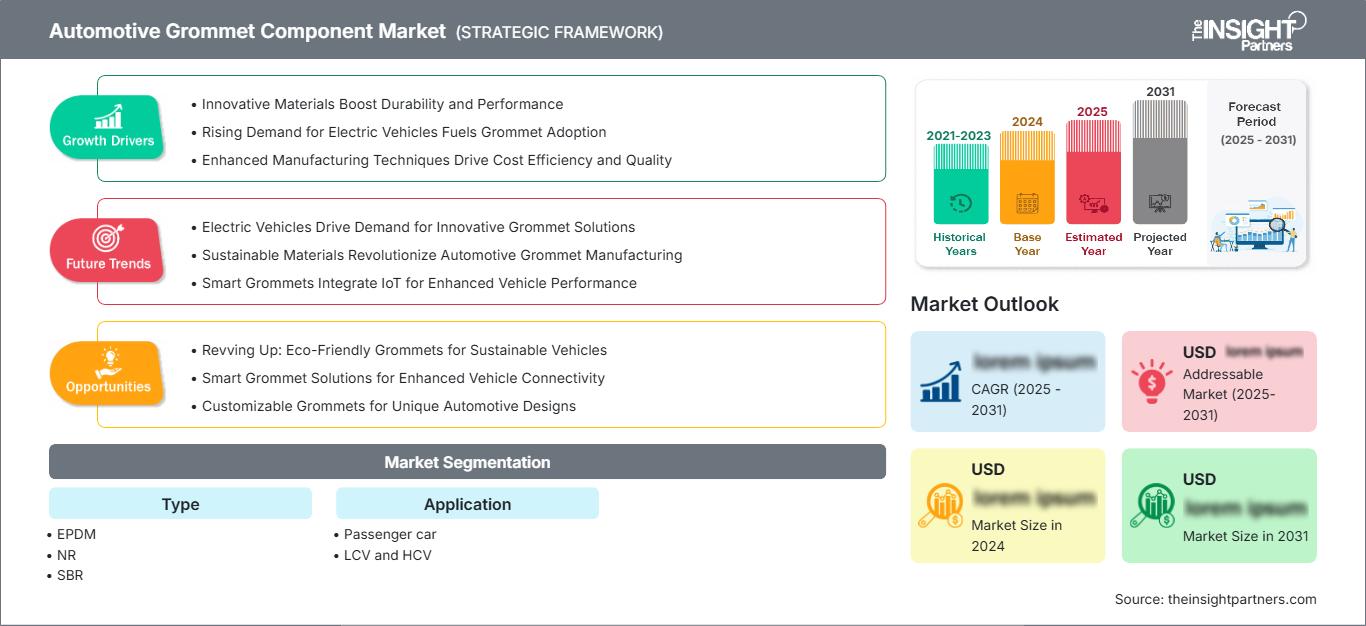
The Automotive Grommet Component Market is projected to grow from US$ 15.22 Billion in 2025 to US$ 29.2 Billion by 2034, registering a CAGR of 8.49% during 2026–2034. Demand is expanding as vehicles use denser wiring harnesses, more sensors, higher-voltage EV cables, and tighter sealing systems across body, chassis, battery, and engine compartments.
North America remains a high-value demand base, with the Automotive Grommet Component Market size supported by electric vehicle wiring protection, pickup and SUV production, safety compliance, and premium cabin sealing requirements. The region is expected to grow at a CAGR of 7.9–8.5% during 2026–2034 as OEMs adopt EPDM and specialty rubber grommets for moisture resistance, vibration isolation, and wire abrasion control.
Automotive Grommet Component Market Assessment and Insights
- North America: North America held 24–27% share in 2025 and is projected to grow at a CAGR of 7.9–8.5% during 2026–2034, supported by EV wiring growth and light-truck production.
- US: The US accounted for 79–83% of North American demand in 2025 and is expected to grow at a CAGR of 7.8–8.4% during 2026–2034.
- Europe: Europe represented 21–24% share in 2025 and is forecast to grow at a CAGR of 7.4–8.0%, led by Germany, France, the UK, Italy, and Spain.
- Asia Pacific: Asia Pacific accounted for 39–43% share in 2025 and is expected to grow at a CAGR of 8.8–9.5%, led by China, Japan, South Korea, and India.
- Largest Segment: Passenger car held 58–62% market share in 2025 and is projected to grow at a CAGR of 8.2–8.8% during 2026–2034.
- High Growth Segment: EPDM held 46–50% market share in 2025 and is projected to grow at a CAGR of 8.9–9.6% during 2026–2034.
- Key companies analyzed in detail: Continental AG, Device Technologies, Inc., Federal-Mogul Corporation, Hutchinson SA, KYOCERA Corporation, LISI Automotive SAS, Ritus Corporation, Sumitomo Riko Company Limited, Toyoda Gosei Co., Ltd., and Trelleborg AB.
Source: The Insight Partners' analysis based on proprietary research, government publications, company annual reports, investor presentations, industry databases, and expert interviews.
Vehicle sealing architecture has moved from simple panel plugs toward engineered elastomer components that protect wiring, hoses, and cable routing points from vibration, heat, water, and abrasion. The Automotive Grommet Component Market is being shaped by electrification, advanced driver-assistance systems, and higher electrical content per vehicle. Production dynamics favor suppliers that can mold tight-tolerance EPDM, NR, and SBR parts while meeting OEM requirements for durability, material traceability, and assembly-line fit.
Future demand is expected to strengthen across Asia Pacific, North America, and Europe as automakers increase electric, hybrid, and connected vehicle output. Investment is moving toward automated rubber molding, recyclable compounds, and grommets designed for high-voltage cable protection. Regulatory emphasis on vehicle safety, waterproofing, and noise reduction also supports adoption in passenger cars and commercial fleets, especially where long service life and resistance to harsh road environments influence sourcing decisions.
Automotive Grommet Component Market Report Scope
| Report Attribute | Details |
|---|---|
| Market size in 2025 | US$ 15.22 Billion |
| Market Size by 2034 | US$ 29.2 Billion |
| Global CAGR (2026 - 2034) | 8.49% |
| Historical Data | 2021-2024 |
| Forecast period | 2026-2034 |
Automotive Grommet Component Market Analysis
Rising wiring complexity, battery protection needs, and stricter NVH targets are supporting Automotive Grommet Component Market growth. Modern vehicles use multiple cable pass-through points across firewalls, doors, battery trays, lighting modules, sensors, and underbody systems. Each point requires sealing and abrasion control, making grommets essential to electrical reliability and passenger comfort.
The value chain includes elastomer compounders, mold designers, rubber processors, tier-one module suppliers, wiring harness producers, and OEM assembly plants. Supply dynamics depend on rubber price stability, tooling precision, quality certification, and localized production. The Automotive Grommet Component Market analysis shows that suppliers must balance low unit cost with high consistency because a small sealing failure can create warranty risk, water ingress, or electrical faults.
Competition is shaped by material science, molding scale, customer validation history, and regional manufacturing reach. Continental AG, Hutchinson SA, Sumitomo Riko Company Limited, Toyoda Gosei Co., Ltd., and Trelleborg AB compete through elastomer engineering and global OEM relationships. Federal-Mogul Corporation, Device Technologies, Inc., Ritus Corporation, KYOCERA Corporation, and LISI Automotive SAS support specialized sealing, fastening, and component programs.
Investment trends favor automated inspection, lightweight compounds, and EV-compatible grommet designs that withstand heat, moisture, ozone, and chemical exposure. Strategic positioning increasingly depends on early design collaboration with harness and battery-pack engineers. Suppliers that can provide modular grommet families, local delivery, and validated compound performance are better placed to win multi-platform programs.
● REPORT CUSTOMIZATION
Tailor This Report To Align With Your Specific Business Requirements
This report can be customized to align precisely with your business objectives, scope, and target markets. Customization options include tailored segmentation, geography, competitive analysis, and strategic insights to support informed decision-making.
Customize This Report →WHAT YOU CAN ADJUST
- ● Segmentations
- ● Geography
- ● Competitive Analysis
- ● Language Preferences
Automotive Grommet Component Market: Strategic Insights
Regional Insights
North America Automotive Grommet Component Market
North America accounted for 24–27% Automotive Grommet Component Market share in 2025 and is expected to expand at a CAGR of 7.9–8.5% during 2026–2034. Demand is supported by electric pickups, SUVs, commercial vans, and premium vehicles that require robust cable sealing, chassis protection, and door harness routing.
Regional suppliers benefit from proximity to US and Mexico assembly operations, where OEMs prioritize just-in-time rubber components and validated quality systems. Growth is reinforced by higher EV content per vehicle, advanced lighting, ADAS sensors, and thermal management systems that increase protected pass-through points.
U.S. Automotive Grommet Component Market
The US represented 79–83% of North American demand in 2025 and is projected to grow at a CAGR of 7.8–8.4% during 2026–2034. Demand is concentrated in passenger vehicles, pickups, delivery vans, and heavy-duty fleets, where sealing reliability affects electrical uptime and cabin noise control.
Company presence is supported by Continental AG, Federal-Mogul Corporation, Ritus Corporation, Trelleborg AB, and other suppliers serving OEM and tier-one programs. Applications are shifting toward battery enclosures, high-voltage wiring, firewall seals, door harnesses, and underbody protection as vehicle electrical architecture becomes more complex.
Europe Automotive Grommet Component Market
Europe held 21–24% share in 2025 and is forecast to grow at a CAGR of 7.4–8.0% through 2034. Germany leads through premium vehicle production and EV platform engineering, while France supports compact EV and hybrid programs. The UK contributes through specialist vehicles and light commercial platforms.
Italy and Spain add regional demand through vehicle assembly, supplier clusters, and replacement channels. European OEMs emphasize low-emission materials, precise sealing, and lightweight parts that support noise reduction and energy efficiency. Hutchinson SA, Continental AG, Sumitomo Riko Company Limited, Toyoda Gosei Co., Ltd., and Trelleborg AB align with these requirements through material expertise and global production networks.
APAC Automotive Grommet Component Market
APAC accounted for 39–43% share in 2025 and is expected to grow at a CAGR of 8.8–9.5% during 2026–2034. China leads through EV scale and wiring harness production, while Japan and South Korea support high-quality rubber components for hybrid and connected vehicles.
India adds growth through passenger car production, LCV demand, and localization of component sourcing. Australia remains smaller but supports aftermarket and imported vehicle requirements. Policy support for electrification and domestic manufacturing strengthens regional investment in molded rubber grommet capacity.
Middle East & Africa Automotive Grommet Component Market
The Middle East & Africa market is expected to grow at a CAGR of 6.8–7.4% during 2026–2034. Saudi Arabia and the UAE lead through premium imports, infrastructure fleets, and heat-exposed driving conditions that require durable sealing and cable protection.
South Africa contributes through regional assembly, aftermarket replacement, and commercial vehicle operations. Rest of MEA demand remains cost-sensitive, but harsh climate, dust exposure, and fleet maintenance needs support steady consumption of EPDM and SBR grommets.
Segmentation Analysis
Type
Type defines Automotive Grommet Component Market scope because compound selection determines weather resistance, elasticity, cost, heat tolerance, and service life. The type segment is expected to grow at a CAGR of 8.4–9.0% during 2026–2034 as OEMs use EPDM for long-life sealing, NR for flexible protection, and SBR for cost-effective molded components.
- EPDM: EPDM is preferred for weather-resistant grommets because it withstands ozone, heat, moisture, and aging, making it suitable for exterior wiring, battery areas, and harsh underbody routing.
- NR: NR supports flexible sealing applications where elasticity, tear strength, and vibration absorption matter, especially in body openings, interior routing, and moderate-temperature cable protection points.
- SBR: SBR remains relevant for cost-sensitive molded grommets that require abrasion resistance and stable mechanical performance in standard passenger car and commercial vehicle applications.
Application
Application is expected to grow at a CAGR of 8.1–8.7% during 2026–2034 as grommet demand follows passenger car production, fleet electrification, and commercial vehicle wiring complexity. Passenger cars dominate unit demand, while LCV and HCV platforms create value through larger harnesses, stronger sealing needs, and heavier operating conditions.
- Passenger car: Passenger car applications generate the largest demand because modern vehicles require grommets for doors, dashboards, lighting, battery systems, sensors, HVAC routing, and body sealing.
- LCV and HCV: LCV and HCV demand is driven by logistics fleets, buses, construction vehicles, and heavy-duty wiring layouts that need durable sealing against dust, heat, vibration, and moisture.
Opportunity Snapshot
| Application | Revenue Contribution | Trend Tag | Adoption Stage |
| Passenger car | High | EV Harness | Mature |
| LCV and HCV | Medium | Fleet Sealing | Scaling |
Automotive Grommet Component Market Growth Drivers and Impact Analysis
Growth in Vehicle Electrical Architecture
Automakers are adding more sensors, cameras, lighting modules, infotainment systems, battery controls, and thermal management circuits, increasing the number of cable pass-through points that require protection. Grommets minimize abrasion where wires come in contact with sheet metal or plastics or structural parts, thus minimizing the chances of an electrical failure. This is an example of a factor that increases the content in each vehicle despite the relatively low growth in vehicle production as a whole.
Electrification and High-Voltage Cable Protection
Electric and hybrid vehicles use larger wiring harnesses, battery-pack interfaces, charging cables, and underbody routing that must remain sealed against moisture, debris, and thermal stress. EPDM and specialty rubber grommet solutions are being developed for these applications, while providing insulation and NVH performance. The effect is most noticeable in China, North America, Europe, Japan, and South Korea, since electric vehicle manufacturing requires qualified suppliers in these countries. It transforms grommets into a critical component that is no longer visible.
Rising Durability and Cabin Comfort Requirements
Consumers and fleet operators expect quieter cabins, lower vibration transfer, and fewer water ingress or wiring issues over the vehicle life cycle. The grommet helps to fulfill these requirements in terms of sealing holes, decreasing the friction between the metal and the wire, as well as isolating vibrations from areas such as doors, firewall, underbody panels, and engine compartments. This has made original equipment manufacturers to come up with stringent quality requirements in terms of compression set, aging, and dimensional stability.
Automotive Grommet Component Market Future Trends
Smart Material Validation for EV Grommets
Automotive Grommet Component Market trends will increasingly focus on validated materials for EV-specific environments. The future generation of grommets is supposed to be able to handle higher levels of heat, chemicals, battery pack sealing, and long service cycles without cracking and losing compression. The suppliers will test the compounds, digitally simulate them, and inspect them automatically prior to launching the platform. Due to the increased safety criticality of vehicle electronics, the OEMs will prefer those partners that have material behavior data.
Recyclable and Low-Emission Rubber Components
Sustainability targets are pushing automakers to examine rubber sourcing, compound recyclability, and production emissions for small components as well as major systems. Suppliers of grommets will have to innovate in molding processes to reduce emissions, use elastomers with recycled content, and create designs that enable easy separation at the end of their life cycle. The innovation is most likely to be prevalent in Europe and Japan, given that the OEM supplier scorecards have included environment-related information in recent times.
Automotive Grommet Component Market Opportunities
Platform-Level Supply for EV Wiring Systems
Automotive Grommet Component Market Forecasts indicate that platform-level EV wiring programs offer attractive opportunities, as a single design win can span multiple models, regions, and battery configurations. Suppliers can partner with harness makers and OEM engineers ahead of time to standardize sealing geometry and simplify assembly, among other things. This creates recurring demand in areas such as battery packs, charge port seals, underbody harnesses, and firewall passages. Firms that have the right EPDM formulation, tooling, and local manufacturing capability can ensure recurring revenue streams.
Localized Rubber Molding Near Assembly Hubs
Localized molding capacity gives suppliers a practical route to win OEM programs in China, India, Mexico, Eastern Europe, and Southeast Asia. Grommets are inexpensive components; however, their lack can cause production disruptions for wiring harnesses or vehicles. In-house manufacturing allows minimizing the risk associated with transportation, responding to engineering modifications, and meeting local content requirements. Suppliers capable of using automatic testing and flexible tooling are able to manufacture grommets for passenger cars, LCVs, and HCVs.
Frequently Asked Questions

- Comprehensive Market Sizing and Forecast Analysis
- Detailed Segmentation Analysis
- In-Depth Market Dynamics Assessment
- Regional and Country-Level Insights
- Competitive Landscape and Company Benchmarking
- Strategic Business Intelligence
Recent Reports
Testimonials

The Insight Partners' SCADA System Market report is comprehensive, with valuable insights on current trends and future forecasts. The team was highly professional, responsive, and supportive throughout. We are very satisfied and highly recommend their services.
RAN KEDEM Partner, Reali Technologies LTDs
I requested a report on a very specific software market and the team produced the report in a few days. The information was very relevant and well presented. I then requested some changes and additions to the report. The team was again very responsive and I got the final report in less than a week.
JEAN-HERVE JENN Chairman, Future Analytica
We worked with The Insight Partners for an important market study and forecast. They gave us clear insights into opportunities and risks, which helped shape our plans. Their research was easy to use and based on solid data. It helped us make smart, confident decisions. We highly recommend them.
PIYUSH NAGPAL Sr. Vice President, High Beam Global
The Insight Partners delivered insightful, well-structured market research with strong domain expertise. Their team was professional and responsive throughout. The user-friendly website made accessing industry reports seamless. We highly recommend them for reliable, high-quality research services
YUKIHIKO ADACHI CEO, Deep Blue, LLC.
This is the first time I have purchased a market report from The Insight Partners.While I was unsure at first, I visited their web site and felt more comfortable to take the risk and purchase a market report.I am completely satisfied with the quality of the report and customer service. I had several questions and comments with the initial report, but after a couple of dialogs over email with their analyst I believe I have a report that I can use as input to our strategic planning process.Thank you so much for taking the extra time and making this a positive experience.I will definitely recommend your service to others and you will be my first call when we need further market data.
JOHN SUZUKI President and Chief Executive Officer, Board Director, BK Technologies
I wish to appreciate your support and the professionalism you displayed in the course of attending to my request for information regarding to infectious disease IVD market in Nigeria. I appreciate your patience, your guidance, and the fact that you were willing to offer a discount, which eventually made it possible for us to close a deal. I look forward to engaging The Insight Partners in the future, all thanks to the impression you have created in me as a result of this first encounter.
DR CHIJIOKE ONYIA MANAGING DIRECTOR, PineCrest Healthcare Ltd.Reason to Buy
- Informed Decision-Making
- Understanding Market Dynamics
- Competitive Analysis
- Identifying Emerging Markets
- Customer Insights
- Market Forecasts
- Risk Mitigation
- Boosting Operational Efficiency
- Strategic Planning
- Investment Justification
- Tracking Industry Innovations
- Aligning with Regulatory Trends





 Get Free Sample for