
Automotive Heat Transfer Label Market Overview, Growth, Trends, Analysis to 2034
Coverage: By Type (RFID, Barcode, Hologram, Others); Printing Technology (Flexography, Digital Printing); Application (Exterior labels, Interior labels, Engine component labels, Others) , and Geography (North America, Europe, Asia Pacific, and South and Central America)
- Status : Data Released
- Report Code : TIPRE00004785
- Category : Automotive and Transportation
- No. of Pages : 150
- Available Report Formats :


- Last update date : August 07, 2026


2025 Market Size
US$ 1.65 Bn
Base year value
2034 Forecast
US$ 2.98 Bn
Projected by 2034
CAGR 2026-2034
6.8 %
Growth rate
Addressable Market
US$ 20.93 Bn
(2026-2034)
The Automotive Heat Transfer Label Market is projected to grow from US$ 1.65 Billion in 2025 to US$ 2.98 Billion by 2034, registering a CAGR of 6.8% during 2026–2034. Demand is increasing as automakers require durable labeling for traceability, compliance, branding, underhood identification, and component authentication across conventional, hybrid, and electric vehicle platforms.
North America remains a specification-driven market where the Automotive Heat Transfer Label Market size is supported by OEM labeling standards, component serialization, aftermarket branding, and EV battery identification needs. The region is estimated to hold 21–24% share in 2025 and expand at a 6.1–6.6% CAGR during 2026–2034, led by connected manufacturing and supplier compliance programs.
Automotive Heat Transfer Label Market Assessment and Insights
- North America: Held an estimated 21–24% share in 2025 and is projected to grow at a 6.1–6.6% CAGR during 2026–2034, supported by OEM traceability, EV labels, and durable underhood applications.
- US: Represented 79–83% of North America demand in 2025 and is expected to expand at a 6.2–6.7% CAGR, led by vehicle assembly, barcode use, and RFID pilots.
- Europe accounted for 25–28% share in 2025 and is forecast to grow at a 5.8–6.3% CAGR, with Germany, the UK, France, Italy, and Spain supporting adoption.
- Asia Pacific: Represented 39–43% share in 2025 and is projected to grow at a 7.2–7.8% CAGR, led by China, Japan, South Korea, India, and Australia.
- Largest Segment: Barcode held 46–50% market share in 2025 and is projected to grow at a 5.9–6.4% CAGR because it remains cost-efficient for component tracking.
- High Growth Segment: RFID held 18–22% market share in 2025 and is projected to grow at a 8.0–8.7% CAGR as automakers expand smart traceability.
- Key companies analyzed in detail: 3M Company; Adhesive Research, Inc.; Avery Dennison Corporation; CCL Industries Inc.; Dunmore; H.B. Fuller Company; ImageTek Labels; Lewis Label Products Corporation; Sika AG; UPM-Kymmene Corporation.
Source: The Insight Partners' analysis based on proprietary research, government publications, company annual reports, investor presentations, industry databases, and expert interviews.
Labeling has shifted from basic brand and warning information toward production-line intelligence, durable identification, and regulatory documentation. The Automotive Heat Transfer Label Market growth is shaped by greater use of heat-resistant films, adhesives, RFID inlays, and digitally printed variable data. Automakers need labels that survive heat, oil, abrasion, cleaning chemicals, and long service lives without losing scan quality or adhesive performance.
The future demand will be driven by EV battery labeling, connected manufacturing, regional car manufacturing, and enhanced parts authentication. The suppliers are focusing on the development of advanced adhesive systems, printable films, and intelligent labels for curved surfaces and harsh environments. The volume of the Asia Pacific region will be the highest, whereas Europe and North America will focus on validation, compliance, and traceability of the lifecycle.
Automotive Heat Transfer Label Market Report Scope
| Report Attribute | Details |
|---|---|
| Market size in 2025 | US$ 1.65 Billion |
| Market Size by 2034 | US$ 2.98 Billion |
| Global CAGR (2026 - 2034) | 6.8% |
| Historical Data | 2021-2024 |
| Forecast period | 2026-2034 |
Automotive Heat Transfer Label Market Analysis
Durable component identification is a direct driver of the Automotive Heat Transfer Label Market growth, as automotive platforms will increasingly have many sensors, electronic components, batteries, and other critical modules. The labels should have barcodes, serial numbers, instructions, warranties, and be able to withstand temperatures found in powertrain, charging system, and interior trim bonding areas.
The value chain includes film producers, adhesive formulators, RFID inlay suppliers, print converters, Tier 1 component makers, and OEM quality teams. Supply dynamics depend on resin pricing, liner availability, print capacity, and qualification cycles. Heat transfer constructions must balance adhesion, legibility, conformability, and removability requirements across exterior labels, interior labels, and engine component labels.
The Automotive Heat Transfer Label Market analysis shows a competitive field led by material science and converting expertise. Avery Dennison Corporation, CCL Industries Inc., 3M Company, UPM-Kymmene Corporation, H.B. Fuller Company, Sika AG, Dunmore, Adhesive Research, Inc., ImageTek Labels, and Lewis Label Products Corporation compete through adhesive durability, printable films, technical support, and OEM-approved specifications.
Investment is moving toward RFID-enabled traceability, digital printing workflows, and materials for EV battery packs and underhood zones. Strategic positioning favors suppliers that can provide validated constructions, regional converting, shorter lead times, and data-ready labels. Cost remains important, but failure risk makes performance certification and scan reliability critical purchase factors.
● REPORT CUSTOMIZATION
Tailor This Report To Align With Your Specific Business Requirements
This report can be customized to align precisely with your business objectives, scope, and target markets. Customization options include tailored segmentation, geography, competitive analysis, and strategic insights to support informed decision-making.
Customize This Report →WHAT YOU CAN ADJUST
- ● Segmentations
- ● Geography
- ● Competitive Analysis
- ● Language Preferences
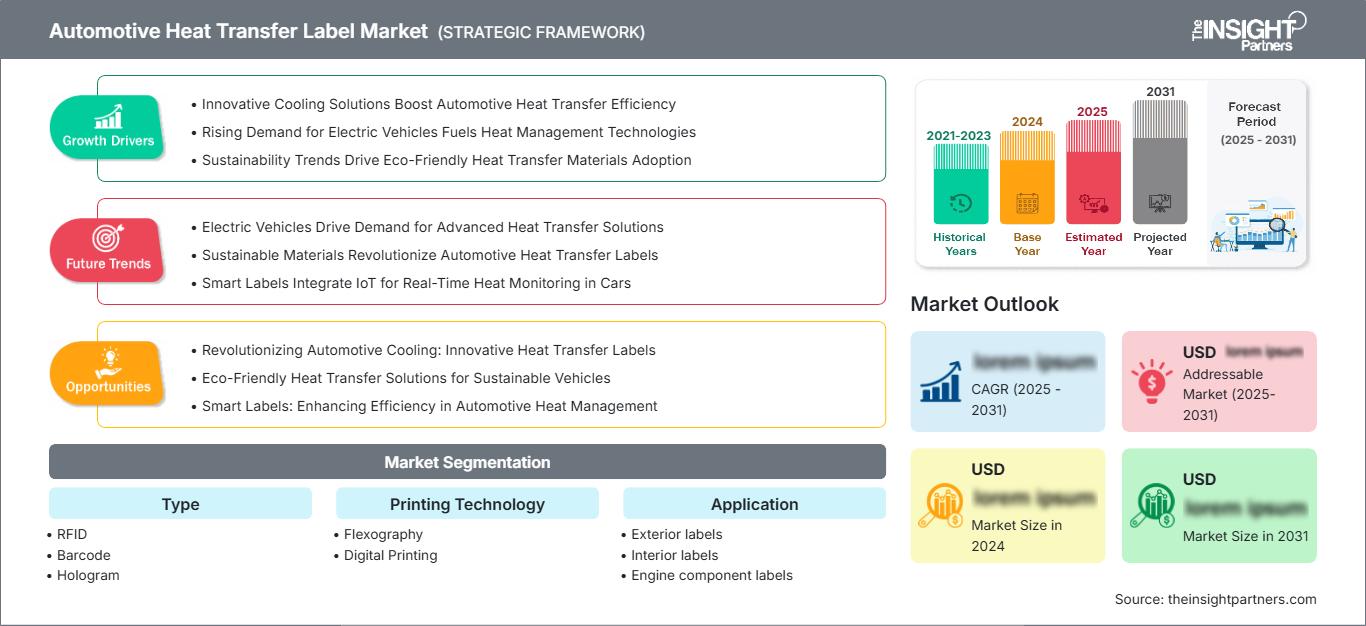
Automotive Heat Transfer Label Market: Strategic Insights
Regional Insights
North America Automotive Heat Transfer Label Market
North America accounted for an estimated 21–24% Automotive Heat Transfer Label Market share in 2025 and is projected to grow at a 6.1–6.6% CAGR during 2026–2034. Demand is concentrated in the US and Mexico, where vehicle assembly, supplier parks, and aftermarket distribution require durable labels for traceability, warnings, tire information, and component identification.
The region benefits from high adoption of barcode systems and increasing RFID trials across parts logistics. EV battery modules, charging components, and power electronics require labels that remain readable under heat, vibration, and chemical exposure. Canada contributes through specialty converting and vehicle programs, while Mexico supports cost-efficient export manufacturing.
U.S. Automotive Heat Transfer Label Market
The US represented 79–83% of North American demand in 2025 and is forecast to grow at a 6.2–6.7% CAGR through 2034. Large assembly capacity, EV investments, and parts serialization make the country the regional anchor for barcode, RFID, and durable thermal transfer labeling.
Company presence is strong through Avery Dennison Corporation, 3M Company, H.B. Fuller Company, Adhesive Research, Inc., Dunmore, ImageTek Labels, and Lewis Label Products Corporation. Applications are expanding from compliance and branding into production analytics, warranty traceability, and battery safety identification, especially where OEMs require validated label constructions.
Europe Automotive Heat Transfer Label Market
Europe held an estimated 25–28% share in 2025 and is projected to grow at a 5.8–6.3% CAGR during 2026–2034. Germany leads demand because of premium vehicle production, EV platforms, and stringent component documentation. The UK supports specialty labels for performance vehicles and aftermarket parts.
France, Italy, and Spain contribute through passenger car assembly, component exports, and packaging-converter networks. European OEMs emphasize regulatory conformity, sustainability, and long-term readability, which supports film labels, low-migration adhesives, and digital printing. Sika AG, UPM-Kymmene Corporation, Avery Dennison Corporation, and CCL Industries Inc. support regional material and converting requirements.
APAC Automotive Heat Transfer Label Market
APAC represented 39–43% share in 2025 and is projected to grow at a 7.2–7.8% CAGR through 2034. China is the leading country because of EV scale, battery manufacturing, and component exports. Japan and South Korea support advanced RFID and quality systems, while India expands volume demand.
Australia adds stable aftermarket and compliance demand. Regional growth is supported by high vehicle output, supplier localization, and rising need for component-level traceability. Barcode remains widely used, but RFID adoption is increasing in battery, logistics, and warranty-sensitive applications.
Middle East & Africa Automotive Heat Transfer Label Market
The Middle East & Africa market is expected to grow at a 4.8–5.4% CAGR during 2026–2034. Saudi Arabia and the UAE lead demand through vehicle imports, fleet maintenance, and harsh-climate labeling needs, while South Africa supports regional assembly and replacement parts.
Labels in this region must withstand heat, dust, UV exposure, and service chemicals. Rest of MEA demand is linked to logistics, aftermarket authentication, and infrastructure fleets. Growth remains moderate but improves as distributors adopt barcode and hologram labels to reduce counterfeiting.
Segmentation Analysis
Type
Type is projected to grow at a 6.4–7.0% CAGR during 2026–2034. The Automotive Heat Transfer Label Market scope by type reflects different identification priorities across manufacturing, logistics, brand protection, and maintenance. Barcode labels remain the practical baseline, RFID expands where automation is valuable, and hologram labels serve anti-counterfeit and authenticity functions.
- RFID enables non-line-of-sight identification, faster inventory checks, and component tracking in smart factories, especially for EV batteries, electronics, and parts requiring lifecycle traceability.
- Barcode remains the dominant option because it is low cost, readable across standard scanners, and widely embedded in OEM, supplier, warehouse, and service workflows.
- Hologram labels support anti-counterfeiting, brand protection, warranty control, and aftermarket authentication for safety-critical or premium automotive components.
Printing Technology
Printing Technology is expected to grow at a 6.2–6.8% CAGR during 2026–2034. Flexography supports high-volume standardized labels, while digital printing is gaining share where variable data, smaller batches, and faster revision cycles are required. Automotive converters increasingly combine durable substrates with precise print registration and scannability validation.
- Flexography supports large production runs, consistent graphics, and cost-efficient printing for standardized warning, branding, and component labels across vehicle platforms.
- Digital Printing enables variable data, quick changeovers, personalization, and smaller lot production, making it important for EV components, service labels, and serialized parts.
Application
Application is forecast to grow at a 6.5–7.1% CAGR during 2026–2034. Demand varies by exposure conditions, label function, and validation requirements. Engine component labels need higher heat resistance, exterior labels require weatherability, and interior labels emphasize appearance, compliance, and long-term adhesion without substrate damage.
- Exterior labels require UV resistance, weatherability, cleaning chemical tolerance, and strong adhesion for brand marks, tire information, service data, and regulatory identification.
- Interior labels support safety, warning, branding, and user information while meeting appearance, flammability, low-odor, and substrate compatibility requirements.
- Engine component labels demand high-temperature resistance, abrasion durability, oil tolerance, and reliable scan performance near powertrain, battery, and thermal management parts.
Opportunity Snapshot
| Application | Revenue Contribution | Trend Tag | Adoption Stage |
| Exterior Labels | Medium | UV Durability | Mature |
| Interior Labels | Medium | Cabin Compliance | Scaling |
| Engine Component Labels | High | Thermal ID | Scaling |
Automotive Heat Transfer Label Market Growth Drivers and Impact Analysis
Vehicle Traceability Requirements Expand Durable Label Use
Automotive manufacturers increasingly require permanent identification at component, module, and assembly levels to support quality audits, warranty claims, recalls, and service records. Labels for heat transfer coding offer scannable information about parts subjected to temperature, vibration, oil, and chemicals. The greatest effect will be observed on batteries, electronic devices, safety systems, and parts used under the hood where legible labels are required for conducting root cause analysis. This is one of the factors behind the growing necessity for bar codes and further development of RFID technology.
EV Platforms Create New Labeling Specifications
Electric vehicles add battery packs, thermal systems, high-voltage cables, inverters, and charging components that require durable warnings and lifecycle identification. These must withstand heat, fire, coolant, and abrasion while being legible to servicing crews and recyclers. This means moving away from using inexpensive labels and toward proven labels that come with material and adhesive performance certifications. Manufacturers that provide label systems designed specifically for electric vehicles will be able to take part in more valuable programs.
Anti-Counterfeit Needs Strengthen Hologram and Smart Labels
Counterfeit automotive parts create safety, warranty, and brand risks, especially in brake, engine, electrical, and aftermarket components. Hologram labels and RFID-enabled authentication help distributors, workshops, and consumers verify product origin. The effect is evident in markets where there are many spare parts distribution channels and active imports. The use of authentication stickers will also enable companies to create exclusive brands and manage their service networks. As companies adopt digital solutions for spare part management, smart stickers can link physical parts to cloud-based validation services.
Automotive Heat Transfer Label Market Future Trends
RFID and Digital Identity Integration
Automotive Heat Transfer Label Market trends point toward labels becoming part of digital vehicle identity systems rather than passive information carriers. There will be an increase in the use of RFID, QR codes, and serial barcodes in linking components to production records, maintenance records, recycling records, and certifications of suppliers. In this scenario, it is likely that the labels with durable substrates coupled with secure data and read ability will be favored. It will take place in EV batteries, electronics, and safety modules.
Sustainable Label Materials for Automotive Platforms
Automakers are extending sustainability reviews into adhesives, films, liners, and release materials. Future specifications for labels will focus on recyclability, reduced gauge levels, minimal use of solvents, and reduced liner waste without compromising their heat resistance and scanning capabilities. The future will require suppliers to demonstrate environmental performance along with OEM validation. This trend provides an opportunity for innovation in films, liner circularity, and adhesives with minimal environmental impact, especially in Europe and North America.
Automotive Heat Transfer Label Market Opportunities
Battery and Power Electronics Identification
Automotive Heat Transfer Label Market Forecasts show attractive opportunity in battery packs, modules, inverters, charging ports, and power electronics. The elements need warnings, serialization, service instructions, and recycling information over extended operating life cycles. Suppliers can add value through labels that are heat, coolant resistant, flame retardant, abrasion resistant, and capable of storing barcode or RFID data. The modular electric vehicle platform will also generate repeatable business since one label design could be used for multiple vehicles and production locations.
Regional Converting and Short-Run Customization
Localized converting offers a practical opportunity because automotive labels are highly specification-driven and frequently revised during platform launches. Digital Printing, Regional Inventory, and Quick Proofs Can Help Reduce Lead Times for Original Equipment Manufacturers (OEM) and their Tier 1 Suppliers. This is crucial for EV start-ups, aftermarket programs, and exported components where there is a need to change languages and requirements. Those suppliers who have regional technical support may win programs through material validation and customization.
Frequently Asked Questions

- Comprehensive Market Sizing and Forecast Analysis
- Detailed Segmentation Analysis
- In-Depth Market Dynamics Assessment
- Regional and Country-Level Insights
- Competitive Landscape and Company Benchmarking
- Strategic Business Intelligence
Recent Reports
Testimonials

The Insight Partners' SCADA System Market report is comprehensive, with valuable insights on current trends and future forecasts. The team was highly professional, responsive, and supportive throughout. We are very satisfied and highly recommend their services.
RAN KEDEM Partner, Reali Technologies LTDs
I requested a report on a very specific software market and the team produced the report in a few days. The information was very relevant and well presented. I then requested some changes and additions to the report. The team was again very responsive and I got the final report in less than a week.
JEAN-HERVE JENN Chairman, Future Analytica
We worked with The Insight Partners for an important market study and forecast. They gave us clear insights into opportunities and risks, which helped shape our plans. Their research was easy to use and based on solid data. It helped us make smart, confident decisions. We highly recommend them.
PIYUSH NAGPAL Sr. Vice President, High Beam Global
The Insight Partners delivered insightful, well-structured market research with strong domain expertise. Their team was professional and responsive throughout. The user-friendly website made accessing industry reports seamless. We highly recommend them for reliable, high-quality research services
YUKIHIKO ADACHI CEO, Deep Blue, LLC.
This is the first time I have purchased a market report from The Insight Partners.While I was unsure at first, I visited their web site and felt more comfortable to take the risk and purchase a market report.I am completely satisfied with the quality of the report and customer service. I had several questions and comments with the initial report, but after a couple of dialogs over email with their analyst I believe I have a report that I can use as input to our strategic planning process.Thank you so much for taking the extra time and making this a positive experience.I will definitely recommend your service to others and you will be my first call when we need further market data.
JOHN SUZUKI President and Chief Executive Officer, Board Director, BK Technologies
I wish to appreciate your support and the professionalism you displayed in the course of attending to my request for information regarding to infectious disease IVD market in Nigeria. I appreciate your patience, your guidance, and the fact that you were willing to offer a discount, which eventually made it possible for us to close a deal. I look forward to engaging The Insight Partners in the future, all thanks to the impression you have created in me as a result of this first encounter.
DR CHIJIOKE ONYIA MANAGING DIRECTOR, PineCrest Healthcare Ltd.Reason to Buy
- Informed Decision-Making
- Understanding Market Dynamics
- Competitive Analysis
- Identifying Emerging Markets
- Customer Insights
- Market Forecasts
- Risk Mitigation
- Boosting Operational Efficiency
- Strategic Planning
- Investment Justification
- Tracking Industry Innovations
- Aligning with Regulatory Trends





 Get Free Sample for