
Automotive Hood Lock Market Size, Trends & Demand by 2034
Coverage: By Type (Cast Iron, Stainless Steel, Other); Application (Passenger Car, Commercial Vehicle) , and Geography (North America, Europe, Asia Pacific, and South and Central America)
- Status : Data Released
- Report Code : TIPRE00021233
- Category : Automotive and Transportation
- No. of Pages : 150
- Available Report Formats :


- Last update date : August 06, 2026


2025 Market Size
US$ 1.27 Bn
Base year value
2034 Forecast
US$ 2.56 Bn
Projected by 2034
CAGR 2026-2034
8.09 %
Growth rate
Addressable Market
US$ 17.21 Bn
(2026-2034)
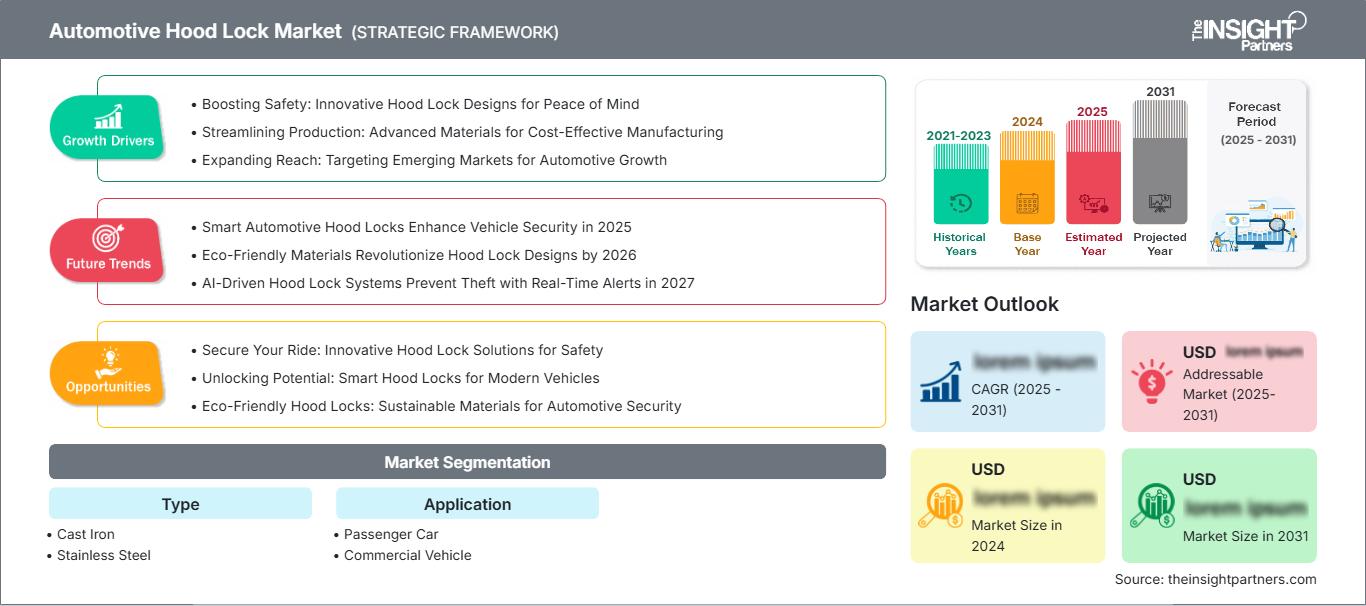
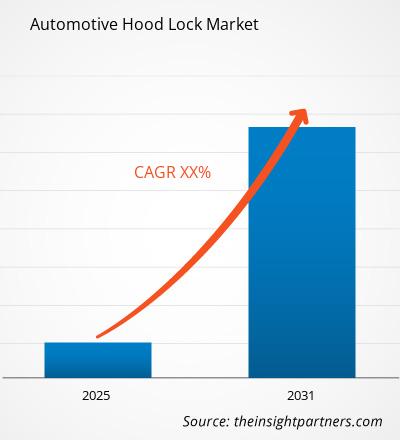
The Automotive Hood Lock Market is projected to grow from US$ 1.27 Billion in 2025 to US$ 2.56 Billion by 2034, registering a CAGR of 8.09% during 2026–2034. Growth is supported by rising vehicle production, stricter closure safety expectations, expanding aftermarket replacement, and the increasing use of secure front-compartment mechanisms across passenger cars and commercial vehicles.
North America remains an important specification-led demand base, with Automotive Hood Lock Market size supported by pickup platforms, utility vehicles, fleet maintenance, and safety-driven replacement cycles. The region is estimated to hold 22–25% share in 2025 and expand at a 7.5–8.0% CAGR during 2026–2034, helped by vehicle parc growth and stronger hood latch durability requirements.
Automotive Hood Lock Market Assessment and Insights
- North America: Held an estimated 22–25% share in 2025 and is projected to grow at a 7.5–8.0% CAGR during 2026–2034, supported by pickups, SUVs, repair demand, and hood safety requirements.
- US: Represented 79–83% of North America demand in 2025 and is expected to grow at a 7.6–8.1% CAGR, led by aftermarket replacement and OEM platform refresh cycles.
- Europe: Accounted for 24–27% share in 2025 and is forecast to grow at a 7.2–7.8% CAGR, with Germany, the UK, France, Italy, and Spain leading demand.
- Asia Pacific: Represented 39–43% share in 2025 and is projected to grow at an 8.4–9.0% CAGR, led by China, Japan, South Korea, India, and Australia.
- Largest Segment: Stainless Steel held 58–62% market share in 2025 and is projected to grow at a 7.9–8.4% CAGR due to corrosion resistance and durability.
- High Growth Segment: Passenger Car held 66–70% market share in 2025 and is projected to grow at an 8.3–8.9% CAGR as vehicle output and safety content rise.
- Key companies analyzed in detail: Dura Automotive Systems, LLC; YoungWoo Tech Co., Ltd.; Dorman Products, Inc.; WITTE Automotive GmbH; Shivani Locks Pvt. Ltd.; AISIN Corporation; Aditya Auto Products & Engineering India Pvt. Ltd.; Crown Automotive Sales Co., Inc.; Magal Engineering Co. India Pvt. Ltd.; Pyeong Hwa Automotive Co., Ltd.
Source: The Insight Partners' analysis based on proprietary research, government publications, company annual reports, investor presentations, industry databases, and expert interviews.
Hood lock systems have moved from simple mechanical retainers toward more validated assemblies with better striker alignment, cable actuation, anti-rattle behavior, and corrosion performance. The Automotive Hood Lock Market growth is linked to vehicle front-end redesign, stricter durability testing, and increasing service demand for worn latch mechanisms. Suppliers are also adapting products for EV front storage areas where secure closure, release control, and sensor feedback become more relevant.
Over the forecast period, regional sourcing, platform localization, and electrified vehicle architecture will influence procurement. Asia Pacific will remain the highest-volume production base, while North America and Europe emphasize safety validation, aftermarket availability, and premium latch feel. Companies with stamping, casting, spring, cable, and assembly expertise are positioned to support OEM and replacement channels.
Automotive Hood Lock Market Report Scope
| Report Attribute | Details |
|---|---|
| Market size in 2025 | US$ 1.27 Billion |
| Market Size by 2034 | US$ 2.56 Billion |
| Global CAGR (2026 - 2034) | 8.09% |
| Historical Data | 2021-2024 |
| Forecast period | 2026-2034 |
Automotive Hood Lock Market Analysis
Rising vehicle production and the need for reliable hood retention are central to Automotive Hood Lock Market growth. Hood locks protect engine bays, battery zones, front storage compartments, and service access panels from unintended opening during operation. Demand is supported by OEM fitment, accident repair, corrosion-related replacement, and fleet maintenance. The ecosystem includes metal processors, spring suppliers, cable manufacturers, latch assemblers, coating providers, Tier 1 system suppliers, distributors, and vehicle service networks.
The Automotive Hood Lock Market analysis shows that performance depends on pull force, secondary catch reliability, release smoothness, coating life, noise behavior, and compatibility with vehicle front-end geometry. Stainless steel and coated ferrous materials dominate because they balance strength and corrosion resistance. Supply dynamics are affected by stamping capacity, tool validation, zinc and steel prices, and regional aftermarket inventories.
Competition is fragmented between global closure-system specialists and regional component manufacturers. WITTE Automotive GmbH, AISIN Corporation, Dura Automotive Systems, LLC, and Pyeong Hwa Automotive Co., Ltd. support OEM-oriented closure and latch technologies, while Dorman Products, Inc. and Crown Automotive Sales Co., Inc. maintain aftermarket visibility. Shivani Locks Pvt. Ltd., Aditya Auto Products & Engineering India Pvt. Ltd., Magal Engineering Co. India Pvt. Ltd., and YoungWoo Tech Co., Ltd. strengthen regional supply coverage.
Investment priorities are shifting toward modular latch assemblies, sensor-ready locking systems, automated forming, and quality systems that reduce warranty risk. Suppliers with validated corrosion testing, consistent spring performance, and regional tooling support can defend sourcing positions. Strategic value is strongest where manufacturers serve both passenger cars and commercial vehicles without compromising cost or durability.
● REPORT CUSTOMIZATION
Tailor This Report To Align With Your Specific Business Requirements
This report can be customized to align precisely with your business objectives, scope, and target markets. Customization options include tailored segmentation, geography, competitive analysis, and strategic insights to support informed decision-making.
Customize This Report →WHAT YOU CAN ADJUST
- ● Segmentations
- ● Geography
- ● Competitive Analysis
- ● Language Preferences
Automotive Hood Lock Market: Strategic Insights
Regional Insights
North America Automotive Hood Lock Market
North America accounted for an estimated 22–25% Automotive Hood Lock Market share in 2025 and is forecast to grow at a 7.5–8.0% CAGR during 2026–2034. Demand is concentrated in the US and Mexico, where light trucks, SUVs, commercial vans, and high-mileage fleets create steady OEM and replacement demand.
Vehicle parc size, repair activity, and safety inspections support latch replacement when release cables stretch, springs weaken, or corrosion affects secondary catches. Mexico contributes through assembly and component exports, while Canada adds fleet and service demand. EV front compartments also require reliable release and closure systems.
U.S. Automotive Hood Lock Market
The US represented 79–83% of North American demand in 2025 and is projected to expand at a 7.6–8.1% CAGR through 2034. Large pickup and SUV fleets increase demand for durable locks, while collision repair and do-it-yourself replacement sustain aftermarket sales.
Dorman Products, Inc., Crown Automotive Sales Co., Inc., WITTE Automotive GmbH, AISIN Corporation, and Dura Automotive Systems, LLC participate through aftermarket catalogs, OEM programs, or closure-system engineering. Application trends favor corrosion-resistant assemblies, direct-fit replacement, and sensor-compatible latch designs.
Europe Automotive Hood Lock Market
Europe held an estimated 24–27% share in 2025 and is expected to grow at a 7.2–7.8% CAGR during 2026–2034. Germany leads through premium vehicle platforms, tight closure tolerances, and advanced front-end modules. The UK supports replacement and performance applications across passenger cars and light commercial vehicles.
France, Italy, and Spain contribute through vehicle assembly, supplier networks, and compact car platforms that require reliable, lightweight latch designs. European sourcing emphasizes corrosion testing, pedestrian safety integration, and tactile release quality. WITTE Automotive GmbH and AISIN Corporation support premium and global OEM programs.
APAC Automotive Hood Lock Market
APAC represented 39–43% share in 2025 and is projected to grow at an 8.4–9.0% CAGR through 2034. China leads demand through vehicle production scale, EV platforms, and localized component supply. Japan and South Korea contribute precision latch engineering, while India expands cost-efficient production.
Australia adds aftermarket replacement and utility vehicle demand. Regional growth is supported by rising passenger car output, commercial vehicle fleets, and greater use of stainless steel or coated components in humid and coastal markets. Local suppliers benefit from OEM localization and export-oriented assembly.
Middle East & Africa Automotive Hood Lock Market
The Middle East & Africa market is expected to grow at a 5.8–6.4% CAGR during 2026–2034. Saudi Arabia and the UAE lead demand through vehicle imports, SUV usage, and harsh-climate service requirements. South Africa supports assembly, replacement, and fleet maintenance channels.
High temperatures, dust exposure, and long service intervals increase stress on release cables, coatings, and latch springs. Rest of MEA demand is linked to commercial fleets, used vehicles, and aftermarket parts distribution. Growth improves as importers prioritize durable and corrosion-resistant assemblies.
Segmentation Analysis
Type
Type is projected to grow at a 7.8–8.4% CAGR during 2026–2034. The Automotive Hood Lock Market scope by type reflects strength, corrosion resistance, manufacturability, and cost. Cast iron remains relevant in heavy-duty or cost-sensitive assemblies, while stainless steel is preferred where durability, coating performance, and exposure to moisture are important.
- Cast Iron supports robust mechanical locking in cost-sensitive and heavy-duty applications, especially where component mass is less critical and buyers prioritize strength, established tooling, and predictable manufacturing economics.
- Stainless Steel leads demand because it improves corrosion resistance, appearance retention, and service life in vehicles exposed to rain, road salt, coastal humidity, and repeated hood opening cycles.
Application
Application is forecast to grow at a 8.0–8.6% CAGR during 2026–2034. Passenger cars generate the largest volume due to high production scale and replacement demand, while commercial vehicles require stronger assemblies that withstand vibration, long duty cycles, and frequent maintenance access.
- Passenger Car demand is supported by large vehicle output, rising safety expectations, compact front-end designs, EV frunks, and replacement of worn latches in aging vehicle fleets.
- Commercial Vehicle applications require durable locking systems for vans, pickups, buses, and trucks where frequent service access, vibration, dust, and long operating hours raise reliability requirements.
Opportunity Snapshot
| Application | Revenue Contribution | Trend Tag | Adoption Stage |
| Passenger Car | High | EV Frunks | Scaling |
| Commercial Vehicle | Medium | Fleet Repair | Mature |
Automotive Hood Lock Market Growth Drivers and Impact Analysis
Vehicle Safety Expectations Raise Latch Validation Needs
Automobile manufacturers now view hood latches as critical safety components, rather than simple mechanical parts that add little complexity. Failure of the latch may affect visibility, service safety, airflow at the front end of the vehicle, and the buyer's confidence. This leads to the need for a more robust secondary latch, corrosion protection, a stable opening force, and testing under vibrational conditions. Suppliers that provide repeatable quality, documented testing, and consistent fitment gain stronger sourcing positions because latch replacement after failure can create warranty costs and brand risk.
EV Front Compartments Create New Closure Requirements
Electric cars are changing the way front-end design is done because they have front-end storage, small cooling systems, and high-voltage servicing areas. This makes having good hood latching systems and confirmation sensors more important. The Automotive Hood Lock Market benefits as latch assemblies become part of broader front-compartment access strategies. EV users also interact with front storage more frequently than traditional engine bays, which raises cycle-life expectations. Suppliers that can adapt mechanical locks for sensor-ready and low-noise applications can capture higher-value programs.
Aftermarket Replacement Expands with Aging Vehicle Parc
Hood locks face wear from repeated opening, cable tension, misalignment, road debris, corrosion, and accident repairs. The increasing age of vehicle fleets makes the replacement market flourish in workshops, DIY markets, and even fleets. This is good for aftermarket manufacturers, since latch assemblies have direct fitment and are relatively cheap and crucial for safety and convenience. This effect is most evident in North America, India, the Middle East, and some parts of Europe, where older cars continue to be operated for many years. Catalogs, fitment accuracy, and availability of parts become key commercial factors here.
Automotive Hood Lock Market Future Trends
Sensor-Ready Hood Lock Assemblies
Automotive Hood Lock Market trends point toward locks that combine mechanical retention with position sensing, diagnostic feedback, and integration into vehicle security systems. The upcoming assemblies will have more capabilities to alert about the opened hood, close the frunk, remotely control its unlocking function, and ensure safety for maintenance operations. The most significant growth will occur with EVs, luxury cars, and business vehicle fleets that use connectivity with maintenance services. The suppliers will have to integrate capabilities of stamping, springs, switches, connectors, and seals in small, inexpensive, and durable assemblies.
Lightweight and Corrosion-Resistant Materials
Material selection will increasingly balance strength, mass, and environmental durability. The use of stainless steel, coated steels, improved surface finishes, and stamping geometry will become important factors as the car companies look to reduce weight on the front end without affecting the latch function. Markets located on the coast, markets that are prone to the use of salt on roads, and commercial fleets will demand validation of the extended life of coating with good release performance post-corrosion.
Automotive Hood Lock Market Opportunities
EV Frunk and Premium Closure Programs
Automotive Hood Lock Market Forecasts show meaningful opportunity in EV frunk systems, premium closure modules, and front-end access assemblies. These components would have to provide security lockup, easy operation, sensing capability, and improved noise characteristics over conventional hood latches. The component suppliers could add value by providing a modular system approach for the latch, striker, cable, actuator, and switch. This is particularly true of programs that use similar electric vehicle architectures, as a single validated design would cover several vehicles and regional assembly plants.
Localized Aftermarket Distribution
Replacement demand creates an opportunity for suppliers with broad catalogs, accurate fitment data, and regional warehouse networks. Hood lock failures are identified through maintenance, repairs after accidents, and inspections. Availability has an effect on the decision for repair work. Firms can expand their business by providing components to independent garages, Internet marketplaces, and fleet operators. The potential in this case is highest where vehicle age and tough driving conditions are present.
Frequently Asked Questions

- Comprehensive Market Sizing and Forecast Analysis
- Detailed Segmentation Analysis
- In-Depth Market Dynamics Assessment
- Regional and Country-Level Insights
- Competitive Landscape and Company Benchmarking
- Strategic Business Intelligence
Recent Reports
Testimonials

The Insight Partners provided valuable market intelligence that supported our global go-to-market strategy. Their team was professional, responsive, and attentive to our feedback, providing thoughtful analysis and helpful methodological clarifications throughout the project.
Junmo Kim Chief Financial Officer (CFO), Enertech Co., Ltd.
The Insight Partners' SCADA System Market report is comprehensive, with valuable insights on current trends and future forecasts. The team was highly professional, responsive, and supportive throughout. We are very satisfied and highly recommend their services.
RAN KEDEM Partner, Reali Technologies LTDs
I requested a report on a very specific software market and the team produced the report in a few days. The information was very relevant and well presented. I then requested some changes and additions to the report. The team was again very responsive and I got the final report in less than a week.
JEAN-HERVE JENN Chairman, Future Analytica
We worked with The Insight Partners for an important market study and forecast. They gave us clear insights into opportunities and risks, which helped shape our plans. Their research was easy to use and based on solid data. It helped us make smart, confident decisions. We highly recommend them.
PIYUSH NAGPAL Sr. Vice President, High Beam Global
The Insight Partners delivered insightful, well-structured market research with strong domain expertise. Their team was professional and responsive throughout. The user-friendly website made accessing industry reports seamless. We highly recommend them for reliable, high-quality research services
YUKIHIKO ADACHI CEO, Deep Blue, LLC.
This is the first time I have purchased a market report from The Insight Partners.While I was unsure at first, I visited their web site and felt more comfortable to take the risk and purchase a market report.I am completely satisfied with the quality of the report and customer service. I had several questions and comments with the initial report, but after a couple of dialogs over email with their analyst I believe I have a report that I can use as input to our strategic planning process.Thank you so much for taking the extra time and making this a positive experience.I will definitely recommend your service to others and you will be my first call when we need further market data.
JOHN SUZUKI President and Chief Executive Officer, Board Director, BK Technologies
I wish to appreciate your support and the professionalism you displayed in the course of attending to my request for information regarding to infectious disease IVD market in Nigeria. I appreciate your patience, your guidance, and the fact that you were willing to offer a discount, which eventually made it possible for us to close a deal. I look forward to engaging The Insight Partners in the future, all thanks to the impression you have created in me as a result of this first encounter.
DR CHIJIOKE ONYIA MANAGING DIRECTOR, PineCrest Healthcare Ltd.Reason to Buy
- Informed Decision-Making
- Understanding Market Dynamics
- Competitive Analysis
- Identifying Emerging Markets
- Customer Insights
- Market Forecasts
- Risk Mitigation
- Boosting Operational Efficiency
- Strategic Planning
- Investment Justification
- Tracking Industry Innovations
- Aligning with Regulatory Trends





 Get Free Sample for