
Automotive Millimeter Wave Radar Market Share, Growth & Forecast by 2034
Coverage: By Type (24GHz, 77GHz, Other); Application (Blind Spot Detection, Adaptive Cruise Control System, Other) , and Geography (North America, Europe, Asia Pacific, and South and Central America)
- Status : Data Released
- Report Code : TIPRE00018366
- Category : Automotive and Transportation
- No. of Pages : 150
- Available Report Formats :


- Last update date : August 13, 2026


2025 Market Size
US$ 17,184.9 Mn
Base year value
2034 Forecast
US$ 46,197.99 Mn
Projected by 2034
CAGR 2026-2034
11.61 %
Growth rate
Addressable Market
US$ 278,759.09 Mn
(2026-2034)
The automotive millimeter wave radar market is projected to grow from US$ 17,184.9 Million in 2025 to US$ 46,197.99 Million by 2034, registering a CAGR of 11.61% during 2026–2034. Demand is accelerating as automakers expand advanced driver assistance systems across passenger vehicles, electric vehicles, and premium commercial platforms requiring reliable sensing for distance, speed, angle, and object tracking. Increasing adoption of adaptive cruise control, automatic emergency braking, and blind-spot detection systems is further supporting market growth.
North America is a major contributor to the automotive millimeter wave radar market size, with regional demand expected to grow at a CAGR of 10.4–11.0% during 2026–2034. Growth is supported by rising ADAS penetration, evolving safety regulations, pickup and SUV technology upgrades, and wider deployment of advanced driver assistance features. Strong OEM investment in connected and autonomous vehicle technologies, along with the presence of leading semiconductor and automotive technology companies, continues to strengthen regional market expansion.
Automotive Millimeter Wave Radar Market Assessment and Insights
- North America: Accounted for 29–32% share in 2025 and is projected to grow at a CAGR of 10.4–11.0% between 2026–2034, supported by ADAS regulation, premium vehicle adoption, and supplier engineering depth.
- US: Represented 83–87% of North America in 2025 and is expected to grow at a CAGR of 10.2–10.8%, driven by radar-based safety systems in light trucks, SUVs, EVs, and semi-autonomous functions.
- Europe: Held 27–30% share in 2025 and is forecast to grow at a CAGR of 10.0–10.6%, with Germany, the UK, France, Italy, and Spain leading radar integration through safety standards and premium platforms.
- Asia Pacific: Accounted for 34–38% share in 2025 and is projected to grow at a CAGR of 12.4–13.2%, supported by China, Japan, South Korea, India, and Australia.
- Largest Segment: 77GHz held 72–76% market share in 2025 and is projected to grow at a CAGR of 12.0–12.8% because higher resolution and long-range capability make it the preferred ADAS radar band.
- High Growth Segment: Adaptive Cruise Control System held 41–45% market share in 2025 and is projected to grow at a CAGR of 12.5–13.3% as highway assist and Level 2 driving functions expand.
- Key companies analyzed in detail: Aptiv PLC, Continental AG, DENSO Corporation, HELLA GmbH & Co. KGaA, Hitachi, Ltd., NIDEC CORPORATION, Robert Bosch GmbH, Shanghai Baolong Automotive Corporation, Veoneer, Inc., ZF Friedrichshafen AG.
Source: The Insight Partners' analysis based on proprietary research, government publications, company annual reports, investor presentations, industry databases, and expert interviews.
The development of radar sensor technology has evolved from being an option for premium driver assistance features to becoming an integral part of safety architecture for the mass vehicle segment, driven by the trend toward multi-sensor platforms in automobiles. This is supported by developments such as moving to 77GHz radars, software-based safety control units, and camera and ultrasonic sensor fusion.
Future developments will be defined by regional safety regulations, roadmaps of the automated vehicle sector, and supplier capabilities to reduce costs without compromising detection quality. New geographies will push the technology as advanced driving assistance features will go from luxury cars to mainstream vehicles. Development will be focused on 4D imaging radar technology, 77-81GHz frequency usage, and localized manufacturing close to EV and smart vehicle production centers.
Automotive Millimeter Wave Radar Market Report Scope
| Report Attribute | Details |
|---|---|
| Market size in 2025 | US$ 17,184.9 Million |
| Market Size by 2034 | US$ 46,197.99 Million |
| Global CAGR (2026 - 2034) | 11.61% |
| Historical Data | 2021-2024 |
| Forecast period | 2026-2034 |
Automotive Millimeter Wave Radar Market Analysis
The automotive millimeter wave radar market growth is driven by demand for reliable all-weather sensing, rising ADAS penetration, and regulatory pressure for collision avoidance technologies. The radar sensors have an edge over the optical sensors when it comes to detection of range and relative velocity in fog, rain, dust, and low-light conditions. Radar sensors are vital for the adaptive cruise control, blind-spot detection, and emergency braking functions. Radar sensor suppliers are working to improve their signal processing capabilities to identify pedestrians, two-wheelers, and vehicles within congested traffic.
The supply chain dynamics in radar sensors are becoming more dependent on semiconductors owing to the requirement of radio-frequency chips, antennas, processors, software, and calibration in radar sensors. The OEMs tend to consider the system capabilities in evaluating their suppliers, along with the hardware capabilities.
The market analysis shows a competitive landscape led by established Tier 1 suppliers with ADAS portfolios and global OEM relationships. Robert Bosch GmbH, Continental AG, DENSO Corporation, Aptiv PLC, ZF Friedrichshafen AG, HELLA GmbH & Co. KGaA, Veoneer, Inc., Hitachi, Ltd., NIDEC CORPORATION, and Shanghai Baolong Automotive Corporation compete through radar accuracy, integration capability, cost scaling, and regional supply support.
Investment is shifting toward 77GHz and 79GHz platforms, higher channel count, software-defined perception, and radar-camera fusion. Suppliers are also positioning around Level 2 and Level 2+ functions, where scalable radar coverage can improve vehicle confidence without the cost burden of full autonomous stacks. Strategic partnerships with semiconductor and software providers are becoming critical for launch timing.
● REPORT CUSTOMIZATION
Tailor This Report To Align With Your Specific Business Requirements
This report can be customized to align precisely with your business objectives, scope, and target markets. Customization options include tailored segmentation, geography, competitive analysis, and strategic insights to support informed decision-making.
Customize This Report →WHAT YOU CAN ADJUST
- ● Segmentations
- ● Geography
- ● Competitive Analysis
- ● Language Preferences
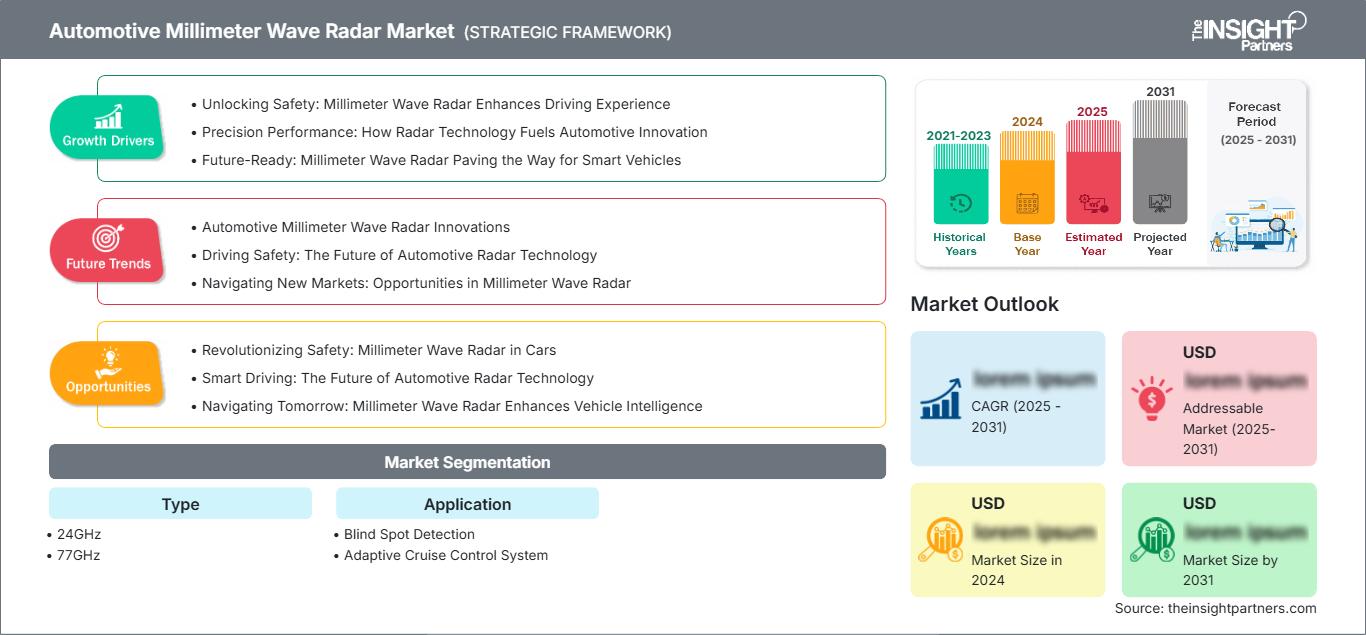
Automotive Millimeter Wave Radar Market: Strategic Insights
Regional Insights
North America automotive millimeter wave radar market
North America held 29–32% share in 2025 and is projected to grow at a CAGR of 10.4–11.0% during 2026–2034. The automotive millimeter wave radar market share is supported by strong light truck output, premium vehicle ADAS fitment, EV launches, and regulatory attention on crash avoidance technologies.
Automakers are using radar to strengthen highway assistance, adaptive cruise control, blind spot detection, and automatic braking packages. The region also benefits from engineering centers, Tier 1 validation capability, and a large repair ecosystem. Cost reduction will be important as radar moves into lower trims.
U.S. automotive millimeter wave radar Market
The US represented 83–87% of North America in 2025 and is projected to grow at a CAGR of 10.2–10.8%. Demand is concentrated in SUVs, pickup trucks, EVs, and premium passenger vehicles, where radar-based driver assistance has become a core safety and convenience feature.
Company presence includes Bosch, Continental, Aptiv, DENSO, ZF, HELLA, and Veoneer-linked radar capabilities serving OEM programs. Applications are expanding from rear and side sensing to front long-range radar, highway assist, lane change support, and adaptive cruise functions.
Europe automotive millimeter wave radar Market
Europe accounted for 27–30% share in 2025 and is expected to grow at a CAGR of 10.0–10.6%. Germany leads because premium OEMs and Tier 1 suppliers are deeply involved in ADAS system development, radar validation, and higher automation readiness.
The UK supports demand through safety-focused vehicle programs and software engineering, while France, Italy, and Spain contribute through compact vehicle production and supplier networks. Euro NCAP safety influence and automated emergency braking expectations keep radar adoption resilient despite vehicle affordability pressures.
APAC automotive millimeter wave radar Market
APAC held 34–38% share in 2025 and is projected to grow at a CAGR of 12.4–13.2%. China is the leading country due to EV production scale, intelligent vehicle competition, and rapid ADAS feature rollout.
Japan and South Korea support advanced radar engineering, while India is gaining momentum as spectrum clarity and safety awareness improve. Australia adds premium and fleet adoption. Regional growth is strongest where local automakers combine ADAS features with connected mobility and export programs.
Middle East & Africa automotive millimeter wave radar Market
The Middle East & Africa is projected to grow at a CAGR of 9.0–9.8% during 2026–2034. Saudi Arabia and the UAE lead adoption through premium vehicles, imported SUVs, fleet modernization, and smart mobility investment.
South Africa remains the most developed automotive production and aftermarket hub, while the rest of MEA demand depends on imported vehicles with factory-fitted ADAS. Harsh heat, dust, and highway conditions increase the value of reliable radar sensing in premium and fleet segments.
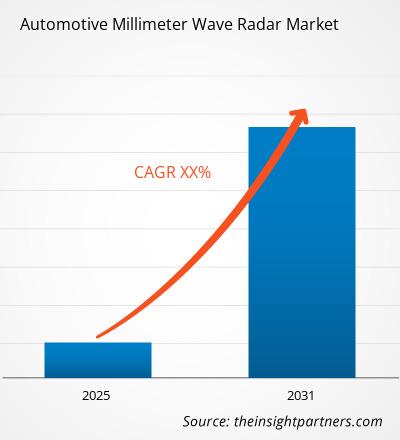
Segmentation Analysis
Type
Type is projected to grow at a CAGR of 11.8–12.5% during 2026–2034. The market scope across frequency types is shaped by detection range, angular resolution, bandwidth availability, regulatory support, and cost. 77GHz is becoming the dominant platform, while 24GHz remains present in legacy short-range and cost-sensitive functions.
- 24GHz continues serving selected short-range and legacy blind spot applications, but regulatory limits and lower resolution restrict its long-term use in advanced safety and automation functions.
- 77GHz leads adoption because it supports longer range, sharper resolution, better object separation, and compatibility with adaptive cruise control, emergency braking, and emerging 4D imaging radar systems.
Application
Application is expected to grow at a CAGR of 11.9–12.7% during 2026–2034. Blind spot detection supports volume deployment across rear and side sensing, while the adaptive cruise control system adoption expands faster as vehicles add highway assist and semi-autonomous driving capabilities.
- Blind Spot Detection remains a high-volume application because side and rear radar sensors improve lane-change awareness, cross-traffic alerts, and parking safety across passenger cars, SUVs, and light commercial vehicles.
- Adaptive Cruise Control System is strategically important because front radar enables speed control, distance keeping, stop-and-go assistance, and Level 2 highway functions across premium and increasingly mass-market platforms.
Opportunity Snapshot
| Application | Revenue Contribution | Trend Tag | Adoption Stage |
| Blind Spot Detection | High | Side Sensing | Mature |
| Adaptive Cruise Control System | High | Highway Assist | Scaling |
Automotive Millimeter Wave Radar Market Growth Drivers and Impact Analysis
ADAS Regulation and Consumer Safety Expectations
As regulations and ratings initiatives prompt auto manufacturers to adopt collision avoidance, blind spot detection, and emergency braking systems across wider vehicle classes, radar-based technology stands out because it provides range and speed sensing even under conditions such as bright light, rainy, foggy, or dark weather when cameras cannot function properly. The implications are far-reaching due to the expansion of safety systems from luxury-class vehicles to middle-range classes. The result is multiple sensors per car and ongoing product wins for vendors that can prove their effectiveness in various regions.
Shift from 24GHz to 77GHz Architectures
The shift from 24 GHz to 77 GHz radar is changing the product roadmap due to better performance in range, resolution, and separation of objects owing to higher bandwidths. These requirements are important for technologies such as adaptive cruise control, automatic braking, lane changes, and early autonomy. There are effects on the RF semiconductors, antennas, signal processing, and packaging modules used. The firms that are able to develop smaller-sized 77 GHz radars on a large scale would gain as the old 24 GHz system becomes obsolete in ADAS technologies.
EV and Software-Defined Vehicle Adoption
Integration of radars into electric and software-defined cars is becoming increasingly popular due to the fact that manufacturers rely on state-of-the-art technologies for the differentiation of technologically advanced vehicles. Electric vehicle platforms are usually centralized from an electronics perspective, which helps to combine information from radars with data from cameras, domain controllers, and even software over-the-air. This is especially obvious in China, North America, Europe, Japan, and South Korea, where the intelligent vehicle concept is directly linked to ADAS capabilities.
Automotive Millimeter Wave Radar Market Future Trends
4D Imaging Radar for Higher Automation
One of the important automotive millimeter wave radar market trends is the shift toward 4D imaging radar that adds elevation information and richer point-cloud style perception. These systems can improve object classification, lane-level awareness, and detection of smaller road users compared with conventional radar. As Level 2+ and Level 3 functions mature, automakers will seek sensing redundancy that performs in poor weather and low light. Suppliers will focus on higher channel counts, AI-enabled signal processing, and integration with centralized compute platforms.
Radar-Camera Fusion as a Standard Safety Stack
Future automotive safety systems will use radar-cam fusion decision-making systems in place of single-sensor systems. The camera provides object classification and the lane setting, while the radar provides distance, velocity, and ruggedness under low-visibility conditions. The fusion system increases confidence in the automatic brake, adaptive cruise control, lane change assistance, and cross-traffic warning systems. This is a move that will enhance the importance of software, since the perception software needs to integrate various sensor signals in real-time.
Automotive Millimeter Wave Radar Market Opportunities
Localized Radar Supply for Emerging ADAS Markets
Automotive millimeter-wave radar market Forecasts indicate a strong opportunity in emerging markets where safety regulations, EV localization, and consumer awareness are increasing. India, Southeast Asia, China, Mexico, and parts of the Middle East are likely to add radar content as automakers introduce global ADAS packages locally. Suppliers can benefit by localizing module assembly, calibration support, validation testing, and aftermarket diagnostics. This reduces cost and helps OEMs comply with regional spectrum and safety requirements while keeping radar-based features affordable for mass-market vehicles.
Retrofit Diagnostics and Repair Ecosystem Expansion
As radar-equipped vehicles age, workshops will need calibration tools, replacement sensors, mounting brackets, and diagnostic procedures. Even minor bumper repairs can affect radar alignment, creating service revenue opportunities. Suppliers and distributors can support this need through certified replacement modules, scan-tool compatibility, and technician training. The opportunity is strongest in North America, Europe, China, and developed APAC markets, where radar penetration is already high. Reliable repair workflows will also protect consumer trust in ADAS performance after collisions or component replacement.
Frequently Asked Questions

- Comprehensive Market Sizing and Forecast Analysis
- Detailed Segmentation Analysis
- In-Depth Market Dynamics Assessment
- Regional and Country-Level Insights
- Competitive Landscape and Company Benchmarking
- Strategic Business Intelligence
Recent Reports
Testimonials

The Insight Partners' SCADA System Market report is comprehensive, with valuable insights on current trends and future forecasts. The team was highly professional, responsive, and supportive throughout. We are very satisfied and highly recommend their services.
RAN KEDEM Partner, Reali Technologies LTDs
I requested a report on a very specific software market and the team produced the report in a few days. The information was very relevant and well presented. I then requested some changes and additions to the report. The team was again very responsive and I got the final report in less than a week.
JEAN-HERVE JENN Chairman, Future Analytica
We worked with The Insight Partners for an important market study and forecast. They gave us clear insights into opportunities and risks, which helped shape our plans. Their research was easy to use and based on solid data. It helped us make smart, confident decisions. We highly recommend them.
PIYUSH NAGPAL Sr. Vice President, High Beam Global
The Insight Partners delivered insightful, well-structured market research with strong domain expertise. Their team was professional and responsive throughout. The user-friendly website made accessing industry reports seamless. We highly recommend them for reliable, high-quality research services
YUKIHIKO ADACHI CEO, Deep Blue, LLC.
This is the first time I have purchased a market report from The Insight Partners.While I was unsure at first, I visited their web site and felt more comfortable to take the risk and purchase a market report.I am completely satisfied with the quality of the report and customer service. I had several questions and comments with the initial report, but after a couple of dialogs over email with their analyst I believe I have a report that I can use as input to our strategic planning process.Thank you so much for taking the extra time and making this a positive experience.I will definitely recommend your service to others and you will be my first call when we need further market data.
JOHN SUZUKI President and Chief Executive Officer, Board Director, BK Technologies
I wish to appreciate your support and the professionalism you displayed in the course of attending to my request for information regarding to infectious disease IVD market in Nigeria. I appreciate your patience, your guidance, and the fact that you were willing to offer a discount, which eventually made it possible for us to close a deal. I look forward to engaging The Insight Partners in the future, all thanks to the impression you have created in me as a result of this first encounter.
DR CHIJIOKE ONYIA MANAGING DIRECTOR, PineCrest Healthcare Ltd.Reason to Buy
- Informed Decision-Making
- Understanding Market Dynamics
- Competitive Analysis
- Identifying Emerging Markets
- Customer Insights
- Market Forecasts
- Risk Mitigation
- Boosting Operational Efficiency
- Strategic Planning
- Investment Justification
- Tracking Industry Innovations
- Aligning with Regulatory Trends





 Get Free Sample for