
Automotive Motors Market Growth, Share & Trends by 2034
Coverage: By Product Type (DC Motor, Stepper Motor, Traction Motor); Application (Performance, Comfort, Safety); Vehicle Type (Passenger Cars, Commercial Vehicles) , and Geography (North America, Europe, Asia Pacific, and South and Central America)
- Status : Data Released
- Report Code : TIPRE00009711
- Category : Automotive and Transportation
- No. of Pages : 150
- Available Report Formats :


- Last update date : August 13, 2026


2025 Market Size
US$ 39.74 Bn
Base year value
2034 Forecast
US$ 58.14 Bn
Projected by 2034
CAGR 2026-2034
4.32 %
Growth rate
Addressable Market
US$ 444.52 Bn
(2026-2034)
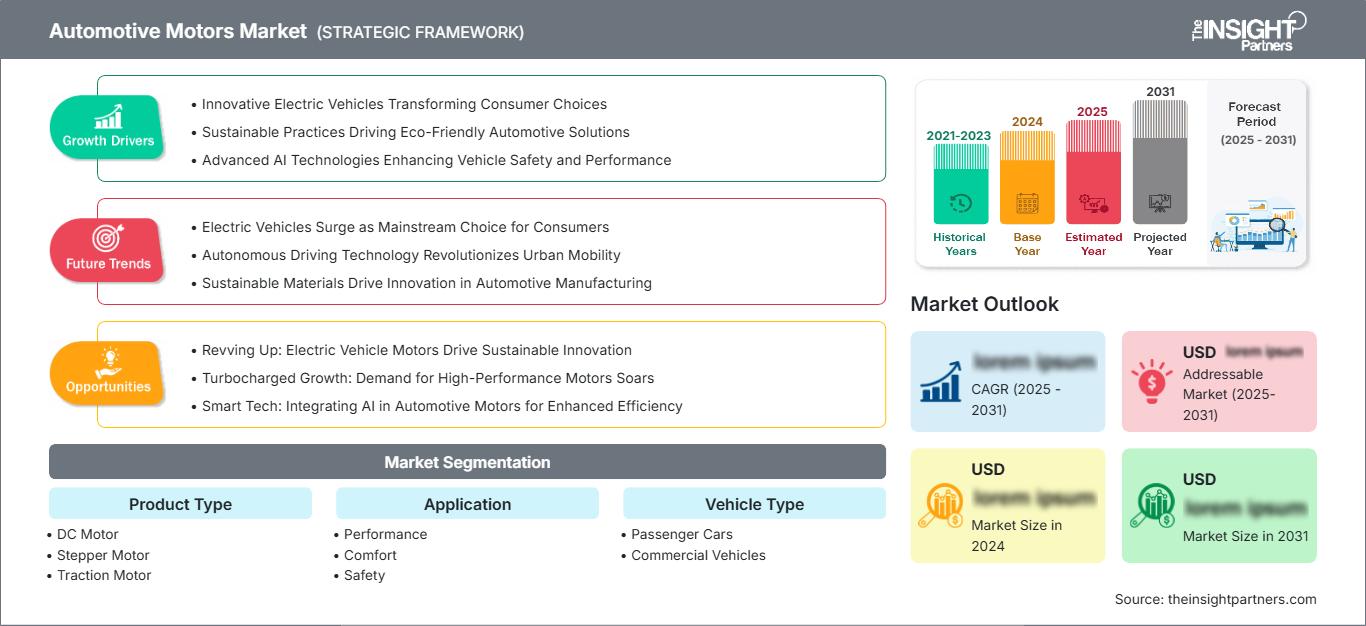
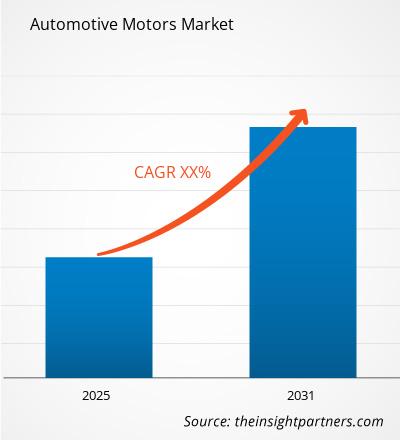
The automotive motors market is projected to grow from US$ 39.74 Billion in 2025 to US$ 58.14 Billion by 2034, registering a CAGR of 4.32 % during 2026–2034. Demand is supported by electrified powertrains, rising comfort electronics, active safety systems, and wider use of compact electric motors across propulsion, thermal management, braking, steering, seating, and body-control functions.
North America remains an important contributor to automotive motors market size, with regional demand expected to grow at a CAGR of 3.8–4.2% during 2026–2034. Growth is supported by electric vehicle assembly, pickup and SUV electronics content, 48V mild-hybrid adoption, and expanding use of motors in safety, comfort, and performance applications across passenger and commercial vehicles.
Automotive Motors Market Assessment and Insights
- North America: Accounted for 22–25% share in 2025 and is projected to grow at a CAGR of 3.8–4.2% between 2026–2034, supported by electrification, light truck production, and high comfort-feature penetration.
- US: Represented 80–84% of North America in 2025 and is expected to grow at a CAGR of 3.7–4.1%, driven by EV platforms, advanced safety systems, and premium vehicle electronics.
- Europe: Held 21–24% share in 2025 and is forecast to grow at a CAGR of 3.6–4.0%, with Germany, the UK, France, Italy, and Spain leading demand through electrification and safety regulation.
- Asia Pacific: Accounted for 43–47% share in 2025 and is projected to grow at a CAGR of 4.8–5.4%, supported by China, Japan, South Korea, India, and Southeast Asian production bases.
- Largest Segment: DC Motor held 42–45% market share in 2025 and is projected to grow at a CAGR of 3.7–4.2% due to broad use in comfort, body, HVAC, and low-voltage systems.
- High Growth Segment: Traction Motor held 24–28% market share in 2025 and is projected to grow at a CAGR of 6.6–7.4% as EV and hybrid platforms scale globally.
- Key companies analyzed in detail: BorgWarner Inc., DENSO Corporation, Johnson Electric Holdings Limited, MABUCHI MOTOR CO., LTD., MAHLE GmbH, MITSUBA Corporation, Mitsubishi Electric Corporation, NIDEC CORPORATION, Robert Bosch GmbH, Valeo SE.
Source: The Insight Partners' analysis based on proprietary research, government publications, company annual reports, investor presentations, industry databases, and expert interviews.
Motor content per vehicle has grown to include integrated electric drives for braking, steering, thermal management, drive train accessories, and propulsion, beyond the initial wipers, windows, and fans. This evolution is good for the market because each step towards electrification creates new opportunities for more efficient, quieter, and smaller motors. Improved brushless technology, enhanced magnets, electronics integration, and diagnosability will change the way products are developed.
Going forward, adoption rates of vehicle electrification, supply of semiconductors, availability of rare earths, and OEM platform strategies will impact demand growth. Asia Pacific will continue to be the volume base, but North America and Europe will generate the high-end traction and safety products. Suppliers with motor design, power electronics, thermal capability, and localized production will have an opportunity to win long-cycle sourcing agreements.
Automotive Motors Market Report Scope
| Report Attribute | Details |
|---|---|
| Market size in 2025 | US$ 39.74 Billion |
| Market Size by 2034 | US$ 58.14 Billion |
| Global CAGR (2026 - 2034) | 4.32% |
| Historical Data | 2021-2024 |
| Forecast period | 2026-2034 |
Automotive Motors Market Analysis
The automotive motors market growth is driven by higher electronic content per vehicle, electrified accessories, and wider use of motorized comfort and safety functions. Automakers are replacing mechanical and hydraulic systems with electric pumps, fans, actuators, compressors, and steering assistance to improve efficiency and controllability. The value chain now links copper, magnets, laminations, semiconductors, software, and precision assembly more tightly than legacy motor supply models.
The supply situation favors firms with economies of scale, skills in motor control, and experience handling volatile prices for copper and rare earth elements. The OEMs demand platform-level standardization with custom design of torque, voltage, package and thermal performance for vehicle-specific applications. This makes validation, durability and regional engineering more important than before.
The market analysis identifies two groups of competitors, namely traditional motor experts and Tier 1 firms focused on electrification. The firms competing in the market include BorgWarner Inc., DENSO Corporation, NIDEC CORPORATION, Robert Bosch GmbH, Valeo SE, MAHLE GmbH, Mitsubishi Electric Corporation, Johnson Electric Holdings Limited, MABUCHI MOTOR CO., LTD., and MITSUBA Corporation.
Investment is moving toward hairpin traction motors, brushless DC modules, high-speed compressors, e-axle integration, and motor systems compatible with 400V and 800V architectures. Suppliers are also strengthening software and electronics capability because motor performance increasingly depends on control algorithms, diagnostics, and thermal management rather than mechanical design alone.
● REPORT CUSTOMIZATION
Tailor This Report To Align With Your Specific Business Requirements
This report can be customized to align precisely with your business objectives, scope, and target markets. Customization options include tailored segmentation, geography, competitive analysis, and strategic insights to support informed decision-making.
Customize This Report →WHAT YOU CAN ADJUST
- ● Segmentations
- ● Geography
- ● Competitive Analysis
- ● Language Preferences
Automotive Motors Market: Strategic Insights
Regional Insights
North America automotive motors market
North America held 22–25% share in 2025 and is projected to grow at a CAGR of 3.8–4.2% during 2026–2034. The automotive motors market share is supported by light truck production, EV localization, and demand for comfort electronics in higher-trim vehicles.
Automakers are adding motors for electric steering, brake actuation, HVAC, battery cooling, seat systems, and propulsion. The US leads regional demand, while Mexico supports component assembly and export programs. Supplier opportunities are strongest where motor modules improve energy efficiency and reduce hydraulic system complexity.
U.S. automotive motors Market
The US represented 80–84% of North America in 2025 and is projected to grow at a CAGR of 3.7–4.1%. Demand is concentrated in EVs, hybrids, SUVs, pickups, and premium passenger vehicles with high levels of electronic actuation.
Company presence includes BorgWarner Inc., DENSO Corporation, Robert Bosch GmbH, Valeo SE, NIDEC CORPORATION, and Johnson Electric Holdings Limited, serving propulsion, body, thermal, and safety applications. Application trends include traction motors, electric oil pumps, coolant pumps, seat motors, wiper systems, and motorized braking components.
Europe automotive motors Market
Europe accounted for 21–24% share in 2025 and is expected to grow at a CAGR of 3.6–4.0%. Germany leads regional demand through premium EV platforms, advanced supplier engineering, and strong uptake of high-efficiency powertrain auxiliaries.
The UK supports motor demand in specialty and premium vehicles, while France, Italy, and Spain contribute through compact car production, commercial vehicle platforms, and electrified component sourcing. Emissions regulation and safety requirements encourage electric actuation, but affordability pressure limits rapid adoption in lower-cost models.
APAC automotive motors Market
APAC held 43–47% share in 2025 and is projected to grow at a CAGR of 4.8–5.4%. China is the leading country due to EV scale, local motor suppliers, and high electronics content in intelligent vehicles.
Japan and South Korea support advanced motor engineering, while India adds demand through passenger car production and two-wheeler electrification spillovers. Australia contributes through imported vehicles and service demand. Regional growth benefits from dense supply chains, cost-competitive manufacturing, and strong OEM localization.
Middle East & Africa automotive motors Market
The Middle East & Africa is projected to grow at a CAGR of 3.2–3.7% during 2026–2034. Saudi Arabia and the UAE support demand through premium vehicle imports, fleet modernization, and EV infrastructure investment.
South Africa remains the leading production and aftermarket hub, while the rest of MEA demand is linked to imported passenger cars and commercial vehicles. Harsh climate conditions raise the importance of reliable cooling, HVAC, fan, and wiper motors across long service cycles.
Segmentation Analysis
Product Type
Product Type is projected to grow at a CAGR of 4.4–4.9% during 2026–2034. The market scope across product types is shaped by voltage architecture, efficiency, torque density, cost, and application duty cycle. DC motors remain widespread in auxiliary functions, stepper motors support precision control, and traction motors gain value as electrified propulsion expands.
- DC Motor remains widely used in windows, seats, HVAC doors, wipers, pumps, and fans because it offers cost efficiency, simple control, mature supply chains, and reliable performance in low-voltage vehicle systems.
- Stepper Motor supports precise positioning in instrument clusters, HVAC flaps, headlamp leveling, valves, and small actuators where controlled incremental motion is more important than continuous high-speed rotation.
- Traction Motor is strategically important for EVs, hybrids, and e-axle systems because it determines propulsion efficiency, torque response, regenerative braking capability, and thermal performance under demanding duty cycles.
Application
Application is expected to grow at a CAGR of 4.2–4.8% during 2026–2034. Comfort applications lead installed volume because modern vehicles use many small motors, while performance applications grow with electrified propulsion. Safety applications benefit from ADAS, braking, steering, and stability systems that require reliable electric actuation.
- Performance applications include traction drive, cooling, oil pumps, turbo support, and active chassis systems, where motor efficiency, thermal stability, torque control, and fast response affect vehicle dynamics.
- Comfort applications include power seats, windows, sunroofs, HVAC systems, mirrors, doors, and cabin ventilation, making the segment highly volume-driven across passenger cars and premium commercial vehicles.
- Safety applications use motors in braking, steering assistance, wiper systems, lighting adjustment, restraint support, and active control systems, where reliability and diagnostic capability are essential.
Vehicle Type
Vehicle Type is projected to grow at a CAGR of 4.1–4.6% during 2026–2034. Passenger cars lead demand because of high production volumes and extensive use of comfort, performance, and safety motors. Commercial vehicles increasingly adopt electric actuation to improve uptime, fuel efficiency, and driver-assistance capability.
- Passenger Cars represent the largest vehicle base because hatchbacks, sedans, SUVs, and EVs integrate motors across propulsion, HVAC, steering, braking, seating, closures, and body-control functions.
- Commercial Vehicles are gaining demand as fleets adopt electric fans, pumps, steering assist, brake actuation, cabin comfort systems, and traction motors in electric vans, buses, and trucks.
Opportunity Snapshot
| Application | Revenue Contribution | Trend Tag | Adoption Stage |
| Performance | High | E-Drive | Scaling |
| Comfort | High | Cabin Actuation | Mature |
| Safety | Medium | Brake Control | Scaling |
Automotive Motors Market Growth Drivers and Impact Analysis
Electrification of Propulsion and Auxiliary Systems
Increased demands from electric motors due to electrified vehicles go beyond the primary traction motor as EVs and HEVs use electric compressors, coolant and oil pumps, fans, brake boosters, and thermal management actuators. This is a very powerful driver in that suppliers of electric motors have the opportunity of securing multiple opportunities within each vehicle, rather than being limited to a propulsion program in the vehicle. OEMs are also adopting electric auxiliary systems to reduce mechanical losses and enhance energy management in addition to 48 volts or higher voltage systems.
Rising Comfort and Convenience Content per Vehicle
The trend for these features has been steadily rising to become a basic requirement even among moderately priced cars. Each of these increases motor content and makes noise, vibration, durability, and space more critical considerations. It is apparent in passenger cars, SUVs, and luxury commercial vehicles where differentiation within the cabin is key to pricing. DC motors and stepper motors will continue to be important due to their economic advantages and well-established production channels. This trend ensures steady volumes irrespective of variations in traction motor use across regions.
Safety Regulation and Electric Actuation Adoption
Modern safety systems have shifted to electric actuation for brake actuation, steering assist, wipers, light adjustments, and control functions. As driver assist systems increase in popularity, motors have to be able to function fast and remain reliable over many cycles. It will have a significant effect in situations where there are incentives to provide advanced braking systems, lane assist systems, and visibility. Additionally, electric actuation will enable diagnostic software to monitor any performance issues before they cause a failure.
Automotive Motors Market Future Trends
High-Efficiency Motors for 800V EV Platforms
One of the key automotive motors market trends is the shift toward high-efficiency traction and auxiliary motors compatible with 800V vehicle platforms. Higher voltage architectures reduce current losses and support faster charging, but they require better insulation, thermal control, and electronics integration. Motor suppliers will focus on hairpin windings, improved cooling, magnet optimization, and compact e-drive packaging. This trend will mainly benefit EV platforms in premium, performance, and long-range segments before wider adoption in cost-sensitive models.
Magnet-Light and Rare-Earth-Reduced Motor Designs
Upcoming motor systems will progressively decrease reliance on expensive, rare earths since their price fluctuation and geographical concentration make them a risky source of procurement. Improved ferrite motor systems, switched reluctance models, externally excited synchronous motor designs, and efficient permanent magnet configurations are being developed by manufacturers. These can minimize cost risks while maintaining desirable torque and efficiency levels. The issue will become even more important as automakers will regionalize their sources of electric vehicles' motors and related components.
Automotive Motors Market Opportunities
Localized Motor Manufacturing Near EV Hubs
The automotive motors market Forecasts point to a strong opportunity for suppliers that localize production near EV and hybrid assembly clusters. Manufacturing closer to the location minimizes logistics risks and increases the coordination in launching activities. Traction motors, pumps, fans, and thermal management systems can be developed in India, China, Mexico, Eastern Europe, and even the United States. Competitiveness of the suppliers can be increased using regional engineering capabilities, automated winding, and locally-sourced magnets, as well as offering services.
Integrated Motor and Electronics Modules
The trend in recent years is for OEMs to demand more from the suppliers in terms of integration, as they want all of the parts of the motor, such as the electric motor, the controller, sensors, software, and thermal capability to be combined into one module. The result is an opportunity for the supplier to change from supplying components to supplying systems. The areas where integration will offer an opportunity are traction drives, coolant pumps, brake actuators, steering and HVAC compressors.
Frequently Asked Questions

- Comprehensive Market Sizing and Forecast Analysis
- Detailed Segmentation Analysis
- In-Depth Market Dynamics Assessment
- Regional and Country-Level Insights
- Competitive Landscape and Company Benchmarking
- Strategic Business Intelligence
Recent Reports
Testimonials

The Insight Partners provided valuable market intelligence that supported our global go-to-market strategy. Their team was professional, responsive, and attentive to our feedback, providing thoughtful analysis and helpful methodological clarifications throughout the project.
Junmo Kim Chief Financial Officer (CFO), Enertech Co., Ltd.
The Insight Partners' SCADA System Market report is comprehensive, with valuable insights on current trends and future forecasts. The team was highly professional, responsive, and supportive throughout. We are very satisfied and highly recommend their services.
RAN KEDEM Partner, Reali Technologies LTDs
I requested a report on a very specific software market and the team produced the report in a few days. The information was very relevant and well presented. I then requested some changes and additions to the report. The team was again very responsive and I got the final report in less than a week.
JEAN-HERVE JENN Chairman, Future Analytica
We worked with The Insight Partners for an important market study and forecast. They gave us clear insights into opportunities and risks, which helped shape our plans. Their research was easy to use and based on solid data. It helped us make smart, confident decisions. We highly recommend them.
PIYUSH NAGPAL Sr. Vice President, High Beam Global
The Insight Partners delivered insightful, well-structured market research with strong domain expertise. Their team was professional and responsive throughout. The user-friendly website made accessing industry reports seamless. We highly recommend them for reliable, high-quality research services
YUKIHIKO ADACHI CEO, Deep Blue, LLC.
This is the first time I have purchased a market report from The Insight Partners.While I was unsure at first, I visited their web site and felt more comfortable to take the risk and purchase a market report.I am completely satisfied with the quality of the report and customer service. I had several questions and comments with the initial report, but after a couple of dialogs over email with their analyst I believe I have a report that I can use as input to our strategic planning process.Thank you so much for taking the extra time and making this a positive experience.I will definitely recommend your service to others and you will be my first call when we need further market data.
JOHN SUZUKI President and Chief Executive Officer, Board Director, BK Technologies
I wish to appreciate your support and the professionalism you displayed in the course of attending to my request for information regarding to infectious disease IVD market in Nigeria. I appreciate your patience, your guidance, and the fact that you were willing to offer a discount, which eventually made it possible for us to close a deal. I look forward to engaging The Insight Partners in the future, all thanks to the impression you have created in me as a result of this first encounter.
DR CHIJIOKE ONYIA MANAGING DIRECTOR, PineCrest Healthcare Ltd.Reason to Buy
- Informed Decision-Making
- Understanding Market Dynamics
- Competitive Analysis
- Identifying Emerging Markets
- Customer Insights
- Market Forecasts
- Risk Mitigation
- Boosting Operational Efficiency
- Strategic Planning
- Investment Justification
- Tracking Industry Innovations
- Aligning with Regulatory Trends





 Get Free Sample for