
Automotive Night vision System Market Size, Trends & Demand by 2034
Coverage: By Technology (Far Infrared (FIR), Near Infrared (NIR)); Display Type (Navigation System, Instrument Cluster, HUD); Components (Night Vision camera, Controlling Unit, Display Unit, Others) , and Geography (North America, Europe, Asia Pacific, and South and Central America)
- Status : Data Released
- Report Code : TIPRE00004977
- Category : Automotive and Transportation
- No. of Pages : 150
- Available Report Formats :


- Last update date : August 17, 2026


2025 Market Size
US$ 3.36 Bn
Base year value
2034 Forecast
US$ 8.38 Bn
Projected by 2034
CAGR 2026-2034
10.69 %
Growth rate
Addressable Market
US$ 51.99 Bn
(2026-2034)
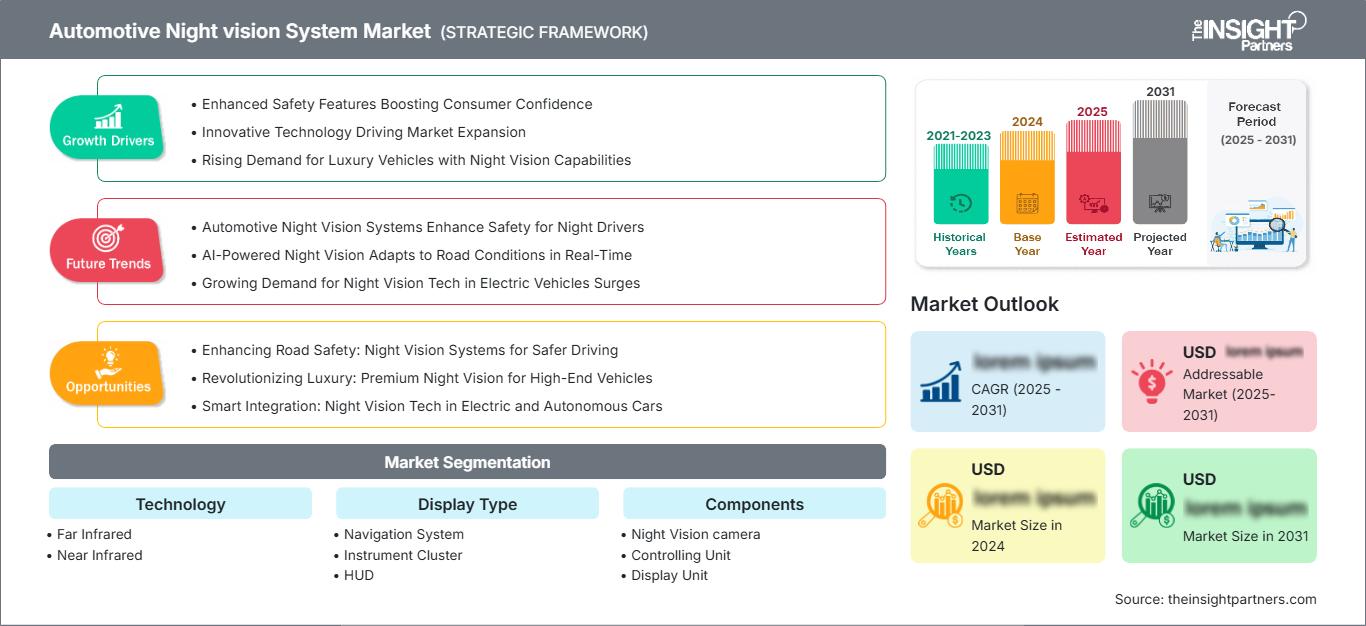
The automotive night vision system market was valued at US$ 3.36 billion in 2025 and is projected to reach US$ 8.38 billion by 2034, registering a CAGR of 10.69% during 2026–2034. The market is witnessing significant expansion due to increasing adoption of advanced driver assistance systems (ADAS), rising vehicle safety standards, and growing demand for premium safety technologies. Automotive manufacturers continue integrating night vision systems into premium and luxury vehicles to improve pedestrian detection, obstacle recognition, and driver visibility under low-light conditions.
North America continues to maintain a strong position owing to high penetration of advanced safety technologies, favorable regulatory initiatives, and increasing adoption of premium passenger vehicles. The automotive night vision system market size across the region is supported by growing investments in autonomous driving technologies and intelligent driver assistance solutions. Expanding deployment of thermal imaging sensors and infrared camera technologies is expected to support a regional CAGR ranging between 9.8–10.5% during the forecast period.
Automotive Night vision System Market Assessment and Insights
- North America: Accounted for 31–34% share in 2025 and is projected to grow at a CAGR of 9.8–10.5% during 2026–2034. Increasing adoption of premium vehicles, stringent vehicle safety regulations, and expanding deployment of ADAS technologies continue to support regional growth.
- US: Represented approximately 75–79% of the North American market in 2025 and is expected to register a CAGR of 10.0–10.7% through 2034. Rising demand for intelligent safety systems and luxury vehicles remains a major growth contributor.
- Europe: Held 28–31% share in 2025 while recording a CAGR of 9.7–10.4%. Germany, France, the United Kingdom, and Italy remain major adopters owing to their established premium automotive manufacturing industries.
- Asia Pacific: Accounted for 30–33% share in 2025 and is projected to register the highest CAGR of 11.6–12.3% during 2026–2034. China, Japan, South Korea, and India continue witnessing increasing adoption of advanced automotive electronics and vehicle safety technologies.
- Largest Segment: Far Infrared accounted for approximately 60–64% market share in 2025 and is anticipated to grow at a CAGR of 10.8–11.5% owing to superior long-range thermal imaging capability.
- High Growth Segment: HUD (Head-Up Display) represented approximately 33–37% market share in 2025 and is expected to register a CAGR of 11.8–12.5% during the forecast period due to increasing adoption of intelligent cockpit technologies.
- Key companies analyzed in detail: OMNIVISION Technologies, Inc.; Autoliv Inc.; Bendix Commercial Vehicle Systems LLC; Continental AG; Mercedes-Benz Group AG; Aptiv PLC; DENSO Corporation; Teledyne FLIR LLC; OMRON Corporation; Robert Bosch GmbH.
Source: The Insight Partners' analysis based on proprietary research, government publications, company annual reports, investor presentations, industry databases, and expert interviews.
Automotive safety systems keep innovating to move from being just passive in nature to becoming intelligent accident prevention systems. The industry has greatly benefited from fast developments in infrared detection, thermal imaging, artificial intelligence, and computer vision algorithms that can detect objects such as pedestrians, cyclists, animals, and roadside obstacles in low-visibility environments. Ongoing advancements in sensor resolution and processing power will make the technology more commercially viable within luxury cars.
The future demand will increase owing to the development of software-defined cars, autonomous drive systems, and intelligent cockpit systems within passenger cars. Investments in automotive semiconductor technologies, thermal imaging sensors, and object recognition technologies using artificial intelligence are expected to speed up the commercial viability of the system.
Automotive Night vision System Market Report Scope
| Report Attribute | Details |
|---|---|
| Market size in 2025 | US$ 3.36 Billion |
| Market Size by 2034 | US$ 8.38 Billion |
| Global CAGR (2026 - 2034) | 10.69% |
| Historical Data | 2021-2024 |
| Forecast period | 2026-2034 |
Automotive Night vision System Market Analysis
Growing implementation of advanced safety technologies remains one of the strongest contributors to market growth. Growing interest in collision avoidance systems that can increase driver awareness in night driving and bad weather is evident among governments and car manufacturers. The use of night vision systems increases the safety of vehicles since it enables them to detect people, animals, and any other obstacles beyond the range of normal headlights. Growing consumer interest in sophisticated safety features keeps encouraging manufacturers to incorporate infrared imaging into new car designs.
The business ecosystem involves producers of infrared sensors, semiconductors, thermal imaging systems, camera providers, software vendors, Tier-1 automotive suppliers, original equipment manufacturers of vehicles, and after-market solutions providers. Ongoing developments in artificial intelligence, machine vision, high-resolution thermal cameras, and embedded computing systems allow manufacturers to increase accuracy while shrinking system size and lowering cost.
Competitive dynamics within the automotive night vision system market analysis continue evolving as global automotive suppliers invest heavily in intelligent sensing technologies. Companies including Continental AG, Robert Bosch GmbH, DENSO Corporation, OMNIVISION Technologies, Inc., Aptiv PLC, and Teledyne FLIR LLC continue strengthening product portfolios through investments in thermal imaging, artificial intelligence, sensor fusion, and next-generation driver assistance platforms. Strategic collaborations with vehicle manufacturers are accelerating commercialization across premium and mid-range vehicle categories.
Higher investment in semiconductor fabrication, automotive software platforms, and advanced sensors is helping in the growth of the market in the coming years. The suppliers are working on a scalable architecture that will be able to integrate night vision features into the ADAS, digital cockpits, and autonomous driving platforms. It is anticipated that such efforts will lower the cost of system implementation.
● REPORT CUSTOMIZATION
Tailor This Report To Align With Your Specific Business Requirements
This report can be customized to align precisely with your business objectives, scope, and target markets. Customization options include tailored segmentation, geography, competitive analysis, and strategic insights to support informed decision-making.
Customize This Report →WHAT YOU CAN ADJUST
- ● Segmentations
- ● Geography
- ● Competitive Analysis
- ● Language Preferences
Automotive Night vision System Market: Strategic Insights
Regional Insights
North America Automotive Night Vision System Market
North America accounted for approximately 31–34% of the global automotive night vision system market share in 2025 and is projected to expand at a CAGR of 9.8–10.5% during 2026–2034. Strong consumer preference for premium vehicles, stringent vehicle safety standards, and continuous technological innovation continue driving adoption across the region. Automotive manufacturers are increasingly integrating thermal imaging systems with ADAS platforms to enhance pedestrian detection and nighttime driving safety while supporting future autonomous vehicle development.
Growing investments in connected mobility, automotive artificial intelligence, and advanced sensing technologies continue to strengthen regional competitiveness. The presence of leading automotive technology providers, semiconductor companies, and premium vehicle manufacturers further supports the commercialization of intelligent night vision solutions. Continuous advancements in thermal imaging sensors and software algorithms are expected to improve product performance while reducing system costs.
U.S. Automotive Night Vision System Market
The US represented approximately 75–79% of the North American market in 2025 and is expected to register a CAGR of 10.0–10.7% during the forecast period. Strong adoption of luxury vehicles, growing deployment of advanced driver assistance systems, and increasing investments in autonomous driving technologies continue driving demand for automotive night vision systems. Premium OEMs remain at the forefront of integrating thermal imaging with intelligent safety platforms.
Artificial intelligence-enabled object recognition, enhanced thermal imaging resolution, and cloud-connected vehicle technologies continue supporting innovation across the domestic automotive sector. Collaboration between automotive suppliers, semiconductor manufacturers, and software developers is accelerating the commercialization of next-generation safety systems capable of improving nighttime driving performance while meeting evolving consumer expectations.
Europe Automotive Night Vision System Market
Europe accounted for approximately 28–31% of the global market in 2025 and is expected to register a CAGR of 9.7–10.4% during the forecast period. Germany leads the regional market owing to its premium automotive manufacturing ecosystem and extensive investment in advanced safety technologies. German automakers continue incorporating thermal imaging and infrared sensing technologies into premium vehicle platforms to enhance driver assistance and vehicle safety.
The United Kingdom continues to expand intelligent mobility research and connected vehicle development through collaborations between automotive manufacturers and technology providers. France focuses on improving vehicle safety and smart mobility solutions, while Italy leverages its premium automotive expertise to integrate innovative driver assistance technologies. Spain remains an important automotive manufacturing hub, supporting wider adoption of advanced vehicle electronics across the European market.
APAC Automotive Night Vision System Market
Asia Pacific accounted for approximately 30–33% of the global market in 2025 and is projected to record the highest CAGR of 11.6–12.3% during 2026–2034. China holds the position as the major regional market on account of the fast development of electric vehicles, increased sales of premium vehicles, and increased investment in automotive electronics. Japan and South Korea are constantly working at their strengths in infrared imaging technology, semiconductors, and intelligent driver assistance systems.
India is becoming a high-potential market because of the increasing demand for premium cars, increased road safety consciousness, and investments in automotive electronics. Australia makes a contribution to the market through the demand for luxury cars and advanced safety systems.
Middle East & Africa Automotive Night Vision System Market
The Middle East & Africa market is anticipated to expand at a CAGR of 8.8–9.5% during the forecast period. Saudi Arabia and the UAE continue investing in premium mobility solutions, intelligent transportation infrastructure, and advanced automotive technologies, creating favorable conditions for the adoption of night vision systems. Increasing demand for luxury vehicles further supports deployment across the region.
South Africa remains the largest automotive manufacturing hub in the region, supported by established vehicle production facilities and expanding adoption of advanced safety technologies. The Rest of the Middle East & Africa is expected to witness gradual market growth as vehicle safety standards improve and premium vehicle ownership continues increasing.
Segmentation Analysis
Technology
The Technology segment is projected to register a CAGR of 10.9–11.6% during 2026–2034. Continuous advancements in thermal imaging sensors, infrared cameras, artificial intelligence, and image processing technologies are significantly improving night vision system performance. Automotive manufacturers increasingly integrate sophisticated sensing technologies to improve nighttime visibility and pedestrian detection. The expanding market scope reflects increasing demand for advanced driver assistance systems across premium and next-generation passenger vehicles.
- Far Infrared: Represents the dominant technology owing to its ability to detect thermal radiation emitted by pedestrians, animals, and vehicles without relying on external light sources. It offers superior long-range visibility under challenging weather and nighttime driving conditions.
- Near Infrared: Utilizes infrared illumination together with specialized cameras to enhance image clarity during low-light conditions. The technology provides high-resolution object recognition and is increasingly adopted in premium vehicle safety systems.
Display Type
The Display Type segment is anticipated to expand at a CAGR of 11.2–11.9% throughout the forecast period. Vehicle manufacturers continue enhancing driver interaction by integrating night vision images into advanced cockpit displays. Improvements in display resolution, processing capability, and user interface design are supporting wider adoption of intelligent visualization technologies that improve driver response during nighttime operation.
- Navigation System: Integrates night vision images into the central infotainment display, enabling drivers to monitor thermal imaging alongside navigation information while maintaining situational awareness during low-visibility driving conditions.
- Instrument Cluster: Presents thermal imaging information directly within the driver's instrument panel, allowing quick interpretation of detected pedestrians, animals, and road hazards without excessive driver distraction.
- HUD (Head-Up Display): Increasingly preferred in premium vehicles because it projects critical night vision alerts directly into the driver's line of sight, minimizing distraction while improving reaction time and overall driving safety.
Components
The Components segment is projected to register a CAGR of 10.5–11.2% during the forecast period. Advancements in sensor miniaturization, image processing, artificial intelligence, and automotive electronics continue improving the overall efficiency of night vision systems. Increasing integration with ADAS platforms and centralized vehicle computing architectures further supports demand across multiple vehicle categories.
- Night Vision Camera: Functions as the primary sensing component by capturing infrared images of pedestrians, vehicles, animals, and roadside obstacles. Improvements in sensor sensitivity and image resolution continue to enhance overall system accuracy.
- Controlling Unit: Processes infrared image data using advanced algorithms and artificial intelligence to identify potential hazards before transmitting alerts to the driver. High-performance processors significantly improve detection speed and decision-making accuracy.
- Display Unit: Delivers processed visual information through navigation displays, instrument clusters, or head-up displays, enabling drivers to quickly recognize hazards while maintaining focus on the road.
Opportunity Snapshot
| Display Type | Revenue Contribution | Trend Tag | Adoption Stage |
|---|---|---|---|
| Navigation System | Medium | Smart Cockpit | Scaling |
| Instrument Cluster | Medium | Digital Display | Mature |
| HUD | High | Augmented Vision | Emerging |
Automotive Night vision System Market Growth Drivers and Impact Analysis
Increasing Adoption of Advanced Driver Assistance Systems (ADAS)
The widespread implementation of advanced driver assistance systems is one of the primary factors accelerating the automotive night vision system market growth. There is an increasing tendency among automotive manufacturers to incorporate night vision systems in ADAS functions like pedestrian detection, forward collision warning, automatic emergency braking, and lane keeping assistance. Through night vision systems, drivers can see objects outside the reach of their regular headlights, making it easier to detect the presence of people, animals, and other hazards while driving at night. The need for increased automotive safety due to regulatory requirements and consumer demand has spurred the deployment of thermal imaging systems by carmakers.
Rising Demand for Premium and Luxury Vehicles
The global need for luxury passenger cars keeps growing because consumers consider such attributes as comfort, connectivity, and modern safety features. Night vision technology has become one of the key differentiation factors used by luxury car producers from Europe, North America, and Asia. The importance of increased visibility at night and collision avoidance has been realized by customers, which is why original equipment manufacturers are making efforts to install the system in more cars. Given the rise in disposable incomes and growth of the luxury car segment in emerging markets, there will be sustained growth in this sector.
Advancements in Infrared Imaging and Artificial Intelligence
Progress in infrared imaging sensors, thermal cameras, artificial intelligence, and computer vision algorithms is constantly improving the effectiveness of automotive night vision systems. The modern systems offer high-resolution thermal images, quick object recognition, and better object detection accuracy in poor environmental conditions like fog, rain, and absolute darkness. Thanks to the artificial intelligence image processing technology, quick classification of objects, including pedestrians, other cars, animals, and various roadside obstacles, can be done without generating any false warnings. Advances in semiconductor technology, processors, and machine learning are helping make night vision systems more effective and cheaper to manufacture.
Automotive Night vision System Market Future Trends
Integration with Autonomous Driving Platforms
Automotive manufacturers are increasingly integrating night vision technology with autonomous driving and advanced driver assistance platforms to improve environmental perception under low-light conditions. This automotive night vision system market trend shift is enabling vehicles to utilize thermal imaging alongside radar, lidar, ultrasonic sensors, and optical cameras for enhanced sensor fusion and object recognition. The combination of multiple sensing technologies improves detection reliability while supporting higher levels of vehicle automation. Continued investments in autonomous mobility and software-defined vehicle architectures are expected to accelerate the adoption of integrated night vision systems throughout the forecast period.
Growing Adoption of AI-Based Object Recognition
AI is quickly changing the way automotive night vision systems work through enhancing object recognition, hazard prediction, and warnings for drivers. AI can analyze thermal imagery better than regular image processing technologies; therefore, the car will be able to recognize pedestrians, cyclists, animals, and static objects in an improved manner. The use of deep learning models with powerful automotive processors should enhance the detection accuracy and reduce the number of false alarms. With the continuous development of artificial intelligence, smart night vision systems are going to play a crucial role in the future connected and autonomous car ecosystem.
Automotive Night vision System Market Opportunities
Expansion into Mid-Range Passenger Vehicles
Declining sensor costs, improvements in semiconductor manufacturing, and economies of scale are creating opportunities for automotive manufacturers to introduce night vision systems beyond premium vehicle categories. The automotive night vision system market Forecasts indicate increasing adoption across upper mid-range passenger vehicles as consumers place greater emphasis on safety and advanced driver assistance technologies. OEMs capable of delivering cost-effective thermal imaging solutions while maintaining high detection accuracy are expected to capture significant market opportunities over the coming years.
Growth of Electric and Software-Defined Vehicles
The emerging centralized computing platform used in electric vehicles and software-defined vehicle platforms allows the integration of advanced sensing technology, such as the use of night vision technology. As a result of focusing on intelligent safety, connectivity, and software updates, there is an increasing demand for night vision thermal technology. There will be greater opportunities for the suppliers of night vision platforms, which can be scaled to central vehicle computing systems.
Frequently Asked Questions

- Comprehensive Market Sizing and Forecast Analysis
- Detailed Segmentation Analysis
- In-Depth Market Dynamics Assessment
- Regional and Country-Level Insights
- Competitive Landscape and Company Benchmarking
- Strategic Business Intelligence
Recent Reports
Testimonials

The Insight Partners' SCADA System Market report is comprehensive, with valuable insights on current trends and future forecasts. The team was highly professional, responsive, and supportive throughout. We are very satisfied and highly recommend their services.
RAN KEDEM Partner, Reali Technologies LTDs
I requested a report on a very specific software market and the team produced the report in a few days. The information was very relevant and well presented. I then requested some changes and additions to the report. The team was again very responsive and I got the final report in less than a week.
JEAN-HERVE JENN Chairman, Future Analytica
We worked with The Insight Partners for an important market study and forecast. They gave us clear insights into opportunities and risks, which helped shape our plans. Their research was easy to use and based on solid data. It helped us make smart, confident decisions. We highly recommend them.
PIYUSH NAGPAL Sr. Vice President, High Beam Global
The Insight Partners delivered insightful, well-structured market research with strong domain expertise. Their team was professional and responsive throughout. The user-friendly website made accessing industry reports seamless. We highly recommend them for reliable, high-quality research services
YUKIHIKO ADACHI CEO, Deep Blue, LLC.
This is the first time I have purchased a market report from The Insight Partners.While I was unsure at first, I visited their web site and felt more comfortable to take the risk and purchase a market report.I am completely satisfied with the quality of the report and customer service. I had several questions and comments with the initial report, but after a couple of dialogs over email with their analyst I believe I have a report that I can use as input to our strategic planning process.Thank you so much for taking the extra time and making this a positive experience.I will definitely recommend your service to others and you will be my first call when we need further market data.
JOHN SUZUKI President and Chief Executive Officer, Board Director, BK Technologies
I wish to appreciate your support and the professionalism you displayed in the course of attending to my request for information regarding to infectious disease IVD market in Nigeria. I appreciate your patience, your guidance, and the fact that you were willing to offer a discount, which eventually made it possible for us to close a deal. I look forward to engaging The Insight Partners in the future, all thanks to the impression you have created in me as a result of this first encounter.
DR CHIJIOKE ONYIA MANAGING DIRECTOR, PineCrest Healthcare Ltd.Reason to Buy
- Informed Decision-Making
- Understanding Market Dynamics
- Competitive Analysis
- Identifying Emerging Markets
- Customer Insights
- Market Forecasts
- Risk Mitigation
- Boosting Operational Efficiency
- Strategic Planning
- Investment Justification
- Tracking Industry Innovations
- Aligning with Regulatory Trends





 Get Free Sample for