
Automotive Pinion Gear Market Trends, Share & Demand by 2034
Coverage: By Material Type (Metallic Gears , Non-Metallic Gears); Application (Transmission System, Differential System, Steering System); Product Type (Spur +F58Gears , Helical Gears, Bevel Gears , Rack and Pinion Gears, Worm Gears, Planetary Gears, Hypoid Gears) , and Geography (North America, Europe, Asia Pacific, and South and Central America)
- Status : Data Released
- Report Code : TIPRE00004017
- Category : Automotive and Transportation
- No. of Pages : 150
- Available Report Formats :


- Last update date : August 17, 2026


2025 Market Size
US$ 7.11 Bn
Base year value
2034 Forecast
US$ 8.99 Bn
Projected by 2034
CAGR 2026-2034
2.64 %
Growth rate
Addressable Market
US$ 73.06 Bn
(2026-2034)
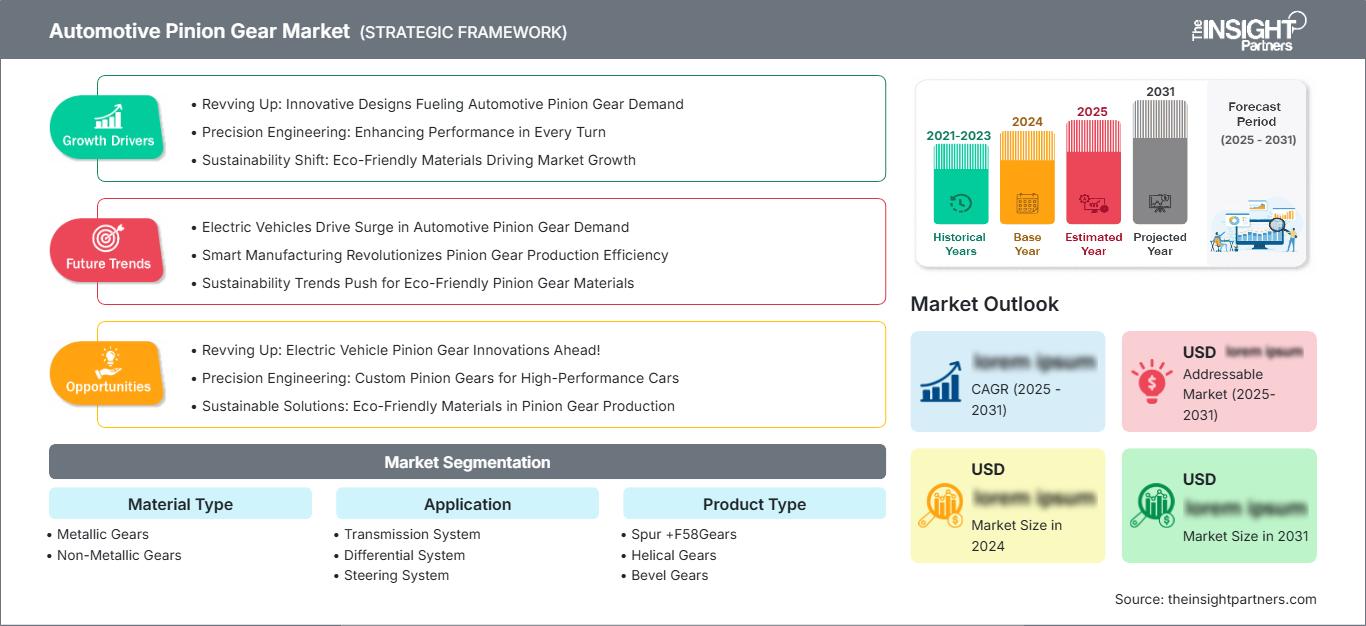
The automotive pinion gear market was valued at US$ 7.11 Billion in 2025 and is projected to reach US$ 8.99 Billion by 2034, expanding at a CAGR of 2.64% during 2026–2034. The demand continues to be directly linked to production, drivetrain changeover cycles, and efficiencies in passenger and commercial vehicles. The continued use of sophisticated transmission technologies, increasing numbers of vehicles on the road, and robust gears in conventional and electrified powertrains all contribute to market stability.
Across North America, rising investments in vehicle manufacturing, drivetrain modernization, and aftermarket replacement networks are strengthening industry fundamentals. The automotive pinion gear market size in the region benefits from established OEM supply chains and high vehicle ownership rates. Regional growth is expected in the range of 2.2%–3.0% CAGR through 2034, supported by pickup truck demand, light commercial vehicle production, and ongoing differential-system upgrades.
Automotive Pinion Gear Market Assessment and Insights
- North America: Share in 2025: 30–34%; CAGR between 2026–2034: 2.2%–3.0%. Strong vehicle fleet renewal, established drivetrain suppliers, and sustained aftermarket demand support steady expansion.
- US: Share in 2025: 74–78% of North America; CAGR between 2026–2034: 2.3%–3.1%. Advanced manufacturing capacity and broad light-truck production underpin consumption.
- Europe: Share in 2025: 25–29%; CAGR between 2026–2034: 2.0%–2.8%. Germany, France, Italy, and the UK remain key production centers emphasizing precision gearing.
- Asia Pacific: Share in 2025: 34–38%; CAGR between 2026–2034: 3.0%–3.8%. China, Japan, South Korea, and India lead regional output through large automotive manufacturing ecosystems.
- Largest Segment: Transmission System application with 44–48% market share in 2025; CAGR 2.4%–3.0%. High installation rates across vehicle categories sustain leadership.
- High Growth Segment: Rack and Pinion Gears with 14–18% market share in 2025; CAGR 3.4%–4.2%. Steering precision and electrified steering adoption support faster development.
- Key companies analyzed in detail: B&R Machine and Gear Corporation, Bharat Gears Limited, Circle Gear and Machine Company, Inc., Eaton Corporation plc, Gear Motions, Inc., Melrose Industries PLC, Precipart Group, Renold Chain India Private Limited, SAMGONG GEAR Co., Ltd., SHOWA Corporation.
Source: The Insight Partners' analysis based on proprietary research, government publications, company annual reports, investor presentations, industry databases, and expert interviews.
The gear production process has advanced from traditional machining to computer-controlled gear-cutting, fine grinding, and metallurgical operations. Automakers are now emphasizing lower noise levels, increased torque transmission, and better wear performance. The industry is continuing to reap the fruits of the replacement market as well as the improvement of the drive systems in the passenger vehicle range, which offers a stable procurement environment for gear producers.
The coming years will see investment flowing more to the Asia-based manufacturing hubs as well as to electrification applications. The focus on car efficiency by the regulations makes it favorable for light-weight components to be used while engineering tolerances are tightened. Growth in vehicle ownership in emerging markets and localization efforts by international manufacturers are set to boost demand for gears used in drives and steering over the forecast period.
Automotive Pinion Gear Market Report Scope
| Report Attribute | Details |
|---|---|
| Market size in 2025 | US$ 7.11 Billion |
| Market Size by 2034 | US$ 8.99 Billion |
| Global CAGR (2026 - 2034) | 2.64% |
| Historical Data | 2021-2024 |
| Forecast period | 2026-2034 |
Automotive Pinion Gear Market Analysis
The automotive pinion gear market growth trajectory is supported by sustained vehicle production, expanding aftermarket replacement requirements, and growing expectations for drivetrain efficiency. Pinion gears continue to play a crucial role in torque transmission, steering responsiveness, and the operation of the differential assembly. In the drive for increased durability and reduced noise levels, manufacturers are focusing on using better-quality materials, machining, and heat treatment techniques. This enables them to increase the longevity of components while meeting their performance criteria.
The supply chain in this market includes steel manufacturers, forgings manufacturers, machining, heat treatment, OEMs, and the aftermarket. The price movements in alloy steel and energy affect the economics of manufacturing; however, well-established supplier relationships act as a buffer. The development of manufacturing capacity in India, China, and Southeast Asia is improving resilience and lead-time performance for global automotive customers.
The automotive pinion gear market analysis indicates a moderately consolidated competitive environment characterized by engineering expertise, manufacturing scale, and customer integration capabilities. Competitive advantage is achieved through innovation in materials, high precision, production efficiency, and long-term supply agreements. Eaton Corporation plc, Bharat Gears Limited and Melrose Industries PLC have a strong competitive advantage through their drivetrain and mobility systems relationship, whereas other companies are concentrated on specialized gear applications.
Areas of investment are shifting toward automation, computerized gear hobbing and inspection systems. B&R Machine and Gear Corporation, Gear Motions, Inc., Precipart Group, Circle Gear and Machine Company, Inc., Renold Chain India Private Limited, SAMGONG GEAR Co., Ltd., and SHOWA Corporation continue concentrating on improving their products and production processes. Positioning strategy involves flexible production in the region of operation and support of both conventional and electrified vehicle architectures.
● REPORT CUSTOMIZATION
Tailor This Report To Align With Your Specific Business Requirements
This report can be customized to align precisely with your business objectives, scope, and target markets. Customization options include tailored segmentation, geography, competitive analysis, and strategic insights to support informed decision-making.
Customize This Report →WHAT YOU CAN ADJUST
- ● Segmentations
- ● Geography
- ● Competitive Analysis
- ● Language Preferences
Automotive Pinion Gear Market: Strategic Insights
Regional Insights
North America automotive pinion gear market
North America accounted for 30–34% market share in 2025 and is expected to grow at a 2.2%–3.0% CAGR through 2034. The market holds a substantial presence in the pinion gears used in automobiles because of high vehicle ownership, aftermarket needs, and OEM production facilities. Pickup trucks, SUVs, and commercial vehicles generate stable demand for the gears in their transmissions and differentials.
The United States, Mexico, and Canada together take advantage of integrated automotive supply chains. Investments in drive train production plants, automation, and local sourcing contribute to resilience. The need for replacement will be especially important due to the constant need to maintain the steering and drivetrain assemblies in fleets of vehicles.
U.S. automotive pinion gear market
The United States represented 74–78% of North American demand in 2025 and is projected to expand at a 2.3%–3.1% CAGR through 2034. A strong local production of light trucks, SUVs, and sports cars drives the requirement for transmission and differential gears that are durable. The availability of modern facilities allows for the constant implementation of precision gears.
All major companies in the industry have production, distribution, or engineering facilities all around the country. The demand becomes more efficient in terms of drivetrain systems and steering mechanisms. Replacement activities are strong because of the large volume of vehicles in the country, ensuring a steady supply of metallic gears.
Europe automotive pinion gear market
Europe held 25–29% market share in 2025 and is anticipated to record a 2.0%–2.8% CAGR through 2034. Germany continues to dominate in terms of demand, given its automotive manufacturing and engineering skills as well as premium vehicle production. The region's demand is driven by accurate drive train components and high-performance transmissions.
The United Kingdom continues to capitalize on its engineering skills in the automotive industry as well as the production of premium vehicles. Germany dominates the regional demand, considering its exports and advanced gearbox manufacture. France, Italy, and Spain combined have contributed through passenger car manufacture, supply chain operations, and drivetrain efficiency.
APAC automotive pinion gear market
Asia Pacific accounted for 34–38% market share in 2025 and is expected to grow at 3.0%–3.8% CAGR, the strongest among major regions. China leads regional demand through extensive vehicle production capacity and large-scale supplier ecosystems.
Japan, South Korea, India, and Australia complement regional growth through advanced engineering, export-oriented manufacturing, and growing vehicle ownership. Government support for automotive production, industrial modernization programs, and localization initiatives strengthens long-term demand for drivetrain and steering-related gear components.
Middle East & Africa automotive pinion gear market
The Middle East and Africa market is projected to expand at a 2.1%–2.9% CAGR through 2034. Saudi Arabia and the UAE are investing in automotive manufacturing capabilities and industrial diversification initiatives that support component demand.
South Africa remains the key automotive production hub within the region, while the broader MEA market benefits from infrastructure development and commercial vehicle utilization. Vehicle maintenance requirements and replacement part consumption provide the primary foundation for market expansion.
Segmentation Analysis
Material Type
Material Type is expected to grow at a 2.5%–3.2% CAGR between 2026 and 2034. The automotive pinion gear market scope within this segment is shaped by durability requirements, torque handling capabilities, and weight-reduction objectives. Material innovation remains important as manufacturers seek to balance strength, wear resistance, and production cost efficiency.
- Metallic Gears: Dominant category due to superior load-bearing capability, durability, and suitability for transmission, steering, and differential applications across passenger and commercial vehicles.
- Non-Metallic Gears: Increasingly considered for selected lightweight applications where noise reduction, corrosion resistance, and lower mass contribute to vehicle performance goals.
Application
Application is projected to record a 2.6%–3.3% CAGR through 2034. Demand patterns reflect the critical role of pinion gears in vehicle motion transfer, steering functionality, and drivetrain efficiency. OEMs continue prioritizing reliable gear systems that improve operational performance and reduce maintenance requirements.
- Transmission System: Largest application area because torque transfer depends heavily on precision gear engagement and long-term mechanical reliability.
- Differential System: Essential for distributing power across drive wheels and maintaining vehicle stability under varying road conditions.
- Steering System: Growth supported by continued penetration of rack-and-pinion steering architectures across light passenger vehicles.
Product Type
Product Type is anticipated to expand at a 2.8%–3.6% CAGR during the forecast period. Product selection depends on application-specific torque requirements, alignment constraints, efficiency needs, and design considerations. Manufacturers increasingly focus on quiet operation and enhanced durability.
- Spur Gears: Widely utilized in straightforward power-transfer applications requiring simple geometry and cost-effective manufacturing.
- Helical Gears: Preferred where smoother engagement and lower operational noise are important design requirements.
- Bevel Gears: Critical in angular power transmission applications and differential assemblies.
- Rack and Pinion Gears: Important for steering precision and vehicle handling performance across modern vehicle fleets.
- Worm Gears: Utilized in specialized systems requiring high reduction ratios and compact packaging.
- Planetary Gears: Valuable in sophisticated transmission architectures requiring efficient torque distribution.
- Hypoid Gears: Commonly deployed within differential systems due to their ability to handle heavy loads and provide smooth operation.
Opportunity Snapshot
| Application | Revenue Contribution | Trend Tag | Adoption Stage |
| Transmission System | High | Multi-Speed | Mature |
| Differential System | Medium | Torque Split | Mature |
| Steering System | High | EPS Migration | Scaling |
Automotive Pinion Gear Market Growth Drivers and Impact Analysis
Expansion of Global Vehicle Parc and Replacement Demand
The extensive use of large fleets of vehicles across the globe results in an ongoing need for drivetrain and steering system components. Pinion gears undergo constant mechanical strain and are therefore prone to frequent replacement in older automobiles. With more people owning automobiles in developing countries, there will be greater demand in the future. The combination of new automobile manufacture and replacement market ensures that there is an evenly balanced business structure for manufacturers. Commercial vehicles are also major players in the process of replacements due to their high mileage.
Advances in Precision Manufacturing Technologies
There is increasing use by manufacturers of automated processes for hobbing, grinding, metrology, and heat treatment in order to increase precision and minimize defects. Precision increases will help lower levels of vibration, noise, and wear, as well as meet performance requirements in current vehicles. Increased efficiencies in manufacturing contribute to increased competitiveness and scalability. With increasing complexity in vehicle design, precision-manufactured gears take on more significance. Data-driven manufacturing helps assure quality assurance in order to meet OEM requirements.
Growth in Drivetrain Efficiency Requirements
Manufacturers are still searching for more efficiencies in order to make their products perform better and conserve energy at the same time. The accuracy of gears plays a vital role in the transmission of torque and mechanical efficiency. Needs arise from traditional combustion engines to hybrid vehicles. Engineers are adopting advanced materials and better tooth designs in order to ensure durability and minimize friction. These efficiency considerations are set to persist for the entire forecast period.
Automotive Pinion Gear Market Future Trends
Rising Integration of Lightweight Engineering Solutions
The automotive pinion gear market trends increasingly reflect demand for lighter yet stronger components. Suppliers are developing advanced alloy compositions, optimized geometries, and improved surface treatments to reduce weight without compromising durability. These innovations support broader industry objectives related to efficiency and vehicle performance. Future product development is expected to emphasize material optimization, digital design simulation, and advanced manufacturing techniques capable of delivering higher strength-to-weight ratios. The trend is likely to influence both passenger vehicle and commercial vehicle platforms throughout the forecast horizon.
Digitalization of Gear Manufacturing Operations
The use of predictive maintenance technology, automation inspection, and real-time monitoring of production is increasingly common in manufacturing plants. This has the benefit of improving product uniformity and reducing the time that production equipment is out of service. In the coming decade, digital manufacturing operations will have the capacity to provide greater customization, reduced manufacturing time and increased quality tolerances.
Automotive Pinion Gear Market Opportunities
Localized Manufacturing Expansion in Emerging Economies
The automotive pinion gear market Forecasts indicate attractive investment potential in emerging automotive production hubs across Asia and selected Middle Eastern economies. Localization strategies reduce transportation costs, enhance supply security, and support regional vehicle manufacturing growth. Companies capable of establishing production capacity near expanding OEM clusters can strengthen customer relationships and improve operational efficiency. Partnerships with regional distributors and vehicle manufacturers may further enhance market access and long-term revenue generation opportunities.
Engineering Solutions for Electrified Powertrains
Electrified vehicles introduce distinct performance requirements involving torque delivery, noise control, and compact packaging. Suppliers that develop application-specific gear designs can capture new business opportunities. Investment in advanced materials, precision manufacturing, and collaborative engineering programs will become increasingly important. Organizations positioned to address evolving drivetrain requirements may benefit from long-term contracts associated with next-generation vehicle platforms.
Frequently Asked Questions

- Comprehensive Market Sizing and Forecast Analysis
- Detailed Segmentation Analysis
- In-Depth Market Dynamics Assessment
- Regional and Country-Level Insights
- Competitive Landscape and Company Benchmarking
- Strategic Business Intelligence
Recent Reports
Testimonials

The Insight Partners' SCADA System Market report is comprehensive, with valuable insights on current trends and future forecasts. The team was highly professional, responsive, and supportive throughout. We are very satisfied and highly recommend their services.
RAN KEDEM Partner, Reali Technologies LTDs
I requested a report on a very specific software market and the team produced the report in a few days. The information was very relevant and well presented. I then requested some changes and additions to the report. The team was again very responsive and I got the final report in less than a week.
JEAN-HERVE JENN Chairman, Future Analytica
We worked with The Insight Partners for an important market study and forecast. They gave us clear insights into opportunities and risks, which helped shape our plans. Their research was easy to use and based on solid data. It helped us make smart, confident decisions. We highly recommend them.
PIYUSH NAGPAL Sr. Vice President, High Beam Global
The Insight Partners delivered insightful, well-structured market research with strong domain expertise. Their team was professional and responsive throughout. The user-friendly website made accessing industry reports seamless. We highly recommend them for reliable, high-quality research services
YUKIHIKO ADACHI CEO, Deep Blue, LLC.
This is the first time I have purchased a market report from The Insight Partners.While I was unsure at first, I visited their web site and felt more comfortable to take the risk and purchase a market report.I am completely satisfied with the quality of the report and customer service. I had several questions and comments with the initial report, but after a couple of dialogs over email with their analyst I believe I have a report that I can use as input to our strategic planning process.Thank you so much for taking the extra time and making this a positive experience.I will definitely recommend your service to others and you will be my first call when we need further market data.
JOHN SUZUKI President and Chief Executive Officer, Board Director, BK Technologies
I wish to appreciate your support and the professionalism you displayed in the course of attending to my request for information regarding to infectious disease IVD market in Nigeria. I appreciate your patience, your guidance, and the fact that you were willing to offer a discount, which eventually made it possible for us to close a deal. I look forward to engaging The Insight Partners in the future, all thanks to the impression you have created in me as a result of this first encounter.
DR CHIJIOKE ONYIA MANAGING DIRECTOR, PineCrest Healthcare Ltd.Reason to Buy
- Informed Decision-Making
- Understanding Market Dynamics
- Competitive Analysis
- Identifying Emerging Markets
- Customer Insights
- Market Forecasts
- Risk Mitigation
- Boosting Operational Efficiency
- Strategic Planning
- Investment Justification
- Tracking Industry Innovations
- Aligning with Regulatory Trends





 Get Free Sample for