
Automotive Shredded Residue (ASR) Market Size, Share & Demand by 2034
Automotive Shredded Residue (ASR) Market Size and Forecasts (2021–2034), Global and Regional Share, Trends, and Growth Opportunity Analysis Report Coverage : by Technology (Air classification, Optical sorting, Magnetic separation, Eddy current separation, Screening); Application (Landfill, Energy recovery, Recycling); Composiiton (Metals, Plastics, Rubbers, Textiles); and Geography (North America, Europe, Asia Pacific, and South and Central America)
- Status : Data Released
- Report Code : TIPRE00040236
- Category : Chemicals and Materials
- No. of Pages : 150
- Available Report Formats :


- Last update date : August 13, 2026


2025 Market Size
US$ 1.22 Bn
Base year value
2034 Forecast
US$ 2. Bn
Projected by 2034
CAGR 2026-2034
5.65 %
Growth rate
Addressable Market
US$ 14.60 Bn
(2026-2034)
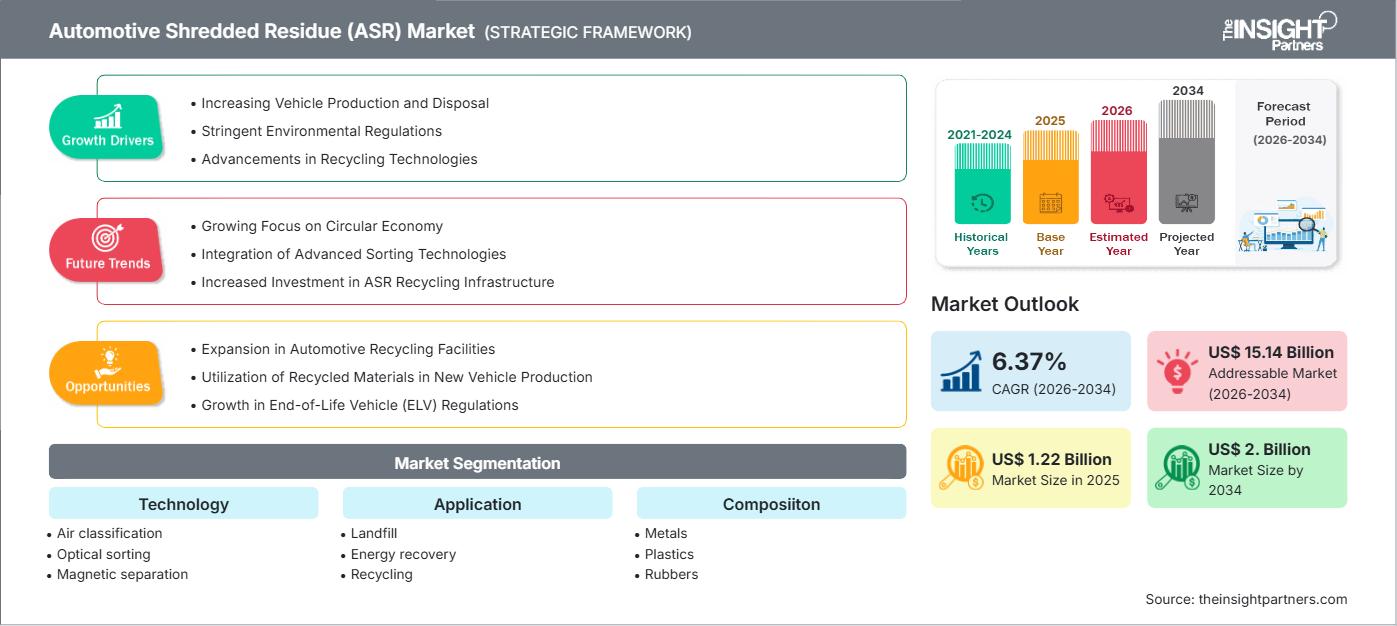
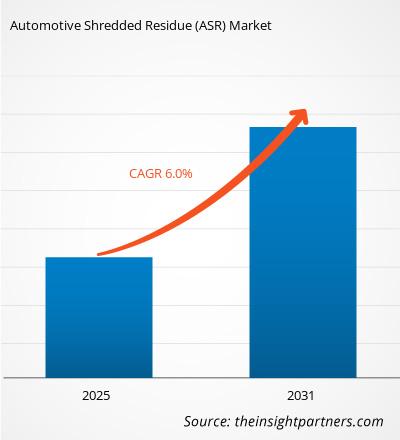
The Automotive Shredded Residue (ASR) market was valued at US$ 1.22 billion in 2025 and is expected to reach US$ 2 billion by 2034; it is estimated to record a CAGR of 5.65% during 2026-2034.
Automotive Shredded Residue (ASR) Market Assessment and Insights
- North America: Accounted for an estimated 34%–37% share in 2025 and is projected to expand at a CAGR of 5.8%–6.4% during 2026–2034. Growth is driven by mature ELV recycling infrastructure, strong demand for recovered secondary materials, and continuous investments in automated post-shredder technologies.
- U.S.: Represented approximately 74%–78% of the North American market in 2025 and is expected to grow at a CAGR of 5.9%–6.5% through 2034, supported by large-scale automotive dismantling operations and advanced recycling facilities.
- Europe: Held an estimated 28%–31% share in 2025 and is anticipated to record a CAGR of 6.6%–7.2%. Germany, the United Kingdom, France, Italy, and Spain remain leading contributors due to stringent ELV regulations and circular economy policies.
- Asia Pacific: Accounted for approximately 24%–27% of the global market in 2025 and is forecast to grow at a CAGR of 6.8%–7.5%, led by China, Japan, South Korea, and India as vehicle ownership and recycling infrastructure continue to expand.
- Largest Segment: Landfill represented an estimated 44%–48% market share in 2025, while transitioning at a CAGR of 4.8%–5.4% as recycling and energy recovery alternatives continue gaining acceptance.
- High Growth Segment: Optical sorting is projected to expand at a CAGR of 8.2%–8.8% with an estimated 11%–14% market share in 2025, supported by improved identification accuracy and higher recovery rates for mixed automotive residues.
- Key companies analyzed in detail: Galloo NV, MBA Polymers, Inc., PLANIC Co., Ltd., Sims Limited, Axion Recycling Ltd., SRW Metalfloat GmbH, Machinex Industries Inc., Wendt Corporation, Binder+Co AG, CP Manufacturing, Inc., TOMRA Systems ASA, Steinert GmbH, and Agilyx ASA.
Source: The Insight Partners' analysis based on proprietary research, government publications, company annual reports, investor presentations, industry databases, and expert interviews.
As the pressure is building up to recycle the precious components of used vehicles, vehicle shredder residue recycling has changed from being simply a method of disposal to becoming an effective resource recovery system. There is an increasing trend to use mechanical sorting techniques together with optical systems, eddy current separators, and advanced air classifiers for improving the recovery ratio of plastics, non-ferrous metals, and rubber.
Looking ahead, market development in the Automotive Shredded Residue Market will increasingly depend on investments in advanced recycling capacity across Asia Pacific and Europe, alongside stricter implementation of extended producer responsibility and circular economy regulations. Demand for higher-purity secondary raw materials is expected to encourage partnerships between automotive manufacturers, recycling technology suppliers, and material recovery companies. Continued innovation in sensor-based separation, AI-assisted sorting, and chemical recycling technologies is likely to create additional opportunities for higher-value recovery from complex automotive waste streams.
Automotive Shredded Residue (ASR) Market Report Scope
| Report Attribute | Details |
|---|---|
| Market size in 2025 | US$ 1.22 Billion |
| Market Size by 2034 | US$ 2. Billion |
| Global CAGR (2026 - 2034) | 5.65% |
| Historical Data | 2021-2024 |
| Forecast period | 2026-2034 |
Automotive Shredded Residue (ASR) Market Analysis
Growing vehicle scrappage rates, tightening environmental regulations, and increasing demand for secondary raw materials continue to support Automotive Shredded Residue Market growth across major recycling markets. The automotive shredded residue obtained from the end-of-life vehicles includes materials like plastic, rubber, fabrics, glass, foams, and even metals, which need to go through sophisticated processing prior to their disposal or reuse. Various regulatory measures that encourage landfill diversion as well as the adoption of circular economy strategies have prompted investments into advanced post-shredder equipment, which can recover valuable fractions while minimizing environmental impact. North America and Europe have led the way due to the well-established ELV recycling infrastructure, while Asia Pacific is experiencing significant growth in its infrastructure due to rising vehicle ownership as well as retirement rates.
Value Chain of the Market starts from vehicle disassembly and shredding, followed by magnetic separation, eddy current separation, air classification, optical separation, and finally material recovery or energy recovery. Sensor-based techniques have helped in improving the efficiency of recovery of plastic as well as non-ferrous metals with minimized contamination.
The Automotive Shredded Residue Market analysis indicates that competition is shifting from conventional waste handling toward integrated resource recovery solutions. Established participants such as Galloo NV, MBA Polymers, Inc., Sims Limited, TOMRA Systems ASA, Steinert GmbH, Wendt Corporation, and Binder+Co AG continue investing in advanced separation technologies, while specialized companies, including Axion Recycling Ltd., PLANIC Co., Ltd., SRW Metalfloat GmbH, Machinex Industries Inc., CP Manufacturing, Inc., and Agilyx ASA, focus on improving material purity and expanding recycling capabilities. Technology differentiation, operational efficiency, and compliance with increasingly stringent environmental regulations remain key competitive factors.
Investment activity increasingly targets optical sorting, AI-assisted material identification, and chemical recycling technologies capable of recovering value from previously unrecyclable residue streams, according to the Automotive Shredded Residue Market. Partnerships among automotive manufacturers, recyclers, and equipment suppliers are expanding to improve circular material flows and reduce landfill dependency. As governments strengthen extended producer responsibility frameworks and sustainability targets, technology providers with scalable, automated recovery systems are expected to strengthen their competitive positioning across developed and emerging recycling markets.
● REPORT CUSTOMIZATION
Tailor This Report To Align With Your Specific Business Requirements
This report can be customized to align precisely with your business objectives, scope, and target markets. Customization options include tailored segmentation, geography, competitive analysis, and strategic insights to support informed decision-making.
Customize This Report →WHAT YOU CAN ADJUST
- ● Segmentations
- ● Geography
- ● Competitive Analysis
- ● Language Preferences
Automotive Shredded Residue (ASR) Market: Strategic Insights
Regional Insights
North America Automotive Shredded Residue Market
North America accounted for an estimated 34%–37% of the global Automotive Shredded Residue Market share in 2025 and is projected to expand at a CAGR of 5.8%–6.4% during 2026–2034. The region benefits from a mature automotive recycling ecosystem, extensive shredder infrastructure, and stringent environmental regulations encouraging higher recovery of metals, plastics, and rubber from end-of-life vehicles. Strong investment in automated post-shredder processing continues to improve resource recovery while reducing landfill disposal.
The United States and Canada continue to adopt advanced optical sorting, eddy current separation, and AI-enabled material identification technologies to improve recycling efficiency. Increasing collaboration among recyclers, automotive manufacturers, and equipment suppliers supports the development of circular material supply chains. Rising demand for recycled polymers and non-ferrous metals further strengthens long-term investment across the regional automotive recycling industry.
U.S. Automotive Shredded Residue Market
The United States represented approximately 74%–78% of the North American market in 2025 and is expected to register a CAGR of 5.9%–6.5% through 2034. Large vehicle ownership, established dismantling facilities, and one of the world's largest end-of-life vehicle recycling industries support the continuous generation of automotive shredded residue requiring advanced recovery technologies. Major equipment suppliers and recycling companies continue expanding processing capacity to improve recovery efficiency, reinforcing the growth trajectory of the Automotive Shredded Residue Market.
Technology adoption continues shifting toward automated sorting systems capable of recovering higher-value plastics and non-ferrous metals. Growing implementation of sustainability programs by automotive manufacturers and increasing use of recycled materials in manufacturing are creating additional opportunities for domestic recyclers while strengthening the country's leadership in advanced automotive residue management.
Europe Automotive Shredded Residue Market
Europe held approximately 28%–31% of the global market in 2025 and is anticipated to grow at a CAGR of 6.6%–7.2% through 2034, making it one of the fastest-growing regional markets in the Automotive Shredded Residue Market. Strict implementation of the End-of-Life Vehicles Directive and ambitious circular economy objectives continue to support investments in advanced material recovery infrastructure. Germany remains the leading country due to its strong automotive production base and high ELV processing volumes.
The United Kingdom continues to strengthen recycling efficiency through investments in automated sorting and landfill diversion initiatives. France, Italy, and Spain are expanding post-shredder treatment capacity alongside increasing adoption of resource recovery technologies to improve recycling performance. Continuous regulatory pressure and growing demand for recycled raw materials are expected to sustain long-term regional market expansion.
APAC Automotive Shredded Residue Market
Asia Pacific accounted for an estimated 24%–27% share in 2025 and is projected to register the fastest regional expansion at a CAGR of 6.8%–7.5% in the Automotive Shredded Residue Market. China leads the regional market, followed by Japan, South Korea, India, and Australia, supported by rising end-of-life vehicle volumes and expanding recycling infrastructure.
Governments across the region are strengthening vehicle recycling regulations while encouraging investment in modern material recovery technologies. Rapid industrialization, increasing vehicle ownership, and expanding circular economy initiatives continue to create favorable conditions for advanced automotive shredded residue processing facilities.
Middle East & Africa Automotive Shredded Residue Market
The Middle East & Africa market is expected to expand at a CAGR of 5.2%–5.8% through 2034 in the Automotive Shredded Residue Market, supported by the gradual modernization of recycling infrastructure and growing environmental awareness. Saudi Arabia, the UAE, and South Africa are emerging as important markets owing to increasing investments in waste management and industrial recycling facilities, creating new opportunities for automotive residue recovery and material recycling.
Infrastructure development programs, industrial diversification, and sustainability initiatives are encouraging the adoption of modern separation technologies across the region. Although recycling capacity remains comparatively limited, long-term investments in circular economy projects are expected to improve the recovery of automotive shredded residue and reduce landfill dependence.
Segmentation Analysis
Technology
Technology remains the foundation of efficient automotive shredded residue processing by improving recovery rates, reducing landfill dependency, and increasing the purity of recovered materials. The segment is projected to expand at a CAGR of 6.8%–7.4% during 2026–2034, supported by increasing deployment of automated sorting systems and advanced separation technologies. The Automotive Shredded Residue Market scope continues to widen as recyclers integrate multiple technologies to maximize material recovery while complying with stricter environmental regulations. Optical sorting and sensor-based systems are increasingly complementing conventional magnetic and mechanical separation processes.
- Air classification: Uses airflow to separate light and heavy materials, improving downstream recovery efficiency for plastics, fibers, and fine particles while lowering contamination in recycling streams.
- Optical sorting: Employs cameras, sensors, and artificial intelligence to identify different materials with high precision, enabling greater recovery of valuable plastics and improving recycling economics.
- Magnetic separation: Recovers ferrous metals efficiently and remains an essential first-stage process because of its high throughput, operational reliability, and ability to produce clean metal fractions.
- Eddy current separation: Extracts non-ferrous metals such as aluminum and copper using electromagnetic fields, increasing resource recovery and supporting higher-value recycling operations.
- Screening: Separates materials according to particle size before advanced sorting, enhancing equipment efficiency and improving the consistency of recovered material streams.
Application
Application trends continue shifting from conventional disposal toward higher-value recovery pathways as governments promote circular economy strategies. This segment is anticipated to register a CAGR of 6.3%–6.9% during 2026–2034. Landfill continues to account for a significant proportion of residue treatment; however, recycling and energy recovery are gaining momentum as investments in advanced processing technologies improve recovery rates and reduce environmental impacts.
- Landfill: Continues to manage non-recoverable residue fractions where recycling remains technically or economically challenging, although regulatory pressure is steadily reducing long-term dependence.
- Energy recovery: Converts combustible residue into alternative energy through thermal treatment, helping reduce landfill volumes while generating value from difficult-to-recycle materials.
- Recycling: Focuses on recovering plastics, metals, rubber, and textiles for reuse in manufacturing, supported by technological advances and increasing demand for secondary raw materials.
Composition
Composition determines the complexity and commercial value of automotive shredded residue processing because each material requires different recovery technologies. The segment is expected to grow at a CAGR of 6.5%–7.1% during 2026–2034, driven by improvements in separation technologies and increasing industrial demand for recycled feedstocks. Plastics and metals remain the most valuable fractions, while the recovery of rubber and textiles continues to improve through technological innovation.
- Metals: Include remaining ferrous and non-ferrous fractions recovered after shredding, providing significant economic value through reuse in steelmaking and non-ferrous metal production.
- Plastics: Represent one of the largest recoverable fractions, with polypropylene and polyethylene increasingly recycled into automotive, construction, and consumer product applications.
- Rubbers: Recovered primarily from tires and vehicle components for use in construction materials, playground surfaces, molded products, and energy recovery applications.
- Textiles: Consist of fibers from vehicle interiors and insulation materials that are increasingly utilized in engineered products, composite materials, and alternative fuel applications.
Opportunity Snapshot
| Application | Revenue Contribution | Trend Tag | Adoption Stage |
|---|---|---|---|
| Landfill | High | Landfill Diversion | Mature |
| Energy Recovery | Medium | Waste-to-Energy | Scaling |
| Recycling | High | Material Recovery | Scaling |
Automotive Shredded Residue (ASR) Market Growth Drivers and Impact Analysis
Stringent End-of-Life Vehicle Regulations Driving Advanced Material Recovery
Governments in North America, Europe, and various Asia-Pacific nations have been increasing their regulations for the end-of-life vehicle (ELV), so as to decrease landfilling of automobiles and increase the efficiency of materials recycling. The regulations under the European Union End-of-Life Vehicles Directive, coupled with the evolving circular economy, demand increased levels of recycling and recovery from used vehicles. These regulations are prompting recycling plants to upgrade themselves to equipment with advanced optical sorting, air classification, magnetism and eddy current separation, which allows for improved recovery of plastic, metals, rubber, and textiles. Advanced post-shredder sorting equipment is being developed by machinery companies, which will allow for better purity of materials with lower costs.
Growing Demand for Secondary Raw Materials Across Manufacturing Industries
The growth in the use of recycled metals and plastics by the industrial sector is driving the need for efficient systems that recover shredded automotive residues. The automotive manufacturers, metal companies and plastics manufacturing firms are using increasing amounts of recycled materials in order to cut down their production costs, reduce their greenhouse gas emissions, and fulfill their sustainability objectives. Recycled aluminum, copper, steel, polypropylene and other engineering plastics are becoming increasingly valuable secondary sources of materials. Separation technologies help in achieving high-quality material, which can be used by recyclers to provide high-quality materials for reuse in industry. Increasing demand from construction, automotive, packaging, and consumer goods sectors is stimulating investments in materials recovery technologies.
Technology Advancements Improving Recovery Efficiency and Resource Utilization
Advancements in technology are revolutionizing the processes used in the treatment of automotive shredder residues via AI and sensors, robots, and digital monitoring systems. Recycling plants are now adopting optical sortation, together with magnetic separation, eddy current separators, and quality control systems to achieve high levels of efficiency without contamination. This has been made possible by technological advancements in the industry, which facilitate the harvesting of previously unrecyclable material, increase efficiency, and reduce dependence on landfills. Digital process optimization results in cost-effective maintenance and improved efficiency, ensuring higher profits. As equipment manufacturers continue to develop more intelligent and energy-saving separation technologies, more modernization will be carried out by recycling firms.
Automotive Shredded Residue (ASR) Market Future Trends
AI-Enabled Sorting Systems Transforming Material Recovery
Artificial intelligence and sensor-based sorting technologies are expected to reshape Automotive Shredded Residue Market trends by improving the identification and separation of complex mixed waste streams. The application of hyperspectral imaging, machine learning algorithms, robotics, and real-time monitoring systems at recycling plants helps boost the recovery rate while decreasing contamination levels. Such measures allow increasing the recovery rate of engineering plastics, non-ferrous metals, and reusable rubber components that could not be effectively separated before. Moreover, recycling plant equipment suppliers are developing cloud-based monitoring systems, which allow for the prediction of possible technical breakdowns and process optimization. The further development of digital recycling technology should positively affect the productivity of operations, quality of secondary materials, and circular economy goals.
Expansion of Circular Automotive Material Ecosystems
Automotive producers are increasingly working together with recyclers, material providers, and technology developers to create closed-loop supply chains for materials. Future automobile manufacturing will involve higher use of recycled aluminum, steel, plastics, and engineered polymers derived from end-of-life automobiles. While at the same time, governments are making regulations on producer responsibilities stringent, as well as promoting sustainable manufacturing methods, favoring the use of recycled materials. Additionally, the investment in chemical recycling and polymer purification technologies will be on the rise, generating further value from automotive shredder residue fractions that were formerly considered non-recyclable.
Automotive Shredded Residue (ASR) Market Opportunities
Expansion of Advanced Recycling Infrastructure in Emerging Markets
Rapid motorization across the Asia Pacific, Latin America, and parts of the Middle East is expected to generate substantially higher volumes of end-of-life vehicles over the next decade. Automotive Shredded Residue Market Forecasts indicate that investments in modern post-shredder processing facilities will create significant opportunities for technology providers, equipment manufacturers, and recycling operators. Governments are increasingly introducing vehicle recycling regulations and sustainability policies that encourage the development of advanced recovery infrastructure. Companies capable of delivering integrated sorting solutions, automated material recovery systems, and digital process optimization platforms are well-positioned to capitalize on expanding recycling capacity. Strategic partnerships with local recyclers and automotive manufacturers are expected to accelerate market penetration and establish long-term revenue streams.
Commercialization of Chemical Recycling for Mixed Polymer Recovery
Various forms of chemical recycling technologies seem to be developing into promising possibilities for the recycling of mixed automotive plastics, which cannot be recycled using conventional mechanical processes. Techniques such as pyrolysis, depolymerization, and solvent purification are gaining popularity for their capability of producing feedstocks from polymer wastes for the production of new plastic and chemicals. Firms that embrace such technologies are set to enhance recycling efficiencies and reduce landfilling of hard-to-recycle wastes. Synergies between automakers, chemical firms and recycling technology providers may be enhanced as sustainability goals continue to become more ambitious. Commercialization of viable chemical recycling technology solutions will enhance circular flows of materials and generate additional revenues.
Recent Developments
- March 2025: Steinert GmbH supplied advanced sensor-based sorting technologies to Japanese recycler MATEC Inc. for its new automotive shredder residue (ASR) processing plant in Tomakomai. The facility, with an annual processing capacity of 30,000 metric tons, incorporates ten STEINERT sensor sorting systems, six non-ferrous metal separators, and two electromagnets to recover stainless steel, copper, and other valuable materials from end-of-life vehicle shredder residue, improving recycling efficiency and resource recovery.
- December 2025: Fornnax Technology Pvt. Ltd. inaugurated one of the world's largest New Product Development (NPD) centers and Demo Plant for recycling technologies on a 12-acre site in Gujarat, India. The facility is designed to accelerate the development and validation of shredders and granulators for applications including automotive shredder residue, e-waste, cables, lithium-ion batteries, and municipal solid waste, while enhancing equipment capacity, energy efficiency, and operational reliability.
Frequently Asked Questions

- Comprehensive Market Sizing and Forecast Analysis
- Detailed Segmentation Analysis
- In-Depth Market Dynamics Assessment
- Regional and Country-Level Insights
- Competitive Landscape and Company Benchmarking
- Strategic Business Intelligence
Recent Reports
Testimonials

The Insight Partners provided valuable market intelligence that supported our global go-to-market strategy. Their team was professional, responsive, and attentive to our feedback, providing thoughtful analysis and helpful methodological clarifications throughout the project.
Junmo Kim Chief Financial Officer (CFO), Enertech Co., Ltd.
The Insight Partners' SCADA System Market report is comprehensive, with valuable insights on current trends and future forecasts. The team was highly professional, responsive, and supportive throughout. We are very satisfied and highly recommend their services.
RAN KEDEM Partner, Reali Technologies LTDs
I requested a report on a very specific software market and the team produced the report in a few days. The information was very relevant and well presented. I then requested some changes and additions to the report. The team was again very responsive and I got the final report in less than a week.
JEAN-HERVE JENN Chairman, Future Analytica
We worked with The Insight Partners for an important market study and forecast. They gave us clear insights into opportunities and risks, which helped shape our plans. Their research was easy to use and based on solid data. It helped us make smart, confident decisions. We highly recommend them.
PIYUSH NAGPAL Sr. Vice President, High Beam Global
The Insight Partners delivered insightful, well-structured market research with strong domain expertise. Their team was professional and responsive throughout. The user-friendly website made accessing industry reports seamless. We highly recommend them for reliable, high-quality research services
YUKIHIKO ADACHI CEO, Deep Blue, LLC.
This is the first time I have purchased a market report from The Insight Partners.While I was unsure at first, I visited their web site and felt more comfortable to take the risk and purchase a market report.I am completely satisfied with the quality of the report and customer service. I had several questions and comments with the initial report, but after a couple of dialogs over email with their analyst I believe I have a report that I can use as input to our strategic planning process.Thank you so much for taking the extra time and making this a positive experience.I will definitely recommend your service to others and you will be my first call when we need further market data.
JOHN SUZUKI President and Chief Executive Officer, Board Director, BK Technologies
I wish to appreciate your support and the professionalism you displayed in the course of attending to my request for information regarding to infectious disease IVD market in Nigeria. I appreciate your patience, your guidance, and the fact that you were willing to offer a discount, which eventually made it possible for us to close a deal. I look forward to engaging The Insight Partners in the future, all thanks to the impression you have created in me as a result of this first encounter.
DR CHIJIOKE ONYIA MANAGING DIRECTOR, PineCrest Healthcare Ltd.Reason to Buy
- Informed Decision-Making
- Understanding Market Dynamics
- Competitive Analysis
- Identifying Emerging Markets
- Customer Insights
- Market Forecasts
- Risk Mitigation
- Boosting Operational Efficiency
- Strategic Planning
- Investment Justification
- Tracking Industry Innovations
- Aligning with Regulatory Trends





 Get Free Sample for