
Automotive Tire Socks Market Size, Growth & Demand by 2034
Coverage: By Material (Rubber, Polyurethane, Nylon, Other Materials); Vehicle Type (Passenger Cars, SUVs, Trucks, Off-road Vehicles); Distribution Channel (Online Retailers, Auto Parts Stores, Dealerships, Other Channels); Usage (Snow and Ice Management, Vehicle Protection, Improved Grip); and Geography (North America, Europe, Asia Pacific, South & Central America, and Middle East & Africa)
- Status : Data Released
- Report Code : TIPRE00015989
- Category : Automotive and Transportation
- No. of Pages : 150
- Available Report Formats :


- Last update date : June 11, 2026


2025 Market Size
US$ 557.62 Mn
Base year value
2034 Forecast
US$ 1834.22 Mn
Projected by 2034
CAGR 2026-2034
14.15 %
Growth rate
Addressable Market
US$ 10,304.31 Mn
(2026-2034)
The global automotive tire socks market was valued at US$ 557.62 million in 2025 and is expected to reach US$ 1834.22 million by 2034; it is estimated to record a CAGR of 14.15% during 2026-2034.
Key market dynamics include rising government mandates for winter traction devices across high-altitude regions, a significant consumer shift toward lightweight textile alternatives to metal chains, and increasing participation in winter sports and seasonal tourism. Additionally, the market is expected to benefit from innovations in high-grip synthetic fibers, the rapid expansion of specialized automotive e-commerce channels, and the growing inclusion of tire socks as essential safety equipment in modern vehicle emergency kits.
Automotive Tire Socks Market Analysis
The automotive tire socks market analysis shows a strategic transition from emergency accessories to performance-oriented safety solutions. The market trends indicate that while passenger car owners remain the largest buyer group, there is a steady rise in adoption by logistics and delivery fleets seeking to maintain schedule reliability without risking damage to vehicle wheel arches. Strategic opportunities are emerging in the development of hybrid material socks that combine textile flexibility with the durability of reinforced polymers. The analysis also notes that market expansion depends on gaining broader regulatory certifications in mountain-pass corridors and educating consumers on the speed-limit requirements of textile traction. Competitive differentiation now focuses on ease of fitment in sub-zero temperatures and branding that emphasizes compatibility with electronic braking and stability systems.
Automotive Tire Socks Market Overview
Automotive tire socks have advanced from basic fabric wraps to advanced textile traction systems. The automotive tire socks include heavy-duty variants for logistics trucks, specialized designs for off-road vehicles, and custom-fit models for passenger cars with limited clearance. Both global automotive parts manufacturers and specialized textile engineering firms compete in this market, using high-tenacity materials like polyurethane and treated nylon. Growing demand for portable, user-friendly winter mobility options in North America and Europe has increased the popularity of tire socks as a storage-efficient safety solution. Europe remains the leading revenue generator due to established winter equipment laws, while the US and Canada are seeing rapid adoption driven by recent regulatory approvals. Competition among brands is fueling greater innovation in tread patterns and the integration of wear-indicator markings to signal replacement needs. The US market is characterized by increasing state-level enforcement of traction mandates in mountainous regions. Growing consumer awareness regarding winter road safety and the rising preference for lightweight, easy-to-install textile alternatives over traditional metal chains are driving adoption across passenger and commercial vehicle segments nationwide.
Market Research Highlights
- Global market for Automotive Tire Socks was valued at US$ 557.62 Million in 2025
- Annual market size is expected to reach US$ 1,834.22 Million by 2034
- Total addressable market (TAM) during 2026-2034 is projected to reach approximately US$ 10,304.31 Million
- Market is anticipated to register a CAGR of 14.15% during the forecast period
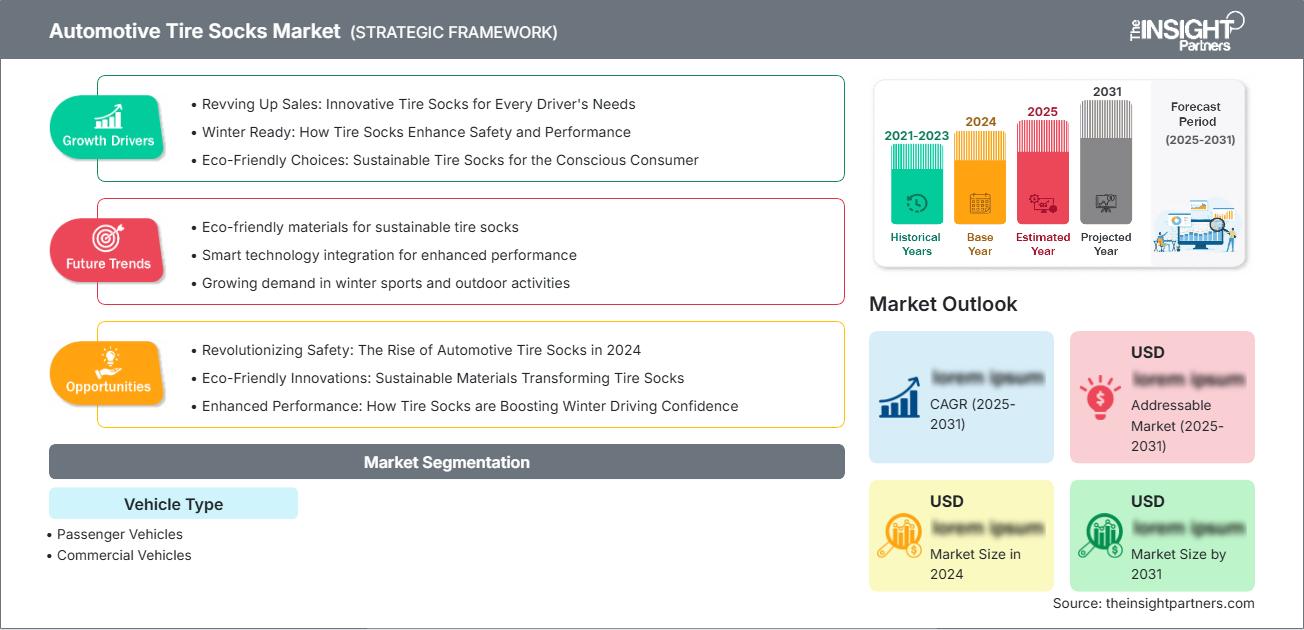
- The United States represents a key market, supported by Revving Up Sales: Innovative Tire Socks for Every Driver's Needs, Winter Ready: How Tire Socks Enhance Safety and Performance, Eco-Friendly Choices: Sustainable Tire Socks for the Conscious Consumer, as well as evolving industry dynamics
- Market analysis covers North America, Europe, Asia-Pacific, South and Central America, Middle East and Africa, with growth evaluated across the forecast period
- Market opportunities such as Revolutionizing Safety: The Rise of Automotive Tire Socks in 2024, Eco-Friendly Innovations: Sustainable Materials Transforming Tire Socks, Enhanced Performance: How Tire Socks are Boosting Winter Driving Confidence are expected to influence market dynamics and addressable market
- Report profiles industry participants, including Autosock, Dunlop, ISSE Safety, Joubert Productions, Michelin, NOVOTOOL INDUSTRIAL CO., LTD, Silknet, TireSocks, Weissenfels, Yokohama, while analyzing competitive strategies and innovation developments
-
Source: The Insight Partners' analysis based on proprietary research, government publications, company annual reports, investor presentations, industry databases, and expert interviews.
● REPORT CUSTOMIZATION
Tailor This Report To Align With Your Specific Business Requirements
This report can be customized to align precisely with your business objectives, scope, and target markets. Customization options include tailored segmentation, geography, competitive analysis, and strategic insights to support informed decision-making.
Customize This Report →WHAT YOU CAN ADJUST
- ● Segmentations
- ● Geography
- ● Competitive Analysis
- ● Language Preferences
Automotive Tire Socks Market: Strategic Insights
-
Get Top Key Market Trends of this report.This FREE sample will include data analysis, ranging from market trends to estimates and forecasts.
Automotive Tire Socks Market Drivers and Opportunities
Market Drivers:
- Heightened Safety Regulations in Snow-Prone Regions: Many jurisdictions now mandate the use of traction devices on specific roads. The approval of tire socks as a legal equivalent to snow chains is a primary growth factor.
- Advancements in Textile Durability and Grip: Ongoing R&D in synthetic fiber technology has led to tire socks that offer superior traction on ice while maintaining enough structural integrity for short-distance use on cleared pavement.
- Consumer Preference for Lightweight Solutions: The ease of handling and compact storage of tire socks compared to traditional heavy chains makes them a preferred choice for urban commuters and elderly drivers.
Market Opportunities:
- Expansion into the EV and Hybrid Segment: Electric vehicles often have tight wheel-well clearances where metal chains cannot be used. Tire socks offer a high-growth opportunity as a safe traction solution for the expanding EV market.
- Growth in Emerging Winter Tourism Hubs: Strategic partnerships with ski resorts and mountain-car rental agencies in regions like Asia-Pacific can facilitate access to seasonal high-margin consumer segments.
- Diversification into Enhanced Grip Certifications: There is a growing opportunity for producers to target professional off-road enthusiasts through certifications that highlight performance in extreme sub-zero conditions.
Automotive Tire Socks Market Report Segmentation Analysis
The Automotive Tire Socks Market share is analyzed across several key segments to provide a detailed view of its growth trajectory and structure. Below is the standard segmentation approach used in industry reports:
By Material:
- Rubber: A durable segment often used in reinforced or hybrid socks to provide structural stability and extended wear life.
- Polyurethane: A high-growth material preferred for its excellent resistance to abrasion and flexibility in extreme cold.
- Nylon: The dominant volume driver for standard socks, valued for its lightweight nature and cost-efficient manufacturing.
- Other Materials: Includes advanced high-tenacity polyesters and recycled synthetic fibers targeting eco-conscious market segments.
By Vehicle Type:
- Passenger Cars: The primary revenue-contributing segment, supported by high ownership rates and general winter safety awareness.
- SUVs: A rapidly expanding niche as more consumers use utility vehicles for winter recreation and mountain travel.
- Trucks: A critical growth area for commercial logistics, where tire socks help minimize downtime during unexpected snowfall.
- Off-road Vehicles: Specialized high-performance socks designed for rugged terrain and enthusiast-level winter driving.
By Distribution Channel:
- Online Retailers: The fastest-growing channel, benefiting from extensive compatibility guides and direct-to-consumer artisanal brands.
- Auto Parts Stores: Remains the primary channel for immediate seasonal needs and professional fitting advice.
- Dealerships: A growing channel for OEM-branded traction kits bundled with new vehicle purchases or winter service packages.
- Other Channels: Includes hypermarkets, gas station convenience stores, and seasonal pop-up retail at mountain resorts.
By Usage:
- Snow and Ice Management: The core functional segment focused on providing essential traction for winter commuting.
- Vehicle Protection: Highlights the use of socks to prevent scratches and mechanical damage caused by metal chains.
- Improved Grip: Targets performance-oriented drivers seeking enhanced lateral stability and shorter braking distances on slippery surfaces.
By Geography:
- North America
- Europe
- Asia Pacific
- South & Central America
- Middle East & Africa
Automotive Tire Socks Market Report Scope
| Report Attribute | Details |
|---|---|
| Market size in 2025 | US$ 557.62 Million |
| Market Size by 2034 | US$ 1834.22 Million |
| Global CAGR (2026 - 2034) | 14.15% |
| Historical Data | 2021-2024 |
| Forecast period | 2026-2034 |
| Segments Covered |
By Material
|
| Regions and Countries Covered |
North America
|
| Market leaders and key company profiles |
|
Automotive Tire Socks Market Players Density: Understanding Its Impact on Business Dynamics
The Automotive Tire Socks Market is growing rapidly, driven by increasing end-user demand due to factors such as evolving consumer preferences, technological advancements, and greater awareness of the product's benefits. As demand rises, businesses are expanding their offerings, innovating to meet consumer needs, and capitalizing on emerging trends, which further fuels market growth.
Automotive Tire Socks Market Share Analysis by Geography
Asia-Pacific is expected to grow fastest in the coming years due to increasing vehicle density in snowy regions of China and Japan. Europe continues to hold the largest market share, driven by deep-seated safety cultures and strict winter driving regulations in countries like France, Italy, and Norway.
The automotive tire socks market is undergoing a significant transformation, moving from a niche emergency backup to a globally recognized traction solution. Growth is driven by the expansion of chain laws in mountainous regions, the rising demand for lightweight vehicle accessories, and the increasing popularity of winter sports tourism. Below is a summary of market share and trends by region:
North America
- Market Share: The fastest-growing regional segment driven by official regulatory approvals in the U.S. Rockies and Sierra Nevada.
- Key Drivers:
- Enforcement of strict state-level chain laws that now include textile traction as a compliant device
- High consumer demand for compact, easy-to-store safety gear for urban SUVs and passenger cars
- National automotive associations recommending tire socks as standard emergency equipment for winter driving
- Trends: Rapid mainstreaming of textile socks in major big-box retailers and a surge in adoption across the Canadian market as an alternative to bulky metal chains.
Europe
- Market Share: Holds the largest share globally, anchored by mature winter driving cultures in France, Italy, Norway, and Germany.
- Key Drivers:
- Long-standing safety mandates and the implementation of the EN 16662-1 standard for textile traction
- High density of premium vehicle owners seeking zero-damage solutions for expensive alloy wheels
- Strong presence of leading manufacturers like AutoSock and ISSE Safety within the region
- Trends: A strategic focus on high-margin, reinforced materials and the integration of eco-friendly, recyclable synthetic fibers to meet European sustainability goals.
Asia-Pacific
- Market Share: A significant and rapidly developing region, with Japan leading the cohort due to heavy snowfall and high safety compliance.
- Key Drivers:
- Massive vehicle population in China and South Korea seeking affordable, space-saving winter accessories
- Government-led road safety campaigns and recommendations for tire socks in standard emergency kits
- Rapid urbanization leading to a preference for one-size-fits-many adjustable traction solutions
- Trends: Heavy reliance on cross-border e-commerce platforms and a growing market for heavy-duty socks used in last-mile delivery fleets.
South and Central America
- Market Share: An emerging market with a growing safety-conscious segment in countries with high-altitude terrain like Chile and Argentina.
- Key Drivers:
- Increasing awareness of tire socks as a viable alternative to chains for mountain pass crossings
- Modernization of the automotive aftermarket and expansion of specialized auto-parts retail chains
- Rising interest in international winter tourism is driving the rental car safety equipment market
- Trends: Growth of private-label boutique brands and the introduction of SUV-specific socks to cater to the region's preference for larger utility vehicles.
Middle East and Africa
- Market Share: Developing market primarily focused on specialized high-altitude corridors and niche off-road applications.
- Key Drivers:
- Demand for high-grip solutions in mountainous regions like the Atlas Mountains and parts of the Levant
- Strategic investments in road safety infrastructure to reduce weather-related accidents
- High demand for durable, heat-resistant synthetic materials that can withstand mixed terrain
- Trends: Implementation of modern distribution networks to formalize the winter accessory market, coupled with a focus on multi-use traction mats and socks for desert and mud conditions.
High Market Density and Competition
Competition is intensifying among established leaders such as AutoSock, ISSE Safety, and Michelin. Regional experts and niche players like SnowGecko and various private-label brands also contribute to a diverse and rapidly expanding market landscape. This competitive environment pushes vendors to differentiate through:
- Premiumization and material technology that positions tire socks as a superior, zero-damage alternative to chains by highlighting their compatibility with luxury alloy wheels.
- Producers manage the entire supply chain from textile weaving to local distribution to ensure quality, transparency, and compliance with safety standards.
- New processing technologies like ultrasonic welding help create seamless, high-strength socks that provide a smoother ride with less vibration than traditional methods.
Opportunities and Strategic Moves
- Partner with OEM and Fleet Management Channels to tap into the surging demand for factory-approved safety kits and minimize downtime for commercial delivery vehicles during severe weather.
- Incorporate Sustainable Manufacturing Practices by using recycled polyester and biodegradable coatings to appeal to eco-conscious Gen Z and Millennial drivers seeking ethical automotive alternatives.
Major Companies operating in the Automotive Tire Socks Market:
- Autosock
- Dunlop
- ISSE Safety
- Joubert Productions
- Michelin
- NOVOTOOL INDUSTRIAL CO., LTD
- Silknet
- TireSocks
- Weissenfels
- Yokohama
Disclaimer: The companies listed above are not ranked in any particular order.
Automotive Tire Socks Market News and Recent Developments
- In October 2025, ISSE, the world leader in textile traction devices, introduced an essential emergency solution for North American drivers: tire socks that prevent slipping and sliding on ice or snow. ISSE tire socks are easy to install, reusable, and effective for both emergencies and preventative use during short trips in inclement weather. Due to their innovative, patented design, ISSE tire socks can be driven up to 30 mph and up to 150 miles before replacement.
- In October 2024, Autosock introduced the AutoSock snow socks, an innovative textile solution designed for the specific requirements of electric vehicles. These lightweight, easy-to-install alternatives to metallic chains offer a high level of traction and safety on snow-covered roads.
Automotive Tire Socks Market Report Coverage and Deliverables
The Automotive Tire Socks Market Size and Forecast (2021–2034) report provides a detailed analysis of the market covering below areas:
- Automotive Tire Socks Market size and forecast at global, regional, and country levels for all the key market segments covered under the scope
- Automotive Tire Socks Market trends, as well as market dynamics such as drivers, restraints, and key opportunities
- Detailed PEST and SWOT analysis
- Automotive Tire Socks Market analysis covering key market trends, global and regional framework, major players, regulations, and recent market developments
- Industry landscape and competition analysis covering market concentration, heat map analysis, prominent players, and recent developments in the Automotive Tire Socks Market.
- Detailed company profiles
Frequently Asked Questions

- Comprehensive Market Sizing and Forecast Analysis
- Detailed Segmentation Analysis
- In-Depth Market Dynamics Assessment
- Regional and Country-Level Insights
- Competitive Landscape and Company Benchmarking
- Strategic Business Intelligence
Recent Reports
Testimonials

The Insight Partners provided valuable market intelligence that supported our global go-to-market strategy. Their team was professional, responsive, and attentive to our feedback, providing thoughtful analysis and helpful methodological clarifications throughout the project.
Junmo Kim Chief Financial Officer (CFO), Enertech Co., Ltd.
The Insight Partners' SCADA System Market report is comprehensive, with valuable insights on current trends and future forecasts. The team was highly professional, responsive, and supportive throughout. We are very satisfied and highly recommend their services.
RAN KEDEM Partner, Reali Technologies LTDs
I requested a report on a very specific software market and the team produced the report in a few days. The information was very relevant and well presented. I then requested some changes and additions to the report. The team was again very responsive and I got the final report in less than a week.
JEAN-HERVE JENN Chairman, Future Analytica
We worked with The Insight Partners for an important market study and forecast. They gave us clear insights into opportunities and risks, which helped shape our plans. Their research was easy to use and based on solid data. It helped us make smart, confident decisions. We highly recommend them.
PIYUSH NAGPAL Sr. Vice President, High Beam Global
The Insight Partners delivered insightful, well-structured market research with strong domain expertise. Their team was professional and responsive throughout. The user-friendly website made accessing industry reports seamless. We highly recommend them for reliable, high-quality research services
YUKIHIKO ADACHI CEO, Deep Blue, LLC.
This is the first time I have purchased a market report from The Insight Partners.While I was unsure at first, I visited their web site and felt more comfortable to take the risk and purchase a market report.I am completely satisfied with the quality of the report and customer service. I had several questions and comments with the initial report, but after a couple of dialogs over email with their analyst I believe I have a report that I can use as input to our strategic planning process.Thank you so much for taking the extra time and making this a positive experience.I will definitely recommend your service to others and you will be my first call when we need further market data.
JOHN SUZUKI President and Chief Executive Officer, Board Director, BK Technologies
I wish to appreciate your support and the professionalism you displayed in the course of attending to my request for information regarding to infectious disease IVD market in Nigeria. I appreciate your patience, your guidance, and the fact that you were willing to offer a discount, which eventually made it possible for us to close a deal. I look forward to engaging The Insight Partners in the future, all thanks to the impression you have created in me as a result of this first encounter.
DR CHIJIOKE ONYIA MANAGING DIRECTOR, PineCrest Healthcare Ltd.Reason to Buy
- Informed Decision-Making
- Understanding Market Dynamics
- Competitive Analysis
- Identifying Emerging Markets
- Customer Insights
- Market Forecasts
- Risk Mitigation
- Boosting Operational Efficiency
- Strategic Planning
- Investment Justification
- Tracking Industry Innovations
- Aligning with Regulatory Trends





 Get Free Sample for