
Automotive Wire Harness Market Growth Opportunities and Forecast by 2034
Coverage: Product Type (Wire Harness Connector, Wire Harness Terminal, Wire, Others); Insulation Material (Polyvinyl Chloride, Cross-linked Polyethylene, Polyethylene, Polypropylene, Polyurethane, Thermoplastic Elastomer, Others); Automotive Application (Body and Interior Systems, Powertrain System, Chassis Systems, Safety and ADAS Systems, Others); Voltage Capacity (Low Voltage, Medium Voltage, High Voltage); Conducting Material (Copper, Aluminium, Optical Fiber, Others); and Geography
- Status : Published
- Report Code : TIPTE100000611
- Category : Electronics and Semiconductor
- No. of Pages : 150
- Available Report Formats :


- Last update date : August 14, 2026


2025 Market Size
US$ 33.25 Bn
Base year value
2034 Forecast
US$ 54.47 Bn
Projected by 2034
CAGR 2026-2034
5.6 %
Growth rate
Addressable Market
US$ 396.87 Bn
(2026-2034)
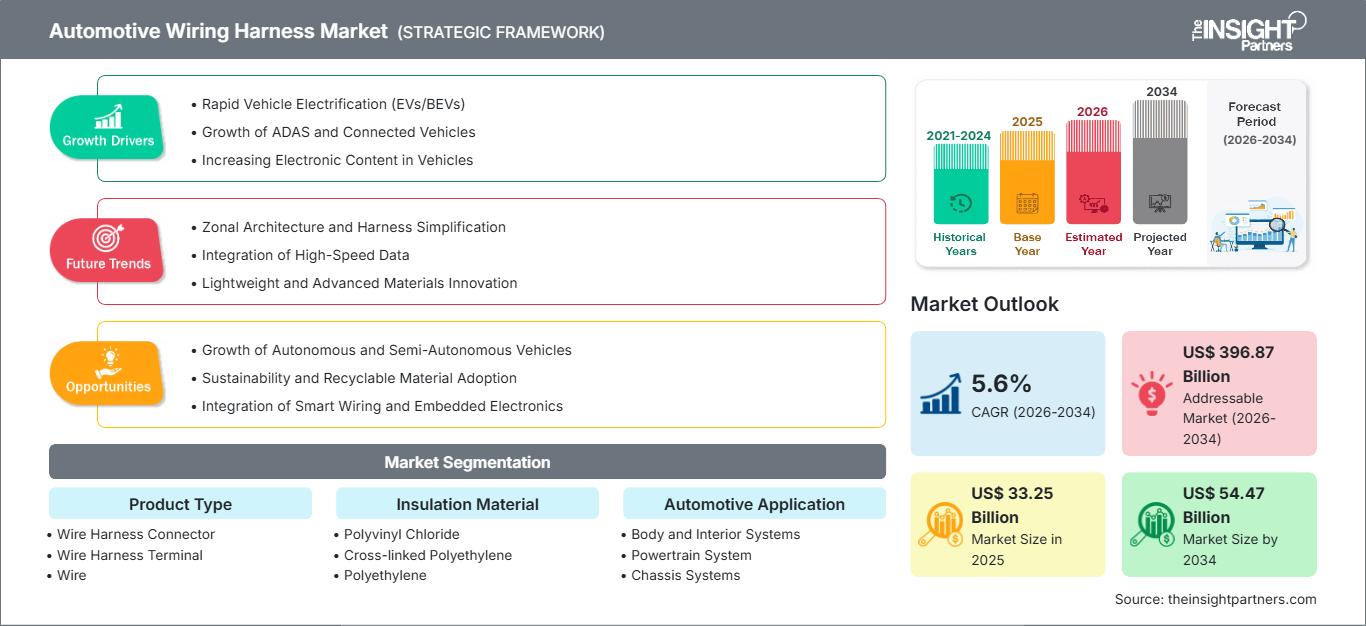
Automotive Wire Harness Market was valued at US$ 33.25 billion in 2025 and is projected to reach US$ 54.47 billion by 2034, expanding at a CAGR of 5.6% during 2026–2034. The market reflects rising electronic content in vehicles, electrification-led high-voltage routing, ADAS sensor integration, and OEM demand for reliable power and signal distribution across increasingly software-defined automotive platforms.
North America remains a high-value regional base as EV assembly localization, premium light truck electronics, and ADAS adoption support an estimated 4.9–5.4% CAGR. Automotive Wire Harness Market size in the region is shaped by U.S. OEM investment in high-voltage vehicle platforms, Mexico-based harness assembly capacity, and rising demand for connectors, terminals, and durable insulation suited to harsh operating conditions.
Automotive Wire Harness Market Assessment and Insights
- North America held 24–27% share in 2025 and is growing at a CAGR of 4.9–5.8% between 2026–2034, supported by EV localization, ADAS content, and Mexico-based harness manufacturing.
- US represented 76–80% of North America in 2025 and is growing at a CAGR of 4.8–5.7% between 2026–2034, led by EV platforms and pickup electronics.
- Europe accounted for 22–25% share in 2025 and is growing at a CAGR of 4.6–5.1% between 2026–2034, led by Germany, France, the UK, Italy, and Spain.
- Asia Pacific captured 43–47% share in 2025 and is growing at a CAGR of 5.9–6.5% between 2026–2034, with China, Japan, South Korea, and India leading volume adoption.
- Largest Segment Wire held 45–53% market share in 2025 and is growing at a CAGR of 5.1–5.6% between 2026–2034.
- High Growth Segment High Voltage held 7.8–8.6% market share in 2025 and is growing at a CAGR of 7.2–8.0% between 2026–2034.
- Key companies analyzed in detail: Yazaki Corporation, Sumitomo Electric Industries, Ltd., Aptiv PLC, Lear Corporation, Samvardhana Motherson International Limited, LEONI AG, Furukawa Electric Co., Ltd., Lisa Dräxlmaier GmbH, Fujikura Ltd., and Kromberg & Schubert Automotive GmbH & Co. KG.
Source: The Insight Partners' analysis based on proprietary research, government publications, company annual reports, investor presentations, industry databases, and expert interviews.
The electrical architecture of vehicles is gradually transitioning from distributed wiring architecture to zonal architecture along with increased bandwidth and compact harness routing. The transition to electrification requires orange high voltage cabling, battery connections, charging circuitry, and thermal resistant insulation, while the ADAS system requires cabling between cameras, radars, lidars, and sensors. These changes are driving production strategies since harnessing remains labor intensive, thereby requiring suppliers to embrace automation, regional assembly centers, and design-for-manufacturing practices that reduce weight and harnessing time.
Future growth will be driven by the combination of EV manufacturing, safety electronics, and supply chain localization. Asia Pacific will enjoy scale economics advantages, North America will gain from nearshoring initiatives, while Europe will focus on lightweight and recyclable materials. The regulatory push for vehicle safety, emissions control, and battery manufacturing drives OEMs to develop new power distribution systems, thus providing greater opportunities for suppliers with high voltage qualification, connector design, and automation assembly skills.
Automotive Wire Harness Market Report Scope
| Report Attribute | Details |
|---|---|
| Market size in 2025 | US$ 33.25 Billion |
| Market Size by 2034 | US$ 54.47 Billion |
| Global CAGR (2026 - 2034) | 5.6% |
| Historical Data | 2021-2024 |
| Forecast period | 2026-2034 |
Automotive Wire Harness Market Analysis
Demand is growing due to the increased power, signal, and data paths per vehicle. Growth of the Automotive Wire Harness Market is linked to battery electric vehicles, hybrid engines, ADAS, infotainment, lighting, body electronics, and diagnostics. According to the International Energy Agency (IEA), electric vehicle deployment is expanding into passenger vehicles, vans, buses, and trucks, resulting in an increased use of high-voltage harnesses with higher demands on shielding, insulation, routing precision, and thermal durability.
The value chain covers conductors, which include copper and aluminium materials; insulation based on polymers; terminals and connectors; tapes and clips; optical fiber; assembly boards; testing equipment; and vehicle OEMs. The supply situation is very sensitive to copper prices and the availability of labor, since assembly of wire harnesses involves many customized products. This is why suppliers are developing modular solutions, automation, and local production facilities near vehicle manufacturing sites.
Competitive positioning is concentrated among global Tier-1 suppliers with long OEM qualification histories. Automotive Wire Harness Market analysis indicates that Yazaki Corporation, Sumitomo Electric Industries, Ltd., Aptiv PLC, Lear Corporation, and Samvardhana Motherson International Limited compete on platform wins, cost control, engineering support, and regional manufacturing depth. Specialists such as LEONI AG, Furukawa Electric Co., Ltd., Fujikura Ltd., and Kromberg & Schubert add technology breadth.
Investment priorities are shifting toward high-voltage cable sets, aluminium conductors, optical data links, connector miniaturization, and automated harness assembly. Lisa Dräxlmaier GmbH and other premium-focused suppliers are positioned around complex interiors and EV systems, while Aptiv PLC and Lear Corporation emphasize E/E architecture and connectivity. Strategic advantage depends on early design involvement, validated safety performance, and the ability to serve OEMs across multiple production regions.
● REPORT CUSTOMIZATION
Tailor This Report To Align With Your Specific Business Requirements
This report can be customized to align precisely with your business objectives, scope, and target markets. Customization options include tailored segmentation, geography, competitive analysis, and strategic insights to support informed decision-making.
Customize This Report →WHAT YOU CAN ADJUST
- ● Segmentations
- ● Geography
- ● Competitive Analysis
- ● Language Preferences
Automotive Wire Harness Market: Strategic Insights
Regional Insights
North America Automotive Wire Harness Market
North America held 24–27% share in 2025 and is expected to grow at a CAGR of 4.9–5.8% during 2026–2034. Automotive Wire Harness Market share is supported by EV battery plants, pickup and SUV electronics, commercial vehicle telematics, and demand for high-reliability connectors that withstand heat, vibration, moisture, and road salt exposure.
Mexico enhances its competitive edge in the region by assembling labor-intensive body harnesses close to OEM assembly facilities in the U.S., while Canada contributes through clusters of automotive manufacturing and electric vehicle supply chain incentives. The region is witnessing a change in the demand pattern moving away from regular low-voltage body harnesses to batteries, chargers, ADAS, and infotainment systems.
U.S. Automotive Wire Harness Market Market
The U.S. accounted for 76–80% of North America in 2025 and is projected to grow at a CAGR of 4.8–5.7% from 2026–2034. Demand is concentrated in EVs, hybrids, large SUVs, pickup trucks, commercial vans, and connected vehicle platforms. OEM investment in domestic electrification increases requirements for high-voltage routing and robust terminal systems.
Aptiv PLC, Lear Corporation, Yazaki Corporation, and Sumitomo Electric Industries, Ltd. maintain strong customer relationships with North American OEMs, while Mexican assembly operations support cost efficiency. Application trends include battery disconnect wiring, ADAS sensor harnesses, digital cockpit cabling, and thermal-resistant insulation. The market also benefits from federal and state incentives that encourage EV supply-chain localization.
Europe Automotive Wire Harness Market Market
Europe represented 22–25% share in 2025 and is forecast to grow at a CAGR of 4.6–5.1% through 2034. Germany leads because premium OEMs, EV platforms, and Tier-1 engineering centers accelerate high-voltage, lightweight, and ADAS-ready harness adoption. France and the UK support demand through electrification programs, safety electronics, and commercial fleet modernization.
Italy and Spain contribute through vehicle assembly, supplier networks, and export-oriented component manufacturing. European automakers prioritize weight reduction, recyclability, and compliance with strict safety and emissions rules, which favors advanced insulation and aluminium conductor development. LEONI AG, Lisa Dräxlmaier GmbH, Aptiv PLC, and Kromberg & Schubert Automotive GmbH & Co. KG strengthen regional competitiveness through deep OEM integration.
APAC Automotive Wire Harness Market Market
APAC held 43–47% share in 2025 and is expected to grow at a CAGR of 5.9–6.5% during 2026–2034. China leads due to vehicle output, EV manufacturing scale, battery supply chains, and rapid ADAS adoption, while Japan and South Korea contribute advanced connector, terminal, and optical fiber technologies.
Demand is increased by India and Australia due to passenger cars, commercial vehicles, mining vehicles, and local sourcing of components. IEA reporting on electric vehicles proves that there is a broad expansion in electric mobility, which results in increased demand for high-voltage harnesses. Policies that promote domestic manufacturing, charging stations, and export electronics contribute to strengthening of supply chains in the region.
Middle East & Africa Automotive Wire Harness Market Market
Middle East & Africa is projected to grow at a CAGR of 4.3–4.9% during 2026–2034. Saudi Arabia and the UAE lead demand through EV assembly initiatives, logistics fleets, construction vehicles, and smart mobility investments, while South Africa contributes established automotive production and export-oriented component supply.
The rest of the demand for MEA is tied to buses, infrastructure projects, and aftermarket replacement in extreme conditions. Energy diversification initiatives favor automobile manufacturing growth, but the implementation has been selective, as the level of car manufacturing is smaller compared to other parts of the world like Asia and Europe.
Segmentation Analysis
Product Type
Product Type is expected to grow at a CAGR of 5.2–5.8% during 2026–2034. Automotive Wire Harness Market scope across product categories is widening as OEMs require denser connector systems, reliable terminals, lighter wires, and specialized assemblies. Wire remains the largest value pool, while connectors and terminals gain importance as high-speed data, safety interlocks, and modular vehicle architectures become standard.
- Wire Harness Connector demand is rising as vehicles add sensors, domain controllers, cameras, and high-voltage interfaces that require secure locking, sealing, and signal integrity.
- Wire Harness Terminal remains strategically important because terminal quality affects current transfer, corrosion resistance, contact stability, and long-term reliability under vibration and thermal cycling.
- Wire holds the largest market position as copper, aluminium, and specialty conductors carry power and data across body, chassis, safety, and propulsion systems.
Insulation Material
Insulation Material is projected to grow at a CAGR of 5.0–5.6% from 2026–2034. Material selection depends on heat resistance, flexibility, abrasion performance, chemical exposure, flame retardance, and cost. EV and high-voltage platforms are increasing demand for XLPE, TPE, PU, and advanced compounds, while PVC remains widely used in cost-sensitive low-voltage applications.
- Polyvinyl Chloride (PVC) remains a mainstream material because it balances cost, processability, flame resistance, and adequate durability for body, interior, and low-voltage harness applications.
- Cross-linked Polyethylene (XLPE) is preferred in higher-temperature and higher-voltage zones where thermal stability, insulation strength, and resistance to deformation are critical.
- Polyethylene (PE) supports applications requiring moisture resistance, dielectric performance, and lightweight insulation, particularly where flexibility and cost efficiency matter.
- Polypropylene (PP) is used where low density, chemical resistance, and recyclability support lightweighting strategies across selected automotive wiring applications.
- Polyurethane (PU) serves demanding zones needing abrasion resistance, flexibility, and durability under mechanical stress, especially in moving or exposed harness routes.
- Thermoplastic Elastomer (TPE) is gaining relevance for EV and compact routing applications because it combines flexibility, heat resistance, and process efficiency.
Automotive Application
Automotive Application is forecast to grow at a CAGR of 5.3–5.9% during 2026–2034. Harness demand is spreading across comfort, propulsion, safety, and chassis systems as vehicles adopt more electronic control units and connected functions. Safety and ADAS systems are especially content-intensive because cameras, radar, sensors, and data lines must operate reliably with low latency.
- Body and Interior Systems use harnesses for lighting, seating, climate control, infotainment, displays, door modules, and comfort electronics, making them a broad and stable demand base.
- Powertrain System applications are changing as ICE control harnesses coexist with hybrid and EV battery, inverter, motor, and charging circuits.
- Chassis Systems require durable wiring for braking, steering, suspension, stability control, and wheel-end sensors exposed to vibration, moisture, and road debris.
- Safety and ADAS Systems represent a strategic growth area because advanced sensing, data transmission, and fail-safe connectivity raise connector and shielding requirements.
Voltage Capacity
Voltage Capacity is expected to grow at a CAGR of 5.6–6.4% during 2026–2034. Low-voltage wiring remains the installed base anchor, medium-voltage systems support hybridization, and high-voltage harnesses are gaining fastest as BEVs and plug-in hybrids expand. Safety validation, shielding, orange cable standards, and thermal performance define supplier competitiveness in this segment.
- Low Voltage (0 to 50V) remains essential for lighting, infotainment, body electronics, sensors, and conventional control circuits across nearly all vehicle types.
- Medium Voltage (50 to 300V) supports hybrid architectures, auxiliary power functions, and transitional electrification systems requiring stronger insulation and validated connector performance.
- High Voltage (More than 300V) is the fastest-growing area as EV battery packs, inverters, charging systems, and e-axles require safe, shielded, high-current routing.
Conducting Material
Conducting Material is projected to grow at a CAGR of 5.1–5.7% from 2026–2034. Copper remains the performance benchmark, aluminium adoption is rising for lightweighting, and optical fiber is gaining relevance for high-speed data. Material decisions increasingly balance conductivity, weight, bend radius, corrosion control, repairability, and compatibility with automated assembly processes.
- Copper dominates because of high conductivity, proven reliability, established termination practices, and broad compatibility with low-voltage and high-current automotive circuits.
- Aluminium is gaining traction where weight reduction and cost control matter, although connector design and corrosion management require careful engineering.
- Optical Fiber supports high-speed data links for cameras, infotainment, autonomous functions, and future zonal architectures needing bandwidth with electromagnetic immunity.
Sales Channel
Sales Channel is forecast to grow at a CAGR of 5.0–5.5% during 2026–2034. OEM supply dominates because harnesses are designed into vehicle platforms early and require validation with architecture, packaging, and safety systems. Aftermarket demand is smaller but relevant for collision repair, aging vehicles, connector replacement, and specialty EV or performance upgrades.
- OEMs account for most revenue because harnesses are customized, platform-specific, validated with vehicle electronics, and sourced through long-term Tier-1 supplier programs.
- Aftermarket demand comes from collision repairs, electrical failures, restoration, fleet maintenance, and specialty upgrades where fitment accuracy and connector compatibility are critical.
Opportunity Snapshot
| Automotive Application | Revenue Contribution | Trend Tag | Adoption Stage |
| Body and Interior Systems | High | Digital Cabin | Mature |
| Powertrain System | High | EV Routing | Scaling |
| Chassis Systems | Medium | Sensor Links | Scaling |
| Safety and ADAS Systems | High | ADAS Data | Scaling |
Automotive Wire Harness Market Growth Drivers and Impact Analysis
Electrification raises harness value per vehicle
Electrical cars or hybrid cars need special wiring systems that will be used for batteries, inverters, chargers, e-axles, thermal management systems and chargers interfaces. Such platforms have more requirements for insulation, shielding, heat resistance and orange coloring of wires than standard cars. This makes design process and added value for suppliers more complicated. IEA Global EV Outlook 2025 shows the growth of electrification in various types of vehicles, so the demand for high voltage harnesses becomes more prominent. In practice, it means moving from standard bundles of low voltage wiring to safety critical systems.
ADAS and connected vehicle electronics increase wiring density
Advanced driver-assist systems require addition of cameras, radars, ultrasound, lidar, domain controllers, displays, and high-speed interfaces across the chassis of the vehicle. These require efficient routing, EMI shielding, connector sealing, and minimum delay in signal transmission. With OEMs aiming at increased safety standards and software-based technologies, harnessing design takes the center stage for reliability rather than being an afterthought while packaging. This translates into greater need for smaller connectors, fiber optic cables, shielded wiring, and modularity of harnessing systems.
Supply-chain localization reshapes sourcing strategy
The nature of automotive harnesses is that they are bulky and tailor-made, making long-distance transportation and last minute engineering changes costly. Automotive Original Equipment Manufacturers (OEMs) have thus encouraged their suppliers to manufacture near their vehicle plants, especially those involved in EV projects that are being facilitated by regional economic policies. In North America, Mexico and the U.S., in Europe, Eastern Europe and North Africa, and in Asia Pacific, China, Japan, Korea, and India are becoming key manufacturers.
Automotive Wire Harness Market Future Trends
Zonal electrical architectures reduce wiring complexity
The Automotive Wire Harness Market trends will start to focus on zonal electrical architecture which uses regional controllers rather than point-to-point electrical connections. The use of zonal electrical architecture may have an impact in reducing the weight of the vehicle, simplifying the assembly process, aiding diagnostics, and enabling the implementation of software-defined functions of the vehicle. The suppliers should be ready to manufacture modular wire harnesses, fast data bus, and connectors that are compatible with zonal controllers.
Lightweight conductors and recyclable insulation gain priority
Future conductive harnesses will give more importance to aluminum wires, thin insulation layers, recyclable polymers, and route optimization in order to decrease the weight of the vehicle and extend the range of the electric vehicle. The use of copper will be necessary in some high-performing circuits; however, some substitutions can lead to reduction in body and interior harnesses. With the help of European sustainability requirements, carbon reduction objectives of OEMs, and battery efficiency objectives, suppliers will be obliged to demonstrate the performance and recyclability of the materials.
Automotive Wire Harness Market Opportunities
High-voltage EV harness localization
EV manufacturing within regions provides a potential for suppliers to manufacture high voltage cable kits, battery connectors, charging harnesses, and safety interlock assembly kits within proximity to their OEM factories. Automotive Wire Harness Market players can increase their success rate by providing engineering capabilities during platform development, rapid prototyping, and production process validation based on their regional content needs. North America, Europe, India, and Southeast Asia provide good potential since incentives for policies and battery technologies are shaping up new supply chains.
Automation-enabled harness manufacturing
Harness assembly has traditionally relied on manpower, however, increased complexity and manpower shortages provide the scope for automation in cutting, stripping, crimping, taping, visual inspection, and electrical testing. The use of digital work instructions, AI-enabled quality control, and modular assembly boards could help to minimize defects and increase repeatability in the production of complex EV and ADAS harnesses. This would be particularly pertinent for suppliers who cater to more than one OEM and whose designs vary frequently.
Recent Developments
- January 2025: Aptiv PLC (NYSE: APTV) (the “Company”), a global technology company enabling a more safe, green and connected future, today announced that its Board of Directors has unanimously approved a plan to separate its Electrical Distribution Systems business (“EDS” or the “EDS business”) from Aptiv, creating two independent companies, each optimally positioned to serve their customers and create value for their shareholders.
- February 2025: Lear Corporation has acquired StoneShield Engineering, a privately held system integrator based in Castelo Branco, Portugal. The acquisition is expected to enhance automation across production processes within the E-Systems segment and support the development of advanced technologies for wire harness manufacturing, improving efficiency and operational excellence.
- December 2025: Samvardhana Motherson International Limited (SAMIL) announced that it had entered into exclusive negotiations through its material subsidiary Motherson Global Investments B.V. (MGI B.V.) to potentially acquire 100% of the global wiring harness business of Nexans autoelectric GmbH (“AutoElectric”), subject to employee consultation and necessary regulatory approvals. The enterprise value of the transaction was €207 million on a cash and debt-free basis, with the actual payout to be determined based on closing adjustments.
Frequently Asked Questions

- Comprehensive Market Sizing and Forecast Analysis
- Detailed Segmentation Analysis
- In-Depth Market Dynamics Assessment
- Regional and Country-Level Insights
- Competitive Landscape and Company Benchmarking
- Strategic Business Intelligence
Recent Reports
Testimonials

The Insight Partners' SCADA System Market report is comprehensive, with valuable insights on current trends and future forecasts. The team was highly professional, responsive, and supportive throughout. We are very satisfied and highly recommend their services.
RAN KEDEM Partner, Reali Technologies LTDs
I requested a report on a very specific software market and the team produced the report in a few days. The information was very relevant and well presented. I then requested some changes and additions to the report. The team was again very responsive and I got the final report in less than a week.
JEAN-HERVE JENN Chairman, Future Analytica
We worked with The Insight Partners for an important market study and forecast. They gave us clear insights into opportunities and risks, which helped shape our plans. Their research was easy to use and based on solid data. It helped us make smart, confident decisions. We highly recommend them.
PIYUSH NAGPAL Sr. Vice President, High Beam Global
The Insight Partners delivered insightful, well-structured market research with strong domain expertise. Their team was professional and responsive throughout. The user-friendly website made accessing industry reports seamless. We highly recommend them for reliable, high-quality research services
YUKIHIKO ADACHI CEO, Deep Blue, LLC.
This is the first time I have purchased a market report from The Insight Partners.While I was unsure at first, I visited their web site and felt more comfortable to take the risk and purchase a market report.I am completely satisfied with the quality of the report and customer service. I had several questions and comments with the initial report, but after a couple of dialogs over email with their analyst I believe I have a report that I can use as input to our strategic planning process.Thank you so much for taking the extra time and making this a positive experience.I will definitely recommend your service to others and you will be my first call when we need further market data.
JOHN SUZUKI President and Chief Executive Officer, Board Director, BK Technologies
I wish to appreciate your support and the professionalism you displayed in the course of attending to my request for information regarding to infectious disease IVD market in Nigeria. I appreciate your patience, your guidance, and the fact that you were willing to offer a discount, which eventually made it possible for us to close a deal. I look forward to engaging The Insight Partners in the future, all thanks to the impression you have created in me as a result of this first encounter.
DR CHIJIOKE ONYIA MANAGING DIRECTOR, PineCrest Healthcare Ltd.Reason to Buy
- Informed Decision-Making
- Understanding Market Dynamics
- Competitive Analysis
- Identifying Emerging Markets
- Customer Insights
- Market Forecasts
- Risk Mitigation
- Boosting Operational Efficiency
- Strategic Planning
- Investment Justification
- Tracking Industry Innovations
- Aligning with Regulatory Trends





 Get Free Sample for