
Autonomous Delivery Robots Market Size, Share & Demand by 2034
Coverage: By Type (Semi-Autonomous Robots, Fully Autonomous Robots); End-User (Retail, Healthcare, Restaurants and Hotels, Food and Beverages, Hospitality, Logistics, Others) , and Geography (North America, Europe, Asia Pacific, and South and Central America)
- Status : Data Released
- Report Code : TIPRE00006238
- Category : Electronics and Semiconductor
- No. of Pages : 150
- Available Report Formats :


- Last update date : July 20, 2026


2025 Market Size
US$ 97.22 Mn
Base year value
2034 Forecast
US$ 481.25 Mn
Projected by 2034
CAGR 2026-2034
19.45 %
Growth rate
Addressable Market
US$ 2,358.89 Mn
(2026-2034)
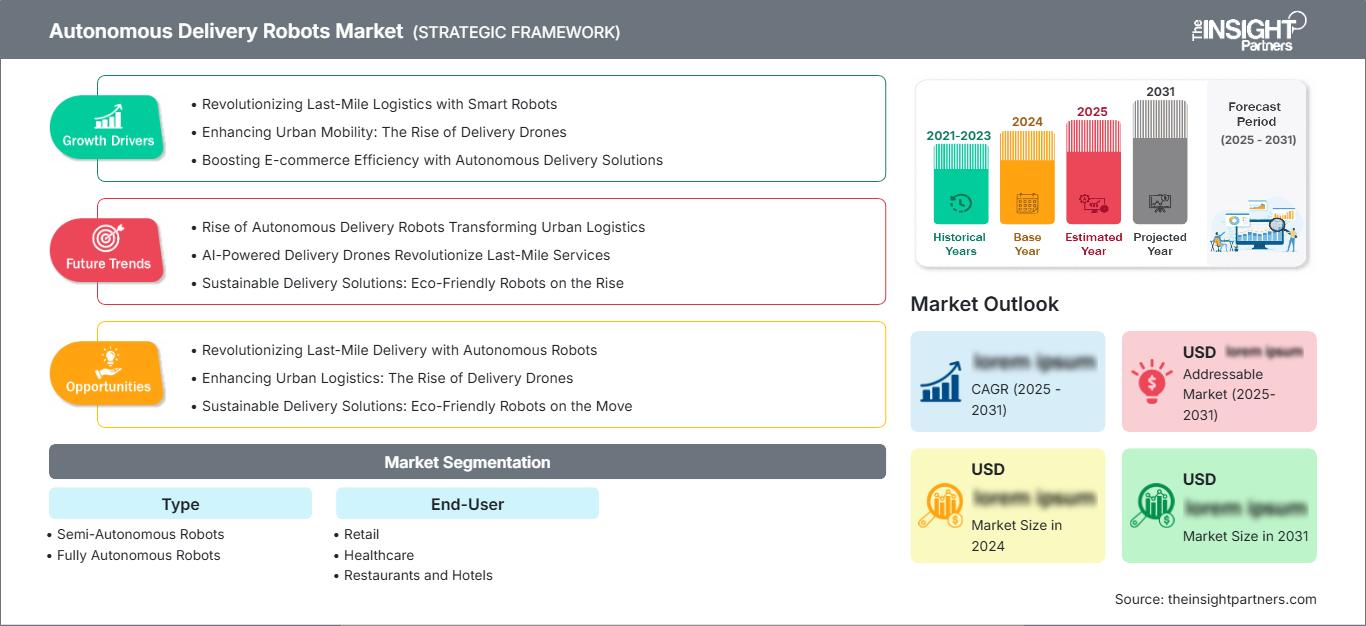
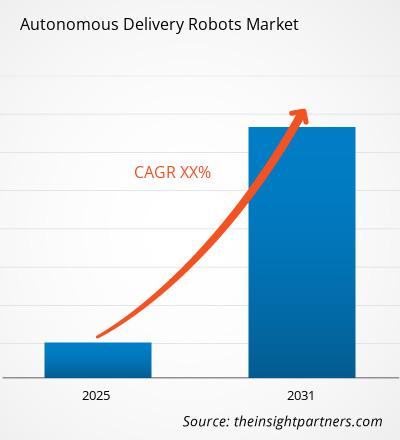
The Autonomous Delivery Robots Market is valued at US$ 97.22 Million in 2025 and is projected to reach US$ 481.25 Million by 2034, registering a CAGR of 19.45% during 2026–2034. Demand is advancing as retailers, hospitals, restaurants, hotels, and logistics operators automate short-distance delivery tasks while improving contactless service, labor productivity, delivery predictability, and low-emission last-mile operations.
North America remains a priority market, with the Autonomous Delivery Robots Market size supported by campus deployments, healthcare logistics automation, restaurant delivery pilots, and sidewalk delivery regulations that are gradually becoming clearer. Regional demand is estimated to grow at a CAGR range of 18.2–19.0% during 2026–2034 as fleet operators scale from controlled campuses toward grocery, hospitality, and mixed-use urban delivery corridors.
Autonomous Delivery Robots Market Assessment and Insights
- North America: The region is estimated to hold 31–35% share in 2025 and grow at a CAGR of 18.2–19.0% during 2026–2034, supported by university, retail, healthcare, and restaurant deployments.
- US: The country represents 76–80% of North America in 2025 and is projected to grow at a CAGR of 18.6–19.4% during 2026–2034.
- Europe: Europe accounts for 26–30% share in 2025 and is expected to grow at a CAGR of 18.0–18.8% during 2026–2034, led by the UK, Germany, Finland, France, and Estonia.
- Asia Pacific: Asia Pacific represents 22–26% share in 2025 and is forecast to grow at a CAGR of 20.4–21.2% during 2026–2034, with China, Japan, South Korea, India, and Australia advancing pilots.
- Largest Segment: Semi-Autonomous Robots hold 58–62% market share in 2025 and are expected to grow at a CAGR of 17.8–18.6% during 2026–2034.
- High Growth Segment: Fully Autonomous Robots hold 38–42% market share in 2025 and are expected to grow at a CAGR of 21.0–22.0% during 2026–2034.
- Key companies analyzed in detail: Aethon Inc.; Amazon.com, Inc.; Eliport S.L.; Kiwibot; Marble Robot Inc.; Nuro, Inc.; Robby Technologies Inc.; Savioke, Inc.; Starship Technologies, Inc.; TeleRetail AG.
Source: The Insight Partners' analysis based on proprietary research, government publications, company annual reports, investor presentations, industry databases, and expert interviews.
The development of robot delivery vehicles has moved from being piloted to becoming commercially viable through fleet deployments on campuses, hospitals, hotels, shopping areas, and certain city routes. Technology advances have seen improvements in visual awareness, LiDAR fusion, remote assistance, fleet orchestration, battery management, and geofencing of autonomy. Production dynamics will be defined more and more by rugged chassis designs, optimized sensor costs, software validation, service availability, charging networks, and local permitting that will govern where robots can be deployed.
Future demand will be driven by urban labor challenges, growing e-commerce deliveries, efficiency programs at hospitals, and sustainability goals that encourage the use of smaller electric delivery vehicles. Geographies adopting robots initially will do so within campuses, gated communities, hospitals, airports, and business parks prior to moving to larger public spaces. Regulatory tailwinds will emerge with speed regulations, insurance guidelines, accessibility standards, and municipal permitting to ease the concerns of fleet investors.
Autonomous Delivery Robots Market Report Scope
| Report Attribute | Details |
|---|---|
| Market size in 2025 | US$ 97.22 Million |
| Market Size by 2034 | US$ 481.25 Million |
| Global CAGR (2026 - 2034) | 19.45% |
| Historical Data | 2021-2024 |
| Forecast period | 2026-2034 |
Autonomous Delivery Robots Market Analysis
The drivers for the Autonomous Delivery Robots Market are the economic factors involved in the short-distance deliveries, such as availability of labor force, churn in couriers, fuel costs, and peak hour traffic, which affect their profit margins. Robots are reducing the monotonous work of transportation within the controlled and semi-controlled routes. An ecosystem consists of Robot OEMs, autonomous software companies, sensors, batteries, mapping companies, cloud-based fleet management platforms, merchants, hospitals, municipalities, and last-mile logistics firms.
The supply dynamic continues to be selective since there will be a need to have the robots able to deal with curbs, pedestrians, weather, elevators, doors, customer service counters, and vandalism. The semi-autonomous function continues to be relevant when it comes to exceptions, while the autonomous stack is evolving from real-world data and remote monitoring.
Analysis of the Autonomous Delivery Robots Market reveals that there is a highly competitive industry comprising sidewalk delivery players, indoor logistics companies, and players in the road autonomy sector. Starship Technologies, Inc. and Kiwibot target food, grocery, and campus deliveries, whereas Aethon Inc. and Savioke, Inc. target healthcare and hospitality workflows, respectively. Road autonomy expertise is provided by Nuro, Inc., while Amazon.com, Inc. has strategic relevance due to logistics automation expertise.
Trends in investment are towards businesses that are capable of integrating fleet hardware, safety cases, teleoperation, routing, and merchant integration rather than marketing robots as separate pieces of hardware. Eliport S.L., TeleRetail AG, Marble Robot Inc., and Robby Technologies Inc. are examples of niche innovation within the area of small-sized delivery robots. Positioning is becoming more about being ready to operate legally, having operational data, etc.
● REPORT CUSTOMIZATION
Tailor This Report To Align With Your Specific Business Requirements
This report can be customized to align precisely with your business objectives, scope, and target markets. Customization options include tailored segmentation, geography, competitive analysis, and strategic insights to support informed decision-making.
Customize This Report →WHAT YOU CAN ADJUST
- ● Segmentations
- ● Geography
- ● Competitive Analysis
- ● Language Preferences
Autonomous Delivery Robots Market: Strategic Insights
Regional Insights
North America Autonomous Delivery Robots Market
North America holds 31–35% share in 2025 and is projected to expand at a CAGR of 18.2–19.0% during 2026–2034. Autonomous Delivery Robots Market share is supported by structured campus environments, grocery pilots, hospital logistics, hotel service automation, and merchant interest in lower-cost local delivery. The region benefits from advanced cloud infrastructure, venture funding, and early consumer familiarity with robot delivery.
Municipal approval continues to be the biggest adoption gate because of variations in regulations on sidewalk access, operating speeds, insurance requirements, accessibility requirements, and data-reporting regulations between jurisdictions. It means that fleet companies are concentrating their efforts on universities, medical facilities, business parks, and planned developments because of route control. The use of robots will expand to include food-ordering platforms, pharmacies, real estate, and hospitals.
U.S. Autonomous Delivery Robots Market
The US accounts for 76–80% of North American demand in 2025 and is expected to grow at a CAGR of 18.6–19.4% during 2026–2034. Adoption is seen mostly among university campuses, hospitals, suburban shopping centers, and restaurant delivery areas where predictable paths maximize utilization. The participating organizations are: Starship Technologies, Inc., Amazon.com, Inc., Nuro, Inc., Aethon Inc., Kiwibot, and Savioke, Inc.
The application focuses on hot food deliveries, grocery deliveries, internal hospital transportation, hotel services, and pharmacy deliveries. In the United States, the operators are experimenting with hub-based dispatching, remote support, curbside delivery, and merchant software integration. The industry is sensitive to policies, but due to high labor costs and delivery demands, the country is the largest commercialization center in the region.
Europe Autonomous Delivery Robots Market
Europe represents 26–30% share in 2025 and is projected to grow at a CAGR of 18.0–18.8% during 2026–2034. The UK and Germany lead deployment because retailers, food platforms, and city authorities have experience with controlled sidewalk pilots. Finland and Estonia provide proven operating environments, while France, Italy, and Spain advance selectively through urban mobility and hospitality use cases.
European demand is influenced by pedestrian safety rules, emissions policy, delivery labor costs, and compact urban layouts. Operators must demonstrate accessibility compliance and low-speed safety before scaling. Grocery delivery is a notable opportunity because route density can support repeat utilization. Germany remains the leading country for engineering partnerships and structured commercial adoption.
APAC Autonomous Delivery Robots Market
APAC accounts for 22–26% share in 2025 and is expected to grow at a CAGR of 20.4–21.2% during 2026–2034. China is the leading country due to e-commerce density, robotics manufacturing capability, and smart-city experimentation. Japan and South Korea emphasize service robotics, while India and Australia test controlled-campus and retail applications.
Industrial and policy drivers include local electronics supply chains, urban delivery congestion, hospital modernization, and growing acceptance of automation in commercial facilities. APAC adoption will likely move fastest in campuses, malls, high-density residential districts, and hospitals, where operating boundaries can be defined before broader citywide sidewalk permissions mature.
Middle East & Africa Autonomous Delivery Robots Market
The Middle East & Africa is projected to grow at a CAGR of 17.0–17.8% during 2026–2034. The UAE is the leading country because smart-city programs, hospitality automation, and premium retail districts provide controlled deployment zones. Saudi Arabia is investing in logistics and infrastructure modernization, while South Africa supports selective hospital and campus use.
Energy and infrastructure contexts favor robots that can operate in heat, dust, secured campuses, malls, airports, hotels, and mixed-use developments. The rest of MEA adoption remains early, but demand should rise where labor allocation, service consistency, and contactless delivery improve facility operations without requiring full public sidewalk deployment.
Segmentation Analysis
Type
The Type segment is projected to grow at a CAGR of 19.0–19.8% during 2026–2034 as operators balance autonomy maturity with safety oversight. Autonomous Delivery Robots Market scope spans supervised sidewalk bots, indoor hospital platforms, hotel service robots, and increasingly capable fully autonomous fleets. Buyers evaluate route complexity, intervention frequency, payload, battery life, regulatory permissions, and integration with ordering systems.
- Semi-Autonomous Robots remain the largest type because remote assistance and supervised navigation reduce safety risk in complex pedestrian environments while supporting commercial delivery, hospital logistics, and hospitality service.
- Fully Autonomous Robots are strategically important as perception, mapping, and decision systems improve, enabling lower intervention rates, stronger unit economics, and broader use in dense routes and controlled facilities.
End-User
The End-User segment is estimated to grow at a CAGR of 19.2–20.0% during 2026–2034 because demand is moving beyond pilots into operational workflows. Retailers need low-cost local fulfillment, hospitals need internal material movement, restaurants want predictable delivery capacity, hotels seek service consistency, and logistics providers are testing robots as part of hub-and-spoke last-mile networks.
- Retail adoption is driven by grocery, pharmacy, convenience, and curbside delivery models where short trip distances, recurring orders, and merchant integration improve robot fleet utilization.
- Healthcare uses robots for medications, specimens, meals, linens, and supplies, reducing nonclinical walking time while improving delivery traceability across hospitals and large medical campuses.
- Restaurants and Hotels deploy robots for food delivery, room service, amenities, and campus-style hospitality routes where predictable layouts and high repeat demand support efficient operations.
- Food and beverages remain strategically important because hot food, snacks, groceries, and beverages create frequent small orders suited to compact electric delivery platforms.
- Hospitality benefits from robots that provide contactless amenities, lobby-to-room delivery, luggage-adjacent service, and staff support in hotels, resorts, serviced apartments, and event venues.
- Logistics adoption centers on parcel handoff, micro-fulfillment, warehouse-to-curb movement, and neighborhood delivery routes where robots can complement vans, lockers, and human couriers.
Opportunity Snapshot
| End-User | Revenue Contribution | Trend Tag | Adoption Stage |
| Retail | High | Grocery Bots | Scaling |
| Healthcare | High | Hospital Logistics | Mature |
| Restaurants and Hotels | Medium | Room Service | Scaling |
| Food and Beverages | High | Hot Food | Scaling |
| Hospitality | Medium | Amenity Runs | Emerging |
| Logistics | Medium | Parcel Handoff | Emerging |
Autonomous Delivery Robots Market Growth Drivers and Impact Analysis
Labor Pressure and Last-Mile Cost Compression
The challenges include high labor costs, high turnover among couriers, and low availability during meals and shifts at hospitals. Autonomous robots solve these challenges through the movement of smaller packages on known routes, whereas the employees take care of the higher value exception cases. This benefit is felt when there is delivery intensity and short travel distance, including campus grounds, hospitals, hotels, and neighborhoods around grocery stores. There are also advantages in terms of minimizing downtime and scheduling the service capacity. From the buyer’s side, the use case will be influenced by route repeatability, utilization period, maintenance cost, and frequency of remote support.
Healthcare and Hospitality Workflow Automation
Robots have been introduced in hospitals and hotels since the movement jobs are repetitive, urgent, and quantifiable. In hospitals, the robots transport drugs, samples, linens, meals, and supplies, and help increase the chain of custody and decrease walking time not related to clinical duties. On the other hand, in hotels, robots deliver amenities, food, and other services requested by the guests without having the employees leave their work at the reception or other places. The significance of the market is evident because the controlled environment of the building decreases regulatory issues in comparison with public streets.
Regulatory Clarity for Sidewalk and Campus Operations
Deployment in public areas is contingent on local regulations for weight, speed, lighting, insurance, right-of-way conduct, accident reporting, accessibility, and operational zones. With more municipalities creating permit systems, operators receive guidance on the conditions of investment for expanding fleets. This effect is not consistent since some cities ban sidewalk delivery robots, whereas others allow for regulated operation within certain districts, campuses, or business parks. It allows for a gradual approach to adoption through pilot projects that generate safety data before broader use of the technology. Those firms that can demonstrate proper incident handling, remote monitoring, and accessibility cooperation will be able to get permits faster.
Autonomous Delivery Robots Market Future Trends
Fleet Intelligence and Remote Assistance Networks
Autonomous Delivery Robots Market trends will increasingly center on fleet intelligence rather than individual robot hardware. Operators will optimize dispatch, battery charging, curbside dwell time, delivery batching, weather routing, and remote intervention using cloud-based control systems. Remote assistance networks will allow one supervisor to support many robots, improving economics while maintaining safety during unusual events. Over time, fleet learning will make routes more predictable and reduce intervention frequency. The most advanced platforms will connect merchant demand, robot availability, local rules, and customer handoff preferences in one operating layer. This trend will favor companies with large datasets and proven uptime across diverse environments.
Indoor-Outdoor Robots for Mixed Facilities
The future robot designs would enable robots to combine both indoor and outdoor locomotion to reach from the kitchen, pharmacies, stockrooms, or even micro-fulfillment centers to guest rooms, hospital wings, sidewalks, and curb-side pick up points. There will be a need for improved localization transitions, elevators, doorways, weather-proofing, and security for payload transportation. The mixed facility deployment would provide great benefit since it ensures that robots would be utilized not only along one route within the building or outdoors. This would assist owners or retail companies to justify any investments in infrastructural aspects like charging docks, staging areas, and digital access control.
Autonomous Delivery Robots Market Opportunities
Retail Micro-Fulfillment and Grocery Delivery Corridors
Autonomous Delivery Robots Market Forecasts indicate a strong opportunity in grocery and retail micro-fulfillment, where frequent small orders, short delivery radii, and predictable customer handoffs can lift fleet utilization. Retailers can deploy robots from stores, dark kitchens, pharmacy counters, or neighborhood hubs to reduce dependence on gig couriers during peak periods. Investment should focus on staging zones, inventory integration, thermal compartments, delivery authentication, and customer communication. The opportunity is strongest in dense suburbs, campuses, and planned communities with repeat demand. Operators that combine robots with loyalty apps, delivery subscriptions, and route analytics can improve service economics while limiting congestion and emissions from short vehicle trips.
Hospital Supply Chain and Inventory Automation
Hospitals' logistics process automation is an actionable business opportunity since robots could link pharmacies, laboratories, stores, kitchens, laundries, and ward delivery logistics. The business case becomes stronger if autonomous transportation systems can be integrated with inventory management systems, EMR (electronic medical records), and real-time locating systems. In hospitals that experience a shortage of personnel, robots can be used to cut down routine walking while at the same time keeping material logistics on time. Robot manufacturers need to focus on the security of the payload compartment, audit trail capability, elevator interface, infection control materials, and 24-hour-a-day assistance. This business opportunity is relatively less impacted by regulations concerning city sidewalks.
Recent Developments
- March 2026: Amazon has acquired Rivr, a Swiss robotics company developing machines for “doorstep delivery.” The delivery robots developed by RIVR, a spin-off from the Swiss Federal Institute of Technology in Zurich, founded in 2023, are designed to carry out doorstep deliveries. They move on four wheeled legs and resemble a dog in terms of their build.
- July 2026: Neolix, a developer of Level 4 (L4) autonomous logistics vehicles, has announced that it has reached a significant commercial milestone in the deployment of autonomous delivery solutions, positioning itself at the forefront of the rapidly expanding Physical AI industry.
- March 2026: Serve Robotics Inc., a leading autonomous robotics company, and White Castle, the innovator of The Original Slider, announced a partnership to deliver the brand's beloved Sliders and Crave-worthy menu items via Serve's autonomous delivery robots on Uber Eats. Customers ordering White Castle in Serve’s delivery zone may now have their meals arrive in one of Serve’s autonomous sidewalk robots.
Frequently Asked Questions

- Comprehensive Market Sizing and Forecast Analysis
- Detailed Segmentation Analysis
- In-Depth Market Dynamics Assessment
- Regional and Country-Level Insights
- Competitive Landscape and Company Benchmarking
- Strategic Business Intelligence
Recent Reports
Testimonials

The Insight Partners' SCADA System Market report is comprehensive, with valuable insights on current trends and future forecasts. The team was highly professional, responsive, and supportive throughout. We are very satisfied and highly recommend their services.
RAN KEDEM Partner, Reali Technologies LTDs
I requested a report on a very specific software market and the team produced the report in a few days. The information was very relevant and well presented. I then requested some changes and additions to the report. The team was again very responsive and I got the final report in less than a week.
JEAN-HERVE JENN Chairman, Future Analytica
We worked with The Insight Partners for an important market study and forecast. They gave us clear insights into opportunities and risks, which helped shape our plans. Their research was easy to use and based on solid data. It helped us make smart, confident decisions. We highly recommend them.
PIYUSH NAGPAL Sr. Vice President, High Beam Global
The Insight Partners delivered insightful, well-structured market research with strong domain expertise. Their team was professional and responsive throughout. The user-friendly website made accessing industry reports seamless. We highly recommend them for reliable, high-quality research services
YUKIHIKO ADACHI CEO, Deep Blue, LLC.
This is the first time I have purchased a market report from The Insight Partners.While I was unsure at first, I visited their web site and felt more comfortable to take the risk and purchase a market report.I am completely satisfied with the quality of the report and customer service. I had several questions and comments with the initial report, but after a couple of dialogs over email with their analyst I believe I have a report that I can use as input to our strategic planning process.Thank you so much for taking the extra time and making this a positive experience.I will definitely recommend your service to others and you will be my first call when we need further market data.
JOHN SUZUKI President and Chief Executive Officer, Board Director, BK Technologies
I wish to appreciate your support and the professionalism you displayed in the course of attending to my request for information regarding to infectious disease IVD market in Nigeria. I appreciate your patience, your guidance, and the fact that you were willing to offer a discount, which eventually made it possible for us to close a deal. I look forward to engaging The Insight Partners in the future, all thanks to the impression you have created in me as a result of this first encounter.
DR CHIJIOKE ONYIA MANAGING DIRECTOR, PineCrest Healthcare Ltd.Reason to Buy
- Informed Decision-Making
- Understanding Market Dynamics
- Competitive Analysis
- Identifying Emerging Markets
- Customer Insights
- Market Forecasts
- Risk Mitigation
- Boosting Operational Efficiency
- Strategic Planning
- Investment Justification
- Tracking Industry Innovations
- Aligning with Regulatory Trends





 Get Free Sample for