
Autonomous Truck Market Size, Growth & Trends by 2034
Autonomous Truck Market Size and Forecast (2021 - 2034), Global and Regional Share, Trend, and Growth Opportunity Analysis Report Report Coverage : by Propulsion (Diesel, Electric, Hybrid), Vehicle Type (Light Duty Truck, Medium Duty Truck, Heavy Duty Truck), Sensor Type (Camera, Radar, Lidar, Ultrasonic, Others), Application (Last Mile Delivery Truck, Mining Truck, Shuttles) and Geography
- Status : Data Released
- Report Code : TIPRE00042049
- Category : Technology, Media and Telecommunications
- No. of Pages : 150
- Available Report Formats :


- Last update date : July 28, 2026


2025 Market Size
US$ 434.97 Bn
Base year value
2034 Forecast
US$ 1,522.50 Bn
Projected by 2034
CAGR 2026-2034
14.94 %
Growth rate
Addressable Market
US$ 8,370.70 Bn
(2026-2034)
The Autonomous truck market was valued at US$ 434.97 Billion in 2025 and is projected to reach US$ 1,522.50 Billion by 2034, expanding at a CAGR of 14.94% during 2026–2034. Growing adoption of AI-enabled driving systems, advanced perception technologies, and connected freight infrastructure is strengthening commercial deployment across logistics, mining, and industrial transportation. Fleet operators are increasingly evaluating autonomous platforms to improve operational efficiency, address driver shortages, and enhance road safety through data-driven vehicle automation.
North America is expected to maintain its leadership position throughout the forecast period, supported by extensive pilot deployments, favorable freight economics, and sustained investment in autonomous mobility technologies. The autonomous truck market size in the region is anticipated to expand at an estimated CAGR of 13.8%–15.2%, driven by increasing highway automation initiatives, supportive regulatory developments in selected U.S. states, and strategic collaborations between technology developers, truck manufacturers, and logistics providers.
Autonomous Truck Market Assessment and Insights
- North America: Accounted for 36%–39% share in 2025 and is projected to grow at a CAGR of 13.8%–15.2% during 2026–2034, supported by commercial freight automation programs, advanced digital infrastructure, and continued investments in autonomous trucking technologies.
- U.S.: Represented approximately 82%–86% of the North American market in 2025 and is expected to expand at a CAGR of 14.0%–15.5% during 2026–2034, driven by long-haul logistics demand, technology partnerships, and favorable testing environments.
- Europe: Held an estimated 26%–29% share in 2025 and is anticipated to register a CAGR of 14.2%–15.4% during 2026–2034. Germany, Sweden, the United Kingdom, and France continue to lead commercialization through OEM innovation and transport digitization initiatives.
- Asia Pacific: Captured approximately 24%–27% share in 2025 and is forecast to expand at a CAGR of 15.8%–17.2% during 2026–2034, led by China, Japan, South Korea, and India through smart mobility investments, manufacturing capabilities, and supportive industrial policies.
- Largest Segment: Heavy Duty Truck accounted for 54%–58% market share in 2025 and is projected to grow at a CAGR of 14.1%–15.0% during 2026–2034, reflecting its dominant role in long-distance freight transportation and mining operations.
- High Growth Segment: Electric propulsion represented 24%–28% market share in 2025 and is expected to record a CAGR of 17.0%–18.8% during 2026–2034, supported by fleet decarbonization strategies, battery improvements, and government incentives for zero-emission commercial vehicles.
- Key companies analyzed in detail: Tesla, Inc.; Waymo LLC; Daimler Truck AG; TuSimple Holdings Inc.; AB Volvo; Navistar, Inc.; Embark Trucks, Inc.; Aurora Innovation, Inc.; Einride AB; PlusAI, Inc.
Source: The Insight Partners' analysis based on proprietary research, government publications, company annual reports, investor presentations, industry databases, and expert interviews.
With rapid advancements in artificial intelligence, sensor fusion, and computing power, the commercial vehicle landscape has seen dramatic change over the past decade. Autonomous trucks have evolved from confined test settings to commercial trials on freight routes, mines, and logistics centers. The original equipment manufacturers have begun to implement cameras, radar, lidar, and fleet management systems via the cloud to increase reliability and safety. On the other hand, chipmakers, cartographers, software firms, and telematics providers have fortified the value chain to create scalable business models. Such trends will continue to drive the expansion of the autonomous truck market as logistics players aim for better fuel economy and cost savings.
In the future, commercialization will increase in pace as regulations mature and infrastructure development continues within important freight corridors. The economies of the Asia Pacific and certain parts of the Middle East are becoming promising destinations for investment because of initiatives in the areas of smart mobility, automation, and logistics. Government support is increasing in developing connected transport infrastructure, but private money remains invested in developing technology such as driverless car software, simulation tools, and vehicle integration technology.
Autonomous Truck Market Report Scope
| Report Attribute | Details |
|---|---|
| Market size in 2025 | US$ 434.97 Billion |
| Market Size by 2034 | US$ 1,522.50 Billion |
| Global CAGR (2026 - 2034) | 14.94% |
| Historical Data | 2021-2024 |
| Forecast period | 2026-2034 |
Autonomous Truck Market Analysis
The market is still being driven by the increase in freight volume, lack of drivers and increasing need for efficient and economical transport within long haul logistics operations. Fleet owners are focusing on automation solutions that enhance route planning, use of vehicles, safety and save on fuel usage and labor costs. Analysis of the autonomous truck market suggests that collaborations between truck manufacturers, software vendors, sensor providers and cloud computing firms have created an ecosystem that enables commercial use. As global digital freight platforms keep expanding, autonomous solutions become more and more integrated into supply chain modernization strategies.
The industry continues to be dominated by the growth of the freight volumes, shortage of drivers and growing demand for cost-effective transportation in long haul logistics. Fleet operators seek automated systems that improve route planning, vehicle usage, ensure safety and minimize the consumption of fuel and labor costs. The analysis of the market of self-driving trucks demonstrates that partnerships between truckmakers, software providers, sensors suppliers and cloud computing companies have established the ecosystem that makes autonomous trucks commercially viable. With the growth of the global digital freight networks, autonomous solutions are becoming increasingly integrated into supply chain modernization initiatives.
Intensifying competitive pressure is characterized by collaboration between well-known truckmakers and autonomous tech companies to speed up commercialization. Daimler Truck AG, AB Volvo, Aurora Innovation, Inc., Waymo LLC, Tesla, Inc., PlusAI, Inc., Navistar, Inc., and TuSimple Holdings Inc. are constantly investing in autonomous driving platforms, collaborations, and pilot projects for long-haul freight hauling and hub-to-hub transport. The main emphasis is on scalable software solutions and safety validation in order to meet the challenges posed by regulation and operations.
Venture capital investments in software solutions, sensors, simulation systems, and fleet automation services remain high. Corporate investments and publicly sponsored programs to foster innovation are ongoing within the value chain. Tech companies are working more often with logistics firms to validate the commercial business model before broader adoption. With the growth of the autonomous freight ecosystem, the companies that can provide integration of hardware, software, connectivity, and lifecycle services are expected to become more competitive and capitalize on future growth opportunities.
● REPORT CUSTOMIZATION
Tailor This Report To Align With Your Specific Business Requirements
This report can be customized to align precisely with your business objectives, scope, and target markets. Customization options include tailored segmentation, geography, competitive analysis, and strategic insights to support informed decision-making.
Customize This Report →WHAT YOU CAN ADJUST
- ● Segmentations
- ● Geography
- ● Competitive Analysis
- ● Language Preferences
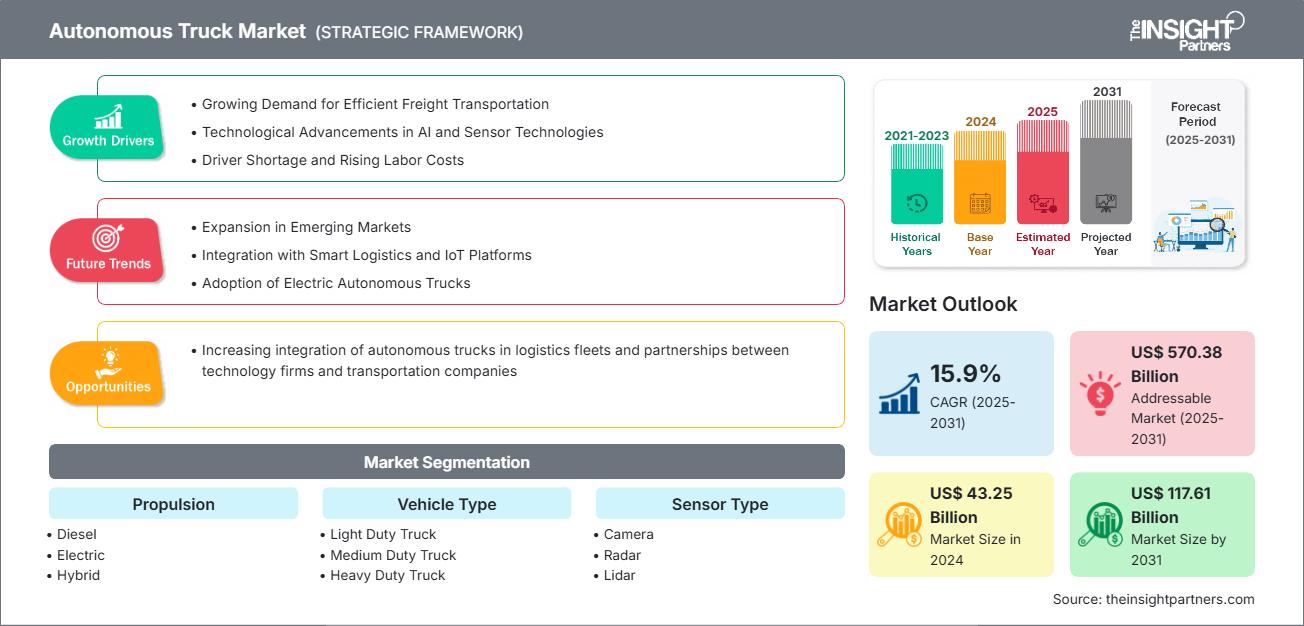
Autonomous Truck Market: Strategic Insights
Regional Insights
North America Autonomous Truck Market
North America accounted for an estimated 36%–39% share of the global market in 2025 and is projected to expand at a CAGR of 13.8%–15.2% during 2026–2034. The region benefits from advanced digital infrastructure, high freight transportation volumes, and early commercialization of autonomous driving technologies. Strong collaboration among truck manufacturers, technology developers, logistics providers, and software companies has accelerated pilot deployments across major freight corridors. The autonomous truck market share remains the highest globally due to favorable investment conditions and continuous innovation.
Rising demands for operational efficiency, road safety, and solutions to problems of driver shortage will continue to favor the use of autonomous trucking systems by fleet owners. The involvement of government and transport authorities in conducting tests of the technology is backed by regulatory changes and infrastructural developments aimed at enabling connections. The use of technologies such as artificial intelligence, high-definition maps, and vehicle-to-everything communications will further foster the use of autonomous trucking in business operations.
U.S. Autonomous Truck Market
The United States represented approximately 82%–86% of the North American market in 2025 and is anticipated to grow at a CAGR of 14.0%–15.5% during 2026–2034. Rising demands for long-distance transportation, growing logistics operations in e-commerce, and positive test regulations in a number of states continue to fuel commercialization efforts. Leading companies working on new technologies and manufacturing companies are actively carrying out pilot projects on interstate transportation routes, facilitating quicker testing of autonomous vehicle technologies in real-world conditions.
There are many major players in the country, such as Tesla, Inc., Waymo LLC, Aurora Innovation, Inc., PlusAI, Inc., and Navistar, Inc., which continue to make additional partnerships with logistics and fleet providers. Rising popularity in transporting goods from one hub to another, logistics in warehouses, and industrial use cases are boosting penetration rates in the market. Investments in digital infrastructure, fleet management via cloud technology, and sensors will drive further commercialization efforts.
Europe Autonomous Truck Market
Europe held an estimated 26%–29% share of the global market in 2025 and is projected to register a CAGR of 14.2%–15.4% during 2026–2034. Germany remains the regional leader owing to its strong commercial vehicle manufacturing base, while Sweden, the United Kingdom, and France continue expanding autonomous mobility initiatives. Alignment of regulations in the European Union and intelligent transportation systems has been a key contributor to the commercialization of autonomous freight vehicles.
The UK has kept enhancing autonomy in the area of mobility through enabling regulations, testing freight corridors and working together with technology companies and logistic providers. Germany enjoys the advantage of hosting major truck manufacturing companies, advanced engineering and substantial investment in automated commercial vehicles technologies.
France, Italy and Spain have been steadily increasing their investments in connectivity and digital logistics for the transportation system. The modernization of fleets, environmental sustainability plans and growth of automation projects have encouraged the introduction of autonomous commercial vehicles in regional freight transportation.
APAC Autonomous Truck Market
Asia Pacific accounted for approximately 24%–27% of the global market in 2025 and is expected to expand at a CAGR of 15.8%–17.2% during 2026–2034. China leads regional deployment through strong manufacturing capabilities and government support for intelligent transportation technologies, while Japan and South Korea continue advancing autonomous mobility innovation.
India and Australia are witnessing increasing investments in mining automation, smart logistics infrastructure, and commercial fleet modernization. Growing industrial production, expanding e-commerce networks, and supportive policy initiatives are expected to accelerate autonomous truck adoption across multiple commercial transportation applications during the forecast period.
Middle East & Africa Autonomous Truck Market
The Middle East & Africa market is projected to register a CAGR of 12.8%–14.0% during 2026–2034. Both Saudi Arabia and the United Arab Emirates are putting effort into developing smart mobility ecosystems, digital logistics corridors, and industrial diversification efforts aimed at promoting self-driving transport solutions.
The Rest of MEA still remains a promising area with its potential related to mining automation and commercial freight transport, whereas South Africa still offers opportunities for automation within its mining industry. Further development of energy, logistics, and infrastructure initiatives in the region will provide good conditions for using self-driving trucks in the future.
Segmentation Analysis
Propulsion
The propulsion segment is evolving as fleet operators balance operating efficiency, emissions compliance, and total cost of ownership across different transportation environments. Diesel-powered autonomous trucks continue to dominate commercial freight because of their established infrastructure and payload capabilities, while electric and hybrid alternatives are gaining momentum through sustainability initiatives and battery advancements. The autonomous truck market scope continues to broaden as multiple propulsion technologies address diverse operational requirements. The overall Propulsion segment is projected to expand at a CAGR of 14.8%–15.6% during 2026–2034.
- Diesel: Diesel remains the preferred propulsion choice for long-haul freight due to extensive refueling infrastructure, proven reliability, and high payload capacity. Continuous improvements in autonomous driving systems are enhancing operational efficiency across existing commercial diesel truck fleets.
- Electric: Electric autonomous trucks are experiencing increasing adoption for urban logistics and regional freight operations. Battery technology improvements, lower operating costs, and government incentives are encouraging fleet operators to integrate zero-emission autonomous vehicles into transportation networks.
- Hybrid: Hybrid propulsion provides operational flexibility by combining conventional engines with electric drivetrains. This approach supports fuel efficiency improvements, extended operating range, and gradual fleet electrification while maintaining compatibility with existing commercial transport infrastructure.
Vehicle Type
Vehicle type plays a significant role in determining deployment strategies across commercial transportation applications. Heavy-duty trucks continue to generate the highest revenue because they dominate long-distance freight movement and industrial logistics, while light- and medium-duty platforms are expanding within urban delivery services. The Vehicle Type segment is anticipated to register a CAGR of 14.2%–15.0% during 2026–2034, supported by increasing commercialization across multiple freight categories.
- Light Duty Truck: Light-duty autonomous trucks are increasingly deployed for urban logistics and e-commerce deliveries where shorter travel distances, frequent stops, and digital fleet management create favorable operating conditions.
- Medium Duty Truck: Medium-duty trucks serve regional distribution networks, municipal services, and industrial transportation. Autonomous capabilities improve route optimization, reduce operational costs, and enhance productivity across medium-distance logistics operations.
- Heavy Duty Truck: Heavy-duty autonomous trucks remain the dominant vehicle category because of their extensive utilization in long-haul freight, mining, and large-scale industrial transportation. Continuous investments from manufacturers and logistics companies reinforce their strategic importance in commercial automation.
Sensor Type
Sensor technologies represent the foundation of autonomous vehicle perception by enabling accurate environmental awareness and safe navigation. Manufacturers increasingly integrate multiple sensing technologies to improve redundancy, object detection, and operational reliability under varying road and weather conditions. The Sensor Type segment is expected to grow at a CAGR of 15.5%–16.3% during 2026–2034, reflecting continuous innovation in perception hardware and artificial intelligence integration.
- Camera: Cameras provide high-resolution visual information for lane detection, traffic sign recognition, object classification, and driver assistance functions. They remain essential components within autonomous perception systems due to their cost efficiency and image-processing capabilities.
- Radar: Radar sensors offer reliable distance measurement and object detection under adverse weather conditions. Their ability to operate effectively in rain, fog, and low-light environments strengthens safety and complements other sensing technologies.
- Lidar: Lidar delivers precise three-dimensional mapping and environmental perception, supporting accurate localization and obstacle detection. Continuous reductions in sensor costs are improving commercial viability across autonomous truck platforms.
- Ultrasonic: Ultrasonic sensors enhance short-range object detection during low-speed maneuvers, parking, docking, and warehouse operations. They complement primary perception systems by improving operational safety in confined industrial and logistics environments.
Application
Application diversity continues to expand as autonomous technologies mature across logistics, industrial operations, and specialized transportation environments. Commercial deployment is increasing in freight delivery, mining, and controlled-route shuttle operations where operational efficiency and safety improvements generate measurable economic benefits. The Application segment is projected to record a CAGR of 15.6%–16.5% during 2026–2034, driven by expanding commercialization and supportive investment across multiple end-use industries.
- Last Mile Delivery Truck: Last-mile delivery applications are expanding with the growth of e-commerce and urban logistics. Autonomous technologies improve delivery efficiency, optimize routing, and reduce operating costs for fleet operators serving densely populated metropolitan areas.
- Mining Truck: Autonomous mining trucks remain strategically important because controlled operating environments enable faster technology deployment. Mining companies continue investing in autonomous haulage systems to improve worker safety, productivity, equipment utilization, and operational consistency.
- Shuttles: Autonomous shuttle trucks support logistics movement within ports, industrial parks, warehouses, and manufacturing facilities. Their operation on predictable routes enables efficient goods transportation while reducing manual intervention and enhancing overall supply chain productivity.
Opportunity Snapshot
| Application | Revenue Contribution | Trend Tag | Adoption Stage |
| Last Mile Delivery Truck | Medium | Urban Logistics | Scaling |
| Mining Truck | High | Autonomous Haulage | Mature |
| Shuttles | Low | Closed Campus | Emerging |
Autonomous Truck Market Growth Drivers and Impact Analysis
Expansion of Commercial Freight Automation Across Long-Haul Logistics
Increasing demands for freight transport and a constant shortage of skilled drivers are motivating logistics companies to invest in self-driving trucks. Technologies of autonomous vehicles allow for continuous operation, make better routing decisions, use less fuel, and decrease expenses, increasing fleet efficiency. The implementation of such technologies on a large scale at designated freight highways becomes increasingly realistic due to advances in perception technologies, artificial intelligence, and high-definition map-making. Transportation companies are also using real-time monitoring of their vehicles' condition and predictive maintenance in order to increase assets' productivity and avoid unplanned downtime. All that increases confidence of transportation companies and shippers in the technology, promoting its commercial use for regional and international transport services.
Advancements in Artificial Intelligence and Multi-Sensor Perception Systems
The ongoing developments in artificial intelligence systems, sensor fusion, and computing have greatly improved the performance of autonomous trucks. Contemporary autonomous systems integrate lidar, radar, cameras, and ultrasonic sensors along with sophisticated software to improve the perception and decision-making abilities of vehicles in a variety of operational settings. The advancements in the machine learning models help vehicles make better sense of complex traffic situations and increase the level of safety during operation. At the same time, reduced cost and increased efficiency of sensors and computing contribute to the economic viability of commercial deployment of autonomous trucks.
Supportive Regulatory Frameworks and Infrastructure Modernization
The advantages related to economic efficiency and safety are gaining recognition by government authorities and transportation administrations for the development of automated freight transportation. Regulatory organizations are developing pilot projects, safety guidelines, and testing frameworks to increase the certainty of technology manufacturers and fleet managers. The construction of intelligent transport systems, connected roadways, communications networks, and smart logistics infrastructure is facilitating the preparedness of autonomous vehicle applications. Public-private collaborations are still contributing to the testing of autonomous trucking technologies via practical trials and business experiments. With the increased regulatory harmonization in the major transportation markets, industry players are projected to increase their investments in autonomous fleets, software platforms, and infrastructure, thus enabling market growth during the forecast period.
Autonomous Truck Market Future Trends
Growing Integration of Autonomous Trucks with Connected Freight Ecosystems
Future commercial deployments will increasingly integrate autonomous trucks with connected freight ecosystems that combine cloud-based fleet management, digital freight exchanges, predictive maintenance platforms, and intelligent transportation infrastructure. The autonomous truck market trends indicate that seamless data sharing among vehicles, logistics operators, warehouses, and infrastructure will improve operational efficiency and supply chain visibility. Artificial intelligence will enable dynamic route optimization, automated dispatching, and continuous vehicle performance monitoring. As interoperability standards mature, logistics companies are expected to achieve greater fleet utilization, reduced transit times, and enhanced operational resilience while supporting more sustainable freight transportation.
Expansion of Autonomous Operations Beyond Highway Freight Transport
There is an expectation that autonomous technologies in trucks will spread from long-distance freight to mining, ports, industrial estates, airfields, and major manufacturing plants. Predictable paths make for the best conditions to enable the fast commercialization of these technologies since they simplify the process of deployment and improve the safety assurance process. The technology suppliers are now designing modular autonomous drive solutions that can facilitate many types of commercial vehicles and specialized industrial operations. Improvements in artificial intelligence, simulation technology, fleet management, and cybersecurity will continue to spur adoption by various industries.
Autonomous Truck Market Opportunities
Investment in Electric Autonomous Freight Corridors
Development of dedicated electric freight corridors presents a significant opportunity for vehicle manufacturers, software developers, and infrastructure providers. As fleet operators pursue decarbonization and automation simultaneously, integrated charging infrastructure, intelligent traffic management, and autonomous fleet services will become increasingly valuable. Autonomous truck market Forecasts indicate that public-private partnerships supporting zero-emission freight corridors can accelerate commercialization while lowering lifecycle operating costs. Investors can capitalize on opportunities spanning battery technology, charging networks, fleet management software, and digital logistics platforms. Companies capable of delivering integrated autonomous mobility ecosystems are expected to strengthen their competitive position as commercial deployment expands globally.
Expansion of Autonomous Solutions for Industrial and Mining Operations
Mining locations, ports, industrial parks, and logistics parks offer great opportunities due to the fact that the trucks run in controlled conditions. It will help make work safer for employees, boost equipment efficiency, cut down on operational costs, and ensure round-the-clock operations. Vehicle manufacturers and autonomous vehicle technology companies are more actively partnering with industrial players and introducing scalable automation solutions specifically for such special cases. Further developments in remote fleet management, artificial intelligence, and industrial internet connectivity are likely to speed up the adoption process in heavy industries, generating sustainable revenue streams.
Frequently Asked Questions

- Comprehensive Market Sizing and Forecast Analysis
- Detailed Segmentation Analysis
- In-Depth Market Dynamics Assessment
- Regional and Country-Level Insights
- Competitive Landscape and Company Benchmarking
- Strategic Business Intelligence
Recent Reports
Testimonials

The Insight Partners' SCADA System Market report is comprehensive, with valuable insights on current trends and future forecasts. The team was highly professional, responsive, and supportive throughout. We are very satisfied and highly recommend their services.
RAN KEDEM Partner, Reali Technologies LTDs
I requested a report on a very specific software market and the team produced the report in a few days. The information was very relevant and well presented. I then requested some changes and additions to the report. The team was again very responsive and I got the final report in less than a week.
JEAN-HERVE JENN Chairman, Future Analytica
We worked with The Insight Partners for an important market study and forecast. They gave us clear insights into opportunities and risks, which helped shape our plans. Their research was easy to use and based on solid data. It helped us make smart, confident decisions. We highly recommend them.
PIYUSH NAGPAL Sr. Vice President, High Beam Global
The Insight Partners delivered insightful, well-structured market research with strong domain expertise. Their team was professional and responsive throughout. The user-friendly website made accessing industry reports seamless. We highly recommend them for reliable, high-quality research services
YUKIHIKO ADACHI CEO, Deep Blue, LLC.
This is the first time I have purchased a market report from The Insight Partners.While I was unsure at first, I visited their web site and felt more comfortable to take the risk and purchase a market report.I am completely satisfied with the quality of the report and customer service. I had several questions and comments with the initial report, but after a couple of dialogs over email with their analyst I believe I have a report that I can use as input to our strategic planning process.Thank you so much for taking the extra time and making this a positive experience.I will definitely recommend your service to others and you will be my first call when we need further market data.
JOHN SUZUKI President and Chief Executive Officer, Board Director, BK Technologies
I wish to appreciate your support and the professionalism you displayed in the course of attending to my request for information regarding to infectious disease IVD market in Nigeria. I appreciate your patience, your guidance, and the fact that you were willing to offer a discount, which eventually made it possible for us to close a deal. I look forward to engaging The Insight Partners in the future, all thanks to the impression you have created in me as a result of this first encounter.
DR CHIJIOKE ONYIA MANAGING DIRECTOR, PineCrest Healthcare Ltd.Reason to Buy
- Informed Decision-Making
- Understanding Market Dynamics
- Competitive Analysis
- Identifying Emerging Markets
- Customer Insights
- Market Forecasts
- Risk Mitigation
- Boosting Operational Efficiency
- Strategic Planning
- Investment Justification
- Tracking Industry Innovations
- Aligning with Regulatory Trends





 Get Free Sample for