
Bedsore Air Cushion Market Share, Growth & Forecast by 2034
Coverage: by Type (Automatic Inflating Air Cushion with Electric Air Pump, Self-Inflating Air Cushion); Application (Hospitals, Clinics, Others), and Geography (North America, Europe, Asia Pacific, and South and Central America)
- Status : Data Released
- Report Code : TIPRE00009090
- Category : Life Sciences
- No. of Pages : 150
- Available Report Formats :


- Last update date : November 12, 2026


2025 Market Size
US$ 3.27 Bn
Base year value
2034 Forecast
US$ 4.75 Bn
Projected by 2034
CAGR 2026-2034
4.22 %
Growth rate
Addressable Market
US$ 36.39 Bn
(2026-2034)
The bedsore air cushion market was valued at US$ 3.27 Billion in 2025 and is projected to reach US$ 4.75 Billion by 2034, registering a CAGR of 4.22% during 2026–2034. Expansion is supported by population aging, increasing immobility, pressure-injury prevention initiatives, and improvements in pressure redistribution. Demand is also influenced by rising clinical emphasis on patient comfort, skin protection, microclimate control, and support surfaces suited to different risk levels.
Within North America, the bedsore air cushion market size is projected to expand at a CAGR of ~4% through 2034. The region benefits from extensive hospital infrastructure, developed wound-care programs, growing elderly care requirements, and institutional quality initiatives targeting hospital-acquired pressure injuries. Replacement of conventional cushions with powered, adjustable, and clinically differentiated support products also contributes to regional demand.
Bedsore Air Cushion Market Assessment and Insights
Regional Outlook
- North America: ~39% of the global Bedsore Air Cushion Market share in 2025 | ~4% CAGR through 2034. Market position: North America leads through high healthcare expenditure, established pressure-injury protocols, substantial hospital capacity, developed reimbursement, and broad access to powered and nonpowered pressure redistribution products.
- US: ~87% of North American market revenue in 2025 | ~4% CAGR through 2034. Market position: The US dominates regional revenue through large inpatient volumes, institutional prevention programs, advanced wound-care practices, established distribution channels, and frequent replacement of hospital support surfaces.
- Europe: ~29% of the global market in 2025 | ~4% CAGR through 2034. Market position: Europe is a mature market supported by public healthcare systems, aging populations, clinical pressure-care standards, and significant demand across Germany, the UK, France, Italy, and Spain.
- Asia Pacific: ~23% of the global market in 2025 | ~6% CAGR through 2034. Market position: Asia Pacific is the fastest-growing region as hospital infrastructure, eldercare capacity, medical-device production, wound-care awareness, and access to pressure redistribution products expand across major economies.
Segment Outlook
- Automatic Inflating Air Cushion with Electric Air Pump: ~69% Share in 2025 | ~4% CAGR through 2034. Market position: Powered cushions lead through adjustable pressure, continuous inflation support, compatibility with higher-risk patients, and growing use within structured hospital pressure-injury prevention programs.
- Hospitals: ~76% Share in 2025 | ~4% CAGR through 2034. Market position: Hospitals represent the highest-growth application through concentrated immobility risk, critical care admissions, postoperative recovery, clinical procurement programs, and regular replacement of pressure-management equipment.
Competitive Coverage
AlboLand S.r.l., Blue Chip Medical Products, Inc., Healthyou Medical Technology Co., Ltd., Baxter International Inc., Invacare International Holdings Corporation, James Consolidated, Inc., LINET spol. s r.o., Medical Air Mattress, Medline Industries, LP, Novis Healthcare Pty Ltd
Methodology
The Insight Partners follows Data Collection & Secondary Research, Primary Research, Data Analysis, and Data Triangulation & Final Review to validate market estimates and insights.
Source: The Insight Partners' analysis based on proprietary research, government publications, company annual reports, investor presentations, industry databases, and expert interviews.
Pressure management devices have moved from simple inflatable overlays to advanced air-cell devices with variable pressure control, pressure cycling, immersion, envelopment, and microclimate management. Pressure management devices today integrate tough air bladders, quiet pumps, pressure sensors, breathable covers, heel guards, and alarms or indicators. Product quality can be assessed based on seam integrity, noise level of the pump, pressure stability, infection control, durability, and patient support over different weight ranges and risk classifications.
The market through 2034 is projected to benefit from investments in automatic pressure adjustment, portability, quiet operation, remote condition monitoring capabilities, and pressure management products for bariatric and high-risk patients. Opportunities lie in emerging healthcare systems in Asia where there is an expanding need for hospital capacity and eldercare facilities. Safety, biocompatibility, flame resistance, cleaning and durability requirements along with clinical evidence claims would be key factors supporting regulators.
Bedsore Air Cushion Market Report Scope
| Report Attribute | Details |
|---|---|
| Market size in 2025 | US$ 3.27 Billion |
| Market Size by 2034 | US$ 4.75 Billion |
| Global CAGR (2026 - 2034) | 4.22% |
| Historical Data | 2021-2024 |
| Forecast period | 2026-2034 |
Bedsore Air Cushion Market Analysis
Drivers for bed sore air cushion market growth are aging population, immobilization, critically ill patients, neurologically compromised patients, postoperative conditions, and institutions striving to avoid pressure ulcers. The sources of demand are nurses, wound care specialists, doctors, biomedical engineers, buyers, and facility managers. The factors evaluated for the cushion include clinical performance, patient comfort, cleaning convenience, reliability, installation, maintenance, portability, and total cost of ownership.
The value chain consists of material suppliers, air-cell makers, pumps and valves manufacturers, electronic products providers, support surfaces producers, healthcare distributors, hospitals, clinics, and equipment rental companies. Sustainable supply chain includes the aspects of materials acquisition, manufacturing, availability of replacement parts, maintenance capabilities, and regional inventory. Clinical performance is also affected by correct installation and repositioning rather than functionality of the product per se.
Bedsore air cushion market analysis shows that competition involves pressure redistribution, automated adjustments, noise, portability, cover effectiveness, reparability, and clinical performance. The company Baxter International Inc. is involved in bedsore air cushion market via Hillrom pressure-care portfolio, and LINET spol. s r.o. offers active, hybrid, and passive support surfaces. Invacare International Holdings Corporation offers pressure and posture care capabilities.
Blue Chip Medical Products, Inc., AlboLand S.r.l., Medical Air Mattress, and Healthyou Medical Technology Co., Ltd. address specialized support-surface requirements. Medline Industries, LP provides broad healthcare distribution, while Novis Healthcare Pty Ltd supports pressure-care access in Australia. James Consolidated, Inc. contributes through specialized healthcare equipment channels. Investment is moving toward sensor-guided inflation, microclimate management, modular repair, and evidence-based product positioning.
● REPORT CUSTOMIZATION
Tailor This Report To Align With Your Specific Business Requirements
This report can be customized to align precisely with your business objectives, scope, and target markets. Customization options include tailored segmentation, geography, competitive analysis, and strategic insights to support informed decision-making.
Customize This Report →WHAT YOU CAN ADJUST
- ● Segmentations
- ● Geography
- ● Competitive Analysis
- ● Language Preferences
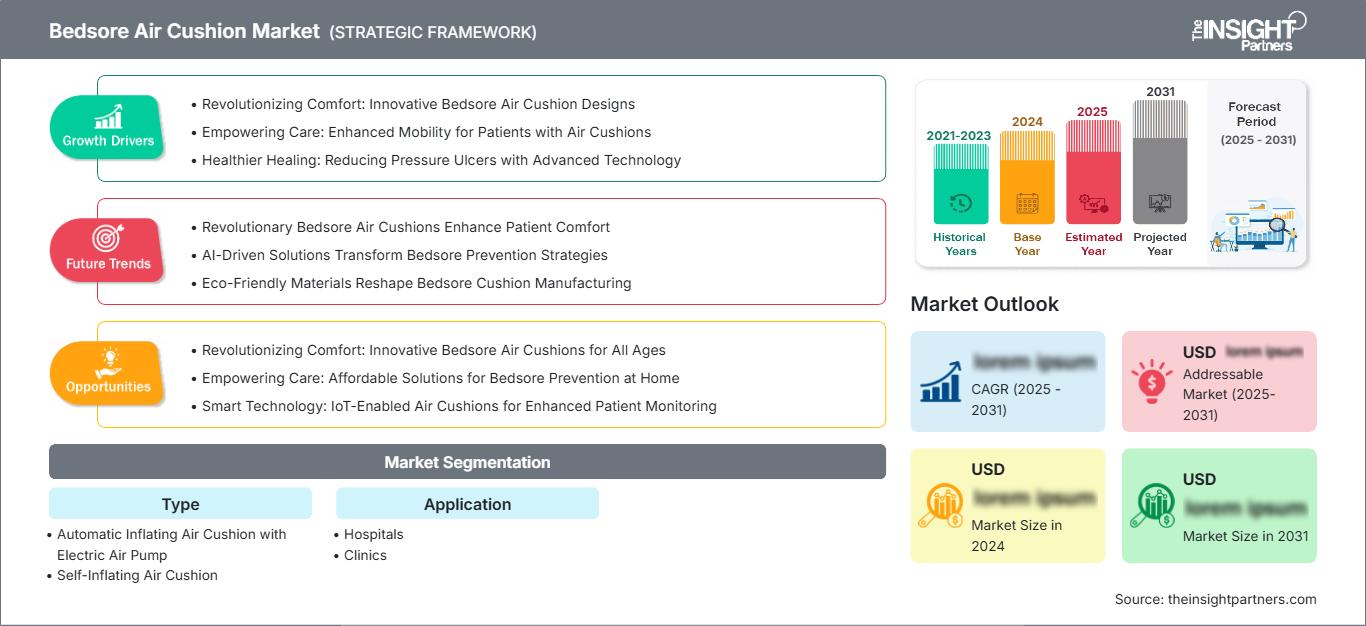
Bedsore Air Cushion Market: Strategic Insights
Regional Insights
North America Bedsore Air Cushion Market
North America accounted for approximately ~39% of global revenue in 2025 and is projected to register a CAGR of ~4% through 2034. Regional market share for bedsore air cushions is a result of the large number of hospitals, presence of advanced wound care infrastructure, high cost of healthcare, and an effort to minimize injuries from pressure on patients. The adoption ranges from powered cushions, alternating pressure pads, therapeutic mattresses, and other positioning products.
In Canada, there is participation in terms of government-funded hospitals, rehabilitation centers, nursing homes, and equipment procurement processes. In Mexico, the market shows potential growth in terms of private hospitals, rehabilitation centers, and specialized care centers. Buyers evaluate interface pressure, weight capacity, noise of pump, ease of cleaning of covers, infection control features, alarm functions, maintenance needs, and availability of equipment.
U.S. Bedsore Air Cushion Market
The US represented approximately ~87% of North American revenue in 2025 and is projected to grow at a CAGR of ~4% through 2034. This strategy is justified by high patient throughput, advanced critical care capacity, advanced wound-care capabilities, and quality initiatives targeting pressure ulcers acquired in the hospital setting. Healthcare organizations continue to standardize products by their risk level and clinical specialty.
Relevant companies that include Baxter International Inc., Medline Industries, LP, Invacare International Holdings Corporation, Blue Chip Medical Products, Inc. and others are specialists in this field. Hospitals need motorized devices for their critically ill and non-movable patients, whereas less complicated cushions provide support during recovery and rehabilitation process. Procurement process takes into consideration lifecycle service, availability, caregivers’ education, patient comfort and ability to document compliance with preventive measures.
Europe Bedsore Air Cushion Market
Europe held approximately ~29% of global revenue in 2025 and is expected to record a CAGR of ~4% through 2034. Aging populations, public healthcare coverage, hospital modernization, and established wound-care guidance support regional demand. Germany is assessed as the leading country in Europe because of its healthcare scale, elderly population, medical-technology base, rehabilitation capacity, and adoption of advanced pressure-care equipment.
There is notable demand for beds in the UK in hospitals, community care, rehabilitation, and long-term care. In France, there is structured hospital procurement combined with extensive availability of specialist wound care products. In Italy and Spain, there is demand creation from the aging population, the need for rehabilitation, and pressure injury prevention. European procurement is driven by clinical effectiveness, conformity documentation, patient comfort, durability of the equipment, cleaning, fire safety, repairability, and whole-life cost. LINET spol. s r.o. and AlboLand S.r.l. bring regional product expertise, while foreign companies assist in distribution. Growth is relatively slow since the penetration of institutions is quite advanced, but replacing old systems with automated and energy-efficient equipment creates opportunities.
APAC Bedsore Air Cushion Market
Asia Pacific represented approximately ~23% of global revenue in 2025 and is the fastest-growing region, with a CAGR of ~6% through 2034. Japan is assessed as the leading country in Asia Pacific due to its aging population, advanced hospital infrastructure, rehabilitation services, and established pressure-care practices. China combines hospital expansion with medical-device manufacturing capacity.
Opportunities in India are based on the development of private hospitals and increased awareness of wound care treatment. In South Korea, there is a preference for technologically advanced medical equipment, whereas Australia retains good aged care and hospital standards. There is an increasingly supportive healthcare policy environment for access to healthcare, manufacturing, aging care investments, and training.
Middle East & Africa Bedsore Air Cushion Market
The Middle East & Africa market is projected to grow at a CAGR of ~5% through 2034. Saudi Arabia is assessed as the leading country in the Middle East & Africa through hospital investment, rehabilitation development, healthcare transformation, and procurement of advanced clinical equipment. The UAE contributes through private hospitals, medical tourism, and specialist rehabilitation services.
South Africa has comparatively developed private-sector wound care and medical-device distribution. Across the Rest of MEA, budget constraints, limited specialist access, inconsistent electricity, and reduced technical support restrict powered-system adoption. Hospital construction and urban infrastructure investment create opportunities for durable cushions with simple controls, replaceable components, and dependable regional servicing.
Segmentation Analysis
Type
The bedsore air cushion market scope covers powered and self-inflating support products used to redistribute interface pressure and improve patient comfort. Type selection depends on pressure-injury risk, mobility, body weight, clinical setting, required adjustability, electrical access, and caregiver capability. Automatic Inflating Air Cushion with Electric Air Pump systems are projected to register a CAGR of ~4% during 2026–2034 as hospitals adopt adjustable air support for higher-risk and immobile patients.
- Automatic Inflating Air Cushion with Electric Air Pump: Powered systems use pumps and connected air chambers to establish or vary inflation. They support adjustable pressure management, alternating cycles, alarms, and higher-acuity care but require electricity, servicing, setup, and noise control.
- Self-Inflating Air Cushion: Self-inflating cushions provide pressure redistribution without continuous electrical operation. Their portability, simpler setup, lower maintenance burden, and suitability for clinics or temporary care support adoption where advanced powered therapy is unnecessary.
Application
Application demand reflects patient acuity, immobility duration, institutional protocols, procurement scale, and access to trained wound-care teams. Hospitals account for concentrated need, whereas clinics use cushions for outpatient treatment, rehabilitation, and follow-up. Hospitals are projected to expand at a CAGR of ~4% during 2026–2034 as pressure-injury prevention programs, critical care volumes, replacement cycles, and risk-based support-surface allocation sustain purchasing.
- Hospitals: Hospitals use air cushions across intensive care, postoperative recovery, neurology, rehabilitation, and medical-surgical units. Procurement emphasizes pressure redistribution, cleanability, equipment uptime, alarms, staff familiarity, weight capacity, and compatibility with clinical prevention protocols.
- Clinics: Clinics use cushions during wound-care visits, rehabilitation, mobility assessment, and recovery. Demand favors portable, easy-to-clean systems that can support seated or reclining patients without requiring complex installation or continuous technical supervision.
Opportunity Snapshot
| Application | Revenue Contribution | Trend Tag | Adoption Stage |
| Hospitals | High | Risk Stratification | Mature |
| Clinics | Medium | Portable Support | Scaling |
Bedsore Air Cushion Market Growth Drivers and Impact Analysis
Growing Population at Risk of Pressure-Related Tissue Damage
Population aging is increasing the number of people experiencing frailty, limited mobility, neurological impairment, vascular conditions, and prolonged recovery. These factors reduce spontaneous movement and increase exposure to pressure over vulnerable tissue. Hospitals and clinics therefore require products that distribute body weight, improve immersion, and support positioning. The commercial effect extends beyond initial equipment purchases because powered products need replacement covers, pumps, maintenance, cleaning, and periodic performance checks. Manufacturers can strengthen adoption by offering multiple sizes and pressure settings rather than relying on a uniform product. Clinical use must remain part of a broader prevention plan involving repositioning, nutrition, moisture management, skin inspection, and mobility support.
Institutional Focus on Pressure-Injury Prevention
Hospitals increasingly treat pressure-injury prevention as a quality, safety, and operational priority. Prevention programs classify patient risk, establish repositioning intervals, evaluate skin condition, and assign appropriate support surfaces. This creates demand for differentiated cushions serving moderate-risk, high-risk, bariatric, and critically ill patients. Procurement teams evaluate whether products can be deployed quickly, cleaned between users, maintained reliably, and used consistently by nursing staff. The market impact extends to professional education, rental services, pressure mapping, equipment tracking, and outcome evaluation. Vendors that connect product selection with clinical implementation can demonstrate greater value than suppliers competing exclusively on acquisition price.
Advances in Pump, Air-Cell, and Cover Technology
Improved pumps, valves, air chambers, covers, and control units are increasing product reliability and therapeutic flexibility. Quieter pumps reduce disruption, while compartmentalized cells can target inflation and maintain support after localized damage. Vapour-permeable covers support microclimate management and simplify cleaning when designed with protected seams and zippers. Visual and audible alarms help identify low pressure, disconnection, or electrical failure. These improvements make powered cushions more suitable for extended clinical use, although added components increase servicing requirements. Commercial differentiation depends on balancing advanced functions with simple controls, repairable construction, dependable spare parts, and clear instructions for selecting pressures according to patient needs.
Bedsore Air Cushion Market Future Trends
Sensor-Guided Personalized Pressure Redistribution
Bedsore air cushion market trends are moving toward systems that use pressure sensors, weight estimation, position detection, and automated inflation to personalize support. Future cushions may identify persistent high-pressure zones and adjust individual air cells rather than applying one pressure level across the surface. Integration with clinical dashboards could document changes, support risk review, and alert staff when a patient remains in one position for an extended period. Adoption will depend on sensor durability, clinical validation, cybersecurity, cleanability, and low false-alarm rates. Intelligent functions must support professional assessment rather than replace repositioning, skin inspection, and direct patient care.
Hybrid and Power-Independent Pressure-Care Products
Hybrid products combining air cells with supportive foam are expected to gain attention because they can provide therapeutic pressure redistribution while preserving support during transport or electrical failure. Power-independent functionality is particularly relevant for clinics, home transitions, emergency preparedness, and healthcare systems with inconsistent electricity. Manufacturers may develop surfaces that operate passively under routine conditions and connect to compact pumps when alternating therapy is required. Future product development will emphasize lightweight construction, rapid inflation, replaceable sections, quieter operation, and simple conversion between modes. Buyer acceptance will depend on whether hybrid products reduce fleet complexity without compromising performance for high-risk patients.
Bedsore Air Cushion Market Opportunities
Pressure-Care Programs Combining Products and Clinical Support
Suppliers can move beyond unit sales by offering assessment tools, product-selection protocols, training, maintenance, rental, replacement covers, and outcome documentation. Bedsore air cushion market Forecasts suggest that hospitals will continue prioritizing prevention while seeking better control over equipment utilization and lifecycle cost. Managed programs can help facilities assign powered products to high-risk patients while using simpler cushions for moderate-risk cases. Manufacturers should support biomedical teams with maintenance schedules, spare parts, cleaning instructions, and equipment-status reporting. Evidence showing improved protocol adherence, patient comfort, or equipment availability can strengthen long-term procurement relationships.
Portable and Affordable Solutions for Emerging Care Settings
Developing healthcare systems need durable pressure-redistribution products suited to constrained budgets, limited technical support, and variable electricity. Manufacturers can address this need through self-inflating cushions, compact pumps, modular air cells, washable covers, manual inflation backup, and straightforward controls. Regional manufacturing or assembly can lower logistics costs and improve spare-part availability. Partnerships with hospitals, rehabilitation centers, distributors, and professional training institutions can support appropriate patient selection and product use. Commercial success will depend on balancing affordability with material strength, pressure retention, infection-control compatibility, and dependable warranty service.
Recent Developments
- February 2026: Invacare International Holdings Corporation announced the combination of its European and Asia Pacific operations with Direct Healthcare Group to create DHCare. The combined organization is intended to strengthen mobility and healthcare offerings for people with reduced movement, creating a broader platform relevant to pressure care, seating, patient transfer, and long-term support solutions.
- December 2025: Novis Healthcare Pty Ltd published a clinical white paper reviewing offloading devices for heel pressure injuries. The educational initiative supports evidence-informed pressure-care selection and complements the company’s portfolio of ProCair alternating-air mattresses and pressure-management products used across hospitals, aged care, rehabilitation, and community environments.
- September 2025: Medline Industries, LP implemented a prime-vendor agreement with Maine Veterans’ Homes as part of its post-acute distribution expansion. The arrangement strengthens Medline’s role in supplying care facilities with clinical products, including durable medical equipment and pressure-redistribution solutions used for elderly and mobility-limited populations.
Frequently Asked Questions

- Comprehensive Market Sizing and Forecast Analysis
- Detailed Segmentation Analysis
- In-Depth Market Dynamics Assessment
- Regional and Country-Level Insights
- Competitive Landscape and Company Benchmarking
- Strategic Business Intelligence
Recent Reports
Testimonials

The Insight Partners provided valuable market intelligence that supported our global go-to-market strategy. Their team was professional, responsive, and attentive to our feedback, providing thoughtful analysis and helpful methodological clarifications throughout the project.
Junmo Kim Chief Financial Officer (CFO), Enertech Co., Ltd.
The Insight Partners' SCADA System Market report is comprehensive, with valuable insights on current trends and future forecasts. The team was highly professional, responsive, and supportive throughout. We are very satisfied and highly recommend their services.
RAN KEDEM Partner, Reali Technologies LTDs
I requested a report on a very specific software market and the team produced the report in a few days. The information was very relevant and well presented. I then requested some changes and additions to the report. The team was again very responsive and I got the final report in less than a week.
JEAN-HERVE JENN Chairman, Future Analytica
We worked with The Insight Partners for an important market study and forecast. They gave us clear insights into opportunities and risks, which helped shape our plans. Their research was easy to use and based on solid data. It helped us make smart, confident decisions. We highly recommend them.
PIYUSH NAGPAL Sr. Vice President, High Beam Global
The Insight Partners delivered insightful, well-structured market research with strong domain expertise. Their team was professional and responsive throughout. The user-friendly website made accessing industry reports seamless. We highly recommend them for reliable, high-quality research services
YUKIHIKO ADACHI CEO, Deep Blue, LLC.
This is the first time I have purchased a market report from The Insight Partners.While I was unsure at first, I visited their web site and felt more comfortable to take the risk and purchase a market report.I am completely satisfied with the quality of the report and customer service. I had several questions and comments with the initial report, but after a couple of dialogs over email with their analyst I believe I have a report that I can use as input to our strategic planning process.Thank you so much for taking the extra time and making this a positive experience.I will definitely recommend your service to others and you will be my first call when we need further market data.
JOHN SUZUKI President and Chief Executive Officer, Board Director, BK Technologies
I wish to appreciate your support and the professionalism you displayed in the course of attending to my request for information regarding to infectious disease IVD market in Nigeria. I appreciate your patience, your guidance, and the fact that you were willing to offer a discount, which eventually made it possible for us to close a deal. I look forward to engaging The Insight Partners in the future, all thanks to the impression you have created in me as a result of this first encounter.
DR CHIJIOKE ONYIA MANAGING DIRECTOR, PineCrest Healthcare Ltd.Reason to Buy
- Informed Decision-Making
- Understanding Market Dynamics
- Competitive Analysis
- Identifying Emerging Markets
- Customer Insights
- Market Forecasts
- Risk Mitigation
- Boosting Operational Efficiency
- Strategic Planning
- Investment Justification
- Tracking Industry Innovations
- Aligning with Regulatory Trends





 Get Free Sample for