
Beer Processing Market Trends, Size & Forecast by 2034
Coverage: By Type (Macrobrewery equipment, Craft brewery equipment); Brewery Type (Macrobrewery, Craft brewery, Microbrewery, Brewpub, Others); Type (Lager, Ale and Stout, Specialty Beer, Low Alcohol Beer); Price Category (Mainstream, Discount, Premium, Super-premium); Distribution Channel (Off-trade, On-trade), and Geography
- Status : Data Released
- Report Code : TIPRE00010062
- Category : Manufacturing and Construction
- No. of Pages : 150
- Available Report Formats :


- Last update date : May 22, 2026


2025 Market Size
US$ 809.21 Bn
Base year value
2034 Forecast
US$ 1,123.22 Bn
Projected by 2034
CAGR 2026-2034
3.71 %
Growth rate
Addressable Market
US$ 8,776.60 Bn
(2026-2034)
The global Beer Processing Market size is projected to reach US$ 1,123.22 billion by 2035 from US$ 809.21 billion in 2025. The market is anticipated to register a CAGR of 3.71% during the forecast period 2026–2035.
Key market dynamics include a heightening global focus on premium and craft beverage experiences, rising consumer awareness regarding diverse beer styles like IPAs and stouts, and a significant shift toward low-alcohol and non-alcoholic options. Additionally, the market is expected to benefit from the growing popularity of brewpubs, expansion in organized retail channels across emerging economies, and the increasing inclusion of specialty beers in high-value gourmet segments like artisanal dining and festivals.
Beer Processing Market Analysis
The beer processing market analysis shows a shift toward high-efficiency and automated brewing solutions as producers prioritize consistency and quality. The market is diversifying into traditional high-volume macro-breweries and high-growth, innovation-led craft in North America and Asia-Pacific. Strategic opportunities are emerging in specialty low-alcohol and non-alcoholic segments, where advanced filtration and dealcoholization technologies offer a clear competitive advantage. The market expansion depends on cold-chain integrity for unpasteurized craft beers and the efficiency of automated fermentation systems. Competitive differentiation now stands out depending on branding that tells a story and highlights local ingredients, sustainable brewing practices, and the ability to track ingredients from farm to bottle. This approach helps independent brewers charge higher prices in a market with many niche suppliers.
Beer Processing Market Overview
Brewing systems have advanced from niche industrial setups to mainstream technological solutions for both massive global brands and local startups. The beer processing includes modular craft systems, high-speed automated bottling lines, and sophisticated laboratory equipment for quality control. Both global beverage companies and D2C craft breweries compete in this market, using raw materials such as malted barley, hops, yeast, and adjuncts. Growing demand for convenient packaged options among social consumers in Asia-Pacific and North America has increased the popularity of canned and bottled beer as a lifestyle beverage. Asia-Pacific leads in revenue due to its massive consumer base and rapid urbanization, while North America is advancing in equipment innovation and the proliferation of microbreweries. The US market is the most developed, driven by health-focused millennials and the broad availability of functional snacks. Consumption is shifting toward premium craft lagers and low-alcohol varieties, supported by advanced automated brewing systems. Intense competition among macro and microbreweries fuels innovation in unique flavors and sustainable, eco-friendly packaging solutions.
Market Assessment and Insights
- Global market for Beer Processing was valued at US$ 16.46 Billion in 2025
- Annual market size is expected to reach US$ 25.79 Billion by 2034
- Total addressable market (TAM) during 2026-2034 is projected to reach approximately US$ 191.64 Billion
- Market is anticipated to register a CAGR of 5.11% during the forecast period
- The United States represents a key market, supported by Rising demand for low alcohol and organic beer, as well as evolving industry dynamics
- Market analysis covers North America, Europe, Asia-Pacific, South and Central America, Middle East and Africa, with growth evaluated across the forecast period
- Market opportunities such as The increasing demand for craft brewing and innovative flavors are expected to influence market dynamics and addressable market
- Report profiles industry participants, including Alfa Laval, GEA Group, Krones Group, Molson Coors Brewing Company, Paul Mueller, Anheuser Busch Inbev NV, Heineken, Carlsberg Group, Molson Coors Brewing Company, while analyzing competitive strategies and innovation developments
-
Source: The Insight Partners' analysis based on proprietary research, government publications, company annual reports, investor presentations, industry databases, and expert interviews.
● REPORT CUSTOMIZATION
Tailor This Report To Align With Your Specific Business Requirements
This report can be customized to align precisely with your business objectives, scope, and target markets. Customization options include tailored segmentation, geography, competitive analysis, and strategic insights to support informed decision-making.
Customize This Report →WHAT YOU CAN ADJUST
- ● Segmentations
- ● Geography
- ● Competitive Analysis
- ● Language Preferences
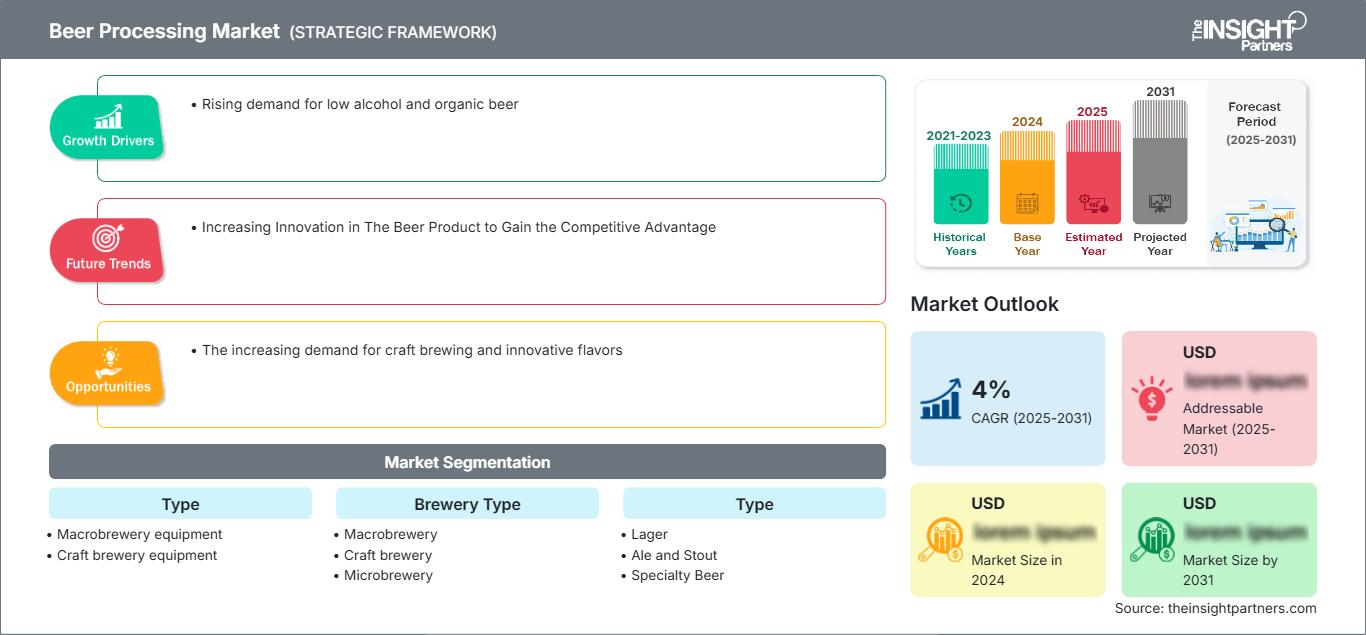
Beer Processing Market: Strategic Insights
-
Get Top Key Market Trends of this report.This FREE sample will include data analysis, ranging from market trends to estimates and forecasts.
Beer Processing Market Drivers and Opportunities
Market Drivers:
- Rising Popularity of Craft and Artisanal Varieties: The global surge in independent microbreweries and brewpubs is driving demand for specialized craft brewery equipment that allows for smaller batch sizes and unique recipes.
- Technological Advancements in Brewing Automation: Innovations in IoT-enabled fermentation monitoring and automated grain handling are enhancing production efficiency, reducing waste, and ensuring batch-to-batch consistency.
- Expansion of the Low-Alcohol and Non-Alcoholic Segment: Increasing health consciousness among consumers is driving the need for sophisticated processing equipment that can remove alcohol while maintaining the original flavor profile of the beer.
Market Opportunities:
- Expansion into Sustainable and Green Brewing: Beyond traditional production, there is a significant opportunity for energy-efficient brewing systems and water recycling technologies that appeal to eco-conscious brands and regulators.
- Growth in Emerging APAC and African Corridors: Forming strategic partnerships between equipment suppliers and local brewing startups in India, China, and Nigeria may facilitate access to high-margin market segments where beer consumption is rising.
- Diversification into Specialty and Gluten-Free Segments: There is a growing opportunity for processors to target specific demographics through specialized equipment for gluten-free grains and organic-certified production, as seen in recent retail expansions in Europe.
Beer Processing Market Report Segmentation Analysis
The Beer Processing Market share is analyzed across various segments to provide a clearer understanding of its structure, growth potential, and emerging trends. Below is the standard segmentation approach used in most industry reports:
By Type:
- Macrobrewery equipment: The dominant volume driver, designed for high-capacity production, focusing on scale and long-term durability for global beverage giants.
- Craft brewery equipment: A fast-growing segment focusing on flexibility and precision, allowing smaller producers to experiment with various styles and flavors.
By Brewery Type:
- Macrobrewery: Large-scale industrial plants that account for the majority of global production volume, benefiting from established distribution networks.
- Craft brewery: Independent entities that prioritize flavor and quality over volume, often serving regional or niche markets.
- Microbrewery: Smaller facilities producing limited quantities, often characterized by a focus on local community engagement.
- Brewpub: A combination of a brewery and a restaurant where the beer is brewed specifically for on-site consumption.
- Others: Includes regional breweries and farm-based operations catering to specific geographic locations.
By Type:
- Lager: The primary segment by volume globally, known for its crisp and refreshing profile.
- Ale and Stout: High-growth categories favored by the craft movement for their complex flavors and diverse sub-styles.
- Specialty Beer: Includes flavored, fruit-infused, and seasonal beers that target experimental consumers.
- Low Alcohol Beer: A rapidly rising category aligning with global health and wellness trends.
By Price Category:
- Mainstream: The largest segment, offering affordable options for the mass market.
- Premium & Super-premium: High-margin segments driven by consumer trade-up and the desire for high-quality, status-aligned beverages.
- Discount: Focuses on price-sensitive consumers and value-driven retail segments.
By Distribution Channel:
- Off-trade: Includes supermarkets, hypermarkets, and liquor stores; remains the primary channel for volume sales.
- On-trade: Includes bars, restaurants, and brewpubs; critical for brand building and premium craft beer experiences.
By Geography:
- North America
- Europe
- Asia Pacific
- South & Central America
- Middle East & Africa
Beer Processing Market Report Scope
| Report Attribute | Details |
|---|---|
| Market size in 2025 | US$ 809.21 Billion |
| Market Size by 2034 | US$ 1,123.22 Billion |
| Global CAGR (2026 - 2034) | 3.71% |
| Historical Data | 2021-2024 |
| Forecast period | 2026-2034 |
| Segments Covered |
By Type
|
| Regions and Countries Covered |
North America
|
| Market leaders and key company profiles |
|
Beer Processing Market Players Density: Understanding Its Impact on Business Dynamics
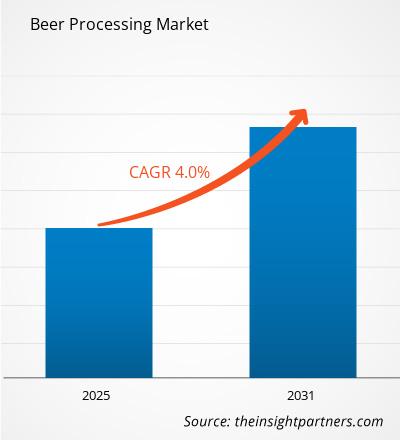
The Beer Processing Market is growing rapidly, driven by increasing end-user demand due to factors such as evolving consumer preferences, technological advancements, and greater awareness of the product's benefits. As demand rises, businesses are expanding their offerings, innovating to meet consumer needs, and capitalizing on emerging trends, which further fuels market growth.
Beer Processing Market Share Analysis by Geography
Asia-Pacific is expected to grow fastest in the coming years. Emerging markets in South & Central America, the Middle East, and Africa also have many untapped opportunities for premium beer producers and equipment manufacturers to expand.
The beer processing market is undergoing a significant transformation, moving from traditional volume-heavy production to a global high-value, functional, and premium landscape. Below is a summary of market share and trends by region:
North America
- Market Share: A dominant force in innovation, driven by the most mature craft brewery ecosystem globally.
- Key Drivers:
- Massive shift toward super-premium segments and a high-ABV efficiency value proposition.
- Heightened demand for processing equipment due to the FIFA 2026 World Cup, spanning 16 host cities.
- Rising interest in premium Mexican lagers and local fruit-infused craft styles.
- Trends: Stabilization of the craft after a period of closures, with a move back toward traditional pilsners and lagers alongside high-tech non-alcoholic production.
Europe
- Market Share: Holds the largest share of high-end equipment manufacturing, anchored by deep-seated brewing traditions in Germany, Belgium, and the Netherlands.
- Key Drivers:
- High domestic demand for iconic regional styles and Protected Designation of Origin (PDO) equivalents in traditional brewing.
- Robust government support for energy-neutral brewery transitions and sustainable water management systems.
- Strict regulatory frameworks are driving the adoption of advanced filtration and flash pasteurization.
- Trends: A strategic bifurcation between high-margin specialty ales and the rapid expansion of private-label, high-ABV lagers in hard discount retail channels like Lidl and Aldi.
Asia-Pacific
- Market Share: The fastest-growing region, led by massive capital investments in China, India, and Vietnam.
- Key Drivers:
- Massive consumer base seeking premium and hypoallergenic low-alcohol alternatives.
- Government-supported focused on high-value brewing facilities.
- Rapid urbanization and rising disposable incomes are leading to a preference for westernized luxury dairy and beverage snacks.
- Trends: Heavy reliance on automated mega-breweries and e-commerce platforms for high-end beer distribution, coupled with a focus on ABV-per-dollar efficiency in value segments.
South and Central America
- Market Share: Emerging market with a growing artisanal industry in countries like Brazil and Chile.
- Key Drivers:
- Increasing awareness of nutritional profiles, such as gluten-free and low-carb beer variants.
- Modernization of small-scale microbreweries into commercial-grade operations to supply urban centers.
- Mainstreaming of non-alcoholic craft variants in high-end retail chains and digital marketplaces
- Trends: Growth of farm-to-bottle boutique brands and the introduction of beer-adjacent ready-to-drink (RTD) products to differentiate from dominant macro-lagers.
Middle East and Africa
- Market Share: Developing market with deep cultural roots in malt-based beverages, transitioning toward formalized commercial production.
- Key Drivers:
- High demand for shelf-stable UHT (Ultra-High Temperature) and non-alcoholic malt beverages in arid climates.
- Strategic investments in Nigeria and Ethiopia to improve local production and reduce import reliance.
- Growth of high-ABV domestic lagers as a value proposition in high-inflation environments.
- Trends: Implementation of modern cooling and filtration technologies to formalize the informal beer market, focusing on high-nutrient pediatric malt drinks.
High Market Density and Competition
Competition is intensifying due to the presence of established leaders such as Anheuser-Busch InBev, Heineken N.V., and Carlsberg Group. Regional equipment experts and niche players like Krones AG and GEA Group, alongside North American innovators, also contribute to a diverse landscape. This environment pushes vendors to differentiate through:
- Premiumization and Functional Branding: Positioning beer as a high-quality artisanal product by emphasizing ingredient purity and specialized brewing techniques.
- Product Diversification: Expanding portfolios to include probiotic-infused beers, gluten-free options, and high-end non-alcoholic variants.
- Supply Chain Transparency: Managing the entire process from sourcing high-quality hops and malts to utilizing sustainable packaging like recyclable cans.
- Innovative Processing Technologies: Using membrane filtration, flash pasteurization, and advanced carbonation to create stable, high-quality products for global export.
Opportunities and Strategic Moves
- Partner with high-end retail and e-commerce: Tap into the surging demand for lactose-friendly, low-alcohol, and artisanal products in Asia-Pacific and North American markets through D2C platforms.
- Incorporate Sustainable Farming: Adopt regenerative certifications and carbon-neutral processing to appeal to environmentally conscious millennials and Gen Z consumers seeking ethical beverage alternatives.
Major Companies operating in the Beer Processing Market are:
- Alfa Laval
- GEA Group
- Krones Group
- Molson Coors Brewing Company
- Paul Mueller
- Anheuser Busch Inbev NV
- Heineken
- Carlsberg Group
- Molson Coors Brewing Company
Beer Processing Market News and Recent Developments
- In January 2026, Carlsberg Nordlyst leads the rollout of a new lower‑alcohol portfolio in Denmark designed to unlock a new pocket of growth in the beer market. The range is designed to give consumers more flexibility and freedom of choice, without compromising the taste or quality of their beer.
- In November 2025, HEINEKEN celebrates the opening of a new state-of-the-art brewery in Passos, Minas Gerais, Brazil. A strategic milestone that underscores the company’s commitment to further evolve its globally advantaged footprint. The facility represents one of HEINEKEN’s largest investments in the region, totaling more than EUR 400 million.
Beer Processing Market Report Coverage and Deliverables
The Beer Processing Market Size and Forecast (2021–2034) report provides a detailed analysis of the market covering below areas:
- Beer Processing Market size and forecast at global, regional, and country levels for all the key market segments covered under the scope
- Beer Processing Market trends, as well as market dynamics such as drivers, restraints, and key opportunities
- Detailed PEST and SWOT analysis
- Beer Processing Market analysis covering key market trends, global and regional framework, major players, regulations, and recent market developments
- Industry landscape and competition analysis covering market concentration, heat map analysis, prominent players, and recent developments in the Beer Processing Market.
- Detailed company profiles
Frequently Asked Questions

- Comprehensive Market Sizing and Forecast Analysis
- Detailed Segmentation Analysis
- In-Depth Market Dynamics Assessment
- Regional and Country-Level Insights
- Competitive Landscape and Company Benchmarking
- Strategic Business Intelligence
Recent Reports
Testimonials

The Insight Partners provided valuable market intelligence that supported our global go-to-market strategy. Their team was professional, responsive, and attentive to our feedback, providing thoughtful analysis and helpful methodological clarifications throughout the project.
Junmo Kim Chief Financial Officer (CFO), Enertech Co., Ltd.
The Insight Partners' SCADA System Market report is comprehensive, with valuable insights on current trends and future forecasts. The team was highly professional, responsive, and supportive throughout. We are very satisfied and highly recommend their services.
RAN KEDEM Partner, Reali Technologies LTDs
I requested a report on a very specific software market and the team produced the report in a few days. The information was very relevant and well presented. I then requested some changes and additions to the report. The team was again very responsive and I got the final report in less than a week.
JEAN-HERVE JENN Chairman, Future Analytica
We worked with The Insight Partners for an important market study and forecast. They gave us clear insights into opportunities and risks, which helped shape our plans. Their research was easy to use and based on solid data. It helped us make smart, confident decisions. We highly recommend them.
PIYUSH NAGPAL Sr. Vice President, High Beam Global
The Insight Partners delivered insightful, well-structured market research with strong domain expertise. Their team was professional and responsive throughout. The user-friendly website made accessing industry reports seamless. We highly recommend them for reliable, high-quality research services
YUKIHIKO ADACHI CEO, Deep Blue, LLC.
This is the first time I have purchased a market report from The Insight Partners.While I was unsure at first, I visited their web site and felt more comfortable to take the risk and purchase a market report.I am completely satisfied with the quality of the report and customer service. I had several questions and comments with the initial report, but after a couple of dialogs over email with their analyst I believe I have a report that I can use as input to our strategic planning process.Thank you so much for taking the extra time and making this a positive experience.I will definitely recommend your service to others and you will be my first call when we need further market data.
JOHN SUZUKI President and Chief Executive Officer, Board Director, BK Technologies
I wish to appreciate your support and the professionalism you displayed in the course of attending to my request for information regarding to infectious disease IVD market in Nigeria. I appreciate your patience, your guidance, and the fact that you were willing to offer a discount, which eventually made it possible for us to close a deal. I look forward to engaging The Insight Partners in the future, all thanks to the impression you have created in me as a result of this first encounter.
DR CHIJIOKE ONYIA MANAGING DIRECTOR, PineCrest Healthcare Ltd.Reason to Buy
- Informed Decision-Making
- Understanding Market Dynamics
- Competitive Analysis
- Identifying Emerging Markets
- Customer Insights
- Market Forecasts
- Risk Mitigation
- Boosting Operational Efficiency
- Strategic Planning
- Investment Justification
- Tracking Industry Innovations
- Aligning with Regulatory Trends





 Get Free Sample for