
Beeswax Market Share, Growth & Demand by 2034
Coverage: by Product Type (Yellow beeswax, White beeswax, Absolute beeswax); Nature (Organic, Conventional); Application (Food, Cosmetics, Industrial) , and Geography (North America, Europe, Asia Pacific, and South and Central America)
- Status : Data Released
- Report Code : TIPRE00012878
- Category : Chemicals and Materials
- No. of Pages : 150
- Available Report Formats :


- Last update date : August 19, 2026


2025 Market Size
US$ 680.93 Mn
Base year value
2034 Forecast
US$ 1,015.00 Mn
Projected by 2034
CAGR 2026-2034
4.54 %
Growth rate
Addressable Market
US$ 7,702.07 Mn
(2026-2034)
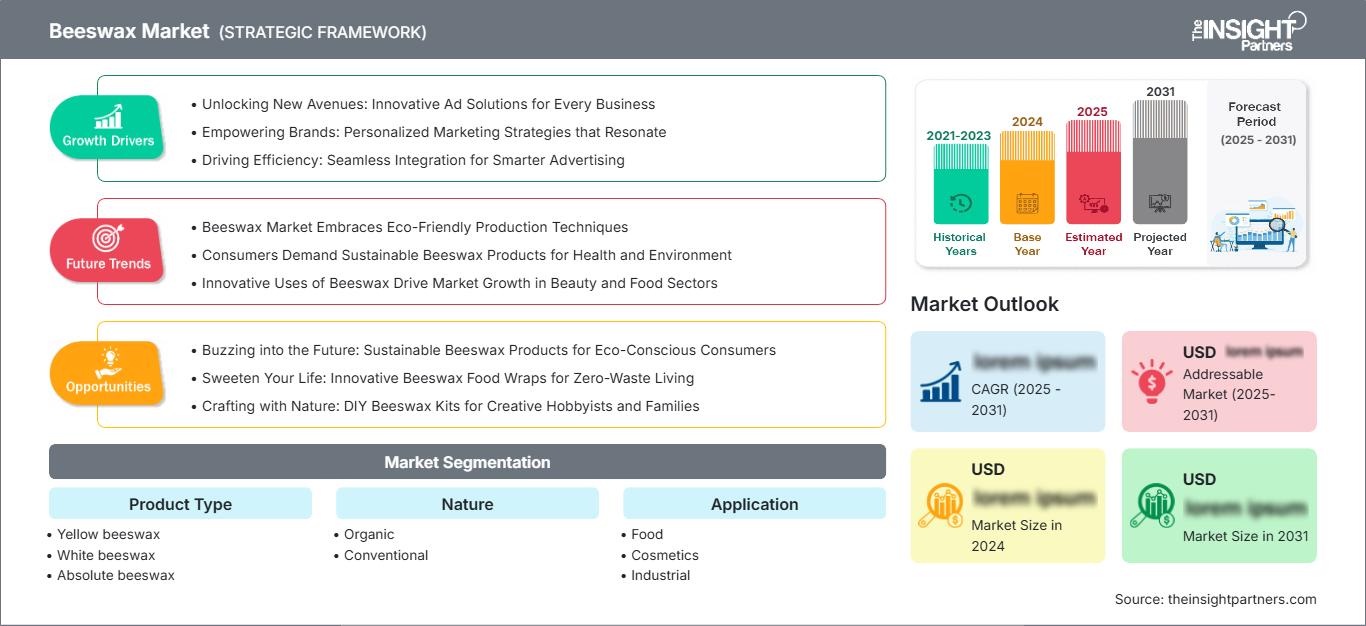
The Beeswax Market size stood at US$ 680.93 Million in 2025 and will likely attain US$ 1,015.00 Million by 2034, exhibiting a CAGR of 4.54% over 2026–2034. This includes yellow beeswax, white beeswax, and absolute beeswax in organic and non-organic variants. Applications include use in food, cosmetics, and other industrial purposes. Rising demand for natural functional ingredients is expected to drive growth in these sectors.
In North America, existing cosmetic manufacturing operations, food manufacturing operations, specialty ingredient distribution channels, and preference for naturally sourced ingredients are expected to drive demand. The region will exhibit a CAGR of 4.1–4.6% over 2026–2034. Demand for grades with regulated levels of color, odor, purity, and traceability is also expected to drive demand.
Beeswax Market Assessment and Insights
- North America: North America accounted for an estimated 28–32% Beeswax Market share in 2025 and is projected to expand at a 4.1–4.6% CAGR between 2026 and 2034, supported by cosmetics, food coatings, candles, and specialty formulations.
- U.S.: The U.S. represented approximately 68–72% of North American demand in 2025 and is forecast to grow at a 4.0–4.5% CAGR during 2026–2034, driven by cosmetics and food applications.
- Europe: Europe held approximately a 24–28% share in 2025 and is expected to register a 3.8–4.3% CAGR during 2026–2034, with Germany, France, Italy, Spain, and the UK supporting refined wax consumption.
- Asia Pacific: Asia Pacific represented approximately 30–34% share in 2025 and is projected to record a 5.0–5.6% CAGR during 2026–2034, led by China, India, Japan, South Korea, and Australia.
- Largest Segment: Cosmetics represented an estimated 38–42% market share in 2025 and is projected to expand at a 5.0–5.5% CAGR during 2026–2034, supported by natural formulation demand.
- High Growth Segment: Organic products accounted for approximately 18–22% market share in 2025 and are expected to grow at a 6.0–6.6% CAGR during 2026–2034, reflecting premium sourcing requirements.
- Key companies analyzed in detail: Arjun Beeswax Industries, Frank B. Ross Co., Inc., Jedwards International, Inc., Kahl GmbH & Co. KG, Kantilal Brothers, Koster Keunen, Inc., Seidler Chemical Co., Inc., Sovereign Chemicals & Cosmetics, Strahl & Pitsch, Inc., The British Wax Refining Company Limited.
Source: The Insight Partners' analysis based on proprietary research, government publications, company annual reports, investor presentations, industry databases, and expert interviews.
The Beeswax market development has come about due to the improvements in the filtration, bleaching, deodorizing, refining, and grading in terms of particle size. This makes it possible for suppliers to be able to develop different grades based on the properties of melting, color, smell, purity, and purpose for use. The refining process is crucial for cosmetics and food companies since the characteristics of the raw beeswax could differ depending on the plant source, geographical location, harvesting methods, and processing methods.
The Beeswax market forecast indicates that there is going to be an expansion of manufacturing operations in Asia, where as the North American and European customers will favor certified and documented products. Factors such as compliance, organic, sustainability, and specification by application could affect the investment decision. Suppliers who have diversified sources will be able to hedge themselves against any seasonal variations in the availability of raw wax.
Beeswax Market Report Scope
| Report Attribute | Details |
|---|---|
| Market size in 2025 | US$ 680.93 Million |
| Market Size by 2034 | US$ 1,015.00 Million |
| Global CAGR (2026 - 2034) | 4.54% |
| Historical Data | 2021-2024 |
| Forecast period | 2026-2034 |
Beeswax Market Analysis
Demand channels in Beeswax Market include inter-related channels in food processing, cosmetics, pharmaceuticals, candles, coating, and specialty industrial applications. The supply chain includes beekeepers and honey producers, aggregators, refiners, distributors, and formulators. Raw beeswax needs to be cleaned, filtered, and graded before application in high-value processes. Increasingly, consumers judge suppliers based on purity, color, smell, melting properties, contamination prevention, and documentations.
Supply side factors in the Beeswax market are directly related to beekeeping and honey production cycle, health of the colonies and collection techniques. Supply may thus differ in terms of regional and seasonal supply. Refiners having a geographic distribution network for sourcing may hedge themselves against any uncertainty in procurement through a combination of sources like Africa, Asia, Latin America and elsewhere. High-value grades of wax create additional profitability since they need higher processing precision and laboratory testing.
Competitive positioning in the Beeswax market today is largely based on the product range, processing capability, certifications, source location, and technical support offered. There are companies like Koster Keunen, Inc., Kahl GmbH & Co. KG, Strahl & Pitsch, Inc., and The British Wax Refining Company Limited, which have positioned themselves in specialty and refined waxes. Jedwards International, Inc., Frank B. Ross Co., Inc., and Seidler Chemical Co., Inc. offer vital distribution and ingredient supply capabilities to the industrial and formulation industries.
Investments are increasingly going towards unique natural ingredients rather than ordinary raw materials. Certifications like organic, pharmaceutical-grade processing, fair trade, customization of particle size and formulation blends are ways to position oneself at premium levels. Companies like Arjun Beeswax Industries and Kantilal Brothers are involved in the Indian supply chain, while Sovereign Chemicals & Cosmetics caters to the needs of downstream ingredient suppliers.
● REPORT CUSTOMIZATION
Tailor This Report To Align With Your Specific Business Requirements
This report can be customized to align precisely with your business objectives, scope, and target markets. Customization options include tailored segmentation, geography, competitive analysis, and strategic insights to support informed decision-making.
Customize This Report →WHAT YOU CAN ADJUST
- ● Segmentations
- ● Geography
- ● Competitive Analysis
- ● Language Preferences
Beeswax Market: Strategic Insights
Regional Insights
North America Beeswax Market
North America accounted for a Beeswax market share of 28–32% in 2025 and is expected to grow at a CAGR of 4.1–4.6% between 2026 and 2034. The region has mature personal care formulation manufacturing capabilities, developed food processing infrastructure, distribution of specialty ingredients, and consumer preference for formulations that are natural. United States is the main regional consumer owing to its presence of major cosmetics, food, pharmaceuticals, candle making, and specialty products industries. Canada is a contributor to the market through beekeeping, food processing, natural personal care and specialty ingredient applications. Increasing demand for documentation regarding origin, purity, processing, sustainability, and certification is seen among regional buyers.
The Beeswax Market share in North America is fueled by diverse demand among end users, not being dependent on single application. Cosmetics makers utilize beeswax for its structuring, emulsifying, film-forming and texturizing properties, while food processors make use of it in specific coating and glazing applications. Domestic beekeeping industry supplies some of the material, although overseas procurement continues to be required for steady industrial volumes and specialty grades.
U.S. Beeswax Market
The U.S. made up 68-72% of North American Beeswax market in 2025 and is forecast to grow at 4.0-4.5% CAGR until 2034. The sector enjoys good formulation diversity, including personal care, food, pharmaceuticals, candles, and industrial specialties. Existing ingredient distributors supply yellow, white, organic, and refined grades to producers of various production levels.
Cosmetics will be one of key consumer centers since beeswax is applied to increase product texture, uniformity, consistency, hardness, and film-forming properties. Another factor of demand growth is food application through approved glazing and coating applications. There is an increasing tendency among U.S. suppliers and importers to provide documentation and testing of the batches. It opens up opportunities for those refiners that can supply standardized grades.
Europe Beeswax Market
Europe accounted for about a 24-28% share in 2025 and is expected to grow at a CAGR of 3.8-4.3% from 2026 to 2034. Germany is the leading domestic market driven by advanced cosmetics, pharmaceuticals, food, and specialty ingredients industries. UK, France, Italy, and Spain are other significant contributors in terms of downstream consumption. European producers are growing more interested in traceability, purity, certification, and compliance of natural waxes.
The UK possesses a well-established infrastructure for wax processing and distribution that includes food, cosmetics, pharmaceutical, candle, and industrial applications. Germany gets benefited due to advanced specialty chemicals and personal care products manufacturing. France and Italy have premium cosmetics and fragrance applications, whereas Spain has food processing, cosmetics, and beekeeping applications.
APAC Beeswax Market
APAC had a 30% to 34% share in 2025 and is expected to achieve a 5.0% to 5.6% CAGR over 2026-2034. China leads the regional processing and consumption, followed by India, Japan, South Korea, and Australia. Increased demand comes from the growth in the production of cosmetics, food processing, candles, and industrial use.
China takes advantage of its extensive manufacturing capabilities; India, on the other hand, enjoys its beekeeping industry as well as its developing cosmetics and food processing industry. Japan and South Korea provide for their premium cosmetic formulations, while Australia provides for its beekeeping and natural ingredients industry.
Middle East & Africa Beeswax Market
Middle East & Africa is projected to experience CAGR growth of 4.4%-5.0% over 2026-2034, driven by beekeeping, cosmetics, food processing, and other specialized applications. Demand from Saudi Arabia and UAE is a key factor, as is South Africa's combination of local production alongside mature markets for agriculture and industry. The sourcing of African wax continues to be an important part of international supplies of refined waxes.
Improvements in infrastructure and logistics can support improved access to downstream consumers. UAE is helped by its position as a regional center for trade and distribution, and Saudi Arabia is assisted by expansion in the consumer and personal care sectors. South Africa makes its contribution via beekeeping and industry. More investment in wax collection and purification could boost the region's involvement in international supplies.
Segmentation Analysis
Product Type
Product Type is projected to register a 4.1–4.7% CAGR during 2026–2034. Demand varies according to color, purity, odor, melting characteristics, and processing requirements. Yellow grades remain widely utilized, while white and absolute grades serve more specialized applications requiring tighter sensory and compositional specifications. Refiners are therefore investing in standardized processing and application-specific product development.
- Yellow beeswax: Yellow beeswax maintains broad demand across cosmetics, food, candles, and industrial formulations because its natural appearance and characteristic properties suit applications where extensive bleaching is unnecessary.
- White beeswax: White beeswax serves cosmetics, pharmaceutical, and food formulations requiring lighter color, controlled visual appearance, and consistent sensory characteristics in finished products.
- Absolute beeswax: Absolute beeswax serves specialized fragrance and personal care formulations where concentrated aromatic characteristics and premium processing support higher-value niche applications.
Nature
Nature is forecast to expand at a 4.8–5.5% CAGR during 2026–2034. Conventional products continue serving mainstream applications, while organic grades are gaining importance among premium cosmetic, wellness, and specialty food brands. Purchasing decisions increasingly consider certification, pesticide controls, beekeeper practices, origin, and chain-of-custody documentation.
- Organic: Organic beeswax is increasingly selected by premium cosmetics and natural personal care manufacturers seeking certified sourcing, traceability, and alignment with clean-label and responsible ingredient strategies.
- Conventional: Conventional beeswax remains important for mainstream food, candle, industrial, and personal care applications where availability, functionality, procurement economics, and established specifications influence purchasing.
Application
Application is projected to grow at a 4.5–5.1% CAGR during 2026–2034. Cosmetics represent the largest application category because beeswax provides structure, texture, film formation, and emollient properties. Food and industrial applications add demand diversity and help reduce dependence on a single downstream sector.
- Food: Food applications use beeswax primarily for approved glazing and coating functions, with demand supported by confectionery, specialty foods, fresh produce, and products requiring controlled surface appearance.
- Cosmetics: Cosmetics represent the largest application base, supported by use in lip products, creams, balms, lotions, hair care, and color cosmetics requiring structure, texture, and emollient characteristics.
- Industrial: Industrial applications include coatings, polishing products, molding, lubrication, electrical applications, and specialty formulations requiring hardness, moisture resistance, and controlled melting behavior.
The Beeswax Market scope extends across raw-material sourcing, refining, certification, distribution, formulation, and downstream utilization. These dimensions are relevant because product value is increasingly determined not only by physical volume but also by grade consistency, processing intensity, traceability, and application suitability. This creates differentiation opportunities across the complete value chain.
Opportunity Snapshot
| Application | Revenue Contribution | Trend Tag | Adoption Stage |
| Food | Medium | Food Coating | Mature |
| Cosmetics | High | Natural Formulation | Scaling |
| Industrial | Medium | Specialty Coating | Mature |
Beeswax Market Growth Drivers and Impact Analysis
Rising Use of Natural Ingredients in Personal Care Formulations
Increasing preferences for nature-derived ingredients are driving up demands from cosmetic manufacturers who need multi-functional ingredients with identifiable sources. Beeswax can act as an emulsifier, emollient, film-forming agent, consistency modifier, and structuring agent depending on the particular formulation in which it is used. These functions are pertinent to lip balms, creams, sticks, hair care products, and color cosmetics. Luxury brands are also focusing on ingredient clarity and sustainable sourcing practices, thus compelling suppliers to offer certification and better documentation. The commercial implications go beyond volume as high-quality cosmetic formulations are known to have stringent requirements. Suppliers who are able to maintain consistency in terms of color, odor, purity, and traceability can meet these requirements and hence access this demand channel.
Expansion of Food Coating and Glazing Applications
Food processors use beeswax where surface protection, gloss, moisture management, and product presentation are commercially important. Its established use as a food additive E901 supports defined applications involving surface treatment and glazing. Demand can benefit from the continued development of confectionery, specialty foods, and fresh produce handling, particularly where manufacturers seek recognizable natural coating materials. European food regulations and corresponding national frameworks provide established conditions for compliant use, reducing uncertainty for manufacturers operating within approved applications. Commercial opportunities extend beyond material supply because refiners can provide grades tailored to coating equipment, food-contact requirements, appearance standards, and processing conditions. Investment in filtration, purification, testing, and batch certification can therefore improve supplier competitiveness. Consistent food-grade material remains particularly valuable to manufacturers operating high-throughput production systems.
Development of Traceable and Certified Beeswax Supply Chains
Supply-chain transparency is becoming an important purchasing factor as manufacturers evaluate origin, beekeeper practices, contamination controls, certification, and processing history. Beeswax originates from biological production systems, making its supply chain less standardized than synthetic wax production. Refiners establishing direct relationships with beekeeping communities can improve raw-material consistency while developing clearer provenance records. Certified organic and fair-trade products can command greater interest among premium cosmetics and specialty food manufacturers. Better traceability also reduces commercial exposure to adulteration, inconsistent quality, and unclear sourcing. Over time, documented supply chains are likely to become increasingly important for multinational buyers operating structured supplier-qualification procedures. Companies that are able to combine upstream relationships, analytical testing, and digital documentation can strengthen customer retention while differentiating themselves from suppliers competing mainly on price.
Beeswax Market Future Trends
Increasing Integration of Digital Traceability in Wax Procurement
Beeswax Market trends are increasingly shaped by digital traceability as buyers seek visibility into raw-wax origin, processing history, certification, and batch quality. Suppliers may integrate digital certificates, geographic sourcing records, batch identifiers, laboratory results, and compliance documentation into procurement systems. These capabilities can simplify supplier qualification and reduce the administrative work associated with repeated documentation requests. Traceability can also help manufacturers identify quality deviations and connect finished products with specific raw-material batches. The trend should be particularly relevant among multinational cosmetics, pharmaceutical, and food manufacturers with centralized procurement systems. Over time, digital documentation may evolve from a differentiating service into a standard supplier expectation. Refiners combining laboratory quality management with digital records can therefore strengthen their position with customers requiring transparent and auditable sourcing.
Growth of Application-Specific Natural Wax Systems
Future formulation development is likely to move toward application-specific systems combining beeswax with other natural waxes, oils, esters, and functional ingredients. Such systems can adjust hardness, melting behavior, spreadability, gloss, texture, and stability while preserving the natural ingredient positioning valued by formulators. Cosmetic manufacturers are particularly likely to adopt customized systems for sticks, balms, emulsions, and color cosmetics where sensory performance is critical. Food and industrial users can also benefit from tailored formulations designed for coating behavior, processing efficiency, or surface performance. This trend creates opportunities for suppliers with application laboratories and technical formulation expertise. Rather than competing solely through raw-material availability, companies can differentiate through prototype development, technical support, and customer-specific formulation engineering. Customized systems can consequently improve margins and customer retention.
Beeswax Market Opportunities
Premium Organic and Fair-Trade Supply Expansion
Expansion of certified organic and fair-trade supply chains represents an attractive opportunity because premium cosmetics and specialty food manufacturers increasingly require documented sourcing. Producers can create additional value by developing relationships with beekeeper cooperatives, implementing standardized collection practices, and investing in purification facilities that preserve traceability throughout processing. African and Asian sourcing regions offer opportunities to strengthen upstream procurement while supporting improved beekeeper economics and supply reliability. Certification can also improve access to export markets where buyers evaluate environmental and social criteria alongside technical performance. Companies entering this segment should prioritize chain-of-custody documentation, contamination testing, recognized certification, and standardized processing. A vertically coordinated sourcing model can reduce procurement uncertainty while enabling suppliers to serve customers seeking premium natural ingredients with verifiable provenance.
Advanced Refining for High-Purity Cosmetic and Food Grades
Investment in advanced filtration, bleaching, deodorization, purification, and quality-control systems can create higher-margin opportunities by converting variable crude wax into consistent application-specific grades. Cosmetic and food manufacturers increasingly require predictable color, odor, melting behavior, and contaminant levels because raw-material variability can influence finished-product appearance and processing. Refiners can develop specialized grades for lip products, creams, food coatings, pharmaceutical preparations, and technical formulations. Modern equipment can also improve yield and reduce losses during purification. Companies with strong laboratory capabilities can establish tighter specifications and provide certificates of analysis that simplify customer qualification. This opportunity is particularly relevant in regions with established beekeeping networks but comparatively limited downstream refining capacity, allowing local processors to capture greater value before material reaches international markets.
Recent Developments
- September 2025: Gramajanya Farmers Producer Company — Karnataka's largest honey-processing unit at Puttur, Dakshina Kannada, became partly operational. The facility has an installed processing capacity of 10 tonnes of honey per day and includes modern processing and laboratory infrastructure. The development strengthens organized honey processing and can improve the recovery and commercialization of beeswax as a valuable honey-production byproduct.
- February 2026: Tanzania International Bee Company Limited (Jambo Asali) — The company secured an agreement to supply 240 metric tons of beeswax annually to a Lithuanian company serving the European Union market. The contract was scheduled for execution from January to March 2026, with the wax intended for pharmaceutical, cosmetics, candle manufacturing, and food-processing applications. The company supports more than 2,000 smallholder beekeepers across Tanzania.
- June 2026: Bee Joyful Products — Bee Joyful continued promoting beeswax- and honey-based personal care products, highlighting their use for moisturizing and caring for dry skin. The company's product positioning demonstrates continued downstream utilization of beeswax in natural skincare formulations, particularly small-batch personal care products that emphasize naturally derived ingredients.
Frequently Asked Questions

- Comprehensive Market Sizing and Forecast Analysis
- Detailed Segmentation Analysis
- In-Depth Market Dynamics Assessment
- Regional and Country-Level Insights
- Competitive Landscape and Company Benchmarking
- Strategic Business Intelligence
Recent Reports
Testimonials

The Insight Partners' SCADA System Market report is comprehensive, with valuable insights on current trends and future forecasts. The team was highly professional, responsive, and supportive throughout. We are very satisfied and highly recommend their services.
RAN KEDEM Partner, Reali Technologies LTDs
I requested a report on a very specific software market and the team produced the report in a few days. The information was very relevant and well presented. I then requested some changes and additions to the report. The team was again very responsive and I got the final report in less than a week.
JEAN-HERVE JENN Chairman, Future Analytica
We worked with The Insight Partners for an important market study and forecast. They gave us clear insights into opportunities and risks, which helped shape our plans. Their research was easy to use and based on solid data. It helped us make smart, confident decisions. We highly recommend them.
PIYUSH NAGPAL Sr. Vice President, High Beam Global
The Insight Partners delivered insightful, well-structured market research with strong domain expertise. Their team was professional and responsive throughout. The user-friendly website made accessing industry reports seamless. We highly recommend them for reliable, high-quality research services
YUKIHIKO ADACHI CEO, Deep Blue, LLC.
This is the first time I have purchased a market report from The Insight Partners.While I was unsure at first, I visited their web site and felt more comfortable to take the risk and purchase a market report.I am completely satisfied with the quality of the report and customer service. I had several questions and comments with the initial report, but after a couple of dialogs over email with their analyst I believe I have a report that I can use as input to our strategic planning process.Thank you so much for taking the extra time and making this a positive experience.I will definitely recommend your service to others and you will be my first call when we need further market data.
JOHN SUZUKI President and Chief Executive Officer, Board Director, BK Technologies
I wish to appreciate your support and the professionalism you displayed in the course of attending to my request for information regarding to infectious disease IVD market in Nigeria. I appreciate your patience, your guidance, and the fact that you were willing to offer a discount, which eventually made it possible for us to close a deal. I look forward to engaging The Insight Partners in the future, all thanks to the impression you have created in me as a result of this first encounter.
DR CHIJIOKE ONYIA MANAGING DIRECTOR, PineCrest Healthcare Ltd.Reason to Buy
- Informed Decision-Making
- Understanding Market Dynamics
- Competitive Analysis
- Identifying Emerging Markets
- Customer Insights
- Market Forecasts
- Risk Mitigation
- Boosting Operational Efficiency
- Strategic Planning
- Investment Justification
- Tracking Industry Innovations
- Aligning with Regulatory Trends





 Get Free Sample for