
Bench-top HbA1c Analyzers Market Size, Trends & Demand by 2034
Coverage: By Type (Ion Exchange Chromatography, HPLC, Boronate Affinity Technology); Application (Hospitals, Diagnostic Centers, Academic and Research Institutes), and Geography (North America, Europe, Asia Pacific, and South and Central America)
- Status : Data Released
- Report Code : TIPRE00015207
- Category : Life Sciences
- No. of Pages : 150
- Available Report Formats :


- Last update date : November 02, 2026


2025 Market Size
US$ 846.07 Mn
Base year value
2034 Forecast
US$ 1,709.31 Mn
Projected by 2034
CAGR 2026-2034
8.13 %
Growth rate
Addressable Market
US$ 11,486.50 Mn
(2026-2034)
The bench-top HbA1c analyzers market was valued at US$ 846.07 Million in 2025 and is projected to reach US$ 1,709.31 Million by 2034, registering a CAGR of 8.13% during 2026–2034. Growth is supported by the rising diabetes burden, expansion of routine glycemic monitoring, demand for rapid laboratory results, and wider diagnostic access. Compact automation and improving analytical precision are strengthening adoption across decentralized testing environments.
Across North America, the bench-top HbA1c analyzers market size is projected to expand at a CAGR of ~8% through 2034. High diabetes testing volumes, established reimbursement, developed laboratory infrastructure, and adoption of standardized HbA1c methods support regional demand. Laboratories increasingly prioritize compact systems offering rapid analysis, hemoglobin variant detection, laboratory information system connectivity, automated calibration, and consistent performance across routine and high-volume workflows.
Bench-top HbA1c Analyzers Market Assessment and Insights
Regional Outlook
- North America: ~38% of the global bench-top HbA1c analyzers market share in 2025 | ~8% CAGR through 2034. Market position: North America leads through high diabetes diagnosis, extensive laboratory infrastructure, recurring analyzer replacement, strong reimbursement, and broad adoption of standardized HbA1c testing across hospitals and diagnostic centers.
- US: ~88% of North American market revenue in 2025 | ~8% CAGR through 2034. Market position: The US dominates regional revenue through substantial testing volume, advanced laboratory automation, rapid product adoption, developed diabetes-care pathways, and the presence of established diagnostics manufacturers.
- Europe: ~28% of the global market in 2025 | ~8% CAGR through 2034. Market position: Europe is a mature market supported by universal healthcare, standardized diabetes monitoring, accredited laboratories, and substantial diagnostic demand across Germany, the UK, France, Italy, and Spain.
- Asia Pacific: ~25% of the global market in 2025 | ~10% CAGR through 2034. Market position: Asia Pacific is the fastest-growing region as diabetes screening, hospital capacity, private diagnostics, local manufacturing, and insurance coverage expand across China, India, Japan, South Korea, and Australia.
Segment Outlook
- HPLC: ~48% Share in 2025 | ~9% CAGR through 2034. Market position: HPLC leads through high analytical precision, established laboratory acceptance, reliable separation of hemoglobin fractions, effective variant identification, and suitability for hospitals and diagnostic centers processing sustained HbA1c volumes.
- Diagnostic Centers: ~42% Share in 2025 | ~10% CAGR through 2034. Market position: Diagnostic Centers are growing through laboratory-chain expansion, outpatient screening, centralized sample processing, increasing test referrals, and investment in compact analyzers that combine throughput with limited space requirements.
Competitive Coverage
Abbott Laboratories, F. Hoffmann-La Roche Ltd, Bio-Rad Laboratories, Inc., Tosoh Corporation, ARKRAY, Inc., Meril Life Sciences Pvt. Ltd., Erba Mannheim, OSANG Healthcare Co., Ltd., TaiDoc Technology Corporation, Trinity Biotech plc
Methodology
The Insight Partners follows Data Collection & Secondary Research, Primary Research, Data Analysis, and Data Triangulation & Final Review to validate market estimates and insights.
Source: The Insight Partners' analysis based on proprietary research, government publications, company annual reports, investor presentations, industry databases, and expert interviews.
The HbA1c assay has moved away from the cumbersome method of chromatography towards an automated solution that brings together sample aspiration, hemolysis, separation, detection, calculation, quality control, and result communication. The manufacturers are now including in their products a fast analytical cycle, barcode reading, automated buffer switching, reagent tracking system, touchscreen user interface, and variant identification. Product performance relies on accurate fluidics, reliable columns, detector system (optical or electrochemical), calibration, software validation, and reliable consumables availability.
For the period up to 2034, there will be investments in fast chromatography, reduced maintenance, connected laboratory platform, minimum sample volume, and regionally applicable diagnostic system. The markets of Asia Pacific and the Middle East will show opportunities for market expansion due to increased diabetes programs and private laboratory development. The regulatory requirements for the analyte traceability, variant interference, quality control, cybersecurity, and performance after marketing approval will be in favor of integrated platform providers.
Bench-top HbA1c Analyzers Market Report Scope
| Report Attribute | Details |
|---|---|
| Market size in 2025 | US$ 846.07 Million |
| Market Size by 2034 | US$ 1,709.31 Million |
| Global CAGR (2026 - 2034) | 8.13% |
| Historical Data | 2021-2024 |
| Forecast period | 2026-2034 |
Bench-top HbA1c Analyzers Market Analysis
The factors driving the growth of bench-top HbA1c analyzers include the rising incidence of diabetes, widespread screening activities, need for repeat testing, and use of HbA1c as an indicator of cumulative glycemic exposure. Accurate testing is needed in hospitals and other diagnostic centers for diagnosing conditions, assessing treatment, and detecting those with potential issues regarding glycemic control.
Value chains include column and resin suppliers, reagent suppliers, fluidics suppliers, analyzers manufacturers, quality control firms, distribution channels, laboratories, and service companies. The economics of such products extend well beyond hardware and into columns, buffers, calibrators, controls, cartridges, maintenance, software, and downtime. Consequently, laboratories consider the cost, turnaround time, sample volume, and stability of consumables together.
Analysis of the bench-top HbA1c analyzers market reveals competition based on method used, speed, ability to detect variants, ease of sample processing, accuracy, cost of maintenance, and lab connectivity. Bio-Rad Laboratories, Inc. and Tosoh Corporation have excellent chromatography abilities, while Abbott Laboratories and F. Hoffmann-La Roche Ltd have good diabetes and laboratory diagnostics portfolios. ARKRAY, Inc. is a company offering established glycohemoglobin testing platforms.
Trinity Biotech plc relies on boronate affinity technology, whereas Meril Life Sciences Pvt. Ltd., Erba Mannheim, OSANG Healthcare Co., Ltd., and TaiDoc Technology Corporation are companies catering to growing and cost-conscious diagnostic markets. The areas of investment include high-speed columns, automatic operation, automated quality control, regional reagent production, and equipment for laboratories with variable workload.
● REPORT CUSTOMIZATION
Tailor This Report To Align With Your Specific Business Requirements
This report can be customized to align precisely with your business objectives, scope, and target markets. Customization options include tailored segmentation, geography, competitive analysis, and strategic insights to support informed decision-making.
Customize This Report →WHAT YOU CAN ADJUST
- ● Segmentations
- ● Geography
- ● Competitive Analysis
- ● Language Preferences
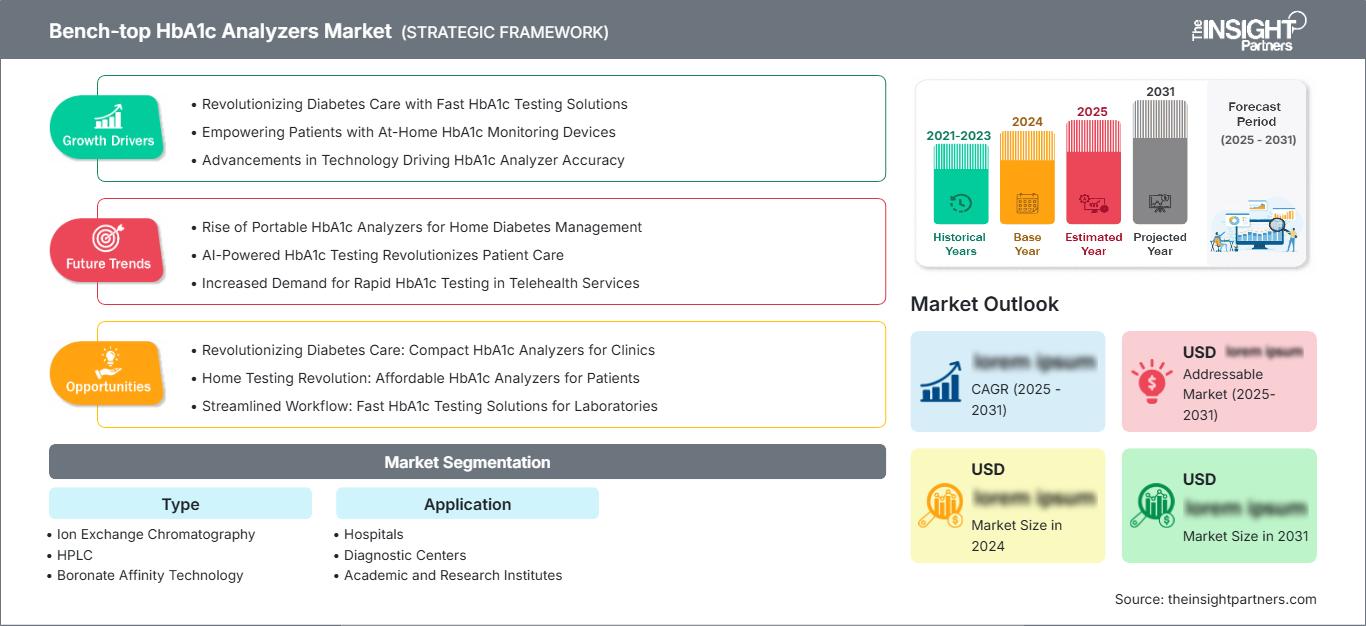
Bench-top HbA1c Analyzers Market: Strategic Insights
Regional Insights
North America Bench-Top HbA1c Analyzers Market
North America accounted for approximately ~38% of global revenue in 2025 and is projected to register a CAGR of ~8% through 2034. The regional bench-top HbA1c analyzer market share has been driven by the significant volume of diabetic testing, developed lab facilities, reimbursement, and widespread use of standardized test equipment. The demand for HbA1c testing comes from hospitals, independent labs, physician affiliated diagnostic centers, and academic institutions.
The Canadian contribution comes from public health care, provincial diabetes screening programs, and structured pathways for management of diabetes. The Mexican contribution comes from lab chain growth, hospital upgrades, and increased access to testing of chronic diseases. The purchase decisions in the region are now influenced by the analytical technology, turnaround time, ability to test for hemoglobin variants, quality control, system connectivity, service response time, and cost of disposables on an ongoing basis.
U.S. Bench-Top HbA1c Analyzers Market
The US represented approximately ~88% of North American revenue in 2025 and is projected to grow at a CAGR of ~8% through 2034. Its rationale is provided by the existence of large populations needing diabetes testing and monitoring, presence of well-established hospitals and reference laboratory setups, good reimbursement structures, and the adoption of automated diagnostic tools. Analyzer replacement and consolidation of laboratory networks have a bearing on the purchase decision.
Abbott Laboratories, Bio-Rad Laboratories, Inc., Tosoh Corporation, ARKRAY, Inc., and Trinity Biotech plc have relevant market exposure. Hospitals emphasize the importance of clinical accuracy, rapid processing, connectivity, and variant detection, while independent diagnostic centers lay emphasis on throughput, reagent costs, reliability, and service availability. The availability of small-sized equipment that produces laboratory quality outputs provides smaller setups with the ability to perform tests which would otherwise be outsourced to reference labs.
Europe Bench-Top HbA1c Analyzers Market
Europe held approximately ~28% of global revenue in 2025 and is projected to expand at a CAGR of ~8% through 2034. Universal healthcare, structured diabetes monitoring, population aging, laboratory accreditation, and chronic disease programs support regional demand. Germany is assessed as the leading country in Europe because of its healthcare scale, diagnosed diabetic population, decentralized laboratory network, and adoption of automated diagnostic systems.
In the UK, national diabetes monitoring pathways are combined with community and hospital screening. In France, there is an advantage of wide access to laboratories and follow-ups for chronic diseases. In Italy and Spain, the factors that drive the market include aging population, regional healthcare system, independent diagnostic centers, and renewal of old analytical instruments.
Key features of European laboratory testing include calibration traceability, standardization, precision of the test, handling of hemoglobin variants, reagent stability, serviceability, and in vitro diagnostic needs. F. Hoffmann-La Roche Ltd, Bio-Rad Laboratories, Inc., Tosoh Corporation, ARKRAY, Inc., Erba Mannheim, and Trinity Biotech plc have relevant capabilities in the regions. The factors that could stimulate growth are community testing with portable devices, renewal of old analyzers, and use of maintenance-free systems. Public procurement and reimbursement regulations could affect pricing.
APAC Bench-Top HbA1c Analyzers Market
Asia Pacific accounted for approximately ~25% of global revenue in 2025 and is the fastest-growing region, with a CAGR of ~10% through 2034. China is assessed as the leading country in Asia Pacific through population scale, diabetes burden, hospital capacity, diagnostic investment, and domestic manufacturing. India combines substantial unmet testing need with rapidly expanding private laboratories.
Japan participates in diabetes care through its current diabetes care program and analytical expertise. South Korea participates with its advanced diagnostic technologies, and Australia has its accredited laboratories and systems in place for monitoring. The regional development is driven by insurance coverage, screening programs, diagnostic chains in the cities, local production, and clinician knowledge of the region.
Middle East & Africa Bench-Top HbA1c Analyzers Market
The Middle East & Africa market is projected to register a CAGR of ~9% through 2034. Saudi Arabia is assessed as the leading country in the Middle East & Africa through diabetes burden, hospital investment, healthcare transformation, and laboratory modernization. The UAE contributes through private hospitals, diagnostic networks, insurance coverage, and medical tourism.
South Africa maintains comparatively developed private pathology and hospital laboratory capacity. Across the Rest of MEA, limited reagent availability, trained personnel, maintenance support, and reimbursement constrain adoption. Urban diagnostic investment, telecommunications infrastructure, public screening, and distributor development can improve access to compact analyzers designed for moderate sample volumes and challenging operating conditions.
Segmentation Analysis
Type
The bench-top HbA1c analyzers market scope covers analytical approaches differentiated by separation mechanism, result interpretation, variant detection, throughput, consumable requirements, and operational complexity. Laboratories select technology according to sample volume, precision requirements, population characteristics, staffing, and ownership cost. HPLC is projected to register a CAGR of ~9% during 2026–2034 as demand increases for automated separation, reliable quantification, visible chromatograms, and identification of common hemoglobin variants.
- Ion Exchange Chromatography: Ion Exchange Chromatography separates hemoglobin fractions according to charge interactions with the stationary phase. It supports precise HbA1c quantification and provides chromatographic information that can help laboratories recognize abnormal or interfering fractions.
- HPLC: HPLC combines controlled mobile-phase flow, specialized columns, and automated detection to produce reproducible HbA1c measurements. Its established clinical acceptance, analytical resolution, and compatibility with sustained workloads support broad laboratory adoption.
- Boronate Affinity Technology: Boronate Affinity Technology measures glycated hemoglobin through selective binding to glucose-related molecular structures. The method offers useful specificity and simplified chromatographic interpretation, although its ability to characterize separate hemoglobin variants differs from ion-exchange approaches.
Application
Application demand varies according to sample volume, turnaround requirements, referral patterns, clinical urgency, and research purpose. Hospitals require rapid testing integrated with patient care, while diagnostic centers emphasize productivity and operating economics. Diagnostic Centers are projected to expand at a CAGR of ~10% during 2026–2034 as laboratory chains, preventive screening, outsourced testing, and chronic disease panels increase sample throughput.
- Hospitals: Hospitals use HbA1c analyzers for inpatient assessment, outpatient diabetes clinics, preoperative evaluation, and chronic disease monitoring. Procurement emphasizes result accuracy, speed, variant identification, information-system connectivity, dependable service, and uninterrupted reagent availability.
- Diagnostic Centers: Diagnostic Centers process referred and walk-in samples across diverse patient populations. Their purchasing decisions prioritize daily throughput, automation, column capacity, low repeat rates, standardized quality control, consumable economics, and efficient reporting to clinicians.
- Academic and Research Institutes: Academic and Research Institutes use analyzers for epidemiological studies, method comparison, biomarker research, clinical studies, and professional training. Flexibility, raw analytical information, data export, repeatability, and technical support strongly influence selection.
Opportunity Snapshot
| Application | Revenue Contribution | Trend Tag | Adoption Stage |
| Hospitals | High | Integrated Diabetes | Mature |
| Diagnostic Centers | High | Network Testing | Scaling |
| Academic and Research Institutes | Low | Method Validation | Scaling |
Bench-top HbA1c Analyzers Market Growth Drivers and Impact Analysis
Expanding Diabetes Screening and Monitoring Requirements
The increasing number of people living with diagnosed or undiagnosed diabetes is expanding demand for HbA1c testing. Unlike a single glucose measurement, HbA1c provides information on longer-term glycemic exposure, making it relevant to diagnosis support and continuing treatment evaluation. Repeated monitoring creates recurring analyzer and consumable demand across hospitals and diagnostic centers. Commercial impact extends to reagents, columns, controls, calibrators, maintenance, software, and service contracts. Growth is strongest where screening programs, healthcare coverage, laboratory access, and physician follow-up operate together. Without these supporting pathways, greater disease prevalence may not translate fully into completed tests or sustained monitoring.
Decentralization of Laboratory-Grade Diabetes Testing
Compact analyzers allow hospital departments, regional laboratories, and diagnostic centers to perform HbA1c testing without installing large central laboratory systems. Local testing can shorten sample transportation, improve result availability, and support clinical discussion within the same care episode. This creates additional placements across geographically distributed healthcare networks. Manufacturers must balance compact dimensions with analytical accuracy, sufficient throughput, buffer and column capacity, automated quality control, and information-system connectivity. The strongest commercial opportunities arise when decentralized instruments produce results comparable with established laboratory methods while remaining simple enough for facilities with limited specialist staffing.
Demand for Accurate Variant Detection and Standardized Results
Hemoglobin variants altered red-cell survival, and analytical interference can affect the interpretation of HbA1c results. Laboratories therefore value systems that separate common fractions, display chromatograms, or flag results requiring further investigation. Standardization to recognized reference frameworks supports comparable reporting across instruments and locations. The market impact favors analytically robust chromatography platforms, quality-control materials, proficiency testing, and professional training. Manufacturers can differentiate through clear interference documentation, automated flagging, high precision, and software that supports qualified review. Clinical interpretation must still consider the patient’s broader medical condition because no analyzer can eliminate every biological limitation affecting HbA1c.
Bench-top HbA1c Analyzers Market Future Trends
Faster HPLC with Automated Interpretation
Bench-top HbA1c analyzers market trends are shifting toward shorter analytical cycles, automated chromatogram review, high-capacity columns, uninterrupted buffer changes, and intelligent flagging. Future instruments may combine laboratory-grade separation with result times approaching those of simpler assay technologies. Software could help identify atypical peaks, assess quality-control performance, and prioritize results for professional review. Adoption will depend on validated algorithms, representative variant libraries, cybersecurity, data integrity, and transparent decision rules. Automated interpretation should reduce repetitive review without replacing qualified laboratory oversight, particularly where unusual hemoglobin patterns or discordant clinical findings are present.
Networked Instrument Management and Predictive Service
Diagnostic networks are expected to manage analyzer fleets through centralized dashboards showing column usage, reagent inventory, calibration status, quality-control shifts, error codes, and maintenance requirements. Predictive service can identify deteriorating performance before instrument failure disrupts reporting. Remote troubleshooting may also reduce engineer travel and improve uptime in geographically dispersed locations. Adoption will require secure connectivity, role-based access, validated software, reliable offline operation, and clear ownership of laboratory data. Suppliers able to convert equipment information into practical maintenance actions can strengthen long-term service relationships and recurring consumable revenue.
Bench-top HbA1c Analyzers Market Opportunities
Diagnostic Network Expansion in High-Burden Markets
Manufacturers can target private laboratory chains, regional hospitals, diabetes centers, and public screening programs across Asia Pacific, the Middle East, Africa, and Latin America. Bench-top HbA1c analyzers market Forecasts indicate attractive opportunity where testing access is expanding but central laboratory capacity remains uneven. Commercial strategies should combine affordable instruments, local reagent inventory, distributor training, external quality support, installation, and preventive maintenance. Reagent-rental or per-test models can reduce initial capital requirements, although suppliers need sufficient testing volume and contract discipline to preserve commercial viability.
Integrated Analyzer, Consumable, and Quality-Control Platforms
Vendors can differentiate by combining analyzers, columns, buffers, calibrators, controls, software, training, and service within a managed platform. Integrated offerings reduce compatibility risk and simplify procurement for laboratories that lack extensive technical teams. Pricing models can include leasing, minimum consumable commitments, multi-year service, and cost-per-reportable-result agreements. Providers should transparently address repeat testing, column replacement, reagent wastage, maintenance, downtime, and quality-control frequency. Strong post-installation support can improve instrument utilization and create durable customer relationships in a market where recurring consumables represent substantial lifetime value.
Recent Developments
- May 2026: Tosoh Corporation launched the HLC-723GX2 glycohemoglobin analyzer in Japan. The compact HPLC platform reduced analysis time per sample compared with its predecessor while retaining high-precision HbA1c measurement. The company also outlined planned commercialization across Europe, Africa, Latin America, Southeast Asia, and India, supporting wider access to compact chromatography-based testing.
- December 2025: Trinity Biotech plc expanded the international rollout of a high-capacity column system for its FDA-cleared Premier Hb9210 analyzer after obtaining regulatory clearances in multiple countries. The upgraded system provides greater testing capacity, improved column stability, lower maintenance interruption, and additional software automation intended to increase laboratory productivity.
- October 2025: Tosoh Bioscience, Inc. received US FDA 510(k) clearance for the compact HLC-723-GR01 glycohemoglobin analyzer. The fully automated ion-exchange HPLC system provides rapid HbA1c results, common variant detection, automatic buffer changes, walkaway operation, and laboratory information system integration for mid- and high-volume testing environments.
Frequently Asked Questions

- Comprehensive Market Sizing and Forecast Analysis
- Detailed Segmentation Analysis
- In-Depth Market Dynamics Assessment
- Regional and Country-Level Insights
- Competitive Landscape and Company Benchmarking
- Strategic Business Intelligence
Recent Reports
Testimonials

The Insight Partners provided valuable market intelligence that supported our global go-to-market strategy. Their team was professional, responsive, and attentive to our feedback, providing thoughtful analysis and helpful methodological clarifications throughout the project.
Junmo Kim Chief Financial Officer (CFO), Enertech Co., Ltd.
The Insight Partners' SCADA System Market report is comprehensive, with valuable insights on current trends and future forecasts. The team was highly professional, responsive, and supportive throughout. We are very satisfied and highly recommend their services.
RAN KEDEM Partner, Reali Technologies LTDs
I requested a report on a very specific software market and the team produced the report in a few days. The information was very relevant and well presented. I then requested some changes and additions to the report. The team was again very responsive and I got the final report in less than a week.
JEAN-HERVE JENN Chairman, Future Analytica
We worked with The Insight Partners for an important market study and forecast. They gave us clear insights into opportunities and risks, which helped shape our plans. Their research was easy to use and based on solid data. It helped us make smart, confident decisions. We highly recommend them.
PIYUSH NAGPAL Sr. Vice President, High Beam Global
The Insight Partners delivered insightful, well-structured market research with strong domain expertise. Their team was professional and responsive throughout. The user-friendly website made accessing industry reports seamless. We highly recommend them for reliable, high-quality research services
YUKIHIKO ADACHI CEO, Deep Blue, LLC.
This is the first time I have purchased a market report from The Insight Partners.While I was unsure at first, I visited their web site and felt more comfortable to take the risk and purchase a market report.I am completely satisfied with the quality of the report and customer service. I had several questions and comments with the initial report, but after a couple of dialogs over email with their analyst I believe I have a report that I can use as input to our strategic planning process.Thank you so much for taking the extra time and making this a positive experience.I will definitely recommend your service to others and you will be my first call when we need further market data.
JOHN SUZUKI President and Chief Executive Officer, Board Director, BK Technologies
I wish to appreciate your support and the professionalism you displayed in the course of attending to my request for information regarding to infectious disease IVD market in Nigeria. I appreciate your patience, your guidance, and the fact that you were willing to offer a discount, which eventually made it possible for us to close a deal. I look forward to engaging The Insight Partners in the future, all thanks to the impression you have created in me as a result of this first encounter.
DR CHIJIOKE ONYIA MANAGING DIRECTOR, PineCrest Healthcare Ltd.Reason to Buy
- Informed Decision-Making
- Understanding Market Dynamics
- Competitive Analysis
- Identifying Emerging Markets
- Customer Insights
- Market Forecasts
- Risk Mitigation
- Boosting Operational Efficiency
- Strategic Planning
- Investment Justification
- Tracking Industry Innovations
- Aligning with Regulatory Trends





 Get Free Sample for