
Bilirubin Assay Kits Market Trends, Size & Growth by 2034
Coverage: By Type (Diazonium Method, Vanadate Oxidation Method); End User (Hospitals, Diagnostic Centers, Others), and Geography (North America, Europe, Asia Pacific, and South and Central America)
- Status : Data Released
- Report Code : TIPRE00015208
- Category : Life Sciences
- No. of Pages : 150
- Available Report Formats :


- Last update date : November 02, 2026


2025 Market Size
US$ 166.82 Mn
Base year value
2034 Forecast
US$ 329.41 Mn
Projected by 2034
CAGR 2026-2034
7.85 %
Growth rate
Addressable Market
US$ 2,232.68 Mn
(2026-2034)
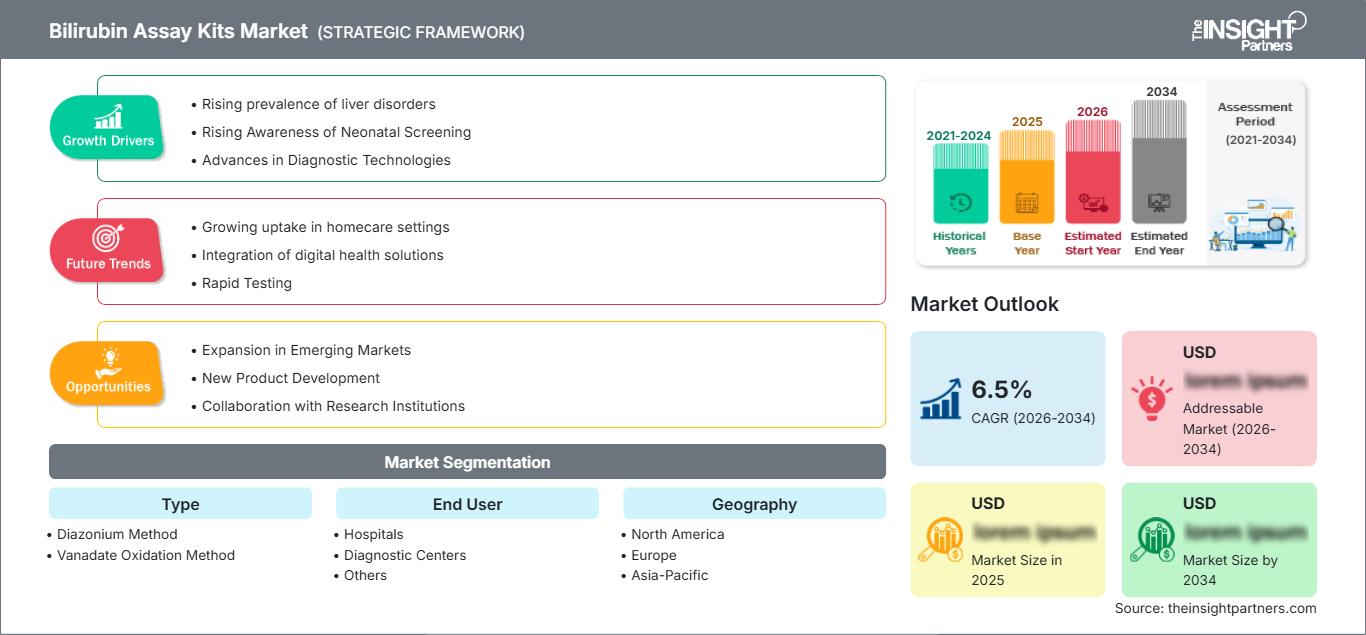
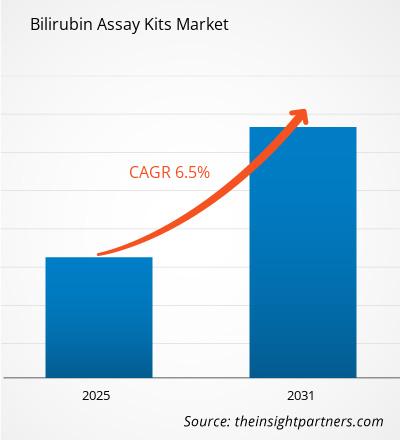
The bilirubin assay kits market was valued at US$ 166.82 Million in 2025 and is projected to reach US$ 329.41 Million by 2034, registering a CAGR of 7.85% during 2026–2034. Market expansion is supported by increasing liver function testing, neonatal jaundice assessment, routine clinical chemistry volumes, and wider diagnostic access. Laboratory automation, analyzer-compatible reagent formats, and demand for reliable total and direct bilirubin measurements are further strengthening recurring kit consumption.
North America represents an established diagnostic testing environment, with the bilirubin assay kits market size expected to expand at a CAGR of ~7% through 2034. High clinical chemistry analyzer penetration structured neonatal screening practices, and frequent liver function testing support regional demand. Laboratories are also emphasizing ready-to-use reagents, standardized calibration, quality-control compatibility, and high-throughput workflow integration, creating sustained demand across hospital laboratories and independent diagnostic centers.
Bilirubin Assay Kits Market Assessment and Insights
Regional Outlook
- North America: ~39% of the global bilirubin assay kits market share in 2025 | ~7% CAGR through 2034. Market position: North America holds the leading regional position due to extensive automated laboratory infrastructure, high testing intensity, established reimbursement pathways, and broad availability of direct and total bilirubin assays.
- US: ~84% of North American market revenue in 2025 | ~7% CAGR through 2034. Market position: The US leads North America through its large hospital laboratory network, neonatal care capacity, clinical chemistry automation, and presence of global diagnostic manufacturers and specialized reagent suppliers.
- Europe: ~29% of the global market in 2025 | ~7% CAGR through 2034. Market position: Europe represents a mature market supported by standardized laboratory practices, aging populations, liver disease monitoring, and strong diagnostic manufacturing capabilities, with Germany leading the region.
- Asia Pacific: ~23% of the global market in 2025 | ~10% CAGR through 2034. Market position: Asia Pacific is the fastest-growing region, supported by diagnostic laboratory expansion, local reagent manufacturing, increasing healthcare access, and growing testing volumes in China, Japan, India, and South Korea.
Segment Outlook
- Diazonium Method: ~64% Share in 2025 | ~7% CAGR through 2034. Market position: The method leads because of its established laboratory acceptance, compatibility with routine chemistry analyzers, broad supplier availability, and suitability for direct and total bilirubin measurement.
- Diagnostic Centers: ~36% Share in 2025 | ~9% CAGR through 2034. Market position: Diagnostic centers are expanding rapidly as outsourced testing, laboratory chains, preventive health packages, and decentralized clinical chemistry services increase test throughput and reagent consumption.
Competitive Coverage
Randox Laboratories Ltd., Roche Diagnostics, Siemens Healthineers AG, Merck KGaA, Pointe Scientific, Inc., Reckon Diagnostics Pvt. Ltd., Abcam plc, Cell Biolabs, Inc., PromoCell GmbH, Abnova Corporation
Methodology
The Insight Partners follows Data Collection & Secondary Research, Primary Research, Data Analysis, and Data Triangulation & Final Review to validate market estimates and insights.
Source: The Insight Partners' analysis based on proprietary research, government publications, company annual reports, investor presentations, industry databases, and expert interviews.
From manual techniques in colorimetry, the bilirubin assay kits market has developed into liquid-stable, analyzer-ready reagents. The trend favors the use of reagents that cut down preparation time and increase workflow uniformity. Manufacturers continue to develop kits that meet the requirements of automated and semi-automated clinical chemistry analyzers while supplying different pack sizes for labs with varying capacities. Manufacturing considerations have thus moved towards developing reagents with increased stability, low lot-to-lot variability, traceability in calibration, interference management, and open-channel capability. Such reagents allow laboratories to handle hemolytic, lipemic, and neonatal samples while controlling re-test and wastage of reagents.
The emphasis for financing until 2034 is going to be on production and distribution scale up, as well as the affordability of the kits in the diagnostic networks that have just emerged. The coverage expansion, along with the development of public laboratories in the Asia Pacific, Latin America, and the Middle East, will increase the customer base for such products. There will be an emphasis on consistency on the part of regulators through their standards for analytical performance, labeling, quality systems, and post-market surveillance.
Bilirubin Assay Kits Market Report Scope
| Report Attribute | Details |
|---|---|
| Market size in 2025 | US$ 166.82 Million |
| Market Size by 2034 | US$ 329.41 Million |
| Global CAGR (2026 - 2034) | 7.85% |
| Historical Data | 2021-2024 |
| Forecast period | 2026-2034 |
Bilirubin Assay Kits Market Analysis
Bilirubin test kits market growth is mainly attributed to the need for the analysis of bilirubin that is performed in liver function profiles, newborns, and patients with hepatic diseases. The demand comes from hospitals and diagnostic centers to the reagent suppliers, analyzers, raw material suppliers, quality control companies, and kit producers. Suppliers who offer calibrators, controls, applications, and technical support along with reagents will be able to maintain customers, since laboratories evaluate the entire procedure instead of the price of reagents only.
Supply chain in the bilirubin assay kits market will rely on reliable delivery of chemical reagents, correct formulation, packaging, need for cold chain, and validation of the batch. High throughput laboratories prefer larger packages for their analyzers, while smaller labs need small volume packages that would reduce waste due to expiration dates. Open channel kits have more access to instruments, but platform kits have easy loading and standardization of performance.
The bilirubin assay kit market analysis reveals competition in analytical accuracy, automation compatibility, stability, speed, and reach of distribution channels. Roche Diagnostics and Siemens Healthineers AG will be benefited by their integrated analyzer ecosystems. Randox Laboratories Ltd., Pointe Scientific, Inc., and Reckon Diagnostics Pvt. Ltd. cater to laboratories looking for options in reagent flexibility. Merck KGaA, Abcam plc, Cell Biolabs, Inc., PromoCell GmbH, and Abnova Corporation provide services through laboratory reagents, assay materials, and research products.
Key investments focus on formulation stability, interference-free chemistry, improved quality controls, and regional manufacturing. Market positioning is varied according to different customer groups. The integrated providers can offer bundled instrument, maintenance, software, and consumables. Independent providers can offer open system compatibility, smaller packaging, and economical sourcing. The companies providing cross-platform performance and good technical support have the competitive advantage.
● REPORT CUSTOMIZATION
Tailor This Report To Align With Your Specific Business Requirements
This report can be customized to align precisely with your business objectives, scope, and target markets. Customization options include tailored segmentation, geography, competitive analysis, and strategic insights to support informed decision-making.
Customize This Report →WHAT YOU CAN ADJUST
- ● Segmentations
- ● Geography
- ● Competitive Analysis
- ● Language Preferences
Bilirubin Assay Kits Market: Strategic Insights
Regional Insights
North America bilirubin assay kits market
North America accounted for ~39% of global revenue in 2025 and is projected to register a ~7% CAGR through 2034. Bilirubin test kits’ market share relies on high demand for automatic clinical chemistry analyzers, well-developed hospital laboratories, and repeat testing related to liver function evaluation and pediatric patients. The reagents are often chosen due to their stability and ability to integrate with the existing analyzer system.
Centralized laboratories in Canada, as well as structured diagnostics in hospitals, provide advantages for this market, while Mexico offers potential for development via building private laboratories and increasing accessibility of automatic chemistry testing. When making a decision, one takes into account such parameters as cost-effectiveness per reported test, reagent stability, staffing, and waste management.
U.S. bilirubin assay kits market
The US represented ~84% of North American revenue in 2025 and is expected to expand at a ~7% CAGR through 2034. Its market positioning is due to its large base of automatic chemistry analysers, extensive network of hospitals and laboratories, as well as the incorporation of bilirubin in hepatic panels. Other sources of testing demands include emergency medicine, oncology surveillance, neonatal intensive care, gastroenterology, and drug-induced hepatotoxicity.
In integrated laboratory settings, the market offerings of Roche Diagnostics and Siemens Healthineers AG are applicable. On the other hand, Randox Laboratories Ltd. and Pointe Scientific, Inc. can supply laboratories that require alternative reagents. Purchase considerations include analytical specificity, turnaround time, calibration frequency, onboard stability, and services. Laboratory consolidation has made high volume packs of reagents more advantageous; nevertheless, physician-office laboratories and regional diagnostic centres still generate demands for small packs.
Europe bilirubin assay kits market
Europe generated ~29% of the revenue in the bilirubin assay kits market in 2025 and is projected to grow at a ~7% CAGR through 2034. The demand is based on the universal or wide healthcare system, the network of hospitals’ laboratories and the procedures for the testing by clinical chemistry. There are high standards regarding the performance, documentation, quality management and reagent traceability for in vitro diagnostics, which encourage manufacturers to spend their money on standard production and post-market data collection.
Germany is the leader among European countries due to the advanced diagnostic infrastructure, numerous hospitals and the presence of the well-known companies in the field of life sciences and medical technologies. UK relies on the demand from the laboratory network in the public sector and its centralized purchasing system. In France, there is hospital testing and private laboratory groups.
More and more European laboratories are considering environmental performance as well as analytical performance in their evaluation process. Decreasing the amount of packaging, increased stability of reagents, efficient loading of analyzers, and reduced re-testing can all have an impact on tendering procedures. Competition thus not only includes assay performance but also distribution security, instrument integration, technical service, and laboratory sustainability. Vendors that can cater to both central high throughput labs and regional labs with different packaging options have an advantage.
APAC bilirubin assay kits market
Asia Pacific accounted for ~23% of global revenue in 2025 and is forecast to register a ~10% CAGR through 2034, making it the fastest-growing region. China is the leading country in Asia Pacific, supported by its large hospital system, domestic reagent manufacturing base, and continued expansion of clinical laboratory capacity.
Testing in Japan is focused on automated testing and workflows of superior quality, while in South Korea the advantage lies in technologically advanced hospital laboratories. In India, good volume opportunity exists via chains of diagnostics, kit production, and increased biochemistry tests. In Australia, the laboratory infrastructure is highly developed with uniform quality standards. Localization, public health spending, and increased analyzer penetration are increasing accessibility outside major cities in the region.
Middle East & Africa bilirubin assay kits market
The Middle East & Africa market is expected to expand at a ~8% CAGR through 2034. Saudi Arabia is positioned as the leading country in the Middle East & Africa, supported by hospital construction, laboratory modernization, and investment in domestic healthcare capabilities. The UAE also provides opportunities through private hospitals, diagnostic centers, and medical tourism-related infrastructure.
South Africa boasts relatively advanced laboratory infrastructure and serves as a major distribution hub for nearby regions. Within other parts of the region, usage is not evenly distributed since the availability of analyzers, reagents, human resource capabilities, and healthcare funding varies greatly. Companies providing consistent products, suitable packaging, distribution training, and adequate regional stock can resolve the issues.
Segmentation Analysis
Type
Type is central to the bilirubin assay kits market scope because methodology affects analytical workflow, interference handling, analyzer compatibility, and laboratory purchasing. Adoption depends on established protocols, sample characteristics, throughput, reagent preparation, and required performance. The leading method is expected to register a ~7% CAGR during 2026–2034, supported by familiarity and broad commercial availability. Alternative chemistry is gaining relevance where laboratories require simplified processing or improved handling of challenging specimens.
- Diazonium Method: This method retains broad acceptance in routine clinical chemistry because laboratories are familiar with diazo-based bilirubin measurement and suppliers provide formats suited to manual, semi-automated, and automated systems.
- Vanadate Oxidation Method: Vanadate oxidation kits offer strategic value for laboratories seeking reduced interference and streamlined processing, particularly when handling pediatric, hemolytic, or lipemic specimens requiring dependable photometric performance.
End User
End-user demand reflects testing volume, analyzer capacity, procurement structure, and clinical workflow. Hospitals remain the principal users because bilirubin testing supports inpatient, emergency, neonatal, and specialist care. Diagnostic networks are increasing their consumption as outsourced testing and preventive packages expand. The fastest-growing end-user category is projected to advance at a ~9% CAGR during 2026–2034, driven by laboratory consolidation, wider geographic coverage, and investment in automated chemistry platforms.
- Hospitals: Hospital laboratories perform recurring bilirubin measurements across neonatal care, hepatology, emergency medicine, oncology, and general inpatient services, favoring high-throughput kits with consistent calibration and dependable turnaround.
- Diagnostic Centers: Independent and chain laboratories prioritize scalable reagent packs, analyzer compatibility, low wastage, and competitive cost per test as centralized processing and sample collection networks increase testing volumes.
- Others: Academic laboratories, research institutes, specialty clinics, veterinary facilities, and smaller testing environments create diversified demand for flexible kit sizes, manual compatibility, and specialized assay configurations.
Opportunity Snapshot
| End Users | Revenue Contribution | Trend Tag | Adoption Stage |
| Hospitals | High | Automated Panels | Mature |
| Diagnostic Centers | High | Network Expansion | Scaling |
| Others | Low | Flexible Formats | Emerging |
Bilirubin Assay Kits Market Growth Drivers and Impact Analysis
Rising Clinical Need for Liver Function Assessment
Bilirubin measurement remains a routine component of hepatic assessment because abnormal values can support evaluation of hepatocellular dysfunction, bile-flow obstruction, hemolysis, and treatment-related effects. Growth in metabolic liver disorders, viral hepatitis management, alcohol-related disease, and medication monitoring increases the number of patients requiring initial and repeat testing. The impact extends beyond specialist hepatology departments because bilirubin is frequently ordered through emergency, oncology, general medicine, and preoperative workflows. This broad clinical utility creates recurring rather than one-time reagent demand. Manufacturers benefit when kits can be integrated into multiparameter chemistry workflows without additional instrumentation, while laboratories gain from consolidated sample handling and reporting.
Expansion of Neonatal Jaundice Testing
Newborn bilirubin assessment creates a clinically important demand base because timely measurement assists healthcare professionals in evaluating hyperbilirubinemia and determining whether additional monitoring is needed. Hospitals require assays that perform consistently at low sample volumes and across neonatal concentration ranges. Demand is particularly relevant to maternity hospitals, neonatal intensive care units, pediatric laboratories, and referral centers. As institutional childbirth and neonatal care capacity expand in emerging economies, more facilities are expected to formalize bilirubin testing protocols. Kit suppliers can strengthen adoption through pediatric-suitable methods, clear interference data, compatible quality controls, and pack sizes aligned with maternity unit throughput.
Automation and Expansion of Clinical Chemistry Networks
Automated clinical chemistry systems increase testing capacity while reducing manual reagent preparation and operator variability. As laboratories consolidate, their procurement shifts toward liquid-ready reagents, barcoded packs, longer onboard stability, and application-specific settings. This transition directly supports recurring assay kit consumption because bilirubin testing can be processed alongside other routine chemistry parameters. Diagnostic chains also extend sample collection into secondary cities, increasing the number of specimens routed to centralized laboratories. Suppliers that demonstrate compatibility across multiple analyzer brands can access diverse installed bases, while dedicated-system vendors can use integrated consumables and service contracts to secure predictable customer relationships.
Bilirubin Assay Kits Market Future Trends
Interference-Resistant and Sample-Efficient Assay Chemistry
Future bilirubin assay kits market trends will emphasize improved performance with hemolytic, lipemic, icteric, pediatric, and limited-volume specimens. Manufacturers are expected to refine chemistry, blanking procedures, calibrators, and quality-control materials to reduce repeat testing and inconclusive results. Sample efficiency will become increasingly valuable in neonatal and pediatric settings, where available blood volume is constrained. Assays that combine broader analytical ranges with stable liquid formats can also reduce manual dilution and preparation. Competitive differentiation will therefore move beyond basic bilirubin detection toward reproducibility under difficult sample conditions, documented interference resistance, and consistent transferability across analyzer platforms.
Digital Connectivity and Sustainable Reagent Design
Laboratory procurement will increasingly consider digital traceability and environmental impact. Barcoded reagents, automated lot recognition, remote inventory monitoring, and middleware connectivity can improve stock control and reduce expired kits. At the same time, laboratories are assessing packaging volume, cold-chain intensity, hazardous material handling, analyzer energy use, and waste per reportable result. Manufacturers may respond with concentrated formulations, recyclable packaging, optimized pack sizes, and longer shelf life. These changes can support sustainability targets while lowering operational costs, particularly for consolidated laboratories processing large sample volumes. Digital and environmental attributes are likely to become tender differentiators alongside analytical performance.
Bilirubin Assay Kits Market Opportunities
Localized Products for Emerging Diagnostic Networks
Emerging markets present opportunities for regional manufacturing, private-label partnerships, and distributor-supported product portfolios. The bilirubin assay kits market Forecasts indicate attractive potential where hospital construction, diagnostic chain expansion, and installation of semi-automated and automated chemistry analyzers increase test accessibility. Companies can address these markets with temperature-tolerant formulations, smaller packs, multilingual instructions, practical controls, and compatibility with widely installed open systems. Local production or final assembly may reduce import dependence and shorten replenishment cycles. Investment should be paired with technical training and application support because laboratories often operate mixed analyzer fleets and require method verification before switching suppliers.
Portfolio Expansion Through Integrated Testing Solutions
Suppliers can move beyond standalone reagents by offering direct and total bilirubin kits with calibrators, controls, analyzer applications, and complementary liver function assays. Bundled portfolios simplify procurement for hospitals and diagnostic centers while increasing supplier relevance across the clinical chemistry workflow. Product planning should prioritize differentiated pack sizes, neonatal-use performance, interference management, and open-channel adaptability. Partnerships with analyzer distributors can extend commercial reach without requiring proprietary instrumentation. Companies can also develop customer-specific configurations for high-volume laboratory groups, linking reagent supply with quality monitoring, training, and inventory planning to create more durable revenue relationships.
Recent Developments
- July 2025: Siemens Healthineers AG announced that its Atellica analyzers and more than 150 clinical chemistry and immunoassay reagents had received My Green Lab ACT Ecolabel certification. The development supports increasing laboratory attention to manufacturing practices, energy and water consumption, chemical use, waste, and packaging when selecting analyzer-reagent systems.
- July 2025: Randox Laboratories Ltd. published an updated diagnostic reagent portfolio presenting more than 100 assays, multiple formats, open-channel analyzer applications, liquid-ready reagents, and flexible kit sizes. The portfolio includes bilirubin reagents and supports laboratories seeking to expand clinical chemistry menus without purchasing dedicated equipment.
- June 2024: Roche Diagnostics launched the cobas c 703 and cobas ISE neo analytical units for cobas pro integrated solutions in CE-mark accepting markets. The cobas c 703 offers up to 2,000 clinical chemistry tests per hour and 70 reagent positions, expanding the infrastructure available for high-volume routine chemistry assays.
Frequently Asked Questions

- Comprehensive Market Sizing and Forecast Analysis
- Detailed Segmentation Analysis
- In-Depth Market Dynamics Assessment
- Regional and Country-Level Insights
- Competitive Landscape and Company Benchmarking
- Strategic Business Intelligence
Recent Reports
Testimonials

The Insight Partners provided valuable market intelligence that supported our global go-to-market strategy. Their team was professional, responsive, and attentive to our feedback, providing thoughtful analysis and helpful methodological clarifications throughout the project.
Junmo Kim Chief Financial Officer (CFO), Enertech Co., Ltd.
The Insight Partners' SCADA System Market report is comprehensive, with valuable insights on current trends and future forecasts. The team was highly professional, responsive, and supportive throughout. We are very satisfied and highly recommend their services.
RAN KEDEM Partner, Reali Technologies LTDs
I requested a report on a very specific software market and the team produced the report in a few days. The information was very relevant and well presented. I then requested some changes and additions to the report. The team was again very responsive and I got the final report in less than a week.
JEAN-HERVE JENN Chairman, Future Analytica
We worked with The Insight Partners for an important market study and forecast. They gave us clear insights into opportunities and risks, which helped shape our plans. Their research was easy to use and based on solid data. It helped us make smart, confident decisions. We highly recommend them.
PIYUSH NAGPAL Sr. Vice President, High Beam Global
The Insight Partners delivered insightful, well-structured market research with strong domain expertise. Their team was professional and responsive throughout. The user-friendly website made accessing industry reports seamless. We highly recommend them for reliable, high-quality research services
YUKIHIKO ADACHI CEO, Deep Blue, LLC.
This is the first time I have purchased a market report from The Insight Partners.While I was unsure at first, I visited their web site and felt more comfortable to take the risk and purchase a market report.I am completely satisfied with the quality of the report and customer service. I had several questions and comments with the initial report, but after a couple of dialogs over email with their analyst I believe I have a report that I can use as input to our strategic planning process.Thank you so much for taking the extra time and making this a positive experience.I will definitely recommend your service to others and you will be my first call when we need further market data.
JOHN SUZUKI President and Chief Executive Officer, Board Director, BK Technologies
I wish to appreciate your support and the professionalism you displayed in the course of attending to my request for information regarding to infectious disease IVD market in Nigeria. I appreciate your patience, your guidance, and the fact that you were willing to offer a discount, which eventually made it possible for us to close a deal. I look forward to engaging The Insight Partners in the future, all thanks to the impression you have created in me as a result of this first encounter.
DR CHIJIOKE ONYIA MANAGING DIRECTOR, PineCrest Healthcare Ltd.Reason to Buy
- Informed Decision-Making
- Understanding Market Dynamics
- Competitive Analysis
- Identifying Emerging Markets
- Customer Insights
- Market Forecasts
- Risk Mitigation
- Boosting Operational Efficiency
- Strategic Planning
- Investment Justification
- Tracking Industry Innovations
- Aligning with Regulatory Trends





 Get Free Sample for