
Bio-Based Foam Market Growth, Trends & Forecast by 2034
Bio-Based Foam Market Size and Forecasts (2021 - 2034), Global and Regional Share, Trends, and Growth Opportunity Analysis Report Coverage : by Raw Material (Soy, Corn, Sugarcane); Type (Rigid and Flexible); End-Use Industry (Building and Construction, Packaging, Automotive, Furniture and Bedding, Footwear and Sports); and Geography (North America, Europe, Asia Pacific, and South and Central America)
- Status : Data Released
- Report Code : TIPRE00040455
- Category : Chemicals and Materials
- No. of Pages : 150
- Available Report Formats :


- Last update date : August 28, 2026


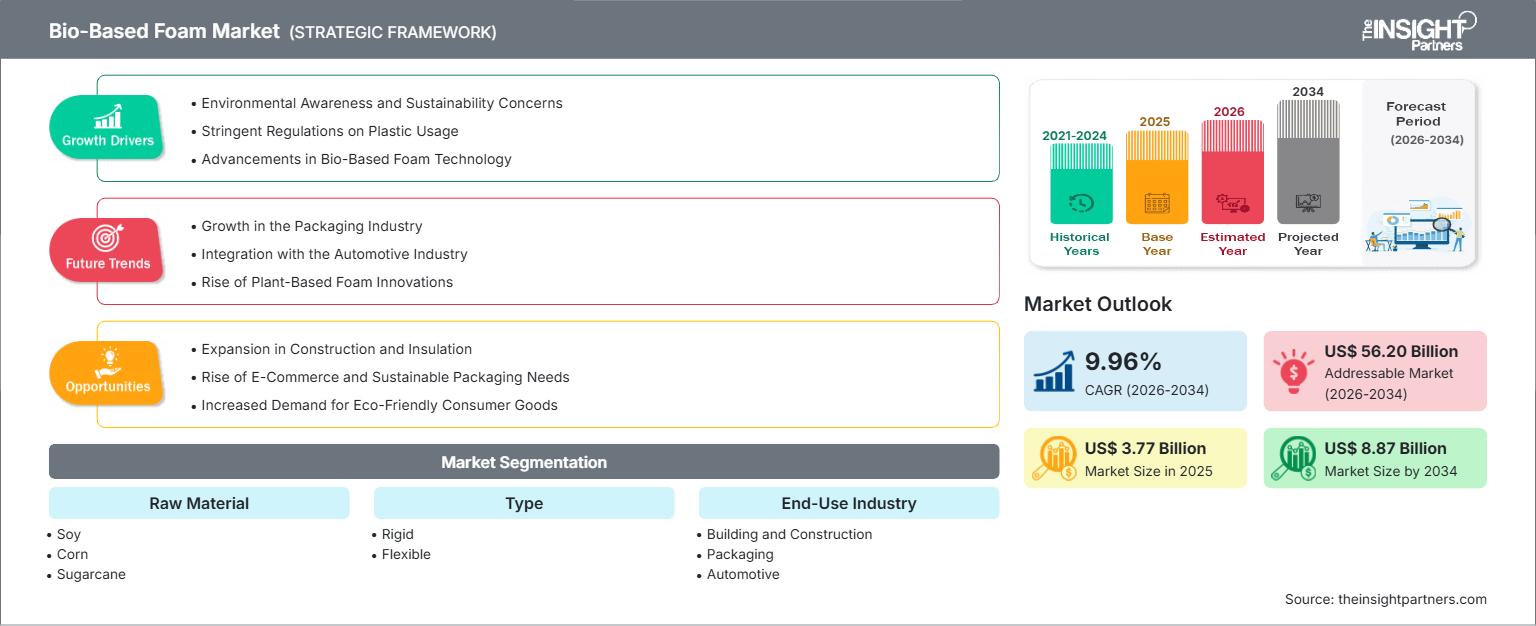
2025 Market Size
US$ 3.77 Bn
Base year value
2034 Forecast
US$ 8.87 Bn
Projected by 2034
CAGR 2026-2034
9.96 %
Growth rate
Addressable Market
US$ 56.20 Bn
(2026-2034)
The Bio-Based Foam Market is gaining industrial relevance as manufacturers shift toward renewable feedstocks and lower-carbon material systems. The market size is estimated at US$ 3.77 Billion in 2025 and is anticipated to be US$ 8.87 Billion by 2034, representing a CAGR of 9.96% between 2026 and 2034 due to growing adoption of renewable-based products as a substitute for petroleum-based foams in various end-use industries.
The North American region will continue to enjoy a robust position on account of sustainable purchasing trends, renewable content initiatives, and automotive lightweighting. The Bio-Based Foam Market size outlook remains promising considering increased use of bio-based polyols, renewable polymer systems, and ease of processing alongside polyurethane, polyethylene, and EVA foam production processes.
Bio-Based Foam Market Assessment and Insights
- North America: North America is estimated to hold a 27–31% share in 2025 and is projected to grow at a CAGR of 9.1–9.8% between 2026 and 2034, supported by automotive lightweighting, sustainable packaging, and renewable-material adoption.
- U.S.: The U.S. is estimated to represent 74–78% of North America's 2025 demand, expanding at a CAGR of 9.3–10.0% during 2026–2034 as manufacturers increase renewable-content formulations and sustainable insulation applications.
- Europe: Europe is estimated to account for a 29–33% share in 2025 and grow at a CAGR of 9.7–10.4%, led by Germany, the UK, France, Italy, and Spain, supported by circular-material policies and packaging sustainability requirements.
- Asia Pacific: Asia Pacific is estimated at a 25–29% share in 2025 and is expected to register a CAGR of 10.5–11.3%, with China, Japan, India, and South Korea benefiting from expanding automotive, packaging, construction, and consumer-product manufacturing.
- Largest Segment: Flexible foam is estimated to hold a 54–58% market share in 2025 and grow at a CAGR of 10.0–10.6%, reflecting broad cushioning and interior applications.
- High Growth Segment: Automotive is estimated to hold a 20–24% market share in 2025 and expand at a CAGR of 10.5–11.2%, driven by lightweighting and lower-carbon interiors.
- Key companies analyzed in detail: BASF SE, Huntsman Corporation, Cargill, Incorporated, Stora Enso Oyj, Braskem S.A., Woodbridge Foam Corporation, BEWI ASA, INOAC Corporation, Trocellen GmbH, Sealed Air Corporation.
Source: The Insight Partners' analysis based on proprietary research, government publications, company annual reports, investor presentations, industry databases, and expert interviews.
The trend in material development is going from bio-polyol partial replacement towards developing materials which use both renewable feedstocks and foam technologies. Manufacturers are optimizing cell structure, resilience, insulative properties, cushioning capacity, and dimensional stability while maintaining compatibility with current converting equipment. The range of feedstocks includes sugarcane-based intermediates, soy-based polyols, cellulose fibers, and polymers made using renewable content. This trend is increasing the commercial viability of material solutions in packaging, automotive interiors, construction insulation, furniture cushioning, and footwear.
Increasing emphasis on investments will be put into feedstock conversion capabilities, certified renewable content, and specific application performance. Europe will continue to have an impact on regulation, but the Asia-Pacific region will reap the benefits of production growth and increased material localization. North America will benefit from renewable content supply chain and automotive applications. Technology suppliers with low carbon intensity, recyclability, durability, and economic processing cost will be able to win more customers until 2034.
Bio-Based Foam Market Report Scope
| Report Attribute | Details |
|---|---|
| Market size in 2025 | US$ 3.77 Billion |
| Market Size by 2034 | US$ 8.87 Billion |
| Global CAGR (2026 - 2034) | 9.96% |
| Historical Data | 2021-2024 |
| Forecast period | 2026-2034 |
Bio-Based Foam Market Analysis
The potential of Bio-Based Foam Market growth is reinforced by the value chain encompassing the feedstocks, bio-based intermediates, polymers manufacturers, foam formulators, converters, and end-users. The availability and ease of conversion of the feedstocks affect their competitiveness in terms of cost while the application needs define the renewable content potential. The manufacturers try hard to optimize the performance of feedstocks, enhance compatibility with foam equipment, and ensure consistent results.
Feedstock supply varies depending on the feedstock types and geographical location. Sugarcane feedstock has a competitive advantage in terms of the already existing agricultural processing facilities. Soy and corn feedstocks give access to the developed agriculture supply chain. Cellulosic feedstocks give yet another option for protective packaging. The manufacturer should take into account seasonality of the feedstocks, agricultural competition, logistics, feedstock certification process, and processing costs.
Bio-Based Foam Market Report highlights a competitive market that is composed of major chemical companies, polymers, renewable materials, and foams. BASF SE and Huntsman Corporation add their formulation capabilities and polyurethane knowledge; Braskem S.A. adds its capabilities of renewable polymers. Cargill, Incorporated, brings its feedstock and bio-based chemical capabilities, while Stora Enso Oyj offers its cellulose foam applications for packaging.
The strategic positioning is now increasingly shifting towards application qualification and not only renewable content. Woodbridge Foam Corporation is focused on the automotive foam applications, whereas INOAC Corporation and Trocellen GmbH offer applications in specialized foam systems. BEWI ASA and Sealed Air Corporation offer packaging and insulation applications access. The competitive investments are thus made into the scalable production, customer tests, life cycle assessment, certification of the renewable content, and material improvement.
● REPORT CUSTOMIZATION
Tailor This Report To Align With Your Specific Business Requirements
This report can be customized to align precisely with your business objectives, scope, and target markets. Customization options include tailored segmentation, geography, competitive analysis, and strategic insights to support informed decision-making.
Customize This Report →WHAT YOU CAN ADJUST
- ● Segmentations
- ● Geography
- ● Competitive Analysis
- ● Language Preferences
Bio-Based Foam Market: Strategic Insights
Regional Insights
North America Bio-Based Foam Market
North America is expected to contribute 27-31% to the Bio-Based Foam Market share in 2025 and is expected to grow at a CAGR of 9.1-9.8% until 2034. North America enjoys favorable conditions in terms of polyurethane production, advanced automotive production, sustainability in packaging, and corporate carbon reduction goals. The USA continues to be the key country owing to its investments in renewable content materials and light weight vehicle parts. Canada offers through its packaging, construction materials and biomaterials from resources. Mexico gains from its automotive manufacturing industry.
Increasing focus will be on applications that enable performance and sustainability without requiring significant changes in the equipment. Automotive seating, headliners, insulation, protective packaging, and furniture cushioning offer practical means for adopting bio-based foams. Mass balance approach and use of renewable raw material will gain increasing importance for regional producers. Availability of the supply is critical as the bio-based intermediates need to compete with petroleum-based intermediates with respect to cost and processability.
USA Bio-Based Foam Market
It is anticipated that the United States will occupy the share of 74–78% of North American market in 2025 and will maintain a CAGR of 9.3-10.0% till 2034. Application channels include automotive interiors, construction insulation, protective packaging, and furniture. The presence of companies such as BASF SE, Huntsman Corporation, Woodbridge Foam Corporation, and Sealed Air Corporation ensures the availability of advanced foam technology and sustainable materials.
Increasingly, the application trends are shifting towards minimizing carbon footprint of the product, inclusion of renewable materials, light-weighting, and compatibility with existing processing systems. Automotive companies have an option to replace polyols with bio-polyols in seating and other interior applications without redesigning the platforms, whereas packaging companies are exploring renewable and recyclable cushioning systems. The benefits of construction applications include the need for insulation and environment-friendly materials.
Europe Bio-Based Foam Market
It is expected that Europe would account for 29–33% of worldwide demand in 2025 and would experience growth in CAGR of 9.7–10.4%, which would make it one of the most advanced adoption regions. The leading national market is that of Germany due to its automotive production, know-how regarding industrial materials and innovations in the packaging industry. The UK, France, Italy and Spain are contributing to adoption through construction, consumer goods, furniture, automotive and packaging applications.
The UK market focuses on sustainable packaging and construction materials where the purchasing processes are becoming more sensitive to recyclability and renewable raw materials. Germany is benefiting from automotive engineering combined with advanced manufacturing of polymers and foams, creating great opportunities for interior and insulation applications. France, Italy and Spain have their markets driven by packaging, furniture, footwear, construction and automotive applications.
APAC Bio-Based Foam Market
APAC is projected to contribute 25-29% to world consumption in 2025 with a growth rate of CAGR 10.5-11.3%. China is the largest consumer in APAC region, whereas demand is coming from Japan, South Korea, India, and Australia as well. Applications include automotive production, electronics packaging, construction, footwear, furniture, etc. In the APAC region, resource utilization and low-carbon materials gain importance in industrial policies.
The country of China has advantages in manufacturing capacity and infrastructure in polymer processing. Japan and South Korea focus on advanced material properties and automotive applications and technology developments. The country of India is more suitable for fast growth due to packaging, automotive, construction, and manufacture of consumer products. Australia is another country providing demand in sustainable construction and packaging applications.
Middle East & Africa Bio-Based Foam Market
It is predicted that the Middle East & Africa region will grow with a CAGR of 8.4%-9.2% until 2034. The industrial platform for the Middle East & Africa region is provided by Saudi Arabia & the UAE, whereas South Africa contributes by way of packaging, automotive, construction, and consumer applications. The other parts of MEA are comparatively fragmented, and the adoption of bio-based chemicals is driven by imported raw materials, processing capability, and sustainability initiatives.
The strategies for energy diversification give rise to the potential for producing bio-based chemicals and conversion of these chemicals into materials. The infrastructure for the production of chemicals is already present in Saudi Arabia & the UAE, which makes it possible for them to follow a hybrid pathway. South Africa offers access to automotive and packaging manufacturing. The infrastructure development of the region is bound to raise the demand for insulation and protective materials.
Segmentation Analysis
Raw Material
The Raw Material segment is projected to expand at a 9.5–10.2% CAGR during 2026–2034. Feedstock selection directly affects cost, carbon profile, processing consistency, and formulation performance. The Bio-Based Foam Market scope covers soy, corn, and sugarcane feedstocks, each offering different advantages in renewable-carbon availability, processing compatibility, and supply-chain integration.
- Soy: Soy-based inputs support polyurethane foam formulations where renewable polyol substitution is required. Their established agricultural availability and compatibility with existing processing systems make them relevant for automotive, furniture, bedding, and cushioning applications.
- Corn: Corn-based feedstocks provide a scalable agricultural source for bio-derived intermediates. Demand is supported by established processing infrastructure, although producers must balance industrial applications with food, feed, and other agricultural uses.
- Sugarcane: Sugarcane provides strong potential for bio-based foam production because established fermentation and chemical-conversion pathways can generate renewable intermediates. Its strategic relevance is particularly high where producers seek scalable, lower-carbon polymer inputs.
Type
Type segmentation in the Bio-Based Foam Market is shaped by application-specific requirements for flexibility, resilience, insulation, cushioning, and structural stability. Flexible foam is estimated to remain the larger category, with the segment projected to expand at a CAGR of 10.0–10.6% during 2026–2034. Rigid systems remain important for insulation and protective applications.
- Rigid: Rigid foam is strategically important for construction insulation, protective packaging, and applications requiring dimensional stability. Adoption depends on thermal performance, mechanical strength, moisture resistance, and compatibility with building or packaging specifications.
- Flexible: Flexible foam serves seating, bedding, automotive interiors, cushioning, footwear, and packaging applications. Its adaptability, resilience, lightweight structure, and established conversion processes support broader commercial deployment across consumer and industrial product categories.
End-Use Industry
End-Use Industry segment in the in the Bio-Based Foam Market is driven by applications where renewable content can be integrated while maintaining performance. The segment is projected to grow at a CAGR of 9.8–10.5% during 2026–2034. Automotive is positioned as a high-growth application because lightweighting and lower-carbon interior materials increasingly influence material selection.
- Building and Construction: Demand centers on insulation and lightweight systems requiring thermal efficiency, dimensional stability, and improved environmental performance. Bio-based content can support material decarbonization objectives where technical and fire-performance requirements are satisfied.
- Packaging: Protective packaging is adopting renewable and recyclable foam alternatives for cushioning, void fill, thermal insulation, and product protection. E-commerce and sustainability requirements strengthen opportunities for material substitution.
- Automotive: Automotive manufacturers use foam for seating, headrests, headliners, acoustic systems, and interior components. Renewable-content foams can reduce reliance on fossil feedstocks while maintaining lightweighting and comfort requirements.
- Furniture and Bedding: Furniture and bedding applications rely heavily on resilient, flexible foams. Bio-based formulations offer manufacturers a route toward renewable-content products without changing core cushioning functions or consumer-use characteristics.
- Footwear and Sports: Footwear and sports products require lightweight, resilient, flexible cushioning. Renewable EVA and polyurethane foam technologies can support lower-fossil-content products while retaining comfort, energy return, and durability requirements.
Opportunity Snapshot
| Application | Revenue Contribution (High/Medium/Low) | Trend Tag | Adoption Stage |
|---|---|---|---|
| Building and Construction | Medium | Green Insulation | Scaling |
| Packaging | High | Fiber Cushioning | Scaling |
| Automotive | High | Lightweight Interiors | Scaling |
| Furniture and Bedding | Medium | Bio Cushioning | Scaling |
| Footwear and Sports | Medium | Renewable EVA | Emerging |
Bio-Based Foam Market Growth Drivers and Impact Analysis
Rising demand for lower-carbon insulation and cushioning materials
Construction, automotive, furniture, bedding, and packaging manufacturers are increasingly evaluating materials according to carbon intensity as well as performance. Bio-based foams can reduce dependence on fossil feedstocks when renewable inputs replace part of conventional polymer chemistry. This creates demand for formulations that preserve thermal insulation, cushioning, resilience, and dimensional stability. The commercial impact is strongest where customers can integrate renewable-content materials without redesigning production equipment. Automotive suppliers can introduce bio-polyol substitution into established seating and interior platforms, while packaging producers can evaluate renewable cushioning against conventional PE and EPS. Over time, these application-level qualifications can create recurring demand for certified feedstocks and standardized foam systems, strengthening the market's transition from niche sustainability projects toward broader industrial procurement.
Expansion of sustainable protective packaging applications
Packaging represents a significant adoption pathway because manufacturers face increasing pressure to reduce fossil-based protective materials while maintaining product safety during transportation. Bio-based foam can address cushioning, impact protection, insulation, and lightweighting requirements in electronics, appliances, medical products, furniture, and e-commerce shipments. The commercial effect extends beyond material substitution because packaging redesign can reduce material consumption and improve recyclability. Cellulose-based foam solutions demonstrate how renewable fibers can enter applications traditionally served by polymer foams. Manufacturers are therefore assessing total packaging-system performance rather than focusing solely on individual material properties. Continued growth in parcel shipments, premium product protection, and circular packaging requirements should increase qualification activity. Suppliers able to demonstrate repeatable quality, scalable conversion, and end-of-life compatibility will have stronger opportunities to secure long-term packaging programs.
Automotive lightweighting and renewable-content integration
Automotive manufacturers are pursuing weight reduction, improved energy efficiency, lower embodied carbon, and differentiated interior materials. Foam systems are relevant to seats, headrests, headliners, trim components, acoustic systems, and energy-absorbing structures. Bio-based formulations provide a pathway to reduce petroleum dependence while retaining established foam-processing methods. The market impact is amplified because vehicle platforms are produced at high volumes, meaning successful material qualification can create substantial recurring consumption. Suppliers are consequently investing in renewable polyols, biomass-balanced feedstocks, and application-specific formulations that satisfy durability, comfort, safety, and thermal requirements. Increasing electric-vehicle production further reinforces lightweighting priorities because lower vehicle mass can support energy efficiency. As automakers and component suppliers expand lifecycle assessment programs, renewable-content foam systems should gain additional consideration in material-selection decisions.
Bio-Based Foam Market Future Trends
Increasing use of certified renewable and circular feedstocks
The Bio-Based Foam Market trends landscape is moving toward greater transparency around feedstock origin, renewable content, carbon accounting, and end-of-life performance. Producers are likely to combine agricultural feedstocks, forestry residues, recycled resources, and biomass-balanced inputs to reduce dependence on virgin fossil materials. Certification and traceability will become increasingly important as customers demand measurable environmental claims rather than broad sustainability statements. Material suppliers are expected to improve chain-of-custody documentation and lifecycle assessment capabilities while developing formulations compatible with existing manufacturing infrastructure. Another emerging direction is hybrid material design, where renewable polymers, recycled content, and fiber-based structures are combined to achieve targeted performance. These developments should broaden procurement criteria from simple bio-content percentages toward total carbon footprint, resource efficiency, recyclability, durability, and verified environmental performance.
Application-specific foam engineering will accelerate commercialization
Future commercialization is expected to rely increasingly on application-specific formulation rather than a single universal renewable foam technology. Automotive suppliers require resilience, comfort, acoustic performance, and dimensional stability, whereas packaging manufacturers prioritize cushioning, recyclability, lightweighting, and conversion efficiency. Construction applications place greater emphasis on thermal insulation, moisture resistance, fire performance, and long-term durability. This differentiation will encourage suppliers to create customized bio-polyol systems, renewable-content EVA grades, cellulose foams, and hybrid structures. Digital modeling and improved process control can shorten formulation development and customer qualification cycles. As performance gaps narrow, manufacturers will increasingly evaluate bio-based foam against conventional materials using total cost, carbon intensity, process compatibility, and end-of-life criteria. This should support broader penetration across established foam value chains.
Bio-Based Foam Market Opportunities
Expansion of renewable insulation solutions in emerging construction markets
Emerging construction markets provide an opportunity for suppliers to introduce renewable-content insulation systems alongside expanding building activity. Developers and material manufacturers can target applications where thermal efficiency, lightweight construction, and improved environmental performance influence purchasing decisions. Investment opportunities include local blending facilities, renewable polyol processing, formulation laboratories, and partnerships with construction-material distributors. Producers can reduce market-entry barriers by adapting established spray, molded, and board-based foam processes rather than creating entirely new production platforms. Regional feedstock partnerships can further improve supply security and reduce logistics exposure. The Bio-Based Foam Market Forecasts indicate that application expansion will depend on successful performance validation, cost competitiveness, and regulatory acceptance. Companies that build technical partnerships with contractors, insulation manufacturers, and building-system designers can accelerate qualification and establish repeat demand.
Development of recyclable cushioning for high-value packaging
High-value electronics, medical equipment, appliances, furniture, and premium consumer products require reliable protection during increasingly complex distribution cycles. This creates opportunities for renewable and recyclable foam alternatives that combine impact resistance with lower environmental burdens. Suppliers can focus on molded or fiber-based cushioning designs that fit paper, board, or compatible recycling streams. Investment should prioritize conversion equipment, protective-performance testing, customer prototyping, and material redesign because renewable foam adoption often requires packaging engineers to modify geometries and protective structures. Strategic partnerships with logistics companies and packaging converters can accelerate commercial validation. The strongest opportunities are likely to emerge where customers face simultaneous pressure to reduce plastic use, protect products, and demonstrate measurable sustainability improvements. Such programs can create scalable demand beyond pilot-stage sustainability initiatives.
Recent Developments
- April 2026: Foamlab B.V. raised €3 million to scale its bio-based foam materials, build a pilot plant, and accelerate commercialization. The company's technology uses bacterial cellulose produced through fermentation to develop renewable foam materials aimed at replacing petroleum-based foams in packaging, consumer products, and industrial applications.
- November 2025: Storopack launched FOAMplus 7008-BIO, a polyurethane packaging foam containing more than 83% real bio-based carbon in its B-component. The material is designed to provide cushioning, blocking, and bracing performance comparable with conventional foam and is compatible with Storopack's existing FOAMplus foam-in-place packaging systems.
- January 2025: Washington State University researchers developed a flexible bio-based polyurethane foam using lignin extracted from pine. The formulation replaces 20% of petroleum-based chemicals while demonstrating strength and flexibility comparable to conventional polyurethane foam. The research team planned further industry collaboration to optimize and scale the technology.
Frequently Asked Questions

- Comprehensive Market Sizing and Forecast Analysis
- Detailed Segmentation Analysis
- In-Depth Market Dynamics Assessment
- Regional and Country-Level Insights
- Competitive Landscape and Company Benchmarking
- Strategic Business Intelligence
Recent Reports
Testimonials

The Insight Partners provided valuable market intelligence that supported our global go-to-market strategy. Their team was professional, responsive, and attentive to our feedback, providing thoughtful analysis and helpful methodological clarifications throughout the project.
Junmo Kim Chief Financial Officer (CFO), Enertech Co., Ltd.
The Insight Partners' SCADA System Market report is comprehensive, with valuable insights on current trends and future forecasts. The team was highly professional, responsive, and supportive throughout. We are very satisfied and highly recommend their services.
RAN KEDEM Partner, Reali Technologies LTDs
I requested a report on a very specific software market and the team produced the report in a few days. The information was very relevant and well presented. I then requested some changes and additions to the report. The team was again very responsive and I got the final report in less than a week.
JEAN-HERVE JENN Chairman, Future Analytica
We worked with The Insight Partners for an important market study and forecast. They gave us clear insights into opportunities and risks, which helped shape our plans. Their research was easy to use and based on solid data. It helped us make smart, confident decisions. We highly recommend them.
PIYUSH NAGPAL Sr. Vice President, High Beam Global
The Insight Partners delivered insightful, well-structured market research with strong domain expertise. Their team was professional and responsive throughout. The user-friendly website made accessing industry reports seamless. We highly recommend them for reliable, high-quality research services
YUKIHIKO ADACHI CEO, Deep Blue, LLC.
This is the first time I have purchased a market report from The Insight Partners.While I was unsure at first, I visited their web site and felt more comfortable to take the risk and purchase a market report.I am completely satisfied with the quality of the report and customer service. I had several questions and comments with the initial report, but after a couple of dialogs over email with their analyst I believe I have a report that I can use as input to our strategic planning process.Thank you so much for taking the extra time and making this a positive experience.I will definitely recommend your service to others and you will be my first call when we need further market data.
JOHN SUZUKI President and Chief Executive Officer, Board Director, BK Technologies
I wish to appreciate your support and the professionalism you displayed in the course of attending to my request for information regarding to infectious disease IVD market in Nigeria. I appreciate your patience, your guidance, and the fact that you were willing to offer a discount, which eventually made it possible for us to close a deal. I look forward to engaging The Insight Partners in the future, all thanks to the impression you have created in me as a result of this first encounter.
DR CHIJIOKE ONYIA MANAGING DIRECTOR, PineCrest Healthcare Ltd.Reason to Buy
- Informed Decision-Making
- Understanding Market Dynamics
- Competitive Analysis
- Identifying Emerging Markets
- Customer Insights
- Market Forecasts
- Risk Mitigation
- Boosting Operational Efficiency
- Strategic Planning
- Investment Justification
- Tracking Industry Innovations
- Aligning with Regulatory Trends





 Get Free Sample for