Biodegradable Pharmaceutical Packaging Market Size & Overview
The biodegradable pharmaceutical packaging market was valued at US$ 163.61 Billion in 2025 and is expected to reach US$ 275.23 Billion by 2034, registering a CAGR of 5.95% during 2026–2034. Growth is supported by pharmaceutical production, sustainability commitments, packaging-waste regulation, and demand for lower-impact material systems. Manufacturers are balancing environmental performance with drug stability, sterility, barrier protection, tamper evidence, traceability, and patient safety.
Across North America, the biodegradable pharmaceutical packaging market size is projected to expand at approximately ~6% CAGR through 2034. The region benefits from substantial pharmaceutical consumption, advanced packaging-conversion capacity, home-based medication use, and corporate decarbonization programs. Investment in fiber-based secondary packs, lightweight glass, recyclable mono-material formats, and selected bio-based polymers is increasing as suppliers redesign packaging without compromising shelf life, product compatibility, or regulatory validation.
The biodegradable pharmaceutical packaging market will be influenced by the necessity to decrease healthcare waste generation while not jeopardizing the safety of medicines. This value chain covers fiber, glass, resins, additives, coating, adhesive, and closure production and converting, molding, forming, printing, sterilization, filling, distribution, usage, collection, and disposal. Environmental sustainability will be determined by the choices made at each step of this entire lifecycle. The biodegradable pharmaceutical packaging market dynamics favor companies with an ability to showcase their environmental sustainability in terms of use of raw materials that could meet the stringent standards set by pharmaceutical industry. Issues such as moisture, oxygen sensitivity, sterilization, cold chain logistics, mechanical stresses, and long-term storage may become hurdles to substitution. Other hindrances may include testing for stability, adjusting filling lines, document preparation, and qualification of the supplier due to package change.
According to the biodegradable pharmaceutical packaging market report, there are instances of rivalry between diversified packaging firms, primary container suppliers, and drug delivery companies. Amcor plc and Berry Global Group, Inc. are well known for providing flexible and rigid packaging solutions. Gerresheimer AG, SCHOTT Pharma AG & Co. KGaA, Nipro Corporation, and West Pharmaceutical Services, Inc. have experience in glass containers, injectables, closures, and delivery devices. Becton, Dickinson and Company and AptarGroup, Inc. take part in the form of medical device and dispensing products. Origin Pharma Packaging provides special packaging for pharmaceutical products. Catalent, Inc. links up packaging needs with drug development and manufacturing. Investments are mainly targeted towards lightweight, recyclable packaging structures, renewable resources, efficient processes, and component reduction packaging system.
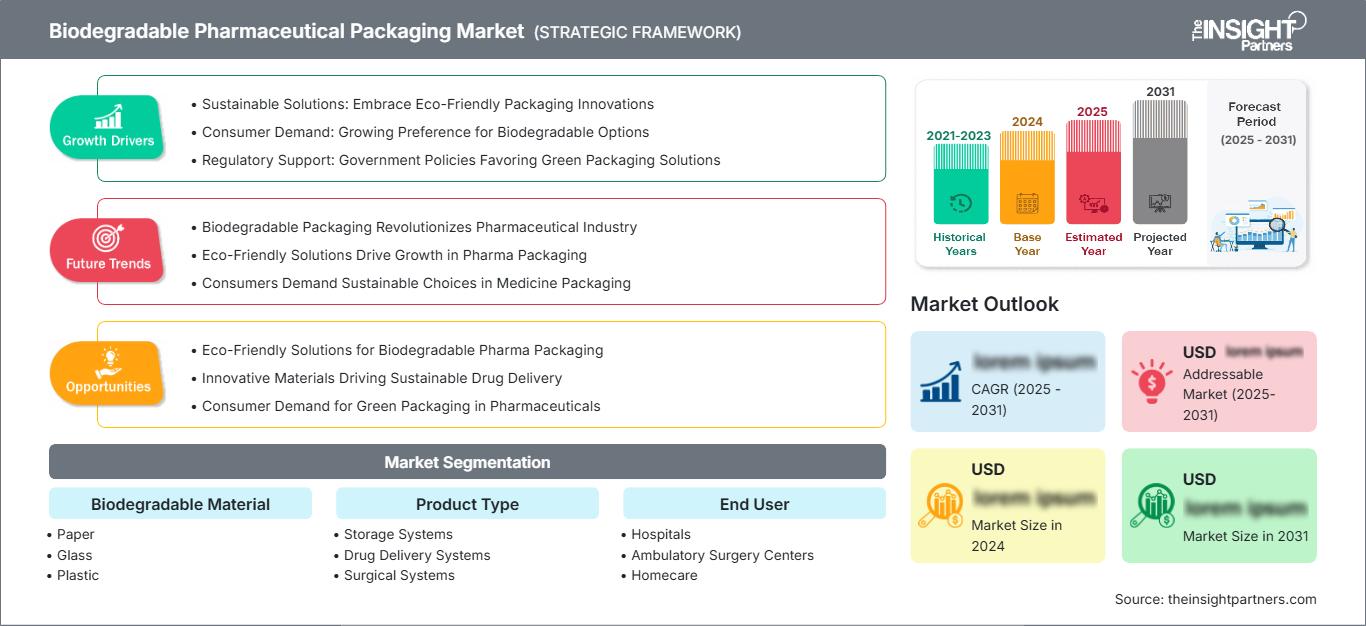
Biodegradable Pharmaceutical Packaging Market Assessment and Insights
Regional Outlook
- North America: ~37% of the global market in 2025 | ~6% CAGR through 2034. Market position: North America leads through its large pharmaceutical industry, developed packaging supply chain, institutional sustainability targets, homecare growth, and early commercialization of lightweight, recyclable, and bio-based formats.
- US: ~87% of North American market revenue in 2025 | ~6% CAGR through 2034. Market position: The US anchors regional demand through high prescription volumes, advanced drug delivery, healthcare procurement, packaging innovation, and substantial manufacturing requirements across solid-dose medicines, biologics, devices, and homecare products.
- Europe: ~31% of the global market in 2025 | ~6% CAGR through 2034. Market position: Europe combines mature pharmaceutical manufacturing with increasingly stringent circularity requirements. Germany leads within Europe, while the UK, France, Italy, and Spain support broad adoption.
- Asia Pacific: ~24% of the global market in 2025 | ~8% CAGR through 2034. Market position: Asia Pacific is the fastest-growing region as medicine production, hospital capacity, packaging conversion, and environmental policy expand. China leads within Asia Pacific, followed by Japan, India, South Korea, and Australia.
Segment Outlook
- Biodegradable Material: ~44% Share in 2025 | ~6% CAGR through 2034. Market position: Biodegradable Material leads because material choice determines barrier performance, stability, sterilization compatibility, structural protection, recyclability, biodegradation potential, manufacturing feasibility, and compliance with pharmaceutical quality requirements.
- Product Type: ~34% Share in 2025 | ~7% CAGR through 2034. Market position: Product Type has the highest growth outlook as medicine delivery shifts toward integrated systems, self-administration, procedure-ready formats, and packaging architectures that reduce material use while preserving functionality.
Competitive Coverage
Origin Pharma Packaging, Gerresheimer AG, Amcor plc, Berry Global Group, Inc., Becton, Dickinson and Company, Nipro Corporation, SCHOTT Pharma AG & Co. KGaA, Catalent, Inc., West Pharmaceutical Services, Inc., AptarGroup, Inc.
Methodology
The Insight Partners follows Data Collection & Secondary Research, Primary Research, Data Analysis, and Data Triangulation & Final Review to validate market estimates and insights.
Source: The Insight Partners' analysis based on proprietary research, government publications, company annual reports, investor presentations, industry databases, and expert interviews.
Biodegradable Pharmaceutical Packaging Market Trends
Evidence-Based Material Selection and Product Carbon Data
The biodegradable pharmaceutical packaging market trends indicate a transition from broad sustainability narratives toward package-level environmental measurement. Suppliers will increasingly quantify material origin, energy use, manufacturing losses, transport emissions, recyclability, and disposal scenarios. Digital product information may allow manufacturers to compare packaging alternatives while preserving documented quality requirements. Carbon calculations will become more useful when methodologies are standardized and externally validated. This approach should reduce misleading comparisons between biodegradable, recyclable, reusable, and lightweight formats. Procurement decisions will consider environmental performance together with total cost, stability, product loss, and compatibility with regional end-of-life infrastructure.
Closed-Loop Systems for Pharmaceutical Transport Components
Controlled closed-loop programs are expected to expand for trays, tubs, pallets, and secondary transport components used between packaging and filling facilities. These materials have defined users and relatively predictable flows, making recovery more feasible than consumer-facing packaging. Segregated collection can preserve material identity and reduce contamination concerns. Future programs may include more vial and syringe formats, standardized return logistics, and digital tracking of reusable or recycled components. Commercial viability will depend on collection density, cleaning or reprocessing requirements, transportation distance, quality assurance, and demonstrated equivalence with virgin packaging.
Biodegradable Pharmaceutical Packaging Market Growth Factors
Pharmaceutical Decarbonization and Waste-Reduction Commitments
Pharmaceutical manufacturers are extending environmental targets into packaging procurement because materials, converting, sterilization, and transportation contribute to supply-chain emissions. Packaging redesign can lower impact through lightweighting, renewable fiber, recycled inputs, fewer components, and improved logistics. The commercial effect is increasing demand for quantified life-cycle evidence rather than unsupported environmental claims. Suppliers able to provide product carbon data, material traceability, and verified performance can participate earlier in drug and device development. Adoption remains selective because environmental gains cannot override stability, sterility, or patient-safety requirements. The strongest programs evaluate total lifecycle impact while avoiding burden shifting between production, transportation, product loss, and end-of-life treatment.
Expansion of Biologics and Self-Administered Medicines
Biologics, injectable therapies, and chronic-disease medicines are increasing demand for vials, cartridges, prefilled syringes, injectors, and protective secondary packaging. These formats often use several materials to deliver barrier performance, mechanical protection, and safe administration. Sustainability efforts therefore focus on reducing component count, increasing filling efficiency, optimizing nests and trays, and designing delivery devices for recovery or simplified disposal. Market impact extends beyond primary containers to labels, cartons, transport systems, and cold-chain protection. Suppliers that cooperate across container, closure, device, and filling interfaces can reduce waste without creating compatibility problems.
Regulation Supporting Circular Packaging Design
Packaging regulation is moving toward recyclability, recycled content, producer responsibility, and material reduction. These measures create economic incentives to replace difficult-to-separate structures and avoid unnecessary packaging. Pharmaceutical applications may receive specific treatment where safety constraints apply, but manufacturers still face pressure to demonstrate progress. Regulatory change is encouraging earlier collaboration between packaging engineers, quality teams, environmental specialists, and suppliers. The resulting market impact includes investment in mono-material structures, fiber alternatives, lightweight glass, and controlled recycling systems. Implementation timelines remain longer than in consumer packaging because material changes require validation and regulatory assessment.
Biodegradable Pharmaceutical Packaging Market Opportunities
Fiber-Based Secondary Packaging and Plastic Component Reduction
Cartons, inserts, sleeves, trays, and transport dividers provide an actionable opportunity because these components generally present fewer drug-contact constraints than primary containers. Packaging companies can invest in high-strength papers, barrier coatings, tamper-evident fiber designs, and forming technologies that replace selected plastic elements. Development should include compression testing, humidity resistance, print verification, serialization compatibility, and automated line performance. Pharmaceutical manufacturers can initially target established products where packaging quantities are large and supply chains are stable. Successful redesigns can reduce plastic use and shipping weight without changing the drug-contact system.
Homecare Packaging with Simplified End-of-Life Pathways
The biodegradable pharmaceutical packaging market Forecasts indicate investment opportunity in packaging for self-administered injectables, oral therapies, diagnostic kits, and remote monitoring programs. Home users need clear separation between sharps, contaminated components, recyclable materials, and general waste. Suppliers can design modular packs with fewer materials, detachable components, clear disposal instructions, and return pathways for selected devices. Effective designs must preserve child resistance, tamper evidence, transport protection, and dose accuracy. Cooperation among pharmaceutical companies, waste providers, pharmacies, and homecare organizations can improve collection economics and reduce confusion.
Segmentation Analysis
Biodegradable Material
The biodegradable pharmaceutical packaging market scope by Biodegradable Material covers substrates selected for containment, protection, transport, labeling, and disposal requirements. Material adoption depends on drug contact, barrier needs, sterilization, mechanical performance, available recovery infrastructure, and regulatory acceptance. Paper is projected to grow at approximately ~7% CAGR during 2026–2034 as manufacturers replace selected plastic secondary components, optimize cartons and inserts, and adopt responsibly sourced fiber formats.
- Paper: Paper and paperboard support cartons, inserts, labels, sleeves, and transport structures. Their advantages include renewable sourcing, established recycling channels, printable surfaces, lightweight construction, and compatibility with responsible fiber-certification programs.
- Glass: Glass provides chemical inertness, strong barrier performance, heat resistance, and wide acceptance for sensitive medicines. Sustainability strategies center on lightweighting, furnace efficiency, renewable energy, cullet use, transport optimization, and container recovery.
- Plastic: Bioplastics and selected biodegradable polymers offer design flexibility and low weight. Pharmaceutical use requires careful assessment of barrier performance, sterilization stability, additives, degradation conditions, extractables, leachables, and interaction with medicine formulations.
Product Type
Product Type determines containment function, patient interaction, dosage delivery, sterility requirements, and packaging complexity. Systems increasingly combine containers, closures, safety components, and instructions within one validated architecture. Drug Delivery Systems are projected to register approximately ~7% CAGR through 2034 as self-administration, biologics, prefilled formats, and home treatment increase demand for efficient packaging with fewer separate components.
- Storage Systems: Bottles, vials, ampoules, cartridges, cartons, and transport systems protect medicines during filling, warehousing, shipping, and shelf life. Design priorities include barrier integrity, breakage prevention, traceability, space efficiency, and material optimization.
- Drug Delivery Systems: Prefilled syringes, injectors, inhalers, pumps, droppers, and dispensing packs combine containment with accurate administration. Sustainable design requires reducing materials without weakening dose accuracy, sterility, device function, or user safety.
- Surgical Systems: Packaging for procedure-ready products must maintain sterility, enable aseptic presentation, and withstand transportation. Opportunities include right-sized trays, recyclable secondary materials, reduced packaging layers, and standardized systems that limit operating-room waste.
End User
End User requirements differ according to purchasing scale, care setting, waste segregation, medicine handling, and patient interaction. Hospitals generate concentrated packaging waste, while outpatient and home settings prioritize portability and intuitive disposal. Homecare is projected to expand at approximately ~7% CAGR through 2034 as self-administered therapies and remote disease management increase the use of medication kits and delivery devices.
- Hospitals: Hospitals purchase substantial medicine volumes and handle diverse packaging streams. Their sustainability priorities include waste segregation, operating-room material reduction, efficient case packing, product identification, sterility, and dependable supply availability.
- Ambulatory Surgery Centers: These facilities require compact, procedure-ready packaging that supports rapid setup and aseptic presentation. Right-sized systems can reduce storage pressure, preparation time, transport volume, and nonhazardous waste from scheduled procedures.
- Homecare: Home users require packaging that is portable, understandable, protective, and easy to discard correctly. Growth in injectables and chronic therapies increases demand for simplified components, clear instructions, tamper evidence, and convenient return or recycling pathways.
Opportunity Snapshot
| End User | Revenue Contribution | Trend Tag | Adoption Stage |
| Hospitals | High | Waste Segregation | Mature |
| Ambulatory Surgery Centers | Medium | Right-Sized Packs | Scaling |
| Homecare | High | Self-Administration | Scaling |
Regional Insights
North America biodegradable pharmaceutical packaging market
In 2025, North America represented about ~37% of worldwide revenues and is expected to experience ~6% CAGR till 2034. Biodegradable pharmaceutical packaging market share captures high volume of prescribed medication, manufacturing of drugs, sophisticated drug delivery technology, and developed conversion technology for packaging. Sustainability initiatives in companies motivate material suppliers to test renewable materials, recycled materials, weight reduction, and mono-material construction.
Organized healthcare purchasing and packaging initiatives in Canada combined with main demand driver from the US make North America an important region for the market. Implementation of sustainability initiatives will be easier when sustainability improvement does not have any impact on drug formulation. Therefore, fiber-based pharmaceutical packaging such as carton, insert, label, and transportation are feasible opportunities. Changes in primary pharmaceutical packaging will involve additional stability, compatibility, and barrier testing. Life cycle data from suppliers will lower the risk of implementation.
U.S. biodegradable pharmaceutical packaging market
The US accounted for approximately ~87% of North American revenue in 2025 and is expected to grow at ~6% CAGR through 2034. Its regional leadership is supported by pharmaceutical development, prescription volumes, biologics manufacturing, hospital procurement, and rising home-based treatment. Packaging demand ranges from bottles and cartons to prefillable syringes, cartridges, diagnostic components, and medication-delivery devices.
Amcor plc, Berry Global Group, Inc., Becton, Dickinson and Company, Catalent, Inc., West Pharmaceutical Services, Inc., and AptarGroup, Inc. have relevant US operations. Buyers increasingly compare material reduction, transport efficiency, recyclability, recycled content, and product carbon impact. Wider adoption depends on consistent resin or fiber supply, filling-line performance, child resistance, tamper evidence, and compliance with stability requirements. Homecare growth also favors compact, understandable, and disposal-conscious systems that support adherence outside clinical environments.
Europe biodegradable pharmaceutical packaging market
Europe held approximately ~31% of global revenue in 2025 and is projected to register ~6% CAGR through 2034. The region combines pharmaceutical manufacturing, packaging engineering, organized waste policy, and increasing producer responsibility. Germany is the leading country in Europe, supported by its pharmaceutical sector, glass and polymer technology, medical-device base, and companies specializing in drug containment.
Pharmaceutical product development and packaging innovations come from the UK, but regulations and waste management policies require specific approaches to the country. France provides demand through the local manufacture of medicines and hospital purchases. Glass, plastic, and device manufacturing comes from Italy, while pharmaceuticals production and increasing sustainability investments are provided by Spain.
Companies such as Gerresheimer AG and SCHOTT Pharma AG & Co. KGaA contribute to the strength of the region in pharmaceutical glass, polymers, syringes, vials, and cartridges. Amcor plc adds its support in flexible and healthcare packaging innovations. Environmental adoption in Europe will depend on packaging waste policies, recycled content policies, eco-modulated extended producer responsibility fees, and restrictions on certain types of hard-to-recycle packages. Yet, patient safety should come first. Packages need to be able to ensure protection from moisture, oxygen, breakage, contamination, and mistakes made with medication.
APAC biodegradable pharmaceutical packaging market
Asia Pacific represented approximately ~24% of global revenue in 2025 and is expected to record the fastest regional CAGR of ~8% through 2034. China is the leading country in Asia Pacific, supported by pharmaceutical manufacturing scale, hospital investment, packaging conversion, and domestic material production.
Japan contributes advanced glass, polymer, and drug-delivery engineering, while South Korea supports biologics and injectable manufacturing. India offers substantial demand through generic medicines, vaccines, contract manufacturing, and export packaging. Australia adds mature regulatory and sustainability practices. Regional expansion will depend on quality consistency, affordable bio-based materials, waste infrastructure, and alignment between domestic packaging requirements and export-market regulations.
Middle East & Africa biodegradable pharmaceutical packaging market
The Middle East & Africa biodegradable pharmaceutical packaging market share is projected to expand at approximately ~5% CAGR through 2034. Saudi Arabia is the leading country in the Middle East & Africa, supported by pharmaceutical localization, hospital investment, and healthcare supply-chain development. The UAE contributes through logistics, private healthcare, and medicine distribution.
South Africa is a well-developed base for pharmaceuticals and packaging in Sub-Saharan Africa; however, the Rest of MEA relies heavily on imported pharmaceuticals and packaging. High temperatures, prolonged transit, and varying waste infrastructures demand packaging that exhibits consistent barrier and mechanical properties. Light-weighting can help minimize load volume; however, biodegradability must take into account the practical aspects of collection and processing at local level.
Biodegradable Pharmaceutical Packaging Market Report Scope
| Report Attribute | Details |
|---|---|
| Market size in 2025 | US$ 163.61 Billion |
| Market Size by 2034 | US$ 275.23 Billion |
| Global CAGR (2026 - 2034) | 5.95% |
| Historical Data | 2021-2024 |
| Forecast period | 2026-2034 |
| Segments Covered | Biodegradable Material, Product Type, End User |
| Region scope | North America, Europe, Asia-Pacific, South and Central America, Middle East and Africa |
Recent Developments
- October 2026: SCHOTT Pharma AG & Co. KGaA announced that its pharmaceutical primary-packaging product carbon footprint calculation tool had been independently validated. The tool supports package-level comparison and customer decisions concerning decarbonization and supply-chain emissions, strengthening evidence-based sustainability assessment for pharmaceutical containers.
- September 2026: SCHOTT Pharma AG & Co. KGaA, Takeda, and Corplex moved a closed-loop vial-tray recycling program into routine operations and completed the first full delivery using trays containing recycled polypropylene. The partners intend to expand the system across Europe and support additional vial formats while maintaining pharmaceutical quality requirements.
- October 2025: Amcor plc received a sustainable healthcare packaging award for ACT2100 Air Peel Technology, a heat-seal coating designed to improve seal performance, breathability, sterilization efficiency, and packaging integrity. The development strengthens the company’s position in resource-efficient packaging for regulated healthcare applications.
Frequently Asked Questions

Recent Reports






