
Black and White B-Ultrasound Market Share, Demand & Growth by 2034
Coverage: by Product Type (Notebook Type, Trolley Type, Others); End User (Hospitals/Clinics, Specialty Clinics, Diagnostic Centers, Others) , and Geography (North America, Europe, Asia Pacific, and South and Central America)
- Status : Data Released
- Report Code : TIPRE00008201
- Category : Life Sciences
- No. of Pages : 150
- Available Report Formats :


- Last update date : November 13, 2026


2025 Market Size
US$ 3.6 Bn
Base year value
2034 Forecast
US$ 5.57 Bn
Projected by 2034
CAGR 2026-2034
4.96 %
Growth rate
Addressable Market
US$ 41.60 Bn
(2026-2034)
The black and white b-ultrasound market was valued at US$ 3.6 Billion in 2025 and is projected to reach US$ 5.57 Billion by 2034, registering a CAGR of 4.96% during 2026–2034. Growth is supported by demand for affordable diagnostic imaging, expansion of primary and maternal healthcare, and greater use of portable ultrasound in resource-constrained facilities. Product durability, simplified operation, and lower ownership costs sustain adoption where advanced color imaging is not routinely required.
Within North America, the black and white b-ultrasound market size is projected to expand at a CAGR of ~4% through 2034. Demand is supported by replacement purchases across outpatient clinics, veterinary and specialty practices, and selected point-of-care environments requiring economical imaging. Portable systems also benefit from decentralized care delivery, although competition from entry-level color Doppler equipment limits faster expansion and encourages suppliers to differentiate through mobility, workflow simplicity, and lifecycle value.
Black and White B-Ultrasound Market Assessment and Insights
Regional Outlook
- North America: ~24% of the global black and white b-ultrasound market share in 2025 | ~4% CAGR through 2034. Market position: North America maintains substantial replacement demand across clinics, community facilities, and specialized practices, although the transition toward color Doppler and handheld imaging moderates growth in conventional monochrome systems.
- US: ~87% of North American market revenue in 2025 | ~4% CAGR through 2034. Market position: The US leads North America through its extensive outpatient infrastructure, broad service network, recurring equipment replacement, and application demand across primary care, procedural guidance, and specialty examinations.
- Europe: ~23% of the global market in 2025 | ~4% CAGR through 2034. Market position: Europe represents a mature market where Germany, the UK, France, Italy, and Spain generate replacement demand, while procurement increasingly emphasizes energy efficiency, serviceability, and clinical workflow integration.
- Asia Pacific: ~38% of the global market in 2025 | ~6% CAGR through 2034. Market position: Asia Pacific is the largest and fastest-growing region, supported by Chinese manufacturing capacity, expanding diagnostic access, maternal health programs, and demand for affordable equipment across China, India, and Southeast Asia.
Segment Outlook
- Notebook Type: ~61% Share in 2025 | ~6% CAGR through 2034. Market position: Notebook systems lead because portability, lower infrastructure requirements, battery-supported operation, and flexible deployment make them suitable for clinics, mobile programs, bedside examinations, and geographically dispersed healthcare facilities.
- Hospitals/Clinics: ~67% Share in 2025 | ~5% CAGR through 2034. Market position: Hospitals and clinics generate the largest revenue contribution because they combine high examination volumes with broad diagnostic requirements, replacement procurement, emergency use, and continuing demand for economical general-imaging equipment.
Competitive Coverage
Shenzhen Mindray Bio-Medical Electronics Co., Ltd., GE HealthCare Technologies Inc., Trivitron Healthcare Pvt. Ltd., Dawei Medical (Jiangsu) Co., Ltd., Sonostar Technologies Co., Limited, Mindsinglong Science and Technology Co., Limited, FUJIFILM Corporation, CHISON Medical Technologies Co., Ltd., Apothecaries Sundries Manufacturing Co., Diasonic Electro Medical Co., Ltd.
Methodology
The Insight Partners follows Data Collection & Secondary Research, Primary Research, Data Analysis, and Data Triangulation & Final Review to validate market estimates and insights.
Source: The Insight Partners' analysis based on proprietary research, government publications, company annual reports, investor presentations, industry databases, and expert interviews.
Technological advancements have changed black-and-white ultrasound equipment, which had been basic stationary machines, into more advanced digital equipment that allows for better beam processing, superior grayscale discrimination, rechargeability, and digital image storage. Production has been confined to Asian producers who have the capacity to integrate component sourcing, transducer assembly, software programming, and manufacturing capacity. There is an increasing tendency by suppliers to utilize common hardware across multiple products in order to make features of high-end equipment available to low-cost equipment.
The need will be towards emerging areas, rural health care networks, mobile testing centers, and small clinics looking for affordable imaging systems without requiring heavy investments in infrastructure. The development effort will target smaller devices with improved battery power, ease of measurements, teleconsultations, and robust probes. The regulations concerning electrical safety, software control, imaging performance, and post-market surveillance will support manufacturers who already have a quality system. Even though the growth of public healthcare and local manufacturing policies will assist, the procurement will target cost, training, and components supply.
Black and White B-Ultrasound Market Report Scope
| Report Attribute | Details |
|---|---|
| Market size in 2025 | US$ 3.6 Billion |
| Market Size by 2034 | US$ 5.57 Billion |
| Global CAGR (2026 - 2034) | 4.96% |
| Historical Data | 2021-2024 |
| Forecast period | 2026-2034 |
Black and White B-Ultrasound Market Analysis
Market demand for black-and-white b-ultrasound products is driven by need for real-time visualization with reduced cost compared to advanced ultrasound systems. The following applications – obstetric examination, abdominal scanning, urinary assessment, musculoskeletal examination and procedure guidance – generate repeat usage scenarios especially in situations where grayscale visualization suffices clinically. Portability broadens application scope even more.
The market ecosystem includes piezoelectric material, transducer assembly, displays, processing, batteries, enclosure, software for measurements, system integration, distribution, training and after sales support. Competitiveness in supply depends on component availability, probe quality, manufacturing capacity, regulatory documentation, and distribution channel capability. Equipment availability is also an important consideration in purchase decision making since manufacturers must manage repair and spare parts inventories.
The Analysis of the Black and White B-ultrasound Market shows competition between diverse imaging manufacturers and price-oriented companies. Shenzhen Mindray Bio-Medical Electronics Co., Ltd., GE HealthCare Technologies Inc., and FUJIFILM Corporation have an edge because of their diverse imaging portfolio and clinical connections. CHISON Medical Technologies Co., Ltd. and Dawei Medical (Jiangsu) Co., Ltd. compete using low-cost portable and trolley devices.
Innovations are directed towards smaller machines, standardization of software, certification for exports, and market penetration through distributors. Trivitron Healthcare Pvt. Ltd. is a source of knowledge about regional healthcare equipment, while Sonostar Technologies Co., Limited and Mindsinglong Science and Technology Co., Limited are sources of expertise for purchasing portable devices. Apothecaries Sundries Manufacturing Co. and Diasonic Electro Medical Co., Ltd. offer their services via regional distribution channels. Competitive advantage comes from balancing image value, price, reliability, and regional technical expertise.
● REPORT CUSTOMIZATION
Tailor This Report To Align With Your Specific Business Requirements
This report can be customized to align precisely with your business objectives, scope, and target markets. Customization options include tailored segmentation, geography, competitive analysis, and strategic insights to support informed decision-making.
Customize This Report →WHAT YOU CAN ADJUST
- ● Segmentations
- ● Geography
- ● Competitive Analysis
- ● Language Preferences
Black and White B-Ultrasound Market: Strategic Insights
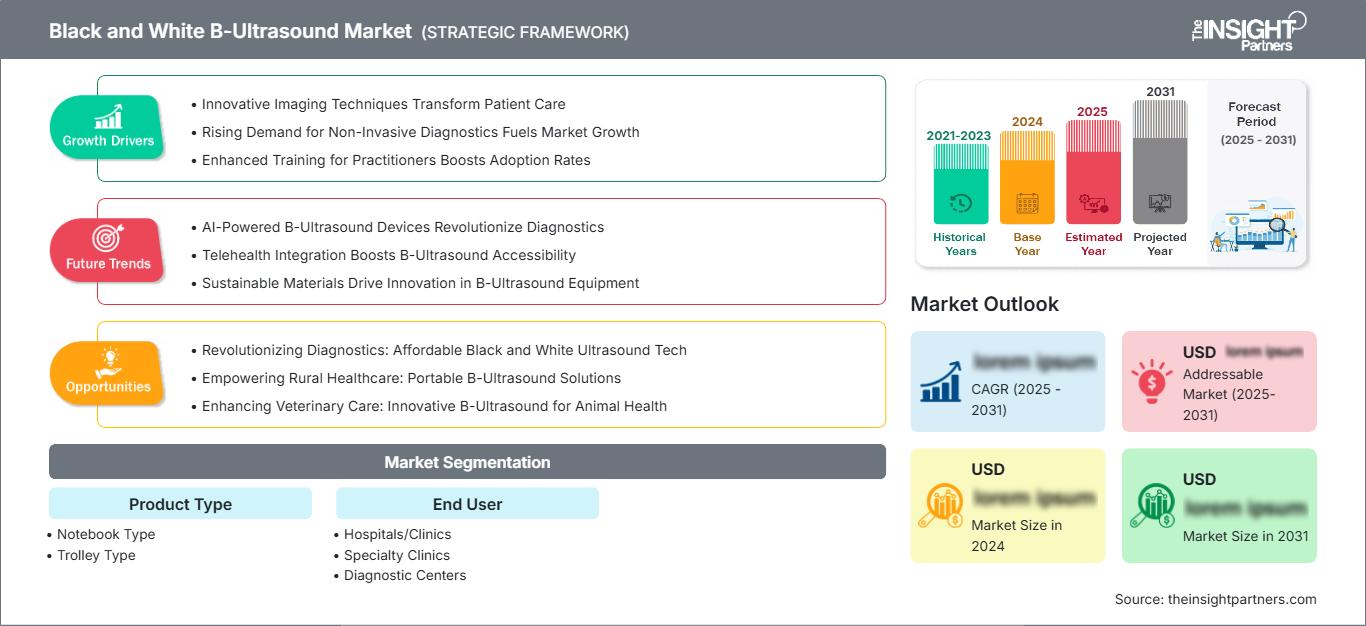
Regional Insights
North America black and white b-ultrasound market
North America represented approximately ~24% of global revenue in 2025 and is projected to expand at a CAGR of ~4% through 2034. The demand exists in outpatient clinics, community clinics, mobile scanning, training environments, and some specialized applications where grayscale images are adequate. In this area, there already exists a substantial installed base of ultrasound machines, and so upgrade cycles rather than installation cycles are relevant.
Imaging quality, transducer quality, infection control features, exportability options, warranties, and cost of ownership are among the factors buyers take into account. Canada contributes to this market through the demand for community health care services and by providing such services in remote areas, in which portability reduces the need for transporting patients. In Mexico, there is incremental potential through the demand from private clinics and increased urban diagnostics. However, there is competition from color systems and handheld ultrasounds.
U.S. black and white b-ultrasound market
The US accounted for approximately ~87% of North American revenue in 2025 and is expected to register a CAGR of ~4% through 2034. The regional positioning is due to a wide outpatient practice base, the need for equipment replacement, and the demand from smaller practices which do not require cardiac and vascular imaging. Availability and compliance have a great impact on the decision since the users of this equipment want consistent equipment operation.
The companies such as GE HealthCare Technologies Inc., Shenzhen Mindray Bio-Medical Electronics Co., Ltd., and FUJIFILM Corporation have widespread visibility regarding ultrasound, but the other cheaper suppliers are competing through distributors and online stores. The applications include initial diagnostics, gynecology, abdomen, urology, musculoskeletal diagnostics, interventional procedures, and veterinary. The biggest opportunity is the portability of the equipment coupled with easy controls, electronic storage of information, and robust probes without requiring expensive software.
Europe black and white b-ultrasound market
Europe held approximately ~23% of global revenue in 2025 and is forecast to grow at a CAGR of ~4% through 2034. It involves extensive use of ultrasound technology along with strict regulations in the medical device industry and organized procurement processes. Older black and white systems continue to be used in small hospitals, general imaging, outreach work, and replacement purposes, whereas color technologies are preferred in acute hospital settings.
Germany is the largest country in Europe due to its large medical devices market, well-developed ambulatory care system, and very high expectation of reliability of medical devices. The UK offers demand from primary care, community diagnostics, and veterinary practices, but public procurement demands good documentation of value. France is a combination of hospital and private practice market, whereas Italy supports demand from decentralized regional healthcare providers in the country.
Consumers in Europe now take into account repair ability, energy usage, software compatibility, security, and end-of-life management. All of these benefit firms that can supply qualified local distributors and clear service provisions. For beginners, conformity, clinical usability, and repeatability of transducers matter more than trying to outdo competitors in terms of price. However, there should be no changes in replacement demand; however, growth might be limited due to cheaper color Doppler and multi-purpose devices.
APAC black and white b-ultrasound market
Asia Pacific accounted for approximately ~38% of global revenue in 2025 and is projected to record the fastest regional CAGR of ~6% through 2034. China is the leading country in Asia Pacific, supported by large-scale ultrasound manufacturing, extensive domestic demand, and established export networks. The black and white b-ultrasound market share also reflects the region’s substantial need for affordable diagnostic equipment.
India offers growth through primary healthcare expansion and domestic device distribution, while Japan and South Korea emphasize reliable, compact equipment for mature clinical environments. Australia provides replacement opportunities under structured regulatory standards. Industrial clustering, healthcare localization, maternal screening initiatives, and rural diagnostic investment support regional expansion, although pricing pressure remains intense.
Middle East & Africa black and white b-ultrasound market
The Middle East & Africa market is projected to expand at a CAGR of ~5% through 2034. Saudi Arabia is the leading country in the Middle East & Africa, supported by hospital investment, primary-care modernization, and healthcare localization. The UAE generates demand through private facilities, mobile services, and regional medical distribution, while South Africa maintains a comparatively developed imaging base.
Across the rest of the region, portable monochrome systems address maternal health, abdominal assessment, and basic diagnostic needs where imaging infrastructure is limited. Energy reliability, equipment durability, battery operation, clinician training, and distributor support are central purchasing considerations. Infrastructure investment can expand adoption, but weak maintenance coverage and constrained public budgets may delay replacement cycles.
Segmentation Analysis
Product Type
The black and white b-ultrasound market scope by product type reflects differences in mobility, examination volume, workspace, power availability, and clinical workflow. Buyers compare portability with screen size, probe connectivity, processing capability, and ergonomic requirements. Notebook Type systems are projected to grow at a CAGR of ~6% during 2026–2034 as decentralized care, mobile diagnostics, bedside assessment, and outreach services increase the value of lightweight equipment that can operate across multiple locations.
- Notebook Type: Notebook systems support flexible deployment in clinics, wards, ambulances, and outreach programs. Compact construction, battery capability, rapid startup, and easier transportation make the format attractive where practitioners share equipment or work beyond fixed imaging rooms.
- Trolley Type: Trolley systems provide larger displays, stable positioning, expanded probe storage, and sustained operation for facilities with dedicated examination areas. Their relevance remains strongest where patient throughput and operator ergonomics justify a fixed or semi-mobile workstation.
End User
End-user adoption reflects examination complexity, patient throughput, procurement scale, and access to trained sonographers. Hospitals and clinics remain central because they perform broad diagnostic examinations and maintain formal equipment-replacement programs. The Hospitals/Clinics segment is projected to expand at a CAGR of ~5% during 2026–2034, supported by primary-care investment, imaging decentralization, and continuing demand for economical systems that complement advanced platforms across routine workflows.
- Hospitals/Clinics: Hospitals and general clinics use economical ultrasound for routine screening, triage, bedside assessment, and departments where grayscale imaging meets clinical needs. Procurement decisions emphasize versatility, service response, probe availability, staff familiarity, and standardized operation.
- Specialty Clinics: Specialty clinics require systems configured for focused workflows such as obstetrics, urology, musculoskeletal care, and veterinary imaging. Demand is influenced by procedure mix, available space, practitioner ownership, and the need to control equipment expenditure.
- Diagnostic Centers: Diagnostic centers prioritize image consistency, examination throughput, reporting efficiency, and dependable daily operation. Monochrome systems are most relevant in price-sensitive locations and for routine examinations that do not require advanced Doppler characterization.
Opportunity Snapshot
| End User | Revenue Contribution | Trend Tag | Adoption Stage |
| Hospitals/Clinics | High | Primary Imaging | Mature |
| Specialty Clinics | Medium | Focused Workflow | Scaling |
| Diagnostic Centers | Medium | Routine Screening | Mature |
Black and White B-Ultrasound Market Growth Drivers and Impact Analysis
Expansion of Affordable Diagnostic Imaging Access
Healthcare systems expanding primary, maternal, and community care require diagnostic technologies that can be deployed without the infrastructure of advanced radiology departments. Black-and-white ultrasound addresses this requirement by providing real-time, radiation-free visualization at comparatively accessible equipment and maintenance costs. The market impact is strongest where abdominal, obstetric, urinary, and basic musculoskeletal examinations constitute a large portion of imaging demand. Government procurement and nongovernmental health programs can extend adoption into underserved locations, but equipment deployment must be accompanied by operator training, quality assurance, and maintenance. Suppliers that combine economical systems with application education and dependable local service are better positioned to convert infrastructure investment into sustained clinical utilization.
Growing Preference for Portable and Shared Equipment
Smaller hospitals and clinics increasingly seek ultrasound systems that can move between examination rooms, wards, emergency areas, and outreach sites. Portable equipment increases asset utilization because one system can support several care settings rather than remaining in a dedicated imaging room. Notebook designs also reduce space and transportation requirements, creating practical value for mobile medical teams and rural providers. The commercial impact extends to batteries, carrying cases, compact carts, and multipurpose probes. Manufacturers must nevertheless preserve durability and image consistency because portability exposes equipment to repeated movement, variable power conditions, and physical wear. Strong enclosure design and accessible repair support therefore become meaningful purchase differentiators.
Rising Maternal and Primary-Care Screening Requirements
Ultrasound is widely used for pregnancy assessment and evaluation of common abdominal and urinary conditions. Expanding maternal health and primary-care programs consequently increase demand for systems capable of routine grayscale examinations. Black-and-white equipment remains relevant where clinical requirements center on anatomical visualization, basic measurements, and fetal assessment rather than complex vascular analysis. Its market impact is particularly visible in district hospitals, community clinics, and mobile screening programs with constrained budgets. Adoption quality depends on practitioner competency and clear referral pathways for uncertain or complex findings. Suppliers can strengthen utilization by pairing equipment with standardized examination protocols, training modules, and remote technical assistance rather than treating the sale as an isolated hardware transaction.
Black and White B-Ultrasound Market Future Trends
Software-Assisted Optimization in Entry-Level Systems
The black and white b-ultrasound market trends increasingly include automated gain adjustment, image optimization, measurement assistance, preset examination protocols, and simplified reporting. These functions can reduce operator variability and shorten the learning curve for clinicians who do not perform ultrasound exclusively. Future systems are likely to use shared software architectures that allow manufacturers to transfer workflow tools from premium platforms into lower-cost devices. Adoption will depend on whether automation improves repeatability without creating complexity or recurring licensing costs. Suppliers must also validate software performance across patient types and clinical applications. Entry-level intelligence will become a practical differentiator as hardware image quality converges among competing systems.
Connectivity and Remote Clinical Collaboration
Future monochrome platforms are expected to offer stronger connectivity for image transfer, teleconsultation, remote education, and centralized quality review. This is particularly relevant where community clinicians require specialist input, but patients cannot easily travel to referral hospitals. Cloud-compatible workflows and secure data export can make basic ultrasound part of wider diagnostic networks instead of a stand-alone examination device. Manufacturers will need to address patient-data protection, interoperability, cybersecurity, and unreliable network conditions. Systems that support both offline operation and later synchronization may gain acceptance in rural settings. Connectivity will therefore add value when it improves clinical escalation and documentation rather than functioning only as a technical feature.
Black and White B-Ultrasound Market Opportunities
Localized Systems for Rural and Community Healthcare
The black and white b-ultrasound market Forecasts indicate an opportunity to develop durable systems around the operating realities of rural facilities. Investment priorities include extended battery life, voltage protection, dust-resistant construction, easily replaceable probes, local-language interfaces, and offline data storage. Manufacturers can combine these features with regional assembly, distributor training, and service-part inventories to lower lifecycle risk. Procurement programs increasingly require evidence that equipment will remain operational after installation, making maintenance capacity as important as initial pricing. Partnerships with public health agencies, medical colleges, and training organizations can improve utilization while creating reference sites for broader regional expansion.
Specialty Configurations for Focused Clinical Workflows
Product suppliers can create differentiated value by configuring economical monochrome systems for focused applications rather than offering undifferentiated general-purpose equipment. Obstetric measurement packages, urology presets, musculoskeletal probes, veterinary configurations, and guided-procedure controls can strengthen relevance for specialized buyers. Investment should prioritize workflow clarity, suitable transducers, documentation tools, and application-specific education. A modular commercial approach can allow clinics to purchase only the functionality required while preserving upgrade pathways. This strategy reduces direct competition with premium multipurpose platforms and helps manufacturers address customer groups that value dependable performance in a narrow set of examinations more than advanced imaging breadth.
Recent Developments
- December 2025: Shenzhen Mindray Bio-Medical Electronics Co., Ltd. unveiled the Resona A20 ultrasound system for North America at RSNA 2025. Although positioned above the conventional monochrome category, its Acoustic Intelligence Technology platform, automated workflows, and advanced image processing indicate how premium capabilities can progressively influence lower-tier ultrasound design and customer expectations.
- November 2025: FUJIFILM Corporation introduced the Sonosite MT portable ultrasound system with a compact clamshell design, touch-based interface, infection-control-oriented construction, and workflow connectivity. The development reinforces industry movement toward durable, portable platforms that can be transported across care settings while supporting efficient point-of-care examinations.
- March 2025: GE HealthCare Technologies Inc. presented its ultrasound portfolio at ECR 2025, including LOGIQ systems, Vscan Air handheld ultrasound, workflow software, and AI-supported imaging solutions. The portfolio demonstrates continued investment in scalable ultrasound ecosystems that connect portable devices, general imaging, reporting, and remote collaboration across multiple clinical environments.
Frequently Asked Questions

- Comprehensive Market Sizing and Forecast Analysis
- Detailed Segmentation Analysis
- In-Depth Market Dynamics Assessment
- Regional and Country-Level Insights
- Competitive Landscape and Company Benchmarking
- Strategic Business Intelligence
Recent Reports
Testimonials

The Insight Partners provided valuable market intelligence that supported our global go-to-market strategy. Their team was professional, responsive, and attentive to our feedback, providing thoughtful analysis and helpful methodological clarifications throughout the project.
Junmo Kim Chief Financial Officer (CFO), Enertech Co., Ltd.
The Insight Partners' SCADA System Market report is comprehensive, with valuable insights on current trends and future forecasts. The team was highly professional, responsive, and supportive throughout. We are very satisfied and highly recommend their services.
RAN KEDEM Partner, Reali Technologies LTDs
I requested a report on a very specific software market and the team produced the report in a few days. The information was very relevant and well presented. I then requested some changes and additions to the report. The team was again very responsive and I got the final report in less than a week.
JEAN-HERVE JENN Chairman, Future Analytica
We worked with The Insight Partners for an important market study and forecast. They gave us clear insights into opportunities and risks, which helped shape our plans. Their research was easy to use and based on solid data. It helped us make smart, confident decisions. We highly recommend them.
PIYUSH NAGPAL Sr. Vice President, High Beam Global
The Insight Partners delivered insightful, well-structured market research with strong domain expertise. Their team was professional and responsive throughout. The user-friendly website made accessing industry reports seamless. We highly recommend them for reliable, high-quality research services
YUKIHIKO ADACHI CEO, Deep Blue, LLC.
This is the first time I have purchased a market report from The Insight Partners.While I was unsure at first, I visited their web site and felt more comfortable to take the risk and purchase a market report.I am completely satisfied with the quality of the report and customer service. I had several questions and comments with the initial report, but after a couple of dialogs over email with their analyst I believe I have a report that I can use as input to our strategic planning process.Thank you so much for taking the extra time and making this a positive experience.I will definitely recommend your service to others and you will be my first call when we need further market data.
JOHN SUZUKI President and Chief Executive Officer, Board Director, BK Technologies
I wish to appreciate your support and the professionalism you displayed in the course of attending to my request for information regarding to infectious disease IVD market in Nigeria. I appreciate your patience, your guidance, and the fact that you were willing to offer a discount, which eventually made it possible for us to close a deal. I look forward to engaging The Insight Partners in the future, all thanks to the impression you have created in me as a result of this first encounter.
DR CHIJIOKE ONYIA MANAGING DIRECTOR, PineCrest Healthcare Ltd.Reason to Buy
- Informed Decision-Making
- Understanding Market Dynamics
- Competitive Analysis
- Identifying Emerging Markets
- Customer Insights
- Market Forecasts
- Risk Mitigation
- Boosting Operational Efficiency
- Strategic Planning
- Investment Justification
- Tracking Industry Innovations
- Aligning with Regulatory Trends





 Get Free Sample for