
Blood Collection Needles Market Growth, Trends & Demand by 2034
Coverage: By Type (Safety Blood Collection Needles, Standard Blood Collection Needles); End-User (Hospitals, Clinics, Ambulatory Surgical Centers) , and Geography (North America, Europe, Asia Pacific, and South and Central America)
- Status : Data Released
- Report Code : TIPRE00021558
- Category : Life Sciences
- No. of Pages : 150
- Available Report Formats :


- Last update date : August 17, 2026


2025 Market Size
US$ 1.32 Bn
Base year value
2034 Forecast
US$ 2.55 Bn
Projected by 2034
CAGR 2026-2034
7.59 %
Growth rate
Addressable Market
US$ 17.43 Bn
(2026-2034)
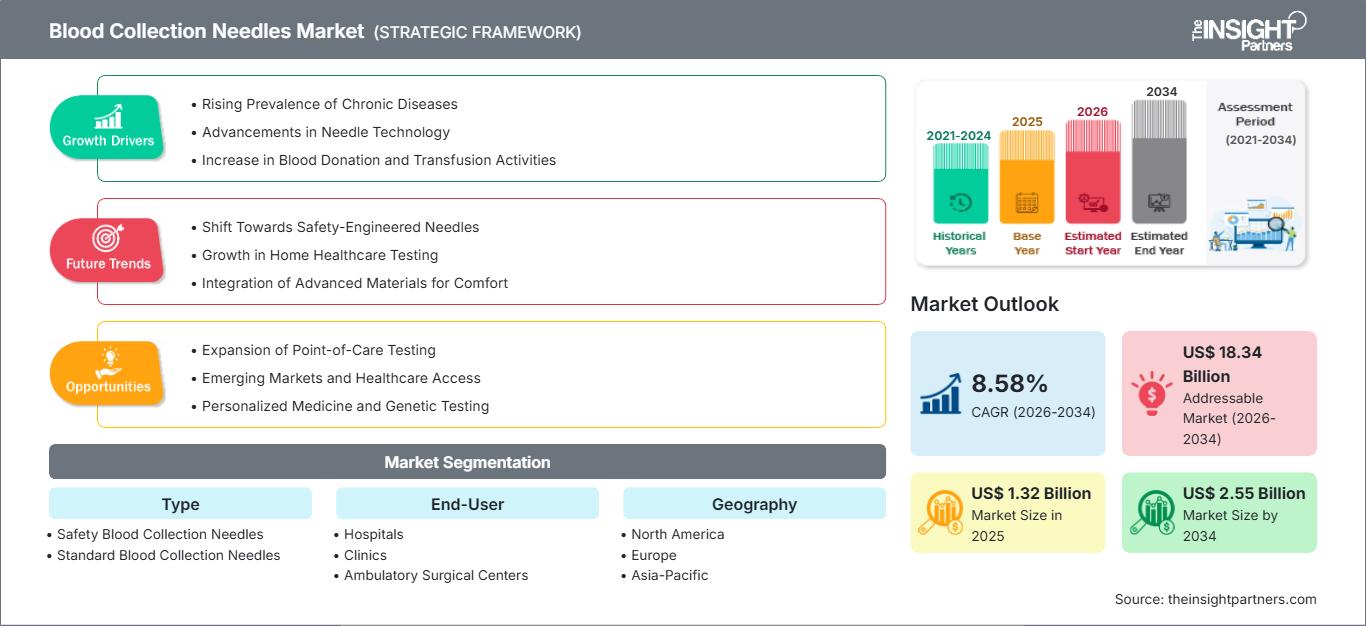
The Blood Collection Needles market was valued at US$ 1.32 billion in 2025 and is expected to reach US$ 2.55 billion by 2034; it is estimated to record a CAGR of 7.59% during 2026-2034.
Blood Collection Needles Market Assessment and Insights
- North America: North America is estimated to represent 35–39% share in 2025 and grow at a CAGR of 8.1–8.8% between 2026–2034, supported by mature hospital procurement, safety-device adoption, and strong diagnostic testing infrastructure.
- US: The US accounts for approximately 82–86% of North America’s 2025 market, with growth of 8.0–8.7% CAGR during 2026–2034 driven by safety compliance and outpatient laboratory activity.
- Europe: Europe is modeled at 27–31% share in 2025 and a 7.7–8.4% CAGR during 2026–2034, led by Germany, the UK, France, Italy, and Spain, where safety-engineered collection devices increasingly support standardized clinical practice.
- Asia Pacific: Asia Pacific is estimated at 23–27% share in 2025 and is projected to expand at 9.5–10.3% CAGR during 2026–2034, with China, Japan, South Korea, India, and Australia providing varied demand across hospital and outpatient settings.
- Largest Segment: Safety Blood Collection Needles represent an estimated 58–62% market share in 2025 and are projected to grow at 9.0–9.8% CAGR during 2026–2034.
- High Growth Segment: Clinics represent an estimated 18–22% market share in 2025 and are projected to expand at 9.3–10.1% CAGR during 2026–2034 as decentralized testing expands.
- Key companies analyzed in detail: International Medsurg Connection, NIPRO Medical Corporation, Argon Medical Devices, Inc., B. Braun Melsungen AG, Medtronic, Inc., Boston Scientific Corporation, Becton, Dickinson and Company, Terumo Corporation, Novo Nordisk A/S, ICU Medical, Inc., Hamilton Company, Hi-Tech Medicare Devices, AdvaCare Pharma, McKesson Corporation, Henry Schein, Inc., and Britannia.
Source: The Insight Partners' analysis based on proprietary research, government publications, company annual reports, investor presentations, industry databases, and expert interviews.
Advancements in technology have changed collection needles from simple puncturing devices to comprehensive safety and ergonomic solutions. Characteristics such as thin-walled cannulas, shields, retraction features, bevel designs, and pre-installed handles are now being differentiated on account of specimen integrity and efficiency of use. The economics of manufacturing are still vulnerable to the cost of stainless steel material, fabrication, sterilization ability, packaging, and quality control considerations.
During the forecast period, there will be increased interest in devices that provide a combination of safety, patient comfort, and ease of integration with distributed diagnostics. Growth of health care infrastructure in the Asia Pacific region, as well as select Middle Eastern and African countries, will generate additional demand volumes through expansion of laboratory facilities. Regulatory focus on engineering controls will also contribute to the replacement of standard products by improved ones.
Blood Collection Needles Market Report Scope
| Report Attribute | Details |
|---|---|
| Market size in 2025 | US$ 1.32 Billion |
| Market Size by 2034 | US$ 2.55 Billion |
| Global CAGR (2026 - 2034) | 7.59% |
| Historical Data | 2021-2024 |
| Forecast period | 2026-2034 |
Blood Collection Needles Market Analysis
Demand for Blood Collection Needles Market growth is anchored in routine diagnostics, inpatient monitoring, chronic disease management, emergency care, and preventive screening. The ecosystem brings needle makers together with blood collection tube suppliers, distributors, hospitals, labs, clinicians, and procurers. Safety considerations are becoming more important to product selection, and the manufacturers need to strike a balance between sharpness, flow characteristics, sample quality, ergonomics, sterilization, and packaging efficiency.
In terms of competition, manufacturers usually fight each other based on production size, quality systems, distribution capability, and product differentiation. Hospitals prefer products that reduce the complexities associated with staff training and inventories, while clinics often prefer more portable and easier-to-use products. Supply chain resiliency requires validated production capacity, component sourcing, sterilization, and diversified geographical distribution, especially when healthcare systems face procurement problems.
Competitive positioning remains fragmented between diversified medical technology companies and specialized needle manufacturers. Becton, Dickinson and Company maintains a broad collection portfolio, while Terumo Corporation and NIPRO Medical Corporation compete through precision manufacturing and extensive clinical-device capabilities. B. Braun Melsungen AG and Medtronic, Inc. participate through wider vascular-access portfolios, whereas Argon Medical Devices, Inc. and International Medsurg Connection provide more specialized offerings.
The Blood Collection Needles market competition is now increasingly focusing on safety, integration into the workflow, local production, and distribution rather than the design of needles. Boston Scientific Corporation, Henry Schein, Inc., McKesson Corporation, and AdvaCare Pharma expand their reach through distribution or overall medical device business. Investments focus on automation of production, diversification of the portfolio, quality management, and distribution in emerging markets; while strategic differentiation is increasingly focused on minimizing failed draws, complexity, and occupational exposure.
● REPORT CUSTOMIZATION
Tailor This Report To Align With Your Specific Business Requirements
This report can be customized to align precisely with your business objectives, scope, and target markets. Customization options include tailored segmentation, geography, competitive analysis, and strategic insights to support informed decision-making.
Customize This Report →WHAT YOU CAN ADJUST
- ● Segmentations
- ● Geography
- ● Competitive Analysis
- ● Language Preferences
Blood Collection Needles Market: Strategic Insights
Regional Insights
North America Blood Collection Needles Market
North America is modeled at 35–39% share in 2025, with a regional CAGR of 8.1–8.8% through 2034. The US represents the principal demand center, supported by extensive hospital networks, outpatient laboratories, preventive testing, and established safety-device procurement. OSHA requirements emphasize engineering and work-practice controls for blood exposure, strengthening the rationale for safety-engineered collection products.
Canada contributes through public healthcare procurement and centralized laboratory networks, while the US market benefits from replacement demand and clinical standardization. Hospitals remain the dominant purchasing environment, although clinics and ambulatory settings are gaining importance as diagnostic services move closer to patients. The region's Blood Collection Needles Market share reflects its mature infrastructure, while continued adoption of safety mechanisms supports sustained replacement cycles.
U.S. Blood Collection Needles Market Market
The Blood Collection Needles Market report indicates that the U.S. accounts for an estimated 82–86% share of North America in 2025 and is modeled to grow at an 8.0–8.7% CAGR during 2026–2034. The demand is concentrated among hospitals, standalone labs, doctors’ clinics, and ambulatory care facilities, with safety-engineered devices preferred where occupational exposure management plays a critical role in purchasing decisions.
The companies that manufacture products used for venipuncture, vascular access, and other associated procedures are Becton, Dickinson and Company, Terumo Corporation, B. Braun Melsungen AG, Medtronic, Inc., and others. The current application trends include outpatient diagnostics, difficult-vein puncture, and device design minimizing patient pain. CDC estimates approximately 385,000 needlesticks and other sharps injuries each year among hospital healthcare workers.
Europe Blood Collection Needles Market
Europe is modeled at 27–31% share in 2025 and a 7.7–8.4% CAGR through 2034, with Germany positioned as the leading national market. Safety is key for UK procurement, whereas Germany has the advantage of good hospital structures and a medical device industry. France, Italy, and Spain add value through their public and private clinical services and diagnostics facilities, as well as increased use of safe collection devices.
Occupational safety and clinical usability criteria are becoming increasingly prevalent in procurement across Western Europe. Germany will stay strategically significant due to its developed hospital network and medical technology industry. The UK has centralized purchasing and good clinical governance, whereas France, Italy, and Spain can add volumes via hospitals, outpatient clinics, and diagnostics networks. Demand will stay stable as healthcare institutions update their collection procedures.
APAC Blood Collection Needles Market
APAC is estimated at 23–27% share in 2025 and is expected to grow at 9.5–10.3% CAGR through 2034, with China leading the region. Japan and South Korea provide mature demand, while India and Australia contribute through expanding diagnostic capacity and hospital infrastructure. China combines domestic manufacturing depth with great clinical demand.
Industrial localization, healthcare infrastructure investment, and wider diagnostic access support regional expansion. India offers significant volume potential through private hospitals and laboratories, while Japan emphasizes quality and procedural reliability. Australia benefits from established healthcare standards. Across APAC, the Blood Collection Needles Market share is supported by growing laboratory utilization and gradual migration toward safer, higher-performance collection devices.
Middle East & Africa Blood Collection Needles Market Market
Middle East and Africa demand is modeled at a 7.1–7.9% CAGR through 2034, led by Saudi Arabia and the UAE in the Gulf and South Africa in sub-Saharan Africa. Hospital modernization, diagnostic infrastructure, and national healthcare investment support replacement and new-device demand.
Saudi Arabia and the UAE benefit from sophisticated private and public healthcare systems, while South Africa anchors demand in the region's more developed clinical infrastructure. The rest of MEA remains influenced by healthcare-access gaps, import dependence, and distribution capacity. Energy revenues in Gulf markets can support medical infrastructure investment, while training and supply reliability remain decisive considerations for less-developed systems.
Segmentation Analysis
Type
Type remains the principal product-level differentiation, with safety features increasingly influencing procurement specifications. Safety Blood Collection Needles are modeled to grow at 9.0–9.8% CAGR during 2026–2034, while Standard Blood Collection Needles are expected to expand at 6.4–7.2%. Adoption reflects the balance between regulatory requirements, procedural economics, clinician familiarity, and patient experience.
- Safety Blood Collection Needles: Safety-engineered shields, retractable mechanisms, and one-handed activation address occupational exposure while supporting standardized workflows, making these products strategically important for hospitals and high-volume phlebotomy environments.
- Standard Blood Collection Needles: Standard formats retain demand where procurement remains cost-sensitive and established procedures dominate, particularly in markets where safety-device conversion is gradual and clinical infrastructure varies.
End-User
End-User dynamics are shaped by procedure volumes, staffing models, procurement structures, and the migration of diagnostic services beyond large hospitals. Hospitals are modeled to grow at 7.5–8.3% CAGR, Clinics at 9.3–10.1%, and Ambulatory Surgical Centers at 8.0–8.8% during 2026–2034. The Blood Collection Needles Market scope therefore, increasingly includes decentralized care settings.
- Hospitals: High testing volumes, inpatient monitoring, emergency procedures, and standardized procurement make hospitals the largest recurring consumption base for blood collection needles.
- Clinics: Expanding outpatient diagnostics and physician-office testing support demand for convenient, ergonomic devices that can simplify routine venipuncture with limited staff resources.
- Ambulatory Surgical Centers: Growth in same-day procedures increases preoperative and postoperative specimen requirements, supporting demand for reliable collection products within streamlined procedural workflows.
Opportunity Snapshot
| Segment Name | Revenue Contribution | Trend Tag | Adoption Stage |
|---|---|---|---|
| Hospitals | High | Safety Conversion | Mature |
| Clinics | Medium | Outpatient Testing | Scaling |
| Ambulatory Surgical Centers | Medium | Same-Day Care | Scaling |
Blood Collection Needles Market Growth Drivers and Impact Analysis
Expansion of Safety-Engineered Device Adoption
The regulatory focus on engineering controls is increasing the rate at which traditional sharps are being replaced by instruments that mitigate occupational exposures. OSHA mandates that all employers with expected occupational exposures to blood take appropriate measures to implement effective engineering and work practice controls, and the CDC recommendations continue to highlight sharps injury prevention. Such an environment impacts the specification of purchases, especially in hospitals and big lab facilities. Hence, manufacturers who incorporate features such as shields, retraction technology, one-handed use, or passive safety can effectively distinguish their products based on safety features and not price alone. The impact of such a situation goes beyond the sale of instruments because safety modification can affect training, disposal, inventory management, and even risk management policies.
Increasing Diagnostic Testing and Outpatient Care
Increased use of lab tests is leading to increased numbers of blood collection methods used in hospitals, clinics, and ambulatory centers. Monitoring of chronic diseases, preventive screening, diagnostics during emergencies and surgical procedures leads to repetitive demand rather than single-use demand. The trend towards outpatient care broadens the target market as small facilities will need more compact, standardized, and user-friendly collection systems. In addition, the process of procuring products is changing as the clinics usually have to weigh the benefits of product quality against the availability of staff and time available to perform the procedure. This can be capitalized on by manufacturers producing user-friendly devices that require minimal preparation and ensure a good first stick.
Improvement in Patient Comfort and Specimen Quality
The patient experience is also becoming a real purchasing criterion as companies strive to eliminate discomfort, failed venipunctures, and multiple venipunctures. Features like thin-wall cannulas, improved bevels, smaller gauge, visual flash, and better handling may assist in achieving easier venous access while still collecting an appropriate volume of the sample. The WHO recommendations take into account that each step in phlebotomy has an influence on patient safety and the quality of specimens collected; thus, both phlebotomy techniques and the choice of devices become operationally significant. Devices that perform better decrease the need for multiple punctures and enhance the efficiency of the process, reducing the number of rejected specimens due to procedural issues.
Blood Collection Needles Market Future Trends
Integration With Low-Volume and Decentralized Sampling
The Blood Collection Needles Market trends are likely to increasingly converge with low-volume sampling, decentralized diagnostics, and patient-centric collection models. Technical improvements in capillary sampling and sample processing at reduced volumes illustrate how diagnostic processes can be made more accessible to pharmacies and doctors' offices while not doing away with laboratory testing altogether. Studies made public in March 2025 by Becton, Dickinson and Company and Babson Diagnostics showed similar precision levels when comparing a few drops of blood taken from the fingertips to blood samples taken from veins in certain tests. Over time, this trend is likely to have an impact on the design of needles as being less traumatic, more manageable, requiring less volume, and compatible with decentralized sampling stations.
Smarter Safety and Workflow-Oriented Needle Design
Future developments are predicted to place more emphasis on passive safety, ergonomic design, and procedural visibility rather than just puncture capability alone. It has become possible to integrate all elements of needle safety, feedback for the puncturing process, optimal flow characteristics, and integration into the device itself within one single-use product line. Development efforts of Terumo Corporation demonstrate this trend and include safety-based needle technology and devices that are developed to facilitate handling and minimize the procedural effort. For collection devices, the same approach would result in automatic shielding, better confirmation of the safety mode activation, and enhanced compatibility with standard holders.
Blood Collection Needles Market Opportunities
Localized Manufacturing and Regional Supply Resilience
The Blood Collection Needles Market Forecasts indicate an opportunity for manufacturers to establish regional production, sterilization, or final-assembly capabilities in high-growth healthcare markets. Localized sourcing would mean less vulnerability to freight disruptions that can occur internationally, as well as less replenishment time and enhanced sensitivity to government procurement initiatives. The relevance of Asia Pacific lies in its ability to cater to domestic demand and production for export because of the growth in health care and manufacturing capabilities. Strategic alliances can be developed with regional distributors, contract manufacturers, and health care networks as opposed to depending only on global supply. Investments must go into proven quality processes, automation in forming and assembling, sterile packing, and production lines that scale up.
Premiumization Through Procedure-Efficiency Solutions
An additional opportunity lies in positioning premium collection devices around measurable procedure efficiency rather than incremental product specifications. Blood Collection Needles Market Forecasts can support investment cases built around fewer failed draws, reduced repeat sampling, easier difficult-vein access, faster tube filling, and simplified staff workflows. Healthcare organizations could be willing to pay more on a per-unit basis if the products exhibit lower overall procedure costs or better patient experiences. Manufacturers would therefore be able to create value propositions that include information on usability, sample quality, user feedback, and workflow benefits. Collaboration with the health systems will help validate these claims and differentiate procurement criteria. This is how manufacturers can create a path towards value-based positioning without having to relinquish the repeat purchase dynamics of disposables.
Recent Developments
- January 2026: Terumo Corporation launched the SurTract Safety Syringe in the United States, incorporating SafeR passive safety technology with automatic needle retraction after use. The product is intended for hospitals, clinics, and emergency-care settings, reinforcing Terumo's strategic focus on passive protection, usability, and reduced needlestick exposure across its needle portfolio.
- December 2025: Terumo Blood and Cell Technologies inaugurated its Africa headquarters and regional training center in Nairobi. The facility is intended to strengthen regional capabilities in blood processing, apheresis, and related technologies, while expanding technical education for clinicians, laboratory technologists, and biomedical engineers across East Africa.
- March 2025: Becton, Dickinson and Company and Babson Diagnostics announced studies showing that selected tests using several drops of fingertip blood achieved accuracy comparable with higher-volume venous collection. The findings support broader use of capillary collection and reinforce the industry's movement toward convenient, lower-volume diagnostic sampling outside conventional phlebotomy environments.
Frequently Asked Questions

- Comprehensive Market Sizing and Forecast Analysis
- Detailed Segmentation Analysis
- In-Depth Market Dynamics Assessment
- Regional and Country-Level Insights
- Competitive Landscape and Company Benchmarking
- Strategic Business Intelligence
Recent Reports
Testimonials

The Insight Partners provided valuable market intelligence that supported our global go-to-market strategy. Their team was professional, responsive, and attentive to our feedback, providing thoughtful analysis and helpful methodological clarifications throughout the project.
Junmo Kim Chief Financial Officer (CFO), Enertech Co., Ltd.
The Insight Partners' SCADA System Market report is comprehensive, with valuable insights on current trends and future forecasts. The team was highly professional, responsive, and supportive throughout. We are very satisfied and highly recommend their services.
RAN KEDEM Partner, Reali Technologies LTDs
I requested a report on a very specific software market and the team produced the report in a few days. The information was very relevant and well presented. I then requested some changes and additions to the report. The team was again very responsive and I got the final report in less than a week.
JEAN-HERVE JENN Chairman, Future Analytica
We worked with The Insight Partners for an important market study and forecast. They gave us clear insights into opportunities and risks, which helped shape our plans. Their research was easy to use and based on solid data. It helped us make smart, confident decisions. We highly recommend them.
PIYUSH NAGPAL Sr. Vice President, High Beam Global
The Insight Partners delivered insightful, well-structured market research with strong domain expertise. Their team was professional and responsive throughout. The user-friendly website made accessing industry reports seamless. We highly recommend them for reliable, high-quality research services
YUKIHIKO ADACHI CEO, Deep Blue, LLC.
This is the first time I have purchased a market report from The Insight Partners.While I was unsure at first, I visited their web site and felt more comfortable to take the risk and purchase a market report.I am completely satisfied with the quality of the report and customer service. I had several questions and comments with the initial report, but after a couple of dialogs over email with their analyst I believe I have a report that I can use as input to our strategic planning process.Thank you so much for taking the extra time and making this a positive experience.I will definitely recommend your service to others and you will be my first call when we need further market data.
JOHN SUZUKI President and Chief Executive Officer, Board Director, BK Technologies
I wish to appreciate your support and the professionalism you displayed in the course of attending to my request for information regarding to infectious disease IVD market in Nigeria. I appreciate your patience, your guidance, and the fact that you were willing to offer a discount, which eventually made it possible for us to close a deal. I look forward to engaging The Insight Partners in the future, all thanks to the impression you have created in me as a result of this first encounter.
DR CHIJIOKE ONYIA MANAGING DIRECTOR, PineCrest Healthcare Ltd.Reason to Buy
- Informed Decision-Making
- Understanding Market Dynamics
- Competitive Analysis
- Identifying Emerging Markets
- Customer Insights
- Market Forecasts
- Risk Mitigation
- Boosting Operational Efficiency
- Strategic Planning
- Investment Justification
- Tracking Industry Innovations
- Aligning with Regulatory Trends





 Get Free Sample for