
Blood Culture Screening Devices Market Size, Share & Forecast by 2034
Coverage: By Type (Automated Blood Culture Systems, Supporting Equipment); Application (Hospitals, Blood Banks) , and Geography (North America, Europe, Asia Pacific, and South and Central America)
- Status : Data Released
- Report Code : TIPRE00022291
- Category : Life Sciences
- No. of Pages : 150
- Available Report Formats :


- Last update date : August 17, 2026


2025 Market Size
US$ 12.21 Bn
Base year value
2034 Forecast
US$ 19.98 Bn
Projected by 2034
CAGR 2026-2034
5.62 %
Growth rate
Addressable Market
US$ 145.88 Bn
(2026-2034)
The Blood Culture Screening Devices market was valued at US$ 12.21 billion in 2025 and is expected to reach US$ 19.98 billion by 2034; it is estimated to record a CAGR of 5.62% during 2026-2034.
Blood Culture Screening Devices Market Assessment and Insights
- North America: North America is expected to command a 36–40% Blood Culture Screening Devices Market share in 2025 and grow at a 6.0–6.5% CAGR between 2026–2034, supported by mature hospital laboratories, sepsis pathways, automation investments, and strong installed bases.
- US: The US is estimated to represent 82–86% of North America's 2025 share and grow at a 6.1–6.6% CAGR during 2026–2034, led by hospital testing volumes and stewardship initiatives.
- Europe: Europe is projected to hold a 25–29% share in 2025 and grow at a 5.6–6.1% CAGR during 2026–2034, with Germany, the UK, France, Italy, and Spain supported by organized microbiology networks and infection-control programs.
- Asia Pacific: Asia Pacific is estimated at a 22–26% share in 2025 and a 7.0–7.6% CAGR during 2026–2034, with China, Japan, South Korea, India, and Australia benefiting from expanding laboratory capacity and infectious-disease diagnostics.
- Largest Segment: Automated Blood Culture Systems hold an estimated 88–92% market share in 2025 and are projected to grow at a 6.1–6.6% CAGR through 2034, reflecting automation-led laboratory adoption.
- High Growth Segment: Supporting Equipment accounts for an estimated 8–12% share in 2025 and is expected to grow at a 7.0–7.6% CAGR, supported by workflow integration and laboratory modernization.
- Key companies analyzed in detail: Thermo Fisher Scientific, Inc.; Becton, Dickinson and Company; Haemonetics Corporation; Fresenius SE & Co. KGaA; Terumo Corporation; bioMérieux SA; Luminex Corporation; Roche Diagnostics International Ltd.; Bruker Corporation; Nikon Corporation.
Source: The Insight Partners' analysis based on proprietary research, government publications, company annual reports, investor presentations, industry databases, and expert interviews.
Technological development in the sector is moving from simple incubation to more complex systems with the integration of processes like detection, sample management, communication, and identification. Detection through fluorescence, traceability by means of barcodes, modular design of the instruments, and connectivity with the laboratory systems are becoming common features in the systems. The production models will focus on the consistent supply of the culture media, scalable instrumentation, and fit within the existing laboratory work processes.
In the future, investments will be geared towards those systems which link culture screening with molecular identification and antimicrobial susceptibility testing. Other emerging health care markets in developing economies will help to promote these systems as the tertiary hospitals update their microbiology laboratories. Antimicrobial resistance, laboratory standardization, and diagnostic stewardship will aid in increasing the need for these systems to produce consistent results with minimal human interaction.
Blood Culture Screening Devices Market Report Scope
| Report Attribute | Details |
|---|---|
| Market size in 2025 | US$ 12.21 Billion |
| Market Size by 2034 | US$ 19.98 Billion |
| Global CAGR (2026 - 2034) | 5.62% |
| Historical Data | 2021-2024 |
| Forecast period | 2026-2034 |
Blood Culture Screening Devices Market Analysis
The Blood Culture Screening Devices market report indicates that growth is directly correlated with the increasing need for diagnosis of bloodstream infection, sepsis, and hard-to-identify organisms. Demand starts at hospitals and blood banks, continues through blood collecting and culture media suppliers, and reaches automated incubation, detection, identification, and susceptibility testing processes. WHO campaigns focusing on enhanced capabilities in diagnosing bacteriology and mycology underline the need for stable laboratory facilities.
Supply consists of instrumentation, culture bottles, detecting methods, software, maintenance, and laboratory services. Automated devices create continuous demand for compatible consumable supplies, forming a business approach where installed equipment can impact future purchasing decisions. Resilient supply chain is strategically valuable due to potential shortages of culture supplies that could interfere with infections diagnosing, as evidenced by the 2024 US shortage of BD blood culture media.
Increasingly, competitive positioning requires integration as much as instrumentation. The Blood Culture Screening Devices Market forecast reveals that traditional players are focusing on integrated workflows that cover specimen quality, automated incubation, detection, informatics, and subsequent identification. Positions in the market are held by Thermo Fisher Scientific, Inc., Becton, Dickinson and Company, bioMérieux SA, Roche Diagnostics International Ltd., and Bruker Corporation across complementary steps in the diagnosis process.
The Blood Culture Screening Devices Market trends indicate that key areas of investment are shifting to automation, connectivity, sample quality monitoring, and improved time-to-actionable result performance. Haemonetics Corporation and Terumo Corporation offer additional capabilities of blood management, while Fresenius SE & Co. KGaA is exposed to hospital and lab ecosystems. Participants such as Luminex Corporation, Nikon Corporation, among others with technology focus, bring capabilities in molecular diagnostics, imaging, and lab technologies.
● REPORT CUSTOMIZATION
Tailor This Report To Align With Your Specific Business Requirements
This report can be customized to align precisely with your business objectives, scope, and target markets. Customization options include tailored segmentation, geography, competitive analysis, and strategic insights to support informed decision-making.
Customize This Report →WHAT YOU CAN ADJUST
- ● Segmentations
- ● Geography
- ● Competitive Analysis
- ● Language Preferences
Blood Culture Screening Devices Market: Strategic Insights
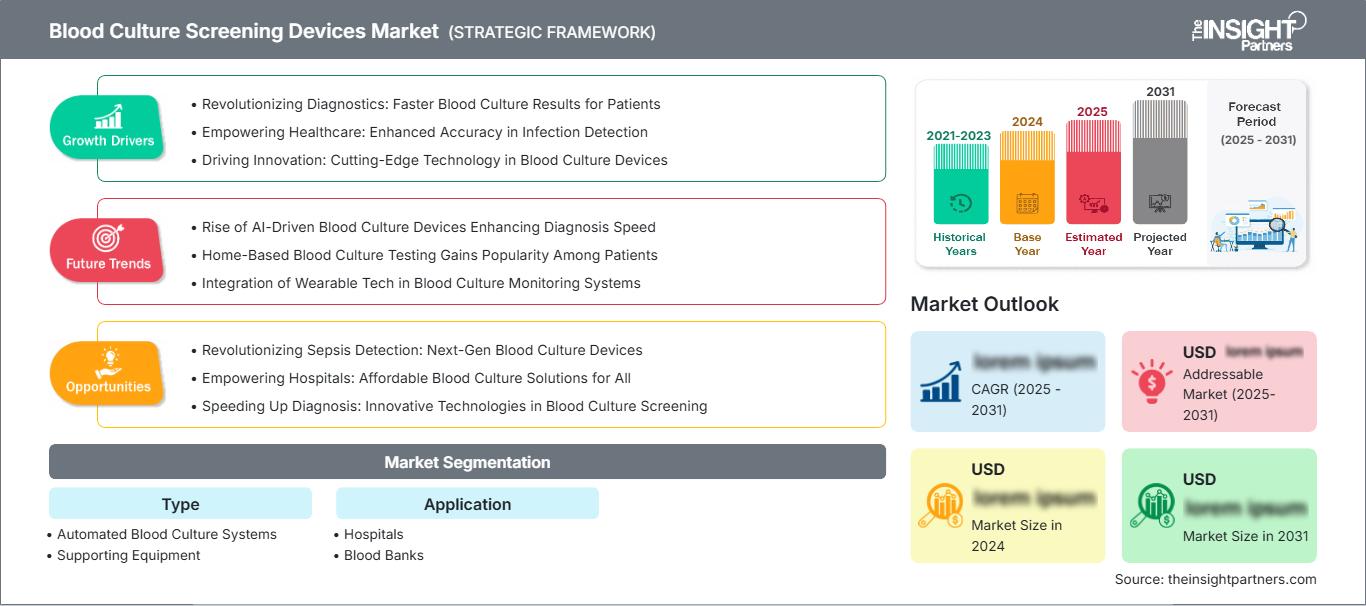
Regional Insights
North America Blood Culture Screening Devices Market
The North American market is forecasted to contribute 36%-40% of the market in 2025 and is expected to grow at a rate of 6.0%-6.5% CAGR till 2034. This region will benefit from its well-established hospital microbiology laboratory system, automation of culture systems, high adoption, and awareness about antimicrobial stewardship. While the United States contributes most of the revenues, Canada offers additional demand via centralized hospital labs and public health care systems.
Growth in the Blood Culture Screening Devices Market from the structural aspects is ensured via sepsis management guidelines, labor shortages in laboratories, and growing demands for standard specimen handling. The region has an extensive installed base that drives recurrent sales of culture media, bottles, maintenance, and software. Improvement of bacteriology capability and diagnostics by the World Health Organization is the overarching policy reason behind it.
U.S. Blood Culture Screening Devices Market
The US accounts for around 82–86% of the North American market of 2025 and is expected to experience growth at a 6.1–6.6% CAGR up to 2034. Large hospital groups, academic medical centers, and reference laboratories perform high test volumes. Automated technologies are preferred when laboratories need standardized sample handling, constant monitoring, and integration with IT systems.
Increasingly popular application trends include diagnostic stewardship, reducing contamination rates, and a quick shift from detecting positive cultures to identifying organisms. Becton, Dickinson and Company, Thermo Fisher Scientific, Inc., bioMérieux SA, Roche Diagnostics International Ltd., and Bruker Corporation have relevant technology exposure throughout the diagnostic process. Research on the use of blood cultures and machine learning-based order entry reflects an increasing interest in appropriate testing rather than volume growth.
Europe Blood Culture Screening Devices Market
Estimated to have a 25%–29% share by 2025, the Europe region is projected to record a CAGR of 5.6%–6.1% through 2034. The leading country market in Europe is Germany. Advantages in the region include the presence of mature microbiology laboratories, infection control practices, and an increasing focus on managing antimicrobial resistance.
The UK and Germany can be regarded as key adopters due to mature hospital laboratory networks and diagnostic algorithms. France, Italy, and Spain make significant contributions owing to their public hospitals and advanced automation in microbiology. Traceability, streamlined workflows, and integration capabilities with identification solutions are some of the key factors that will drive adoption of microbiology platforms in European laboratories.
APAC Blood Culture Screening Devices Market
The market share of APAC in 2025 is projected to be around 22-26%, growing at a rate of 7.0-7.6% CAGR up to 2034. The leading countries in this region will be China, Japan, South Korea, India, and Australia. Growth in tertiary hospitals and microbiology will drive the demand.
Modernization of industries, infectious diseases' surveillance, and government spending on diagnostic facilities are key factors driving adoption. The scope for expansion of the market in China and India is immense, while that in Japan and South Korea is due to technologically advanced laboratories.
Middle East & Africa Blood Culture Screening Devices Market
Middle East and Africa is expected to expand at a 5.4–6.0% CAGR through 2034. Saudi Arabia is projected to lead regional adoption, followed by the UAE and South Africa, while the rest of MEA remains influenced by uneven laboratory infrastructure and healthcare investment.
Hospital modernization, infectious-disease preparedness, and infrastructure development are central demand factors. Gulf countries can support advanced automation through higher healthcare investment and centralized hospital projects, whereas African markets require scalable systems suited to resource constraints. Energy-linked public investment in the Gulf can indirectly support laboratory capacity expansion.
Segmentation Analysis
Type
Type represents the core technology layer, with automated systems accounting for the overwhelming majority of current demand. Blood Culture Screening Devices scope within this segment is shaped by laboratory throughput, workflow standardization, staffing availability, and compatibility with culture media. The segment is projected to grow at a 6.1–6.6% CAGR during 2026–2034 as hospitals prioritize continuous monitoring and integrated diagnostics.
- Automated Blood Culture Systems: These systems dominate purchasing decisions because they provide continuous incubation and automated detection, reducing manual observation requirements while supporting standardized processing in high-volume hospital laboratories.
- Supporting Equipment: Supporting equipment includes workflow-enabling hardware and laboratory accessories that improve handling, integration, monitoring, and operational continuity, making it strategically important as laboratories modernize complete diagnostic environments.
Application
Application divides demand between hospital and blood-bank environments, with hospitals representing the principal utilization setting. Blood Culture Screening Devices analysis indicates a 6.0–6.6% CAGR for this segment during 2026–2034, reflecting the central role of bloodstream infection testing in acute care, intensive care, and emergency medicine.
- Hospitals: Hospitals generate recurring screening demand because suspected sepsis and bloodstream infections require timely microbiological evaluation, particularly across emergency departments, intensive care units, oncology services, and complex inpatient populations.
- Blood Banks: Blood banks use microbial screening technologies to protect transfusion safety and maintain quality, creating demand for reliable systems that support standardized testing and traceable laboratory workflows.
Opportunity Snapshot
| Segment Name | Revenue Contribution | Trend Tag | Adoption Stage |
|---|---|---|---|
| Hospitals | High | Sepsis Screening | Mature |
| Blood Banks | Medium | Donor Safety | Scaling |
Blood Culture Screening Devices Market Growth Drivers and Impact Analysis
Rising Antimicrobial Resistance and Diagnostic Stewardship
The rise in antimicrobial resistance will drive the commercial value of precise microbiology testing due to the reduced reliability of empirical therapy in the face of unknown antibiotic resistance patterns. According to WHO data, one out of every six lab-confirmed bacterial infections worldwide was resistant to antibiotics in 2023. This makes accurate diagnosis even more relevant. In terms of labs, this means the increased commercial value of solutions that provide consistent detection of positive cultures along with linking them to further identification and susceptibility tests. Besides the purchase of instruments, the market effect will be broader as hospitals will need consumables, software, maintenance services, and integration with the workflow. With the growth of stewardship programs, the choice will be made in favor of solutions providing actionable results.
Hospital Laboratory Automation and Workforce Constraints
Clinical laboratories are under pressure to process growing workloads while managing staffing limitations and increasingly complex testing requirements. Automated blood culture platforms can reduce repetitive manual steps, provide continuous monitoring, and improve workflow visibility. The impact is particularly relevant to large hospitals operating centralized microbiology departments, where standardized processes can reduce variation between shifts and locations. Automation also creates opportunities for laboratories to integrate instrument status, specimen tracking, and result communication into broader information systems. As capital budgets increasingly evaluate technology through labor productivity and operational resilience, automated platforms can gain preference over manually intensive alternatives. The commercial effect is therefore strongest where hospitals can quantify improvements in workflow continuity, capacity utilization, quality monitoring, and staff allocation.
Increasing Emphasis on Sample Quality and Workflow Standardization
Blood culture performance depends substantially on specimen quality, collection practices, and appropriate blood volume. Consequently, market demand is increasingly influenced by technologies capable of monitoring preanalytical variables and reducing avoidable workflow errors. Standardized collection protocols, barcode identification, automated loading, and quality dashboards can help laboratories identify operational weaknesses before they affect clinical reporting. This creates a broader market opportunity for suppliers that combine instruments with consumables, informatics, training, and quality-management services. The impact is particularly significant for hospital networks seeking consistent performance across multiple facilities. Platforms that provide actionable operational data can strengthen customer retention because laboratories may evaluate the total workflow rather than replacing individual pieces of equipment in isolation.
Blood Culture Screening Devices Market Future Trends
Integration of Culture Screening With Rapid Identification
Blood Culture Screening Devices trends are moving toward tighter integration between positive-culture detection and rapid organism identification. During the forecast period, laboratories are likely to connect automated culture instruments with molecular panels, mass spectrometry, and antimicrobial susceptibility workflows so that a positive signal triggers a more efficient downstream pathway. Bruker Corporation is advancing clinical validation around positive blood culture workflows and rapid susceptibility testing, illustrating the direction toward connected microbiology. Such integration can reduce the gap between detection and actionable clinical information. Future purchasing decisions may therefore assess the compatibility of the complete diagnostic pathway rather than evaluating the screening instrument as an isolated capital asset.
Data-Driven Blood Culture Quality Management
Future platforms are expected to make greater use of operational analytics covering contamination, positivity, specimen volume, turnaround time, and workflow exceptions. This shift could transform instruments from passive detection systems into active quality-management platforms. Automated dashboards may allow laboratory managers to compare performance between collection areas, shifts, and facilities, helping identify training requirements or process weaknesses. Connectivity with laboratory information systems and hospital analytics platforms should become increasingly important as health systems consolidate diagnostic operations. Vendors capable of combining reliable detection with interpretable operational data can create stronger differentiation without depending exclusively on hardware specifications. The resulting competitive environment is likely to reward interoperability, cybersecurity, usability, and evidence demonstrating measurable workflow improvements.
Blood Culture Screening Devices Market Opportunities
Expansion Through Modular Systems in Emerging Hospitals
Blood Culture Screening Devices Forecasts point toward opportunities in emerging healthcare systems where hospitals are expanding microbiology capabilities but may face constraints on capital expenditure, staffing, and laboratory space. Modular systems can provide a practical pathway by allowing facilities to begin with essential automated capacity and expand as testing volumes increase. Suppliers can target regional hospital networks, private diagnostic groups, and newly commissioned tertiary facilities with scalable configurations, service agreements, and consumable supply models. In Asia Pacific, the Middle East, and selected African markets, localization of training and maintenance could be as important as instrument pricing. Investment strategies should therefore emphasize lifecycle economics, local technical support, reliable consumable availability, and interoperability with existing laboratory information infrastructure.
Integrated Diagnostic Ecosystems for Large Hospital Networks
A second opportunity lies in supplying integrated diagnostic ecosystems to large hospital networks that are consolidating microbiology operations. Blood culture systems can serve as anchor technologies around which specimen tracking, rapid identification, antimicrobial susceptibility testing, and analytics are organized. Vendors can strengthen their position through interoperability agreements, workflow software, and service models that support multiple laboratories under common quality standards. The opportunity is particularly relevant to health systems seeking centralized procurement and consistent operating procedures across facilities. Successful strategies should demonstrate measurable effects on turnaround time, labor utilization, contamination monitoring, and result communication. Companies with broad diagnostic portfolios can potentially capture additional value by connecting culture screening with downstream technologies rather than competing only on instrument placement.
Recent Developments
- June 2026: Becton, Dickinson and Company introduced its next-generation BD BACTEC FXI Culture System as a forthcoming platform designed around faster detection, automated workflows, individual blood-volume measurement, scalable capacity, and connectivity through BD Synapsys informatics. The system is positioned to address increasing laboratory workload, sepsis management requirements, antimicrobial resistance, and specimen-quality challenges.
- April 2026: Bruker Corporation announced expanded MALDI Biotyper and IR Biotyper workflows, including clinical validation activities for automated sample preparation and positive blood culture processing through MBT SepsiMatic. The company also reported development work targeting rapid phenotypic antimicrobial susceptibility testing from positive blood cultures, supporting a more integrated microbiology workflow.
- September 2025: bioMérieux SA highlighted ongoing investment in BACT/ALERT blood culture operations and manufacturing capacity during its 2025 half-year reporting. The company reported replenishment of BACT/ALERT raw materials and investment in US manufacturing capacity and automation, following earlier supply pressures affecting blood culture bottles.
Frequently Asked Questions

- Comprehensive Market Sizing and Forecast Analysis
- Detailed Segmentation Analysis
- In-Depth Market Dynamics Assessment
- Regional and Country-Level Insights
- Competitive Landscape and Company Benchmarking
- Strategic Business Intelligence
Recent Reports
Testimonials

The Insight Partners' SCADA System Market report is comprehensive, with valuable insights on current trends and future forecasts. The team was highly professional, responsive, and supportive throughout. We are very satisfied and highly recommend their services.
RAN KEDEM Partner, Reali Technologies LTDs
I requested a report on a very specific software market and the team produced the report in a few days. The information was very relevant and well presented. I then requested some changes and additions to the report. The team was again very responsive and I got the final report in less than a week.
JEAN-HERVE JENN Chairman, Future Analytica
We worked with The Insight Partners for an important market study and forecast. They gave us clear insights into opportunities and risks, which helped shape our plans. Their research was easy to use and based on solid data. It helped us make smart, confident decisions. We highly recommend them.
PIYUSH NAGPAL Sr. Vice President, High Beam Global
The Insight Partners delivered insightful, well-structured market research with strong domain expertise. Their team was professional and responsive throughout. The user-friendly website made accessing industry reports seamless. We highly recommend them for reliable, high-quality research services
YUKIHIKO ADACHI CEO, Deep Blue, LLC.
This is the first time I have purchased a market report from The Insight Partners.While I was unsure at first, I visited their web site and felt more comfortable to take the risk and purchase a market report.I am completely satisfied with the quality of the report and customer service. I had several questions and comments with the initial report, but after a couple of dialogs over email with their analyst I believe I have a report that I can use as input to our strategic planning process.Thank you so much for taking the extra time and making this a positive experience.I will definitely recommend your service to others and you will be my first call when we need further market data.
JOHN SUZUKI President and Chief Executive Officer, Board Director, BK Technologies
I wish to appreciate your support and the professionalism you displayed in the course of attending to my request for information regarding to infectious disease IVD market in Nigeria. I appreciate your patience, your guidance, and the fact that you were willing to offer a discount, which eventually made it possible for us to close a deal. I look forward to engaging The Insight Partners in the future, all thanks to the impression you have created in me as a result of this first encounter.
DR CHIJIOKE ONYIA MANAGING DIRECTOR, PineCrest Healthcare Ltd.Reason to Buy
- Informed Decision-Making
- Understanding Market Dynamics
- Competitive Analysis
- Identifying Emerging Markets
- Customer Insights
- Market Forecasts
- Risk Mitigation
- Boosting Operational Efficiency
- Strategic Planning
- Investment Justification
- Tracking Industry Innovations
- Aligning with Regulatory Trends





 Get Free Sample for