
Blood Preparation Market Share, Growth & Forecast by 2034
Coverage: By Product Type (Whole Blood, Blood Components, and Blood Derivatives); Application (Thrombocytosis, Pulmonary Embolism, Renal Impairment, Angina Blood Vessel Complications, and Others); End Use (Hospitals, Clinics, Diagnostic Centers, Research Labs, Blood Banks, Pharmaceuticals, and Others), and Geography (North America, Europe, Asia Pacific, and South and Central America)
- Status : Data Released
- Report Code : TIPRE00023674
- Category : Life Sciences
- No. of Pages : 150
- Available Report Formats :


- Last update date : July 30, 2026


2025 Market Size
US$ 53.63 Bn
Base year value
2034 Forecast
US$ 83.66 Bn
Projected by 2034
CAGR 2026-2034
5.72 %
Growth rate
Addressable Market
US$ 644.03 Bn
(2026-2034)
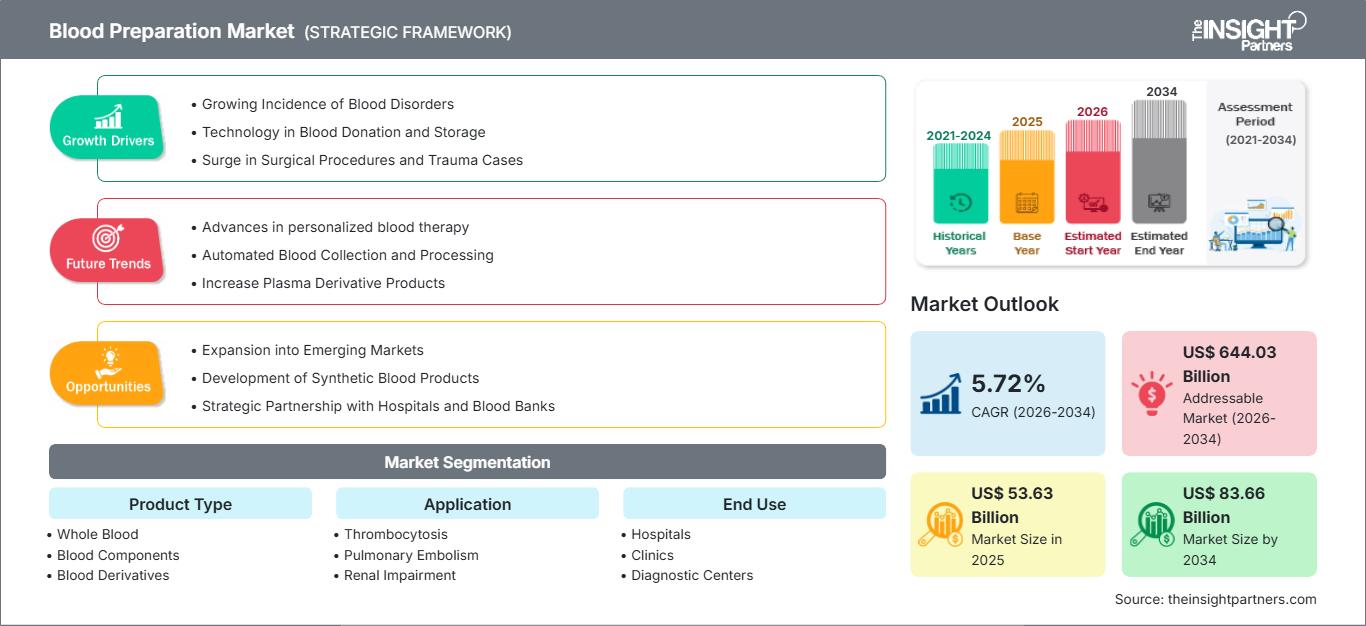
The Blood Preparation Market size is anticipated to witness growth from US$ 53.63 Billion in 2025 to US$ 83.66 Billion in 2034, at a CAGR of 5.72%. The market includes whole blood, blood components, and blood derivatives that are utilized in conditions such as thrombocytosis, pulmonary embolism, renal dysfunction, angina blood vessels issues, among others.
In North America, the need for blood preparations will be influenced by well-established blood transfusion practices, specialization in hematology treatment, and usage of anticoagulant medications in hospitals. The Blood Preparation Market will grow at a CAGR between 5.0% to 5.4% during the period 2026 to 2034, fueled by automation of blood banks, organized donor programs, and growing cases of venous thromboembolism and surgical bleeding along with plasma derived drugs.
Blood Preparation Market Assessment and Insights
- North America held a 38–41% Blood Preparation Market share in 2025 and is projected to grow at a CAGR range of 5.0–5.4% during 2026–2034, supported by blood-bank digitization, specialty therapies, and hospital-led anticoagulation protocols.
- US accounted for 78–82% of North America in 2025 and is projected to grow at a CAGR range of 4.9–5.3% during 2026–2034, driven by thrombosis care and high procedural volumes.
- Europe represented a 25–28% share in 2025 and is expected to expand at a CAGR range of 4.7–5.1% during 2026–2034, led by Germany, the UK, France, Italy, and Spain.
- Asia Pacific held a 20–23% share in 2025 and is projected to grow at a CAGR range of 6.8–7.3% during 2026–2034, supported by China, Japan, India, South Korea, and Australia.
- Largest Segment Blood Components accounted for a 42–45% market share in 2025 and is expected to grow at a CAGR range of 5.6–6.0% during 2026–2034.
- High Growth Segment Blood Derivatives held a 28–31% market share in 2025 and is projected to grow at a CAGR range of 6.4–6.9% during 2026–2034.
- Key companies analyzed in detail: AstraZeneca PLC, Sanofi S.A., LEO Pharma A/S, Bristol Myers Squibb Company, Baxter International Inc., Pfizer Inc., Portola Pharmaceuticals, Inc., GlaxoSmithKline plc, Shandong East Chemical Industry Co., Ltd., Celgene Corporation.
Source: The Insight Partners' analysis based on proprietary research, government publications, company annual reports, investor presentations, industry databases, and expert interviews.
Technology advancements are influencing the economics of manufacturing as blood banks are transitioning from manual separation to automated component separation, cold chain storage validation, and inventory control via digital records. WHO recorded 120.4 million global blood donations, out of which 36 percent were donated in high-income countries constituting 15 percent of the world’s population, highlighting the role of infrastructure development in resource allocation.
The developing geographies are likely to receive increased attention on donor mobilization, plasma donation, and establishment of quality standards in the future. As reported by WHO, only 49 of 168 countries that reported using plasma-derived medicinal products manufacture them from locally donated plasma; 119 others either do not use such products at all or import them.
Blood Preparation Market Report Scope
| Report Attribute | Details |
|---|---|
| Market size in 2025 | US$ 53.63 Billion |
| Market Size by 2034 | US$ 83.66 Billion |
| Global CAGR (2026 - 2034) | 5.72% |
| Historical Data | 2021-2024 |
| Forecast period | 2026-2034 |
Blood Preparation Market Analysis
The demand has increased due to the need for blood-based products in procedures such as transfusions, oncology treatments, renal conditions, treatment of pulmonary embolisms and cardiovascular interventions. Blood preparation market growth is supported by hospitals’ focus on preventing adverse reactions, enhancing availability of components and standardizing anticoagulant management. CDC reports up to 900,000 individuals in the United States suffer from venous thromboembolism annually, providing continuous demand.
Factors influencing the supply include donor availability, screening capabilities, fractionation capability, temperature management and traceability requirements. According to IATA, transporting healthcare products by air requires highly developed temperature management systems due to the products' sensitivity to temperature variations in transit.
The competitiveness of the companies is driven by the range of therapy, hospital channel presence, and manufacturing consistency. Blood Preparation Market analysis reveals that AstraZeneca PLC, Sanofi S.A., Bristol Myers Squibb Company, Pfizer Inc., Baxter International Inc., and LEO Pharma A/S compete through anticoagulants, hemostatic therapy, infusion technology, and rare blood disorders rather than commoditized supply.
The strategic positioning has become increasingly dependent on the availability of access programs, evidence-based specialty care, and hospital work flow integration. Portfolio history is still beinthe portfolio'sd by Portola Pharmaceuticals, Inc. and Celgene Corporation through thrombosis and hematology assets, and the wider pharmaceutical and materrelevance across pharmaceuticals beininput materialsKline plc and Shandong East Chemical Industry Co., Ltd.
● REPORT CUSTOMIZATION
Tailor This Report To Align With Your Specific Business Requirements
This report can be customized to align precisely with your business objectives, scope, and target markets. Customization options include tailored segmentation, geography, competitive analysis, and strategic insights to support informed decision-making.
Customize This Report →WHAT YOU CAN ADJUST
- ● Segmentations
- ● Geography
- ● Competitive Analysis
- ● Language Preferences
Blood Preparation Market: Strategic Insights
Regional Insights
North America Blood Preparation Market
In 2025, North America had a 38-41% share and is expected to witness a 5.0-5.4% CAGR over 2026-2034. Some of the key drivers include advanced blood banking services, robust hospital procurement, and high diagnostic rates for venous thromboembolism. According to the CDC, VTE is the number one cause of potentially preventable hospital mortality. Hence, anticoagulation and transfusion policies become integral to the protocol.
The market share of North America in Blood Preparation Market is further bolstered by the availability of plasma-based products, automation of component preparation, and integration of hospital pharmacy services. Larger organizations continue to link hemovigilance and laboratory testing, along with recordkeeping and inventory management. It enables reduced wastage, quick availability, and compliance with product handling criteria at acute care, oncology, cardiac care, and emergency departments.
U.S. Blood Preparation Market
The United States comprised 78–82% share of North America in 2025 and is projected to witness a CAGR of 4.9–5.3% in the forecast period of 2026–2034. Factors driving demand include VTE associated with cardiovascular disease, orthopedic surgeries, cancer treatments, kidney disease, and pulmonary embolisms. According to CDC data, there were 60,000 to 100,000 fatalities from VTE in the US annually.
Company presence is highly selective. Active firms include Bristol Myers Squibb Company, Pfizer Inc., Sanofi S.A., AstraZeneca PLC, Baxter International Inc., and LEO Pharma A/S. These firms operate either through therapeutics or infusion systems or hematology. Emerging application areas comprise increased use in case of pulmonary embolisms, angina blood vessel complication, renal insufficiency, and acute-care facilities.
Europe Blood Preparation Market
Europe held a 25–28% share in 2025 and is projected to expand at a CAGR range of 4.7–5.1% during 2026–2034. Germany is the leading country, supported by advanced hospital infrastructure, strong biologics capability, and established transfusion governance.
Advantages that the UK has include centralization of blood services, national procurement, and clinical pathways. Hospital demand remains stable for surgeries, oncology treatments, emergency cases, and outpatient follow-up for anticoagulation.
In Germany, the strengths include production capabilities, quality systems, and tertiary care networks. In France, Italy, and Spain, strengths include surgical recovery, expansion in hematology care, and hospital upgrades. Adoption in the regions is steady due to pricing and reimbursement reviews and national procurement policies.
APAC Blood Preparation Market
In 2025, APAC holds a market share of 20–23%, and it is forecasted to witness a CAGR of 6.8–7.3% from 2026–2034. China leads the pack, followed by Japan, India, South Korea, and Australia. Growth can be attributed to increased hospitals, diagnostics, and blood safety policies.
Government-led programs for donors and the production capabilities of pharmaceuticals in these regions are helping to strengthen the supply chain. As per WHO, the donation rate is 8.5 per 1,000 population in LMIC compared to 28.9 in HIC, which shows that there is indeed an accessibility challenge.
Middle East & Africa Blood Preparation Market
Middle East & Africa is projected to grow at a CAGR range of 5.6–6.1% during 2026–2034. Saudi Arabia leads regional demand through tertiary hospital expansion, procurement modernization, and specialty-care investment. UAE, South Africa, and the Rest of MEA show gradual improvement in blood banking capacity.
Energy-backed infrastructure spending across Gulf countries supports advanced hospitals, diagnostic networks, and cold-chain assets. South Africa remains important for clinical services, while import dependence and uneven donor systems affect plasma derivatives. These conditions encourage partnerships, centralized blood services, and quality-system upgrades.
Segmentation Analysis
Product Type
The Product Type segment is projected to grow at a CAGR range of 5.5–5.9% during 2026–2034. Blood Preparation Market scope includes whole blood, processed components, and derivatives that support acute care, chronic hematology, and therapeutic manufacturing. Adoption is influenced by collection reliability, separation efficiency, screening precision, storage quality, and clinical preference for targeted transfusion.
- Whole Blood remains relevant in trauma care, emergency transfusion, and resource-limited facilities where immediate volume replacement and simplified logistics can be clinically important.
- Blood Components dominate use because red cells, plasma, and platelets enable targeted treatment, better inventory management, and improved suitability across surgery, oncology, and critical care.
- Blood Derivatives gain strategic value through immunoglobulins, clotting factors, and plasma-derived medicines used in bleeding disorders, immune deficiencies, and specialty therapeutic protocols.
Application
The Application segment is projected to grow at a CAGR range of 5.4–5.8% during 2026–2034. Demand is shaped by thrombosis risk, vascular complications, renal comorbidities, and hospitalization-linked coagulation management. Hospitals prioritize products that support rapid intervention, compatibility with laboratory workflows, and consistent therapeutic outcomes across complex patient groups.
- Thrombocytosis requires careful hematology monitoring and blood-related interventions where platelet behavior, clotting risk, and long-term disease management influence product selection.
- Pulmonary Embolism drives demand for anticoagulants, reversal strategies, and treatment pathways because urgent clinical response and recurrence prevention remain essential.
- Renal Impairment creates complex dosing and safety needs, particularly where dialysis, anemia treatment, vascular access, and coagulation control intersect.
- Angina Blood Vessel Complications support demand in cardiovascular pathways where clot prevention, vascular stability, and hospital monitoring influence therapy choices.
End Use
The End Use segment is projected to grow at a CAGR range of 5.8–6.2% during 2026–2034. Hospitals represent the most mature demand base, while blood banks and pharmaceutical users support supply continuity and advanced processing. Diagnostic centers and research labs contribute through coagulation testing, compatibility workflows, and translational hematology studies.
- Hospitals remain the core channel because emergency care, surgery, oncology, cardiovascular therapy, and intensive care require reliable availability and protocol-guided utilization.
- Clinics support recurring anticoagulation management, outpatient monitoring, chronic disease follow-up, and care models shifting selected therapies away from inpatient settings.
- Diagnostic Centers strengthen demand through compatibility testing, coagulation workups, molecular screening, and laboratory support for faster therapeutic decisions.
- Research Labs contribute through hematology models, plasma science, biomarker validation, and improved testing methods that support product safety and clinical utility.
- Blood Banks remain essential for collection, screening, component separation, storage, and distribution, making them central to emergency readiness and supply resilience.
- Pharmaceuticals use plasma-derived inputs, biologics expertise, and regulated manufacturing capacity to develop therapies for bleeding, immune, and clotting disorders.
Opportunity Snapshot
| Segment Name | Revenue Contribution | Trend Tag | Adoption Stage |
| Hospitals | High | Protocol Care | Mature |
| Clinics | Medium | Outpatient Anticoagulation | Scaling |
| Diagnostic Centers | Medium | Coagulation Testing | Scaling |
| Research Labs | Low | Hematology Models | Emerging |
| Blood Banks | High | Component Automation | Mature |
| Pharmaceuticals | High | Plasma Fractionation | Scaling |
| Others | Low | Support Access | Emerging |
Blood Preparation Market Growth Drivers and Impact Analysis
Rising Thromboembolic and Cardiovascular Disease Burden
Thromboembolic disease is a major demand catalyst because prevention, diagnosis, treatment, and recurrence management require anticoagulants, components, and supporting blood products. According to the CDC, in excess of a third of all cases of VTE diagnosed each year are linked to recent hospitalization, with 70% of healthcare-associated cases potentially being preventable by means of strategies like using anticoagulation drugs and compression stockings. Such an observation is significant for procurement practices in hospitals, especially with regard to orthopedic surgery, oncology, pregnancy care, and intensive care units. In terms of the market, it becomes significant wherever the health care system implements standardized risk assessment and discharge planning for VTE.
Expansion of Plasma-Derived Medicines and Specialty Hematology
Plasma-derived medicines are becoming strategically important as health systems treat immune deficiencies, bleeding disorders, and rare hematology conditions with targeted therapies. According to the WHO, 119 countries either import all plasma-derived medicinal products or do not use them at all, indicating a structural dependence on foreign sources. It creates an incentive for the development of plasma procurement, fractionation outsourcing, donor retention, and quality control. The greatest effect is seen in the pharmaceutical and blood banking industries, where traceability and compliance with regulations are the key to survival. With the development of specialty hematology, companies capable of supplying reliable, validated, and refrigerated products enjoy an advantageous position.
Automation and Quality Systems in Blood Banks
Automation is improving the safety, economics, and consistency of blood preparation by reducing manual variability, supporting component separation, and improving inventory visibility. Blood banks are adopting barcode tracking, connected storage, digital crossmatching, and data-backed demand planning to reduce expiry and improve emergency readiness. WHO emphasizes that blood collection, testing, processing, storage, and distribution should be coordinated through national systems and supported by legislation and quality standards. The market impact is visible in stronger demand for validated storage systems, standardized consumables, and software-linked workflows. Modernized facilities can extend product availability, reduce wastage, and comply more effectively with hemovigilance requirements, creating value beyond basic collection capacity.
Blood Preparation Market Future Trends
Digital Traceability Across Blood and Plasma Supply Chains
Blood Preparation Market trends are moving toward end-to-end digital traceability, where donation history, testing status, component handling, storage conditions, transport records, and clinical use are connected through interoperable platforms. This will shift procurement criteria from availability alone to documented chain-of-custody performance and service reliability. Hospitals and blood banks will increasingly use predictive analytics to forecast component demand, identify shortage risk, reduce expiry, and optimize stock rotation. The trend also supports regulatory reporting, recall management, adverse-event investigation, and donor-to-recipient accountability. Over time, digital traceability can improve compatibility confidence and create measurable differentiation among suppliers, logistics partners, and blood service operators.
Shift Toward Localized Fractionation and Regional Self-Sufficiency
Regional self-sufficiency is expected to become a policy priority as import dependence exposes health systems to price volatility, logistics disruption, and supply allocation risk. Countries with rising healthcare expenditure are likely to invest in plasma collection networks, public-private fractionation partnerships, validated laboratories, and harmonized quality systems. The transition will not eliminate global trade, but it will diversify supply sources and support faster access to critical derivatives. Manufacturers can benefit by offering technology transfer, regulatory support, donor-center management, and contract processing models. This trend is especially relevant in APAC and the Middle East, where hospital expansion is moving faster than domestic plasma-derived medicine capacity.
Blood Preparation Market Opportunities
Hospital-Integrated Anticoagulation and Transfusion Programs
Hospitals can create measurable value by integrating anticoagulation stewardship, transfusion governance, diagnostic testing, and post-discharge monitoring into unified clinical programs. Blood Preparation Market Forecasts indicate that institutions adopting standardized pathways can lower complication risk, improve inventory planning, and strengthen payer negotiations. Suppliers should align offerings with hospital quality metrics by combining products with education, adherence tools, and decision-support resources. This opportunity changes procurement discussions from unit-price comparison to outcomes-linked relationships. It is strongest in large systems managing orthopedic surgery, cancer care, pulmonary embolism, renal impairment, and cardiovascular complications. Vendors that support workflow integration can secure durable institutional preference.
Emerging Market Blood Bank Modernization
Emerging markets offer an actionable opportunity for suppliers of collection systems, component processing technologies, screening platforms, cold storage, and plasma-related partnerships. Many countries are still building donor programs, national blood policies, and laboratory quality frameworks, creating demand for scalable and compliant infrastructure. Companies can enter through training collaborations, managed service models, and modular systems suited to regional budgets. The highest-value pathway is not only equipment placement but recurring consumables, maintenance, assay support, and data systems. Investors should prioritize countries with hospital expansion, rising surgical volumes, and government-backed quality programs because these conditions support durable adoption and recurring revenue.
Recent Developments
- April 2026: Bristol Myers Squibb Company and Pfizer Inc. announced that Eliquis would be made available through Mark Cuban Cost Plus Drug Company beginning April 27 2026, giving cash-paying US patients a direct purchase option for the widely prescribed oral anticoagulant used in atrial fibrillation, deep vein thrombosis, and pulmonary embolism management.
- December 2025: Baxter International Inc. presented real-world data at the American Society of Health-System Pharmacists Midyear Clinical Meeting showing that smart infusion pump integration with electronic medical records may improve patient safety and nursing productivity, based on analysis involving more than one million intravenous infusions using Spectrum IQ large volume infusion pumps.
- March 2025: Sanofi S.A. received US FDA approval for Qfitlia, also known as fitusiran, as the first antithrombin-lowering therapy for routine prophylaxis to prevent or reduce bleeding episodes in hemophilia A or B patients aged 12 years or older, with or without inhibitors.
Frequently Asked Questions

- Comprehensive Market Sizing and Forecast Analysis
- Detailed Segmentation Analysis
- In-Depth Market Dynamics Assessment
- Regional and Country-Level Insights
- Competitive Landscape and Company Benchmarking
- Strategic Business Intelligence
Recent Reports
Testimonials

The Insight Partners' SCADA System Market report is comprehensive, with valuable insights on current trends and future forecasts. The team was highly professional, responsive, and supportive throughout. We are very satisfied and highly recommend their services.
RAN KEDEM Partner, Reali Technologies LTDs
I requested a report on a very specific software market and the team produced the report in a few days. The information was very relevant and well presented. I then requested some changes and additions to the report. The team was again very responsive and I got the final report in less than a week.
JEAN-HERVE JENN Chairman, Future Analytica
We worked with The Insight Partners for an important market study and forecast. They gave us clear insights into opportunities and risks, which helped shape our plans. Their research was easy to use and based on solid data. It helped us make smart, confident decisions. We highly recommend them.
PIYUSH NAGPAL Sr. Vice President, High Beam Global
The Insight Partners delivered insightful, well-structured market research with strong domain expertise. Their team was professional and responsive throughout. The user-friendly website made accessing industry reports seamless. We highly recommend them for reliable, high-quality research services
YUKIHIKO ADACHI CEO, Deep Blue, LLC.
This is the first time I have purchased a market report from The Insight Partners.While I was unsure at first, I visited their web site and felt more comfortable to take the risk and purchase a market report.I am completely satisfied with the quality of the report and customer service. I had several questions and comments with the initial report, but after a couple of dialogs over email with their analyst I believe I have a report that I can use as input to our strategic planning process.Thank you so much for taking the extra time and making this a positive experience.I will definitely recommend your service to others and you will be my first call when we need further market data.
JOHN SUZUKI President and Chief Executive Officer, Board Director, BK Technologies
I wish to appreciate your support and the professionalism you displayed in the course of attending to my request for information regarding to infectious disease IVD market in Nigeria. I appreciate your patience, your guidance, and the fact that you were willing to offer a discount, which eventually made it possible for us to close a deal. I look forward to engaging The Insight Partners in the future, all thanks to the impression you have created in me as a result of this first encounter.
DR CHIJIOKE ONYIA MANAGING DIRECTOR, PineCrest Healthcare Ltd.Reason to Buy
- Informed Decision-Making
- Understanding Market Dynamics
- Competitive Analysis
- Identifying Emerging Markets
- Customer Insights
- Market Forecasts
- Risk Mitigation
- Boosting Operational Efficiency
- Strategic Planning
- Investment Justification
- Tracking Industry Innovations
- Aligning with Regulatory Trends





 Get Free Sample for