
Blood Pressure Cuff Market Share, Growth & Demand by 2034
Coverage: By Product (Reusable, Disposable); Type (Single-airbag, Multi-airbag); End User (Hospitals, Emergency Centers, Others); and Geography , and Geography (North America, Europe, Asia Pacific, and South and Central America)
- Status : Data Released
- Report Code : TIPRE00017782
- Category : Life Sciences
- No. of Pages : 150
- Available Report Formats :


- Last update date : July 30, 2026


2025 Market Size
US$ 1.6 Bn
Base year value
2034 Forecast
US$ 2.96 Bn
Projected by 2034
CAGR 2026-2034
7.10 %
Growth rate
Addressable Market
US$ 20.61 Bn
(2026-2034)
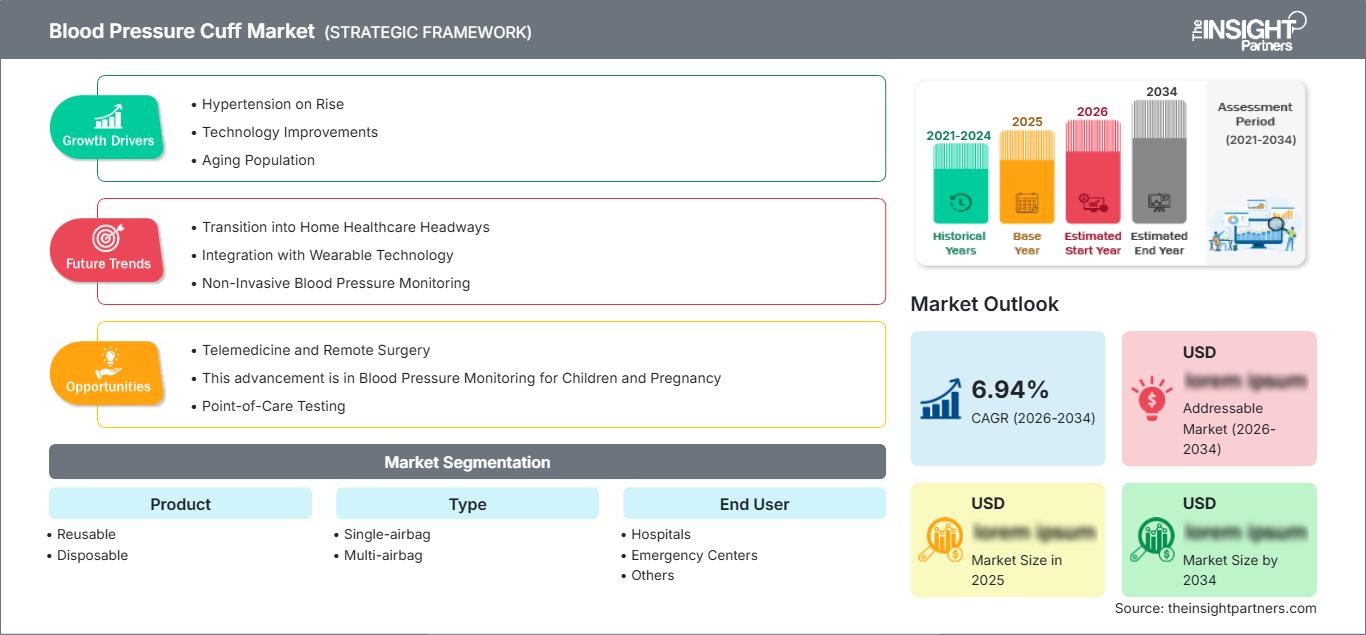
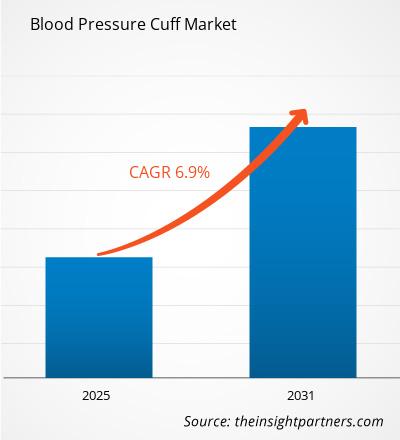
The Blood Pressure Cuff Market size was worth US$ 1.6 billion in 2025 and is expected to be worth US$ 2.96 billion by 2034, growing at a CAGR of 7.10% between 2026–2034. The market shows sustained demand for reliable and non-invasive blood pressure monitoring in hospitals, emergency facilities, out-patient departments, and home-based clinical settings.
North America continues to witness strong adoption, and the Blood Pressure Cuff Market value in the region can be attributed to factors such as hospital turnover, hypertension screening, and integration with the vital sign monitoring workflow. The region is forecast to grow at a CAGR of 6.6-7.0% between 2026-2034, owing to a higher installed base of patient monitors, reimbursement for ambulatory blood pressure monitoring, and validated cuff demand.
Blood Pressure Cuff Market Assessment and Insights
- North America accounted for 34–38% Blood Pressure Cuff Market share in 2025 and is expected to grow at a CAGR between 6.6–7.0% during 2026–2034, supported by acute-care procurement, ambulatory monitoring adoption, and replacement of aging cuff inventories.
- US represented 78–82% of North America in 2025 and is expected to grow at a CAGR between 6.5–6.9% during 2026–2034, led by hospital networks, home monitoring programs, and OEM integration.
- Europe held 24–28% share in 2025 and is projected to grow at a CAGR between 6.4–6.8% during 2026–2034, with Germany, the UK, France, Italy, and Spain leading demand through structured cardiovascular screening.
- Asia Pacific accounted for 22–26% share in 2025 and is forecast to grow at a CAGR between 8.0–8.6% during 2026–2034, with China, Japan, South Korea, India, and Australia expanding clinical and primary-care measurement capacity.
- Largest Segment reusable cuffs held 56–60% market share in 2025 and are expected to grow at a CAGR between 6.6–7.0% during 2026–2034, reflecting installed-base replacement and cost efficiency.
- High Growth Segment disposable cuffs held 40–44% market share in 2025 and are expected to grow at a CAGR between 7.8–8.4% during 2026–2034, driven by infection-control protocols and high-throughput settings.
- Key companies analyzed in detail: Spacelabs Healthcare, SunTech Medical, Welch Allyn, Inc., SCHILLER AG, Cardioline S.p.A., Mortara Instrument, Inc., Contec Medical Systems Co., Ltd., Rudolf Riester GmbH, Daray Medical Ltd, and Vasomedical, Inc.
Source: The Insight Partners' analysis based on proprietary research, government publications, company annual reports, investor presentations, industry databases, and expert interviews.
Technology migration trends include validated cuff design, soft materials for patient contact, reusable/disposable balance and incorporation into automated monitors. The dynamics of production of cuffs are likely to shift to dual sourcing, regional finishing and enhanced quality control after health care systems have faced shortages of disposable and reusable cuffs. OEM cooperation is still relevant, because cuffs need to work with monitors in adult, pediatric, neonatal and emergency workflows.
During the forecast period, hospital upgrades in the Asia Pacific region, purchasing programs in the Middle East, and disease management in the outpatient setting will increase the application of cuffs beyond conventional ward measurement. Regulatory demands for validated blood pressure measurements, increased requirements for infection prevention and targets for hypertension control will be met by suppliers offering cuffs with clinical accuracy, wide range of sizes and regular supplies.
Blood Pressure Cuff Market Report Scope
| Report Attribute | Details |
|---|---|
| Market size in 2025 | US$ 1.6 Billion |
| Market Size by 2034 | US$ 2.96 Billion |
| Global CAGR (2026 - 2034) | 7.10% |
| Historical Data | 2021-2024 |
| Forecast period | 2026-2034 |
Blood Pressure Cuff Market Analysis
The market expansion is driven more by increased measurement rates from clinical use than by device replacement alone. Hypertension is common among many adults in the world, and there is increasing use of blood pressure measurement in triage, inpatient admissions, emergencies, dialysis procedures, surgical operations, and at-home chronic disease monitoring programs. The need for cuffs that retain accuracy after cleaning and wide arm size range and the ability to interface with patient monitors arises in such a context.
Suppliers of fabric, bladder and tubing, monitor OEMs, distributors, hospital purchasing groups, and regulatory quality professionals make up the ecosystem. The supply chain is sensitive to material availability, sterilization requirements, and product label information. Failure rates, cuff monitor compatibility, infection control guidelines, and SKU simplification are being evaluated by buyers due to substitution avoidance and training ease considerations.
The Blood Pressure Cuff Market analysis indicates competition that is defined by installed monitor bases, clinical validation, and channel access. Welch Allyn, Inc., SunTech Medical, and Spacelabs Healthcare compete strongly due to their relationships with hospitals and monitor compatibility, whereas SCHILLER AG, Cardioline S.p.A., and Mortara Instrument, Inc. have the advantage of operating within the diagnostic cardiology ecosystem. Contec Medical Systems Co., Ltd., Rudolf Riester GmbH, Daray Medical Ltd, and Vasomedical, Inc. cater to various value-added and specialty applications and procurement requirements.
Current strategic positioning is shifting from supply assurance to continuity assurance and workflow integration. Manufacturers focus on wider cuff size offerings, reusability with durable materials, as well as disposables that correspond to infection control guidelines. Companies with strong manufacturing capabilities, open communication of allocation processes, and accessories for ambulatory, emergency, and perioperative use will be able to protect their market share and margins.
● REPORT CUSTOMIZATION
Tailor This Report To Align With Your Specific Business Requirements
This report can be customized to align precisely with your business objectives, scope, and target markets. Customization options include tailored segmentation, geography, competitive analysis, and strategic insights to support informed decision-making.
Customize This Report →WHAT YOU CAN ADJUST
- ● Segmentations
- ● Geography
- ● Competitive Analysis
- ● Language Preferences
Blood Pressure Cuff Market: Strategic Insights
Regional Insights
North America Blood Pressure Cuff Market
North America had a share of 34-38% in the Blood Pressure Cuffs Market in 2025 and is estimated to exhibit a CAGR of 6.6-7.0% over 2026-2034. The demand in North America will be driven by high penetration of patient monitoring devices, screening for hypertension, emergency diagnosis, and replacement of cuffs that accompany multi-parameter monitors. There is a need for different cuff sizes in hospitals.
The uptake in the region will be driven by guidelines-driven diagnosis, ambulatory blood pressure monitoring, and hygiene in intensive care units, cardiology outpatient care, and emergency rooms. Vendors offering clinical validation, latex-free products, disposables, reusables, and cleaning procedures are favored in North American procurement processes.
U.S. Blood Pressure Cuff Market
In 2025, the U.S. accounted for 78%-82% of the North American market and will continue to grow at a CAGR of 6.5%-6.9% between 2026-2034. There will be the highest demand for this device in integrated delivery networks, ambulatory surgery centers, emergency departments, and home health monitoring applications. The company presence is substantial with Welch Allyn, Inc., Spacelabs Healthcare, and SunTech Medical servicing the clinical and OEM markets.
The technology trend is towards automation in vital signs documentation, ambulatory blood pressure monitoring, and standardization of cuff selection in large hospital networks. Also, there is a trend of patient safety programs promoting accurate cuff selection and measurements. Buyers in the U.S. are becoming increasingly aware of total life-cycle costs, supply chain reliability, and monitor compatibility.
Europe Blood Pressure Cuff Market
Europe held 24–28% market share in 2025 and is projected to witness a CAGR of 6.4–6.8% over 2026–2034. Germany leads owing to hospital facilities, high quality devices requirements, and cardiovascular diagnostics prevalence. In the UK, drivers include primary-care BP checks, community-based prevention initiatives, and NHS procurement focusing on standardization of consumables.
The German market is defined by the prevalence of reusable cuffs, validated ambulatory monitoring solutions, and purchases driven by cardiology clinics and hospitals. Purchasers seek regulatory compliance, durability during the cleaning process, and compatibility with monitors from European diagnostics brands such as SCHILLER AG and Cardioline S.p.A., rewarding vendors with proper documentation.
Public hospital procurement in France, improvements in the emergency care system and outpatient cardiovascular screening in France, Italy, and Spain. France is witnessing stable purchase of hospital-grade cuffs, whereas Italy and Spain offer growth opportunities via the replacement cycle and private clinics' investments. Regional players compete via deep distribution networks, servicing capabilities, and multilingual documentation for clinical training.
APAC Blood Pressure Cuff Market
The APAC region captured 22%–26% market share in 2025 and is anticipated to witness the highest CAGR of 8.0%–8.6% during 2026–2034. In the APAC region, China dominates the market owing to hospital growth and domestic monitor manufacturing, whereas Japan and South Korea focus on validation and elderly care.
Demand in India and Australia comes from screening initiatives for primary health care and management of chronic diseases and emergencies. Some of the factors driving industrial growth in the APAC region are local manufacturing capacity, competitive costs of manufacturing cuffs, and OEMs' supply chains. Public and private healthcare sectors have initiatives that detect hypertension and noncommunicable diseases.
Middle East & Africa Blood Pressure Cuff Market
The Middle East & Africa market is expected to grow at a CAGR of 6.8–7.4% during 2026–2034. Saudi Arabia is the leading country, supported by hospital construction, digital health investment, and tertiary-care expansion. The UAE shows demand for premium monitoring systems in private hospitals and specialty clinics.
South Africa and the Rest of MEA require cost-efficient, durable cuffs for public hospitals, emergency care, and mobile screening. Energy-linked infrastructure investment in Gulf countries supports healthcare facility upgrades, while broader regional needs center on basic cardiovascular detection. Supplier success depends on distributor networks, training, and dependable availability across varied care settings.
Segmentation Analysis
Product
The Product segment is expected to grow at a CAGR of 6.9–7.3% during 2026–2034. Blood Pressure Cuff Market scope across product categories is shaped by infection-control requirements, replacement frequency, and total cost of ownership. Reusable cuffs dominate in routine wards and outpatient clinics, while disposable cuffs gain traction where cross-contamination risk and throughput are higher.
- Reusable cuffs hold the leading position because hospitals prioritize durability, repeated cleaning, and lower per-use cost across inpatient wards, clinics, and diagnostic departments where patient turnover is manageable.
- Disposable cuffs are strategically important in emergency, intensive care, isolation, and perioperative settings, where infection-prevention protocols and staff efficiency justify higher recurring consumable use.
Type
The Type segment is projected to grow at a CAGR of 6.8–7.2% during 2026–2034. Digital and automated measurement workflows are influencing single-airbag and multi-airbag selection. Single-airbag cuffs remain common because of broad compatibility and cost efficiency, while multi-airbag designs support measurement consistency in selected clinical environments requiring improved fit and pressure distribution.
- Single-airbag cuffs remain widely used due to lower complexity, broad monitor compatibility, and suitability for routine adult, pediatric, and emergency blood pressure measurement across healthcare facilities.
- Multi-airbag cuffs address specialized measurement needs where improved conformance, patient comfort, and pressure distribution can support more reliable readings in complex or high-acuity care environments.
End User
The End User segment is expected to grow at a CAGR of 7.0–7.5% during 2026–2034. Hospitals remain the largest demand center because cuffs are used across admission, wards, operating rooms, intensive care, and discharge workflows. Emergency centers show strong replacement needs because devices experience high turnover, rapid cleaning cycles, and frequent use across diverse patient sizes.
- Hospitals generate high revenue contribution because they require multiple cuff sizes, validated compatibility, reusable and disposable options, and inventory redundancy across departments and patient monitoring systems.
- Emergency Centers show strong strategic importance as rapid triage, ambulance transfer, urgent procedures, and infection-control pressures increase demand for reliable cuffs with fast availability.
Opportunity Snapshot
| Segment Name | Revenue Contribution | Trend Tag | Adoption Stage |
| Hospitals | High | Ward Standardization | Mature |
| Emergency Centers | Medium | Rapid Triage | Scaling |
| Others | Low | Community Screening | Emerging |
Blood Pressure Cuff Market Growth Drivers and Impact Analysis
Rising Hypertension Screening Across Care Settings
There is a trend towards increasing the number of procedures performed, which contributes to the increased need for cuffs, as blood pressure measurement is the primary gateway for cardiovascular disease detection. WHO reports that there is a significant percentage of the adult population suffering from hypertension and the healthcare system is aiming for early detection through regular checks in primary care settings, workplaces, pharmacists, and outpatient cardiology. There is increased demand for affordable cuffs that are appropriately sized, validated, and convenient to use. The impact on the market is highest in facilities where measurement is more frequent than new equipment acquisition.
Infection-Control Requirements in High-Throughput Facilities
Clinical monitoring systems are becoming more reliant on complementary cuff accessories to give accurate readings in standard clinical conditions. OEM compatibility is essential since hospitals will be needing cuffs that will fit seamlessly into their clinical monitoring systems such as the bedside monitors, transport monitors, ambulatory blood pressure monitors, and the vital signs monitors. The market implication will become evident when purchasing involves bundles of the monitor, accessories, replacements, and maintenance services. Companies with proven compatibility and wide ranges of sizes will be guaranteed ongoing sales of consumables once the monitors have been installed.
OEM Integration with Automated Patient Monitoring
Patient monitoring systems increasingly depend on compatible cuff accessories that deliver reliable readings under routine clinical conditions. OEM integration matters because hospitals want cuffs that work seamlessly with bedside monitors, transport monitors, ambulatory blood pressure devices, and vital-signs carts. The market impact is visible in procurement decisions that bundle monitors, accessories, replacements, and service support. Suppliers with validated compatibility and broad size ranges can lock in repeat consumable demand after monitor installation. This favors companies with strong engineering documentation, hospital service relationships, and channels capable of supporting recurring accessory replacement across large networks.
Blood Pressure Cuff Market Future Trends
Shift Toward Data-Ready Measurement Accessories
Blood Pressure Cuff market trends will begin to show the need for accessories that enable documentation and remote monitoring via technology. While the cuffs themselves will continue to be mechanical products that come into contact with patients, their utility will be measured by their ability to accurately measure in the context of a system. In terms of hospital purchases, there is an opportunity for companies to produce cuffs that minimize repeat measurements, help with proper cuff size, and function well with equipment that populates the EHR.
Greater Use of Size-Inclusive and Patient-Comfort Designs
Future product development will include size flexibility, bariatric measurement, pediatric comfort, and low inflation discomfort. Mismatched sizes of the cuffs could provide false readings, thus increasing the risks to the patient and the need for repeated measurements. Providers will be required to expand their cuff options, make their markings better, and design materials which hold the cuffs in position without putting excess pressure. Designs involving multi-airbags and focus on comfort may be preferred in instances where there is movement or anxiety during the process of reading.
Blood Pressure Cuff Market Opportunities
Hospital Network Standardization Programs
Health systems offer a strong opportunity for suppliers that can standardize cuff portfolios across multiple facilities. Large networks seek fewer SKUs, compatible connectors, reliable replenishment, and clear cleaning instructions. Blood Pressure Cuff Market Forecasts suggest that procurement will increasingly reward vendors able to reduce variation across wards, emergency departments, and outpatient clinics. The opportunity requires action beyond product selling. Companies should support inventory audits, size-mix planning, staff training, and monitor compatibility mapping. Vendors that demonstrate lower stockouts, fewer substitutions, and improved measurement consistency can convert standardization projects into recurring contracts with predictable replacement demand.
Expansion in Community and Primary-Care Screening
Community screening creates an investment opportunity in durable, affordable cuffs designed for high-frequency use outside tertiary hospitals. Public health programs, clinics, pharmacies, employer health checks, and mobile medical units need products that are easy to clean, simple to size, and compatible with automated devices. Growth potential is especially relevant in Asia Pacific, the Middle East, Africa, and rural markets where hypertension detection gaps remain high. Suppliers can compete by offering bundled kits, distributor training, multilingual instructions, and replacement programs. Success will depend on balancing price sensitivity with clinical reliability and long-term availability.
Recent Developments
- July 2025: SunTech Medical announced the launch and availability of the Vet40 Portable Multiparameter Monitor for companion animals and equine patients. The device includes non-invasive blood pressure capability using SunTech’s Advantage Vet blood pressure technology, supports automatic readings at programmed intervals, and stores up to 960 data points for veterinary clinical workflows.
- May 2025: Baxter Healthcare Corporation announced that Welch Allyn FlexiPort Disposable blood pressure cuffs were no longer on allocation effective May 12, 2025. The company stated that capacity expansion included one U.S. blood pressure cuff machine already operational and another installed at a U.S.-based production location for late-May operation.
- April 2025: OSI Systems, Inc. announced that its healthcare division, Spacelabs Healthcare, received an approximately US$ 4 million award from an existing U.S.-based customer. The agreement covered patient monitoring solutions and related supplies and accessories, reinforcing Spacelabs Healthcare’s role in hospital monitoring infrastructure and recurring accessory supply.
Frequently Asked Questions

- Comprehensive Market Sizing and Forecast Analysis
- Detailed Segmentation Analysis
- In-Depth Market Dynamics Assessment
- Regional and Country-Level Insights
- Competitive Landscape and Company Benchmarking
- Strategic Business Intelligence
Recent Reports
Testimonials

The Insight Partners provided valuable market intelligence that supported our global go-to-market strategy. Their team was professional, responsive, and attentive to our feedback, providing thoughtful analysis and helpful methodological clarifications throughout the project.
Junmo Kim Chief Financial Officer (CFO), Enertech Co., Ltd.
The Insight Partners' SCADA System Market report is comprehensive, with valuable insights on current trends and future forecasts. The team was highly professional, responsive, and supportive throughout. We are very satisfied and highly recommend their services.
RAN KEDEM Partner, Reali Technologies LTDs
I requested a report on a very specific software market and the team produced the report in a few days. The information was very relevant and well presented. I then requested some changes and additions to the report. The team was again very responsive and I got the final report in less than a week.
JEAN-HERVE JENN Chairman, Future Analytica
We worked with The Insight Partners for an important market study and forecast. They gave us clear insights into opportunities and risks, which helped shape our plans. Their research was easy to use and based on solid data. It helped us make smart, confident decisions. We highly recommend them.
PIYUSH NAGPAL Sr. Vice President, High Beam Global
The Insight Partners delivered insightful, well-structured market research with strong domain expertise. Their team was professional and responsive throughout. The user-friendly website made accessing industry reports seamless. We highly recommend them for reliable, high-quality research services
YUKIHIKO ADACHI CEO, Deep Blue, LLC.
This is the first time I have purchased a market report from The Insight Partners.While I was unsure at first, I visited their web site and felt more comfortable to take the risk and purchase a market report.I am completely satisfied with the quality of the report and customer service. I had several questions and comments with the initial report, but after a couple of dialogs over email with their analyst I believe I have a report that I can use as input to our strategic planning process.Thank you so much for taking the extra time and making this a positive experience.I will definitely recommend your service to others and you will be my first call when we need further market data.
JOHN SUZUKI President and Chief Executive Officer, Board Director, BK Technologies
I wish to appreciate your support and the professionalism you displayed in the course of attending to my request for information regarding to infectious disease IVD market in Nigeria. I appreciate your patience, your guidance, and the fact that you were willing to offer a discount, which eventually made it possible for us to close a deal. I look forward to engaging The Insight Partners in the future, all thanks to the impression you have created in me as a result of this first encounter.
DR CHIJIOKE ONYIA MANAGING DIRECTOR, PineCrest Healthcare Ltd.Reason to Buy
- Informed Decision-Making
- Understanding Market Dynamics
- Competitive Analysis
- Identifying Emerging Markets
- Customer Insights
- Market Forecasts
- Risk Mitigation
- Boosting Operational Efficiency
- Strategic Planning
- Investment Justification
- Tracking Industry Innovations
- Aligning with Regulatory Trends





 Get Free Sample for