
Blood Processing Consumables Market Share, Demand & Growth by 2034
Coverage: By Product Type (Blood Administration Sets, Blood Bags, Blood Collection Needles, Blood Collection Tubes, Blood Filters, Blood Lancets, Blood Grouping Reagents, Blood Coagulation Reagents, Others); End User (Hospitals and Clinics, Blood Banks, Diagnostic Laboratories, Others) , and Geography (North America, Europe, Asia Pacific, and South and Central America)
- Status : Data Released
- Report Code : TIPRE00022292
- Category : Life Sciences
- No. of Pages : 150
- Available Report Formats :


- Last update date : July 30, 2026


2025 Market Size
US$ 22.57 Bn
Base year value
2034 Forecast
US$ 37.80 Bn
Projected by 2034
CAGR 2026-2034
5.90 %
Growth rate
Addressable Market
US$ 273.53 Bn
(2026-2034)
The Blood Processing Consumables Market Size will reach US$ 37.80 billion by 2034, up from US$ 22.57 billion in 2025, growing at a CAGR of 5.90%. This growth will be due to increased transfusions, increased diagnostic tests, and increased usage of sterile single-use consumables in blood processing procedures. Hospitals, blood banks, and laboratories are the key areas of purchase.
In North America, the purchasing trends are anticipated to stay consistent over the coming years, with a CAGR of 5.4-5.8% over 2026–2034. Factors determining Blood Processing Consumables Market Size in the region include high procedural volumes, organized blood collection practices, stringent hemovigilance protocols, and repeated replacement needs of blood bags, collection tubes, filters, and administration sets used in blood processing procedures.
Blood Processing Consumables Market Assessment and Insights
- North America: Share in 2025 is estimated at 37–39%, growing at a CAGR between 2026–2034 of 5.4–5.8%, supported by mature transfusion infrastructure, high surgical intensity, and standardized collection protocols across hospitals and blood centers.
- US: Share in 2025 is estimated at 81–84% of North America, growing at a CAGR between 2026–2034 of 5.3–5.7%, led by hospital-based transfusion demand and organized blood services.
- Europe: Share in 2025 is estimated at 27–29%, growing at a CAGR between 2026–2034 of 5.2–5.6%, with Germany, the UK, and France leading through centralized blood services and strict quality systems.
- Asia Pacific: Share in 2025 is estimated at 23–25%, growing at a CAGR between 2026–2034 of 6.8–7.2%, led by China, Japan, India, South Korea, and Australia as blood screening and hospital capacity expand.
- Largest Segment: Blood Bags held a market share range of 24–27% in 2025, with a CAGR range of 5.7–6.1% during 2026–2034 due to recurring use in collection and storage.
- High Growth Segment: Blood Collection Tubes held a market share range of 15–18% in 2025, with a CAGR range of 6.6–7.0% during 2026–2034 as diagnostic testing decentralizes.
- Key companies analyzed in detail: bioMérieux SA, Abbott Laboratories, Bio-Rad Laboratories, Inc., Becton, Dickinson and Company, F. Hoffmann-La Roche Ltd, Danaher Corporation, Immucor, Inc., ThermoGenesis Holdings, Inc., Grifols, S.A., Terumo Corporation
Source: The Insight Partners' analysis based on proprietary research, government publications, company annual reports, investor presentations, industry databases, and expert interviews.
There is a shift from simple collection supplies to advanced, quality-controlled consumable systems to minimize the risk of contamination, facilitate traceability, and enable component therapy. Blood Processing Consumables Market manufacturers are gearing up for manufacturing of closed-system bags, preanalytical tubes, leukoreduction filters, and suitable reagents. The dynamics of manufacturing are favoring validated polymers, automated packages, and localized supply chains due to the priority given to continuity after recent disruptions in medical devices distribution.
Moving forward, growth in the market will be driven by the modernization of blood services in developing countries, investments in diagnostic laboratories, and a regulatory focus on transfusion safety. WHO figures show that there are over 120 million blood donations worldwide annually, demonstrating the cyclical nature of demand for consumables. Countries that are improving their universal health coverage, traumatology, oncology, and maternal care will need standardized blood processing supplies.
Blood Processing Consumables Market Report Scope
| Report Attribute | Details |
|---|---|
| Market size in 2025 | US$ 22.57 Billion |
| Market Size by 2034 | US$ 37.80 Billion |
| Global CAGR (2026 - 2034) | 5.90% |
| Historical Data | 2021-2024 |
| Forecast period | 2026-2034 |
Blood Processing Consumables Market Analysis
Demand is driven by the recurring nature of clinical need as opposed to discretionary spending. The factors driving the Blood Processing Consumables Market include increased elective surgery, use of emergency rooms, treatments for cancers, and management of chronic hematological diseases. For each collected unit there will be a need for needles, tubes, bags, filters, reagents, and administering materials.
Supply side trends are becoming more focused on the capabilities for sterilization, resins, quality auditing, and documentation. Companies that have extensive SKU ranges can better serve hospitals and centralized blood banks. At the same time, purchasing agents are moving from sole reliance on pricing to lifetime performance, lot traceability, and compatibility with testing/processing systems.
Blood Processing Consumables Market analysis shows an environment in which size, regulatory experience, and laboratory process integration are crucial. Access to collections via specimen management solutions has been improved by Becton, Dickinson and Company, while competition among Grifols, S.A., Bio-Rad Laboratories, Inc., and Immucor, Inc. exists in immunohematology and blood grouping processes. Terumo Corporation and ThermoGenesis Holdings, Inc. have addressed requirements for collection, processing, and cellular therapy adjacent needs.
Trends show the need for automation-friendly consumables, closed systems which are sterile, and reagents that decrease the number of tests that are required to be done. Pull-through from diagnostic installed bases is helping Abbott Laboratories, F. Hoffmann-La Roche Ltd, Danaher Corporation, and bioMérieux SA. Consequently, strategic focus should shift towards bundled solutions, services, quality-assurance documentation, and supply-chain robustness.
● REPORT CUSTOMIZATION
Tailor This Report To Align With Your Specific Business Requirements
This report can be customized to align precisely with your business objectives, scope, and target markets. Customization options include tailored segmentation, geography, competitive analysis, and strategic insights to support informed decision-making.
Customize This Report →WHAT YOU CAN ADJUST
- ● Segmentations
- ● Geography
- ● Competitive Analysis
- ● Language Preferences
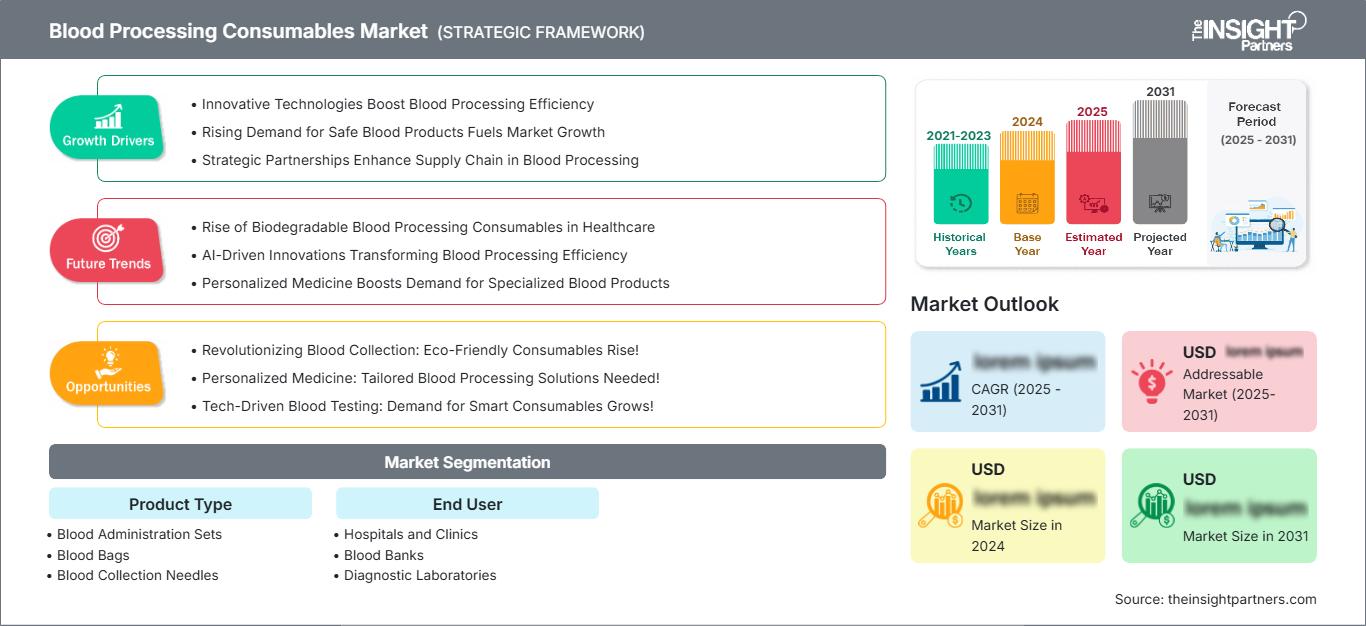
Blood Processing Consumables Market: Strategic Insights
Regional Insights
North America Blood Processing Consumables Market
North America accounted for an estimated 37–39% share in 2025 and is expected to register a CAGR range of 5.4–5.8% during 2026–2034. The region benefits from mature hospital networks, organized donor systems, and consistent use of leukoreduction, blood typing, coagulation testing, and sterile transfusion administration products. Blood Processing Consumables Market share in North America is also reinforced by regular product replacement cycles.
Demands for the area have been dictated by the high volume of surgeries, cancer treatments, trauma care, and treatment of chronic illnesses. U.S. and Canadian health care providers are continuously improving their sample collection and transfusion processes to minimize manual errors. Companies that can demonstrate validated manufacturing capabilities, FDA clearance of their products, and distribution facilities have a good market standing.
U.S. Blood Processing Consumables Market
The U.S. accounted for an estimated 81-84% share of North America in 2025 and is anticipated to expand with a CAGR range of 5.3-5.7% from 2026-2034. The demand will be driven by hospital transfusion services, blood banks, oncology associations, and expansion of outpatient diagnostics. Daily demand for red cells, platelets, and plasma, as indicated by the CDC and American Red Cross, reflect a continuous purchase cycle.
Company footprint is well established within the segment for collection devices, reagents, diagnostics, and processing supplies. Becton, Dickinson and Company, Abbott Laboratories, Bio-Rad Laboratories, Inc., Terumo Corporation, and Grifols, S.A. have a solid presence in the U.S. market. Trends in applications include capillary blood collection, automated immunohematology, platelet source augmentation, and processing equipment with software connectivity.
Europe Blood Processing Consumables Market
The European region is predicted to account for 27–29% in 2025 and is forecast to grow at a CAGR of 5.2–5.6% in the period 2026–2034. Germany is one of the key countries owing to high hospital density, well-established transfusion practices and laboratory automation.
The UK sustains its market based on national blood services and procurement practices within hospital trusts. France, Italy and Spain have stable growth owing to public healthcare system, oncology demand and regionalized blood collection structure. France has strong focus on hemovigilance and compatibility testing; Italy has hospital renewal and Spain supports centralized blood banking. Across Europe, CE marking of consumables, MDR compliance, and quality documentation are critical when selecting suppliers and tenders.
APAC Blood Processing Consumables Market
APAC had an approximate share of 23-25% in 2025 and is expected to grow within a range of 6.8-7.2% CAGR from 2026-2034. China dominates regional growth, backed by development in hospitals, blood stations, and screening. Advanced transfusion quality is the concern for Japan and South Korea, whereas India concentrates on collections and diagnostics accessibility.
Australia supports demand by providing regulated blood services with high clinical standards. Health policy priorities include universal health coverage, maternal care, trauma system, and infectious diseases screening; thus, leading to higher adoption of consumables. Additionally, local production, import replacement, and the expansion of private diagnostic chains influence purchase decisions in Asia's healthcare industry.
Middle East & Africa Blood Processing Consumables Market
The Middle East & Africa is projected to witness a CAGR of 5.8–6.2% from 2026 to 2034. Saudi Arabia is the leader in the region, driven by investment in hospital infrastructure, tertiary care, and medical cities. The UAE ranks second, owing to its advanced private healthcare sector and laboratory consolidation, while South Africa drives the growth in Sub-Saharan Africa.
Public investments in healthcare facilities in Gulf nations, driven by energy sector investments, drive hospital procurement, while the lack of infrastructure in Africa is an impediment. The Rest of the MEA market depends on donor acquisition, blood unit safety, and diagnostics. Growth will depend on training, reliable cold chains, and low cost of collection and administration equipment.
Segmentation Analysis
Product Type
The Product Type segment is expected to grow at a CAGR range of 5.8–6.2% during 2026–2034. Blood Processing Consumables Market scope across product categories covers collection, storage, filtration, administration, grouping, and coagulation testing. Demand is strongest for products that reduce contamination, improve component quality, and support standardized pre-analytical workflows in hospitals, blood banks, and diagnostic laboratories.
- Blood Administration Sets: These products are essential for safe transfusion delivery and remain mature purchases in hospitals, where replacement demand is linked to inpatient care, surgery, emergency medicine, and oncology treatment.
- Blood Bags: Blood bags represent the largest segment, supported by whole blood collection, component separation, storage needs, and closed-system handling requirements across national blood services and hospital-based blood banks.
- Blood Collection Needles: Collection needles are critical at donor and diagnostic touchpoints, with demand influenced by safety-engineered designs, donor comfort, phlebotomy efficiency, and measures to reduce needlestick injuries.
- Blood Collection Tubes: Tubes are gaining strategic importance as diagnostic testing expands, with demand tied to pre-analytical quality, automation compatibility, sample stability, and decentralized collection in outpatient settings.
- Blood Filters: Filters support leukoreduction and transfusion safety, particularly in regions applying strict hemovigilance practices and in hospitals treating immunocompromised, neonatal, surgical, and oncology patients.
- Blood Lancets: Lancets serve point-of-care and capillary sampling needs, with demand supported by screening programs, outpatient diagnostics, pediatric collection, and preference for minimally invasive sample acquisition.
- Blood Grouping Reagents: These reagents are central to compatibility testing and transfusion safety, with demand linked to immunohematology automation, donor screening, antenatal testing, and complex patient matching.
- Blood Coagulation Reagents: Coagulation reagents support assessment of bleeding risk, anticoagulant monitoring, and perioperative care, making them strategically important for laboratories serving hospitals and emergency departments.
End User
The End User segment is expected to grow at a CAGR range of 5.7–6.1% during 2026–2034. Demand varies by institutional workflow, with hospitals consuming administration and testing products, blood banks prioritizing collection and processing systems, and diagnostic laboratories increasing tube and reagent utilization. Procurement decisions increasingly weigh reliability, regulatory compliance, and supplier ability to support uninterrupted clinical workflows.
- Hospitals and Clinics: Hospitals and clinics generate high revenue contribution through transfusion administration, pre-surgical testing, emergency care, oncology treatment, and routine diagnostics that require diverse consumables daily.
- Blood Banks: Blood banks are strategically important because they purchase bags, needles, filters, and testing reagents in volume, with demand shaped by donor activity and component processing requirements.
- Diagnostic Laboratories: Diagnostic laboratories show expanding adoption as test volumes rise, automation increases, and outpatient collection networks require standardized tubes, lancets, reagents, and quality-controlled workflows.
Opportunity Snapshot
| Segment Name | Revenue Contribution (High/Medium/Low) | Trend Tag (MAX 2 words, specific) | Adoption Stage (Emerging/Scaling/Mature) |
| Hospitals and Clinics | High | Transfusion Safety | Mature |
| Blood Banks | High | Component Processing | Scaling |
| Diagnostic Laboratories | Medium | Sample Automation | Scaling |
Blood Processing Consumables Market Growth Drivers and Impact Analysis
Rising Transfusion Demand Across Acute and Chronic Care
The transfusion requirement is persistent because blood products cannot be synthesized artificially and must be continually obtained, processed, stored, and administered. WHO data on over 120 million blood donations made worldwide indicates the extent of the operational infrastructure which uses such items as bags, syringes, tubes, filters, and reagents. With increasing specialization in the fields of oncology, heart surgery, trauma, maternal bleeding control, and hematology treatments, the demand for safe component therapy increases. The greatest influence on the market is seen in hospitals and blood banks, where constant preparedness of their stock is a necessity.
Expansion of Diagnostic Testing and Pre-analytical Quality Controls
Diagnostic labs are also turning into heavy consumers of blood handling consumables due to the shift towards high throughput analyzers and the use of distributed sampling sites. Pre-analytical quality is becoming an integral part of clinical accuracy, particularly for coagulation, blood grouping, infectious diseases screening, and crossmatch tests. Consumables like tubes, lancets, and reagents that promote sample stability and compatibility with analyzers minimize redraws and help improve lab efficiency. This factor is particularly significant for out-patient networks, urgent care facilities, and developing countries with increasing test availability. Providers that package consumable collection tools with validation, training, and analyzer-compatibility information become more relevant in procurement, as labs evaluate total performance rather than price per unit.
Regulatory Focus on Hemovigilance and Infection Risk Reduction
The global blood safety initiatives remain concerned about traceability, donor screening, sterility, and surveillance of transfusion-related adverse reactions. This regulatory trend promotes the use of closed systems of blood bags, leukoreduction filters, quality tubes for blood collections, and grouping reagents. The result can be observed from the requests for quality certification, batch identification, and proven compatibility with existing processes. Markets with evolving blood services infrastructure adopt such standards in a gradual way, thus creating a steady demand for quality consumables. In developed markets, hemovigilance requirements necessitate product substitution and the avoidance of non-certified consumables.
Blood Processing Consumables Market Future Trends
Automation-Compatible Consumables for Blood Centers
Blood Processing Consumables Market trends suggest that automation is going to play an increasingly important role in shaping consumables. The shift towards a system where there will be reduced centrifugation through manual operations, consistent components, and connection of the processing information with the inventory management systems is underway. The new generation of consumables will have barcodes, standardized connectors, lot tracing ability, and compatibility with automatic separators and immunohematology instruments. While the trend may manifest itself first in the advanced markets, emerging blood service organizations can be expected to adopt automation modularly due to the staff shortage and growing quality requirements.
Growth of Capillary and Decentralized Collection Models
Capillary and low-volume blood collection formats are expected to expand as healthcare systems push diagnostics closer to patients. Retail clinics, physician offices, home-based care pilots, and rural outreach programs require safe collection tools that non-specialist staff can use after training. Lancets, microcollection tubes, and compact handling systems will benefit as decentralized testing grows. Adoption will depend on evidence that capillary samples deliver reliable results for selected assays, along with clear regulatory pathways. For suppliers, the opportunity lies in designing consumables that maintain sample integrity during transport, support digital labeling, and reduce dependence on conventional venipuncture infrastructure.
Blood Processing Consumables Market Opportunities
Localized Manufacturing and Supply Resilience Programs
Healthcare providers increasingly value domestic or regionally diversified supply for essential transfusion consumables. Blood Processing Consumables Market Forecasts point to opportunities for manufacturers that establish local assembly, sterilization partnerships, or dual-sourcing models in Asia Pacific, the Middle East, and selected European markets. Investment in regional capacity can reduce lead times, support public tenders, and mitigate currency or logistics risks. Governments seeking health security may favor suppliers with local compliance documentation and reliable emergency supply commitments. Companies that combine production resilience with technical service and training can capture long-term institutional contracts rather than competing only through pricing.
Bundled Solutions for Blood Banks and Laboratories
Blood banks and diagnostic laboratories are seeking vendors that can simplify procurement while improving workflow reliability. Bundled offerings that combine bags, filters, tubes, reagents, software interfaces, training, and service support can reduce validation burden and strengthen customer retention. This opportunity is relevant for suppliers with broad portfolios and application expertise across immunohematology, collection, and component processing. Smaller companies can participate through specialist products that integrate into larger platforms. Commercial success will depend on demonstrating measurable reductions in errors, turnaround time, inventory complexity, and staff workload. Value-based procurement models could therefore expand beyond capital equipment into consumable supply agreements.
Recent Developments
- June 2026: Grifols, S.A. announced Evanzys IH, a next-generation modular automated system for immunohematology sample processing. The platform was introduced during the International Society of Blood Transfusion Congress and is designed to reduce manual intervention, improve laboratory flexibility, and strengthen the company’s blood typing and transfusion medicine automation portfolio.
- December 2025: Terumo Corporation reported that Appleton’s Community Blood Center became the fifth U.S. site to implement the Reveos Automated Blood Processing System and Lumia Software Platform. The deployment supported faster component processing, reduced manual steps, and improved operational resilience for hospitals served across Wisconsin, Illinois, and Michigan’s Upper Peninsula.
- March 2025: Becton, Dickinson and Company and Babson Diagnostics announced study results showing that selected tests using BD MiniDraw capillary blood collection technology demonstrated accuracy comparable to higher-volume venous draws. The development supported broader use of low-volume collection in physician offices, urgent care settings, and accessible outpatient diagnostic environments.
Frequently Asked Questions

- Comprehensive Market Sizing and Forecast Analysis
- Detailed Segmentation Analysis
- In-Depth Market Dynamics Assessment
- Regional and Country-Level Insights
- Competitive Landscape and Company Benchmarking
- Strategic Business Intelligence
Recent Reports
Testimonials

The Insight Partners' SCADA System Market report is comprehensive, with valuable insights on current trends and future forecasts. The team was highly professional, responsive, and supportive throughout. We are very satisfied and highly recommend their services.
RAN KEDEM Partner, Reali Technologies LTDs
I requested a report on a very specific software market and the team produced the report in a few days. The information was very relevant and well presented. I then requested some changes and additions to the report. The team was again very responsive and I got the final report in less than a week.
JEAN-HERVE JENN Chairman, Future Analytica
We worked with The Insight Partners for an important market study and forecast. They gave us clear insights into opportunities and risks, which helped shape our plans. Their research was easy to use and based on solid data. It helped us make smart, confident decisions. We highly recommend them.
PIYUSH NAGPAL Sr. Vice President, High Beam Global
The Insight Partners delivered insightful, well-structured market research with strong domain expertise. Their team was professional and responsive throughout. The user-friendly website made accessing industry reports seamless. We highly recommend them for reliable, high-quality research services
YUKIHIKO ADACHI CEO, Deep Blue, LLC.
This is the first time I have purchased a market report from The Insight Partners.While I was unsure at first, I visited their web site and felt more comfortable to take the risk and purchase a market report.I am completely satisfied with the quality of the report and customer service. I had several questions and comments with the initial report, but after a couple of dialogs over email with their analyst I believe I have a report that I can use as input to our strategic planning process.Thank you so much for taking the extra time and making this a positive experience.I will definitely recommend your service to others and you will be my first call when we need further market data.
JOHN SUZUKI President and Chief Executive Officer, Board Director, BK Technologies
I wish to appreciate your support and the professionalism you displayed in the course of attending to my request for information regarding to infectious disease IVD market in Nigeria. I appreciate your patience, your guidance, and the fact that you were willing to offer a discount, which eventually made it possible for us to close a deal. I look forward to engaging The Insight Partners in the future, all thanks to the impression you have created in me as a result of this first encounter.
DR CHIJIOKE ONYIA MANAGING DIRECTOR, PineCrest Healthcare Ltd.Reason to Buy
- Informed Decision-Making
- Understanding Market Dynamics
- Competitive Analysis
- Identifying Emerging Markets
- Customer Insights
- Market Forecasts
- Risk Mitigation
- Boosting Operational Efficiency
- Strategic Planning
- Investment Justification
- Tracking Industry Innovations
- Aligning with Regulatory Trends





 Get Free Sample for