
Blood Products Market Size, Trends & Growth by 2034
Coverage: By Product Type (Platelets, Fresh Frozen Plasma (FFP), Red Blood Cells (RBCs), White Blood Cells (WBCs), Others); End User (Hospital, Blood Station, Others) , and Geography (North America, Europe, Asia Pacific, and South and Central America)
- Status : Data Released
- Report Code : TIPRE00028573
- Category : Life Sciences
- No. of Pages : 150
- Available Report Formats :


- Last update date : July 29, 2026


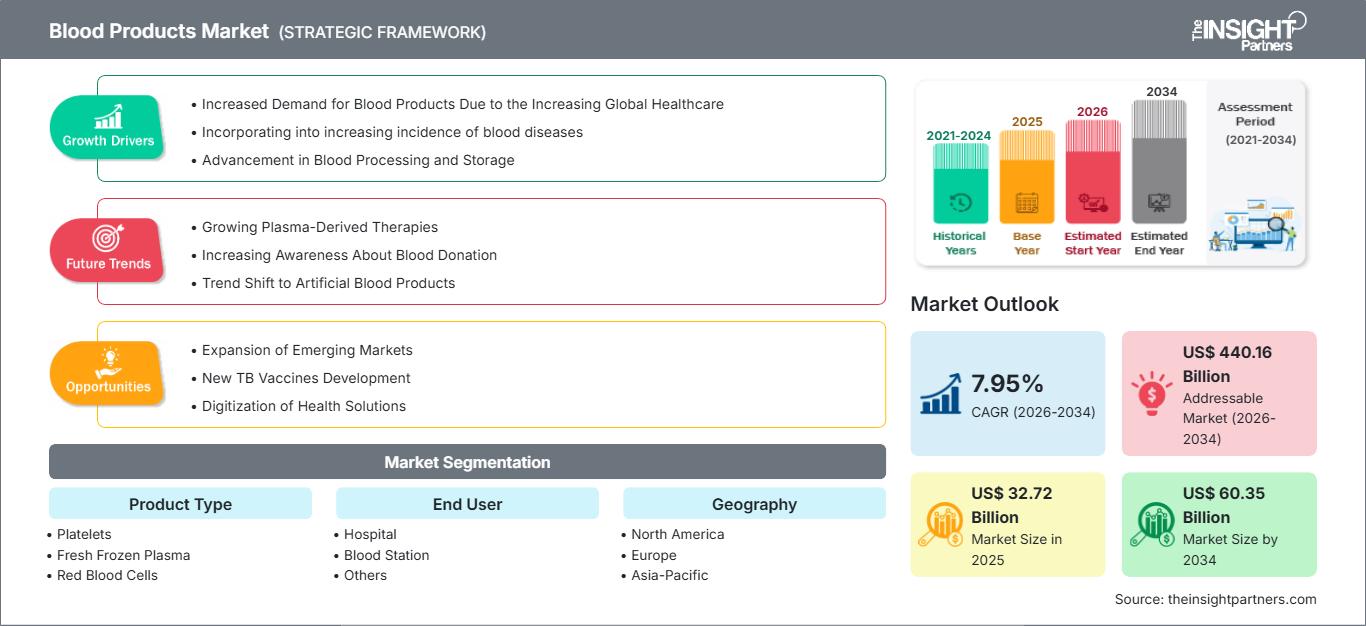
2025 Market Size
US$ 32.72 Bn
Base year value
2034 Forecast
US$ 60.35 Bn
Projected by 2034
CAGR 2026-2034
7.95 %
Growth rate
Addressable Market
US$ 440.16 Bn
(2026-2034)
The Blood Products Market is estimated to increase from US$ 32.72 Billion in 2025 to US$ 60.35 Billion by 2034 with a CAGR of 7.95%. The market is characterized by consistent demand for transfusion components, plasma derived products, and hospital-based blood support in trauma treatment, surgeries, oncology, obstetric, immunology, and hematology areas. Availability of the product, donor systems, cold chain management, and regulatory oversight are key factors contributing to the performance of the market.
In North America, the blood products market size is driven by highly developed hospitals, the volume of surgical procedures, and the presence of efficient donor collection systems. This market is forecast to register a CAGR of 7.2–7.8% over the period 2026-2034, driven by highly advanced transfusion medicine practices and plasma fractionation technologies. The development of component therapy, pathogen reduction, and digital inventory management contributes to the better use of blood.
Blood Products Market Assessment and Insights
- North America held a 39–41% Blood Products Market share in 2025 and is expected to grow at a CAGR range of 7.2–7.8% during 2026–2034, supported by hospital demand, plasma collection scale, and FDA-regulated processing networks.
- US accounted for 84–87% of North America in 2025 and is projected to grow at a CAGR range of 7.1–7.7% during 2026–2034, reflecting strong transfusion usage and manufacturer presence.
- Europe represented a 26–28% share in 2025 and is expected to grow at a CAGR range of 6.8–7.4% during 2026–2034, with Germany, the UK, France, Italy, and Spain leading regional adoption.
- Asia Pacific captured a 22–24% share in 2025 and is projected to grow at a CAGR range of 8.8–9.6% during 2026–2034, led by China, Japan, India, South Korea, and Australia.
- Largest Segment Red Blood Cells held a market share range of 40–44% in 2025 and is projected to grow at a CAGR range of 6.7–7.3% during 2026–2034.
- High Growth Segment Platelets accounted for a market share range of 16–19% in 2025 and is expected to grow at a CAGR range of 8.6–9.4% during 2026–2034.
- Key companies analyzed in detail: CSL Limited, Kedrion S.p.A., Bio Products Laboratory Limited, Octapharma AG, Mitsubishi Tanabe Pharma Corporation, Grifols S.A., Takeda Pharmaceutical Company Limited, ADMA Biologics, Inc., Kamada Ltd., Sanquin, and LFB S.A.
Source: The Insight Partners' analysis based on proprietary research, government publications, company annual reports, investor presentations, industry databases, and expert interviews.
Blood Products Market trends consist of the shift from whole-blood transfusions towards component-based therapy, apheresis automation, leukoreduction, pathogen screening, and value creation through fractionation. Demand differentiation in hospitals between the components of red blood cells, platelets, plasma, and specialty components is on the rise to prevent wastage and enhance patient matchings. The production scenario is also changing with manufacturers adopting plasma yield maximization, donor center efficiency, cold chain verification, and quality systems that meet the biologics manufacturing standards.
The industry will receive further impetus from the development of new healthcare systems in the Asia Pacific region, the Middle East, and select markets in Latin America as countries develop their blood policies. Favorable regulatory trends would include stringent hemovigilance rules, pathogen testing, and voluntary donor program investments. Gaps in global blood supply as reported by WHO underscore the need for integrated collection, processing, storage, and distribution systems.
Blood Products Market Report Scope
| Report Attribute | Details |
|---|---|
| Market size in 2025 | US$ 32.72 Billion |
| Market Size by 2034 | US$ 60.35 Billion |
| Global CAGR (2026 - 2034) | 7.95% |
| Historical Data | 2021-2024 |
| Forecast period | 2026-2034 |
Blood Products Market Analysis
The clinical need for the market growth rests on increasing number of surgeries, cancer treatments, response to trauma, care of the mother, hematological conditions, and immune deficiencies. The WHO report stating 120 million blood donations made in 2023 proves the volume of supply sources, but different donation rates among population strata demonstrate that there still exist needs that are not met. Although hospitals continue being the major nodes of demand, blood banks, plasma centers, and contract fractionators dictate supply terms.
The sustainability of supply side is based on donor acquisition, testing capacities, storage possibilities, and inventory forecasting. While red blood cells must be strictly controlled in terms of shelf life, platelets need shorter storage and plasma products rely heavily on fractionation efficiency. Therefore, the ecosystem develops towards evidence-based planning of collections, centralized testing, and regional storage balancing.
The Blood Products Market analysis indicates that the market is competitive and dominated by plasma experts, transfusion services, and biopharmaceuticals companies with regulatory expertise. The key players include CSL Limited, Grifols S.A., Takeda Pharmaceutical Company Limited, Octapharma AG, Kedrion S.p.A., and Bio Products Laboratory Limited. They use strategies such as access to blood plasma, fractionated output, geographic presence, and specialty proteins portfolio.
The investment trend is shifting towards plasma-based medicinal products, national supply, and automation technologies. The key players include ADMA Biologics, Inc., Kamada Ltd., Sanquin, LFB S.A., and Mitsubishi Tanabe Pharma Corporation. They are developing their market position by using strategies such as niche immunoglobulins, albumins, coagulation proteins, and regional supplies.
● REPORT CUSTOMIZATION
Tailor This Report To Align With Your Specific Business Requirements
This report can be customized to align precisely with your business objectives, scope, and target markets. Customization options include tailored segmentation, geography, competitive analysis, and strategic insights to support informed decision-making.
Customize This Report →WHAT YOU CAN ADJUST
- ● Segmentations
- ● Geography
- ● Competitive Analysis
- ● Language Preferences
Blood Products Market: Strategic Insights
Regional Insights
North America Blood Products Market
North America holds a 39–41% market share in 2025 and will register a compound annual growth rate range of 7.2–7.8% for the forecast period 2026–2034. The share in North America is higher due to the advanced transfusion practices, large plasma network and biologics production in the region. Hospital demand is driven by oncology, cardiovascular, transplant, and trauma care.
Additionally, the region enjoys rigorous regulations of FDA and Health Canada, automation of tests, and hemovigilance reports. The companies like CSL Limited, Grifols S.A., Takeda Pharmaceutical Company Limited, ADMA Biologics, Inc., and Kedrion S.p.A. enjoy solid commercial and manufacturing position in the region. The investment in donor center productivity, plasma yields, pathogen reduction and cold chain traceability ensures steady supply.
U.S. Blood Products Market
The U.S. accounted for 84–87% of North America in 2025 and is forecast to grow at a CAGR range of 7.1–7.7% during 2026–2034. Demand is supported by high blood component utilization in surgery, cancer therapy, emergency medicine, and chronic disease care. The country also maintains one of the world’s largest plasma collection infrastructures, giving manufacturers strong supply advantages.
The firm's presence is more prevalent in plasma therapies, immunoglobulins, albumin, and coagulation therapies. CSL Limited, Grifols S.A., Takeda Pharmaceutical Company Limited, Octapharma AG, Kedrion S.p.A., and ADMA Biologics, Inc. have operations that include U.S. sourcing, distribution arrangements, or manufacturing facilities. The application trend leans towards component management, inventory analysis, and therapy that requires plasma-based supply.
Europe Blood Products Market
Europe held a 26-28% share in 2025 and is projected to register CAGR in a 6.8-7.4% range over 2026-2034. Germany dominates the region, owing to mature transfusion medicine, consistent reimbursement environment, and significant clinical application of plasma products. The United Kingdom maintains its domestic plasma resilience via public supply and manufacturing arrangements.
Germany and the United Kingdom set regional standards concerning safety, procurement, and hospital utilization. France coordinates blood services, whereas Italy enables the manufacturing of plasma products through domestic collection and fractionation. Spain experiences stable demand from surgery, oncology, and blood service modernization.
The European Blood Alliance advocates for increased public plasma collection, aiming to increase European plasma collection from 9 million liters in 2022 up to at least 11 million liters in five years. Such policy landscape favors sovereignty and independence in supplies, minimizing imports and promoting growth.
APAC Blood Products Market
The APAC held a market share of 22–24% in 2025 and is forecast to grow with a CAGR of 8.8–9.6% from 2026–2034. The prominent countries in the region are China because of increased hospitalizations, surgical availability, and adoption of albumin and immunoglobulin treatments. Japan and South Korea fuel demand with aging population and advanced practices.
Other contributors in the region include India and Australia as a result of advancements in blood banks, voluntary blood donations, and efficient cold chain systems. Factors that drive policy development in this region are blood safety initiatives, hospital accreditation, and the development of domestic plasma processing plants.
Middle East & Africa Blood Products Market
Middle East and Africa will experience growth with a CAGR of 6.4 to 7.2% between 2026 and 2034. Saudi Arabia will be the primary market in this region. In the United Arab Emirates, there will be development in private hospitals. South Africa is going to play a critical role in providing transfusion services and blood safety regulations. The other regions in MEA are associated with trauma, maternal health, anemia, and emergency medicine.
Healthcare infrastructure funding by the energy sector in Gulf nations will help with procurement of advanced hospitals, cold chain, and specialized centers. There are many challenges facing some African markets due to lack of donor support, logistics issues, and poor testing facilities. Growth in the region is dependent on the support from public donors and regional blood banks.
Segmentation Analysis
Product Type
The Product Type segment is projected to grow at a CAGR range of 7.6–8.2% during 2026–2034. Blood Products Market scope across this segment is shaped by clinical component selection, shelf-life constraints, patient blood management, and plasma-derived therapeutic use. Demand remains broad because every component serves a distinct clinical pathway, from oxygen transport and coagulation support to immune replacement and emergency resuscitation.
- Platelets are strategically important in oncology, hematology, transplant, and major surgery because they address bleeding risk in thrombocytopenic patients and require fast turnover due to short storage duration.
- Fresh Frozen Plasma is used for coagulation factor replacement, trauma resuscitation, liver disease management, and massive transfusion protocols, making it important for emergency and critical care settings.
- Red Blood Cells maintain the largest position because they are widely used across surgery, trauma, obstetrics, oncology, anemia management, and intensive care where oxygen-carrying capacity is clinically critical.
- White Blood Cells have more selective use, mainly in specialized laboratory, immune, and therapeutic applications, with demand tied to advanced clinical protocols rather than routine transfusion.
End User
The End User segment is expected to grow at a CAGR range of 7.9–8.5% during 2026–2034. Hospitals remain the dominant users because transfusion decisions occur at the point of care, while blood stations provide essential collection, testing, processing, and distribution functions. Growth is reinforced by integrated inventory platforms, regional supply agreements, and stronger alignment between clinical demand forecasting and donor collection planning.
- Hospital users generate high revenue contribution because they manage surgeries, emergency care, oncology, obstetrics, intensive care, and chronic transfusion programs requiring multiple component categories.
- Blood Station users are strategically critical as they coordinate donor recruitment, component preparation, compatibility testing, storage, and distribution across hospitals and regional healthcare systems.
Opportunity Snapshot
| End User | Revenue Contribution | Trend Tag | Adoption Stage |
| Hospital | High | Inventory AI | Mature |
| Blood Station | High | Donor Tech | Scaling |
| Others | Low | Specialty Access | Emerging |
Blood Products Market Growth Drivers and Impact Analysis
Rising Procedure Intensity Across Hospitals
More cases of surgical intensity, trauma patients, cancer treatment, organ transplantation programs, and obstetric emergencies have increased the requirements for reliable blood components. Red blood cells are used by hospitals for oxygen delivery, platelets for managing bleeding, and plasma for correcting coagulation deficiencies. This results in an ongoing multi-component requirement for hospitals. Ageing populations in developed nations contribute to the burden of chronic diseases, whereas hospital expansion in developing nations contributes to the first-time exposure of transfusion services. The actual implications of this situation include more demand for regional inventory management, clinical blood management, and cross-matching standardization.
Plasma Supply Security and Fractionation Expansion
There is increasing strategic importance placed on plasma-derived medicines due to their use for treating immune deficiencies, critical care, liver diseases, and blood disorders. The WHO statistics indicating that many nations depend on imports of all plasma derived medicinal products indicate a structural weakness in terms of supply. To overcome such weaknesses, governments and manufacturers are increasing efforts in building up collection facilities, national plasma and fractionation facilities. Such a trend influences the industry not only in terms of volume increase but also in changing priorities in procurement towards robustness and diversification of supply.
Technology Adoption in Testing, Storage, and Traceability
Automation is improving product safety, inventory accuracy, and operational efficiency across blood collection and transfusion workflows. Nucleic acid testing, pathogen reduction, barcoding, electronic cross-match systems, and cold-chain monitoring reduce avoidable risks and help preserve component quality. Since platelets have shorter shelf lives than red blood cells and plasma, better forecasting tools can directly improve availability and reduce product expiry. The impact is especially meaningful in metropolitan hospital networks where demand fluctuates rapidly. As transfusion services digitize, suppliers that integrate data reporting, logistics visibility, and quality documentation into customer relationships can build more durable contracts.
Blood Products Market Future Trends
Data-Led Blood Utilization Management
Market trends will increasingly center on predictive inventory systems that connect donor scheduling, component processing, hospital demand, and expiry management. Advanced analytics can help blood centers anticipate platelet shortages, redirect red blood cell inventories, and balance plasma availability across regions. The next stage will involve interoperable platforms that support patient blood management programs and regulatory reporting. This shift is not only operational; it changes procurement behavior by rewarding suppliers that provide transparency and service reliability. Over time, digital utilization management should reduce wastage, improve emergency preparedness, and support value-based decisions in transfusion medicine.
Regionalization of Plasma-Derived Medicine Supply
Health systems are expected to pursue more regional control over plasma-derived therapy supply after pandemic-era disruptions and rising geopolitical concerns. Europe’s plasma collection targets, U.S. manufacturing investments, and Asian healthcare industrial policies all point toward localization of collection, processing, and stockholding. This trend will reshape partnerships between public blood services, specialist manufacturers, and national procurement agencies. It may also strengthen demand for contract fractionation and technology transfer in countries that collect plasma but lack sufficient processing infrastructure. Market participants will need adaptable compliance systems to serve multiple regulatory jurisdictions.
Blood Products Market Opportunities
Integrated Hospital and Blood Station Service Models
A major opportunity lies in combining hospital transfusion demand planning with blood station collection and distribution intelligence. Blood Products Market Forecasts indicate that providers able to offer inventory dashboards, emergency stock protocols, compatibility support, and component utilization analytics can improve customer retention. These models are particularly relevant in urban hospital clusters, where shortages in one facility may coincide with excess inventory in another. Investment should focus on interoperable software, validated storage, transport tracking, and clinical education. Companies that help health systems reduce expiry, maintain readiness, and document quality outcomes can move beyond commodity supply relationships.
Emerging Market Plasma and Component Infrastructure
Emerging economies offer investment potential in donor recruitment, apheresis capacity, testing laboratories, regional blood banks, and fractionation partnerships. Many countries still face lower donation rates than high-income systems, creating room for national programs that improve voluntary donor participation and component availability. Demand is likely to rise as oncology, trauma, cardiac surgery, and intensive care services expand. Commercial success will depend on affordability, regulatory compliance, and public-sector collaboration rather than premium pricing alone. Companies can prioritize training, cold-chain systems, quality accreditation, and supply agreements that build market access while supporting national blood safety goals.
Recent Developments
- March 2026: CSL Limited company broke ground on a US$ 1.5 billion expansion of its Kankakee, Illinois, plasma therapy manufacturing facility, building on more than US$ 3 billion invested in U.S. operations since 2018. The project is expected to add at least 300 jobs and enhance albumin and plasma-derived therapy output through advanced manufacturing capabilities.
- March 2026: Kedrion S.p.A. Biopharma activated nationwide U.S. distribution for QIVIGY, its FDA-approved 10% intravenous immunoglobulin therapy. The rollout expands access across specialty pharmacies, infusion centers, hospitals, and other care sites, strengthening the company’s immunoglobulin presence and supporting broader availability for patients requiring treatment for primary humoral immunodeficiency.
- March 2025: Octapharma AG — NHS patients received medicines manufactured by Octapharma using UK-donated plasma for the first time in almost 30 years. The milestone forms part of the UK Plasma for Medicines program, under which Octapharma supplies immunoglobulins and albumin made from domestic plasma to reduce reliance on imported plasma-derived medicinal products.
Frequently Asked Questions

- Comprehensive Market Sizing and Forecast Analysis
- Detailed Segmentation Analysis
- In-Depth Market Dynamics Assessment
- Regional and Country-Level Insights
- Competitive Landscape and Company Benchmarking
- Strategic Business Intelligence
Recent Reports
Testimonials

The Insight Partners' SCADA System Market report is comprehensive, with valuable insights on current trends and future forecasts. The team was highly professional, responsive, and supportive throughout. We are very satisfied and highly recommend their services.
RAN KEDEM Partner, Reali Technologies LTDs
I requested a report on a very specific software market and the team produced the report in a few days. The information was very relevant and well presented. I then requested some changes and additions to the report. The team was again very responsive and I got the final report in less than a week.
JEAN-HERVE JENN Chairman, Future Analytica
We worked with The Insight Partners for an important market study and forecast. They gave us clear insights into opportunities and risks, which helped shape our plans. Their research was easy to use and based on solid data. It helped us make smart, confident decisions. We highly recommend them.
PIYUSH NAGPAL Sr. Vice President, High Beam Global
The Insight Partners delivered insightful, well-structured market research with strong domain expertise. Their team was professional and responsive throughout. The user-friendly website made accessing industry reports seamless. We highly recommend them for reliable, high-quality research services
YUKIHIKO ADACHI CEO, Deep Blue, LLC.
This is the first time I have purchased a market report from The Insight Partners.While I was unsure at first, I visited their web site and felt more comfortable to take the risk and purchase a market report.I am completely satisfied with the quality of the report and customer service. I had several questions and comments with the initial report, but after a couple of dialogs over email with their analyst I believe I have a report that I can use as input to our strategic planning process.Thank you so much for taking the extra time and making this a positive experience.I will definitely recommend your service to others and you will be my first call when we need further market data.
JOHN SUZUKI President and Chief Executive Officer, Board Director, BK Technologies
I wish to appreciate your support and the professionalism you displayed in the course of attending to my request for information regarding to infectious disease IVD market in Nigeria. I appreciate your patience, your guidance, and the fact that you were willing to offer a discount, which eventually made it possible for us to close a deal. I look forward to engaging The Insight Partners in the future, all thanks to the impression you have created in me as a result of this first encounter.
DR CHIJIOKE ONYIA MANAGING DIRECTOR, PineCrest Healthcare Ltd.Reason to Buy
- Informed Decision-Making
- Understanding Market Dynamics
- Competitive Analysis
- Identifying Emerging Markets
- Customer Insights
- Market Forecasts
- Risk Mitigation
- Boosting Operational Efficiency
- Strategic Planning
- Investment Justification
- Tracking Industry Innovations
- Aligning with Regulatory Trends





 Get Free Sample for