
Blood Storage Device Market Demand, Size & Forecast by 2034
Coverage: By Type (Refrigerator, Freezers); Application (Hospitals, Blood Banks) , and Geography (North America, Europe, Asia Pacific, and South and Central America)
- Status : Data Released
- Report Code : TIPRE00022294
- Category : Life Sciences
- No. of Pages : 150
- Available Report Formats :


- Last update date : July 29, 2026


2025 Market Size
US$ 1.27 Bn
Base year value
2034 Forecast
US$ 1.8 Bn
Projected by 2034
CAGR 2026-2034
4.46 %
Growth rate
Addressable Market
US$ 14.31 Bn
(2026-2034)
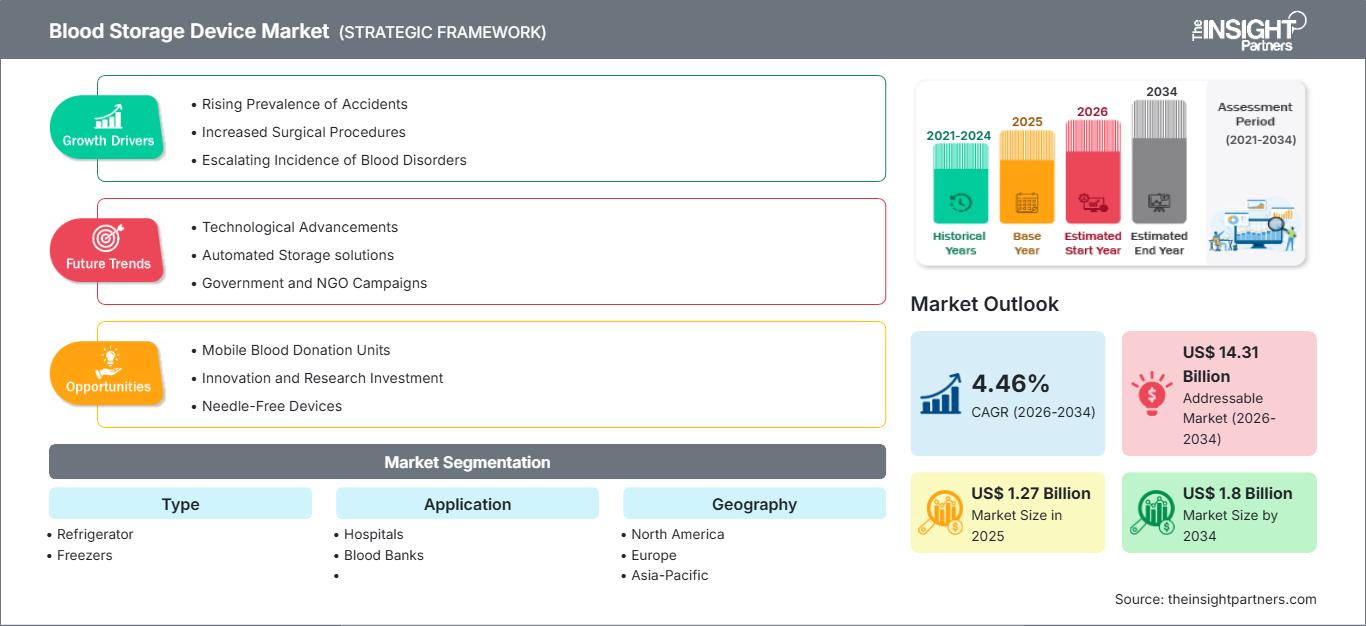
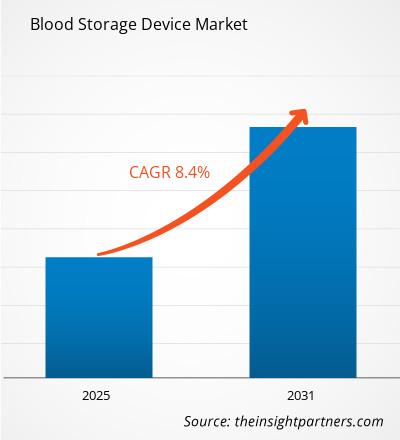
The Blood Storage Device Market size is forecasted to increase from US$ 1.27 Billion in 2025 to reach US$ 1.8 Billion in 2034 at a CAGR of 4.46% between 2026 and 2034. This market is growing on the back of increasing transfusion volume, safety requirements, cold chain infrastructure upgradation in hospitals, and replacement of traditional refrigeration and freezer devices with controlled, energy-efficient, medical-grade refrigeration/freezer devices in hospitals and blood banks.
North America continues to be a structurally mature regional demand pocket, where the Market size growth would be underpinned by centralized blood collection facilities, high number of surgeries, and stringent temperature documentation procedures. The North American region’s market is likely to grow at a CAGR of 3.8-4.3% during 2026-2034 period.
Blood Storage Device Market Assessment and Insights
- North America accounted for 34–36% share in 2025 and is expected to grow at a CAGR between 2026–2034 of 3.8–4.3%, supported by accredited blood banks, strong hospital procurement, and replacement of aging medical refrigeration assets.
- US represented 78–82% of North America in 2025 and is projected to grow at a CAGR between 2026–2034 of 3.7–4.2%, led by transfusion services and hospital system standardization.
- Europe held 27–29% share in 2025 and is projected to grow at a CAGR between 2026–2034 of 3.5–4.0%, with Germany, the UK, France, Italy, and Spain leading procurement for blood safety compliance.
- Asia Pacific captured 24–26% share in 2025 and is expected to grow at a CAGR between 2026–2034 of 5.2–5.8%, led by China, Japan, India, South Korea, and Australia.
- Largest Segment Refrigerators held 66–70% market share in 2025 and is expected to grow at a CAGR range of 4.0–4.5% during 2026–2034, reflecting routine whole-blood storage needs.
- High Growth Segment Blood Banks held 36–40% market share in 2025 and is expected to grow at a CAGR range of 4.8–5.4% during 2026–2034, supported by network expansion and inventory digitization.
- Key companies analyzed in detail: Thermo Fisher Scientific Inc., Blue Star Limited, Helmer Scientific Inc., Vestfrost Solutions A/S, Philipp Kirsch GmbH, Zhongke Meiling Cryogenics Company Limited, LEC Medical, Qingdao Haier Biomedical Co., Ltd., Abbott Diagnostics Inc., Beckman Coulter, Inc.
Source: The Insight Partners' analysis based on proprietary research, government publications, company annual reports, investor presentations, industry databases, and expert interviews.
The technology innovations seen in the Blood Storage Devices market have moved away from simply using refrigeration systems to using validated, alarmed, low-power consumption systems that provide traceability. Technologies like variable speed compressors, hydrocarbon refrigerant, automatic defrosting, temperature recording, and access controls have become critical purchase considerations. The manufacturing dynamics in this market have been altered too by the need to balance durability provided by stainless steel construction, low energy consumption and documentation requirements for hospitals with quality management systems in place.
In the future, growth in the Blood Storage Devices Market will be strongest in areas where investments in blood donation facilities, trauma care centers, maternal care facilities, and laboratories are occurring concurrently. Healthcare systems in the Asia Pacific region as well as the Middle East have decided on investing in a resilient cold chain infrastructure, with manufacturers creating modular systems appropriate for urban hospitals and decentralized blood banks. This is supported by World Health Organization statistics on global blood availability.
Blood Storage Device Market Report Scope
| Report Attribute | Details |
|---|---|
| Market size in 2025 | US$ 1.27 Billion |
| Market Size by 2034 | US$ 1.8 Billion |
| Global CAGR (2026 - 2034) | 4.46% |
| Historical Data | 2021-2024 |
| Forecast period | 2026-2034 |
Blood Storage Device Market Analysis
The market growth is attributed to the increased significance of secure transfusion access in emergency care, oncology, obstetrics, and major surgeries. The World Health Organization states that there were 120.4 million blood donations worldwide and that high-income countries account for 36% of total collections while representing only 15% of the world’s population.
Value chain participants include component providers, refrigerator system integration companies, medical equipment makers, distributors, hospitals, and blood banks. Availability of supply depends more on compressor efficiency, certification of the monitoring system, serviceability, and possibility of local installation. Purchasing is shifting from mere price-based strategy to total lifecycle costs, uptime support, validation capabilities, and interoperability with digital quality systems.
The competition is fairly high. The Market reveals a gap between global cold chain leaders and regional medical refrigeration companies. Such competitors as Thermo Fisher Scientific Inc., Helmer Scientific Inc., Vestfrost Solutions A/S, and Qingdao Haier Biomedical Co., Ltd. differentiate their products via temperature distribution, energy efficiency, and documentation capabilities.
Blue Star Limited and LEC Medical facilitate regional reach, while Philipp Kirsch GmbH and Zhongke Meiling Cryogenics Company Limited cater to specialized laboratory and health care sectors. Abbott Diagnostics Inc. and Beckman Coulter, Inc. impact neighboring diagnostic markets, which are influenced by sample integrity and lab automation trends.
● REPORT CUSTOMIZATION
Tailor This Report To Align With Your Specific Business Requirements
This report can be customized to align precisely with your business objectives, scope, and target markets. Customization options include tailored segmentation, geography, competitive analysis, and strategic insights to support informed decision-making.
Customize This Report →WHAT YOU CAN ADJUST
- ● Segmentations
- ● Geography
- ● Competitive Analysis
- ● Language Preferences
Blood Storage Device Market: Strategic Insights
Regional Insights
North America Blood Storage Device Market
The North American region has had a 34–36% Blood Storage Device market share in 2025 owing to mature transfusion systems, large procedure volumes, and the necessity for good documentation practices. It is anticipated to have a CAGR of 3.8–4.3% from 2026 to 2034 due to adoption of connected refrigerators and freezers in place of legacy equipment in hospitals.
There are several structural factors like quality management driven by hospital accreditation, centralized blood collection, and capital expenditure in resilient healthcare infrastructure. North American hospitals have to pay attention to temperature consistency, alarm functions, energy efficiency, and service agreements since blood products need constant compliance monitoring through storage, handling, and release for emergencies.
U.S. Blood Storage Device Market
The U.S. represented 78–82% of North America in 2025 and is expected to grow at a 3.7–4.2% CAGR during 2026–2034. Demand is led by hospitals, cancer centers, emergency departments, blood centers, and integrated delivery networks standardizing equipment across multiple sites.
Company presence is strong, with Thermo Fisher Scientific Inc. and Helmer Scientific Inc. offering blood bank refrigerators designed around 4°C storage, alarms, and energy-saving compressor systems. Application trends favor high-capacity upright units, pass-through models, and freezer platforms for plasma and components, particularly where transfusion services handle high inventory turnover.
Europe Blood Storage Device Market
Europe accounted for 27–29% market share in 2025 and is estimated to witness growth of 3.5–4.0% CAGR during 2026–2034. The leading country in this region is Germany on account of robust infrastructure of hospitals, strict quality assurance measures and preference for reliable and proven medical refrigerators.
The UK represents growing demand driven by uptime, energy efficiency and temperature documentation in NHS trusts and private healthcare providers. Selection criteria for equipment include total cost of ownership, space optimization, and workflow considerations for hospital transfusion labs serving emergency surgery, oncology, and maternity departments.
Stable demand in Europe is provided by France, Italy, and Spain with their regional blood establishments and hospital modernization programs. Vestfrost Solutions A/S, Philipp Kirsch GmbH, and LEC Medical will gain from familiarity of Europe with medical-grade cold storage, purchase process oriented towards CE and low-noise, low-energy devices.
APAC Blood Storage Device Market
APAC accounted for 24–26% share in 2025 and is projected to grow at a 5.2–5.8% CAGR during 2026–2034. China is the leading country, followed by Japan, India, South Korea, and Australia, as hospital expansion and blood bank network upgrades accelerate.
Policy focus on healthcare access, emergency preparedness, and rural blood availability supports investment. Qingdao Haier Biomedical Co., Ltd. and Zhongke Meiling Cryogenics Company Limited benefit from regional manufacturing scale, while solar and vehicle-mounted blood refrigeration address access gaps in areas with unstable power.
Middle East & Africa Blood Storage Device Market
The Middle East & Africa is expected to grow at a 4.6–5.2% CAGR during 2026–2034, with Saudi Arabia leading regional demand. UAE, South Africa, and the Rest of MEA are investing in blood safety infrastructure, trauma care, and laboratory modernization.
Energy reliability remains a key procurement factor, especially outside major urban hospitals. Solar-compatible refrigeration, extended holdover time, and ruggedized storage designs gain relevance where grid interruptions affect healthcare operations, while Gulf countries emphasize premium hospital infrastructure and traceable cold-chain performance.
Segmentation Analysis
Type
The Type segment is expected to grow at a 4.1–4.7% CAGR during 2026–2034. Blood Storage Device Market scope by type is shaped by the need to maintain whole blood, plasma, and components under defined temperature bands. Refrigerators dominate daily transfusion workflows, while freezers support plasma preservation and longer-term inventory strategies in centralized facilities.
- Refrigerator systems remain the primary equipment category because whole blood and red cell inventories require controlled chilled storage, fast access, visual monitoring, and continuous alarms in hospitals and blood banks.
- Freezers support plasma and component storage where longer shelf-life management, batch handling, and frozen inventory control are strategic priorities for blood banks, large hospitals, and regional transfusion centers.
Application
The Application segment is expected to grow at a 4.4–5.0% CAGR during 2026–2034. Hospitals generate recurring demand from transfusion services, surgical departments, and emergency care. Blood banks show faster adoption because centralized collection, testing, processing, and distribution require larger inventories, validated storage, and reliable monitoring across multiple temperature zones.
- Hospitals represent a mature application base where replacement purchasing is driven by safety audits, operating room readiness, transfusion demand, energy consumption targets, and integration with facility monitoring systems.
- Blood Banks are strategically important because they manage high-volume collection, processing, and distribution, creating demand for high-capacity refrigerators, plasma freezers, backup units, and digitally traceable inventory storage.
Opportunity Snapshot
| Application | Revenue Contribution | Trend Tag | Adoption Stage |
| Hospitals | High | Audit Ready | Mature |
| Blood Banks | High | Network Scale | Scaling |
Blood Storage Device Market Growth Drivers and Impact Analysis
Stricter Blood Safety and Storage Compliance
Regulatory and accreditation requirements have heightened demand for temperature validation in the Blood Storage Device market. According to WHO, blood collection, testing, processing, storage and distribution must be integrated into an efficient system of blood supply through appropriate planning and coordination, thus the equipment becomes integral to the safety of patients. The effect is felt strongly in cases where hospitals and blood banks have internal audit procedures and are dealing with distributed inventory. Manufacturers who are able to supply proof of calibration and service become preferred vendors because of the consequences of equipment malfunction which could involve wastage of inventory.
Growth in Surgical, Oncology, and Emergency Care Volumes
The need for products will increase in tandem with increased usage of transfusion-dependent care pathways in surgery centers, cancer clinics, trauma centers, and maternity services. The products should be readily available, but they cannot be exposed to temperature excursion, hence the need for storage units. This particular driver applies to emerging markets, where there is an increase in construction of hospitals and specialties resulting in more hospitals with transfusion ability. This particular driver affects the market more than the units' sales alone, since hospitals need backup storage, freezer capacity, remote alarms, and maintenance. Companies that can make their products scalable will find it easier to target both small and big hospitals.
Energy Efficiency and Cold-Chain Resilience Requirements
Energy-efficient medical refrigeration is becoming a purchasing priority as hospitals and blood banks try to reduce operating costs without compromising storage integrity. Variable-speed compressors, natural refrigerants, and improved insulation now influence technical evaluations. Helmer Scientific Inc. highlights OptiCool technology with 50–65% better efficiency than traditional technology, while Thermo Fisher Scientific Inc. emphasizes V-Drive systems and natural R290 refrigerants in TSX blood bank refrigerators. These features affect total cost of ownership and help facilities meet sustainability goals. The practical outcome is faster replacement of older units, especially where energy prices, environmental rules, and uptime expectations are all rising.
Blood Storage Device Market Future Trends
Connected Monitoring and Predictive Service Models
Blood Storage Device Market trends will increasingly center on connected monitoring, predictive maintenance, and automated compliance documentation. Future devices are expected to integrate more deeply with hospital facility systems, laboratory information systems, and cloud-based service dashboards. Instead of relying on manual chart review, buyers will prefer continuous data logs, alert escalation, access history, and equipment health indicators. This shift will favor manufacturers that combine hardware reliability with software-enabled quality control. For blood banks, connected platforms can reduce audit burden and improve inventory confidence across satellite sites, mobile collection centers, and regional distribution hubs.
Decentralized and Solar-Compatible Blood Storage
Decentralized storage will gain importance as health systems expand blood access beyond major hospitals. Solar direct drive refrigerators, long holdover designs, and vehicle-mounted units make storage feasible in areas with unstable electricity or long transport routes. Qingdao Haier Biomedical Co., Ltd. offers solar direct drive blood refrigeration with 2–8°C operation and extended holdover features, indicating how manufacturers are adapting platforms for field resilience. The trend will support rural transfusion services, disaster response, military medicine, and mobile collection programs. It also creates opportunities for devices that balance rugged design with validated temperature performance.
Blood Storage Device Market Opportunities
Blood Bank Network Modernization in Emerging Economies
Blood Storage Device Market Forecasts indicate that blood banks offer one of the strongest investment opportunities as emerging economies modernize collection, testing, component processing, and distribution. WHO data highlights large variation in donation rates, with lower-middle-income and low-income countries reporting much lower donation rates per 1,000 people than high-income countries. This gap points to infrastructure expansion needs, including storage capacity. Manufacturers can target public tenders, donor-funded infrastructure projects, and regional blood service upgrades with standardized refrigerators, freezers, installation support, and training packages that improve cold-chain reliability over the equipment lifecycle.
Lifecycle Service, Validation, and Retrofit Programs
A second opportunity lies in services rather than hardware alone. Hospitals and blood banks increasingly need calibration, preventive maintenance, validation, spare parts, and documentation support. Suppliers can differentiate by offering multi-year service contracts, remote alarm integration, temperature mapping, and replacement planning. This approach is attractive because many facilities operate mixed fleets from different manufacturers and need consistent compliance records. Retrofit programs for alarms, data loggers, and access control can also support budget-constrained buyers. Companies that build service density in high-use hospital clusters can improve retention and reduce customer switching risk.
Recent Developments
- July 2026: Vestfrost Solutions A/S published an update on CCEOP projects in Mozambique, positioning its cold-chain equipment capabilities for difficult operating environments. The update reinforces the supplier’s focus on resilient refrigeration, installation, and field support in healthcare and vaccine cold-chain applications relevant to blood storage infrastructure in lower-resource settings.
- April 2026: Helmer Scientific Inc. issued technical documentation for the HBR120-GXC Horizon Series blood bank refrigerator, showing a 20.2 cu ft unit with 364 blood bag capacity, 4°C set point, Energy Star certification, variable-capacity compressor technology, and 49 dB noise performance. The release supports procurement evaluation for high-performance hospital blood storage.
- 2025: Thermo Fisher Scientific Inc. continued offering TSX Series high-performance blood bank refrigerators certified to AABB SCoPE and listed as FDA Class II devices. The product line includes V-Drive technology, factory 4°C setting, dual-zone temperature display probes, R290 refrigerants, and DeviceLink Connect readiness for connected monitoring.
Frequently Asked Questions

- Comprehensive Market Sizing and Forecast Analysis
- Detailed Segmentation Analysis
- In-Depth Market Dynamics Assessment
- Regional and Country-Level Insights
- Competitive Landscape and Company Benchmarking
- Strategic Business Intelligence
Recent Reports
Testimonials

The Insight Partners' SCADA System Market report is comprehensive, with valuable insights on current trends and future forecasts. The team was highly professional, responsive, and supportive throughout. We are very satisfied and highly recommend their services.
RAN KEDEM Partner, Reali Technologies LTDs
I requested a report on a very specific software market and the team produced the report in a few days. The information was very relevant and well presented. I then requested some changes and additions to the report. The team was again very responsive and I got the final report in less than a week.
JEAN-HERVE JENN Chairman, Future Analytica
We worked with The Insight Partners for an important market study and forecast. They gave us clear insights into opportunities and risks, which helped shape our plans. Their research was easy to use and based on solid data. It helped us make smart, confident decisions. We highly recommend them.
PIYUSH NAGPAL Sr. Vice President, High Beam Global
The Insight Partners delivered insightful, well-structured market research with strong domain expertise. Their team was professional and responsive throughout. The user-friendly website made accessing industry reports seamless. We highly recommend them for reliable, high-quality research services
YUKIHIKO ADACHI CEO, Deep Blue, LLC.
This is the first time I have purchased a market report from The Insight Partners.While I was unsure at first, I visited their web site and felt more comfortable to take the risk and purchase a market report.I am completely satisfied with the quality of the report and customer service. I had several questions and comments with the initial report, but after a couple of dialogs over email with their analyst I believe I have a report that I can use as input to our strategic planning process.Thank you so much for taking the extra time and making this a positive experience.I will definitely recommend your service to others and you will be my first call when we need further market data.
JOHN SUZUKI President and Chief Executive Officer, Board Director, BK Technologies
I wish to appreciate your support and the professionalism you displayed in the course of attending to my request for information regarding to infectious disease IVD market in Nigeria. I appreciate your patience, your guidance, and the fact that you were willing to offer a discount, which eventually made it possible for us to close a deal. I look forward to engaging The Insight Partners in the future, all thanks to the impression you have created in me as a result of this first encounter.
DR CHIJIOKE ONYIA MANAGING DIRECTOR, PineCrest Healthcare Ltd.Reason to Buy
- Informed Decision-Making
- Understanding Market Dynamics
- Competitive Analysis
- Identifying Emerging Markets
- Customer Insights
- Market Forecasts
- Risk Mitigation
- Boosting Operational Efficiency
- Strategic Planning
- Investment Justification
- Tracking Industry Innovations
- Aligning with Regulatory Trends





 Get Free Sample for