
Blood Urea Nitrogen Diagnostics Market Size, Share & Forecast by 2034
Coverage: By Type (ELISA, Colorimetric, Spectrophotometric); Application (Hospital, Laboratory, Clinic, Other), and Geography (North America, Europe, Asia Pacific, and South and Central America)
- Status : Data Released
- Report Code : TIPRE00008543
- Category : Life Sciences
- No. of Pages : 150
- Available Report Formats :


- Last update date : July 31, 2026


2025 Market Size
US$ 2.19 Bn
Base year value
2034 Forecast
US$ 3.35 Bn
Projected by 2034
CAGR 2026-2034
4.83 %
Growth rate
Addressable Market
US$ 25.14 Bn
(2026-2034)
The Blood Urea Nitrogen Diagnostics Market is valued at US$ 2.19 Billion in 2025 and is anticipated to hit the mark of US$ 3.35 Billion in 2034, registering a CAGR of 4.83% from 2026 to 2034. There exists a continued need in the clinical field to test the functioning of kidneys and that is reflected in the market, as the test of blood urea nitrogen continues to be a basic parameter used for the same along with assessing the presence of metabolic imbalance and dehydration in addition to assessing the therapy.
North America continues to be an important region due to the presence of a number of automated labs, the prevalence of high screening of chronic kidney disease cases and wide adoption of metabolic panels in the region. Growth in the region is likely to register in the range of 4.4-4.9%.
Blood Urea Nitrogen Diagnostics Market Assessment and Insights
- North America accounted for 34–37% share in 2025, growing at a CAGR between 2026–2034 of 4.4–4.9%, supported by renal disease surveillance, high routine chemistry testing volumes, laboratory consolidation, and strong analyzer installed bases.
- US represented 78–82% of North America in 2025, growing at a CAGR between 2026–2034 of 4.3–4.8%, driven by primary care metabolic testing and hospital automation.
- Europe held 25–28% share in 2025, growing at a CAGR between 2026–2034 of 4.0–4.5%, led by Germany, the UK, France, Italy, and Spain through chronic disease screening and standardized laboratory quality programs.
- Asia Pacific captured 23–26% share in 2025, growing at a CAGR between 2026–2034 of 5.4–5.9%, with China, Japan, India, South Korea, and Australia benefiting from expanding diagnostics infrastructure and preventive care adoption.
- Largest Segment Hospital held 46–50% market share in 2025, growing at a CAGR range of 4.5–5.0% during 2026–2034, due to emergency, inpatient, surgical, and dialysis-linked testing demand.
- High Growth Segment Laboratory held 34–38% market share in 2025, growing at a CAGR range of 5.1–5.6% during 2026–2034, supported by outsourcing, automation, network consolidation, and scalable reagent purchasing.
- Key companies analyzed in detail: F. Hoffmann-La Roche Ltd, Siemens Healthineers AG, Bioo Scientific Corporation, XpressBio, Eagle Biosciences, Inc., Thermo Fisher Scientific Inc., Beacon Diagnostics Pvt. Ltd., Invitrogen, Accurex Biomedical Pvt. Ltd., Pointe Scientific, Inc.
Source: The Insight Partners' analysis based on proprietary research, government publications, company annual reports, investor presentations, industry databases, and expert interviews.
Automated systems have revolutionized the Blood Urea Nitrogen Diagnostics Market from manual preparation of reagents to the use of chemistry platforms based on colorimetric and spectrophotometric methods on high-speed automated analyzers. The manufacturing trend continues to move toward liquid stable reagents, multi-analytes, and validated kits to decrease variation between operators. Additionally, manufacturers are packaging assays in line with the throughput of small, medium, and large labs, optimizing the inventory management system while sustaining traceability, stability, and compatibility across open and closed systems.
During the forecast period, there will be contributions from developing geographies because the screening of diabetes, hypertension, and kidney disease is becoming part of the outpatient setting. The public health recommendation of regular blood and urine testing for kidney risk encourages early adoption of the tests. Funding will focus on local production of reagents, distribution-driven market access, and regulatory-ready portfolio of clinical chemistry products.
Blood Urea Nitrogen Diagnostics Market Report Scope
| Report Attribute | Details |
|---|---|
| Market size in 2025 | US$ 2.19 Billion |
| Market Size by 2034 | US$ 3.35 Billion |
| Global CAGR (2026 - 2034) | 4.83% |
| Historical Data | 2021-2024 |
| Forecast period | 2026-2034 |
Blood Urea Nitrogen Diagnostics Market Analysis
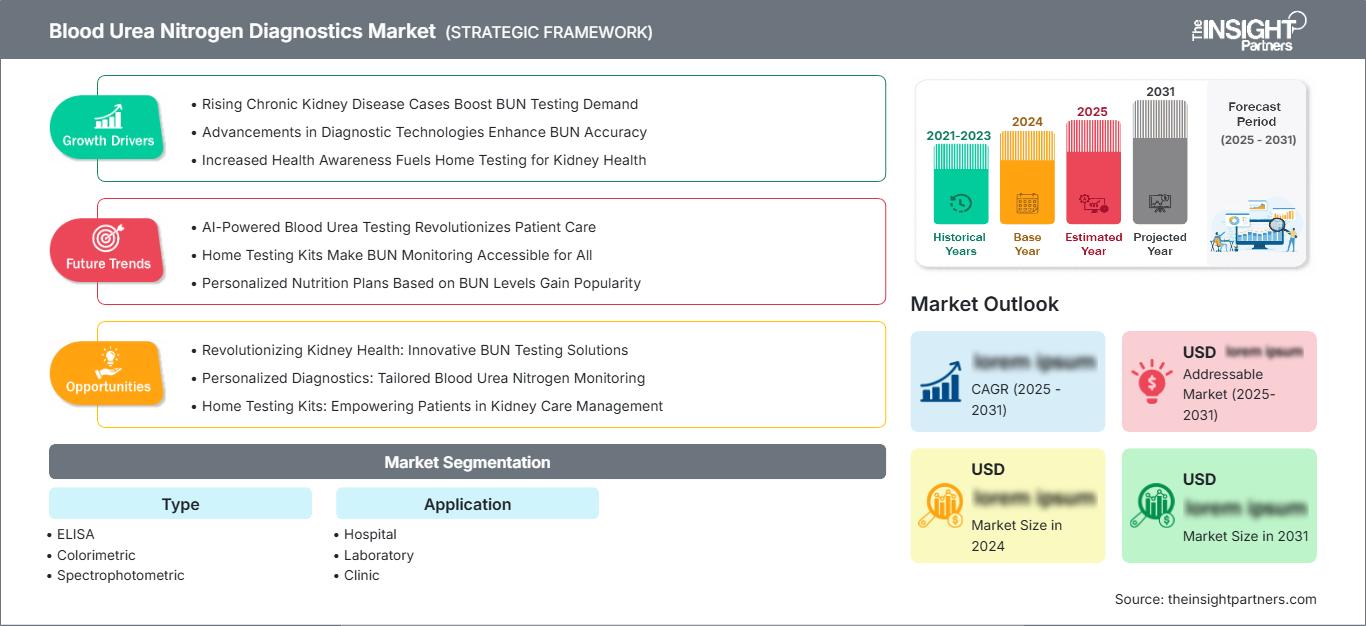
Growth drivers for the Blood Urea Nitrogen Diagnostics Market include the increasing incidence of chronic kidney diseases, diabetes, high blood pressure, and age-related metabolic disorders. The demand stems from the test's availability in renal panel tests, pre-surgical evaluations, intensive care unit tests, and assessments of drug toxicity. The supply chain comprises reagent suppliers, analyzer companies, distributors, reference labs, hospitals, and clinics, with value creation driven by accuracy, turnaround time, lot-to-lot variation, and instrument compatibility of the assays.
There is stability in the supply environment due to the use of known enzymatic and colorimetric chemistries in urea testing instead of rare biologicals. Nonetheless, laboratories are moving towards sourcing companies that offer reagents, calibrators, control materials, and technical support as a package instead of individual components.
In this regard, the Blood Urea Nitrogen Diagnostics Market analysis indicates a competitive market structure influenced by the installation of analyzers, number of reagents menu, distribution coverage, and quality documentation. F. Hoffmann-La Roche Ltd and Siemens Healthineers AG drive demand through integrated laboratory solutions, whereas Thermo Fisher Scientific Inc., Pointe Scientific, Inc., and Accurex Biomedical Pvt. Ltd. facilitate wide distribution of chemistry reagents.
Key players like Eagle Biosciences, Inc., XpressBio, Beacon Diagnostics Pvt. Ltd., Bioo Scientific Corporation, and Invitrogen cater to research, kit, and reagent markets where flexibility is required. Investment trends cover liquid stability of formulation, automation-friendly packaging, regional approvals, and collaborations to increase distribution to middle range laboratories. Thus, strategic positioning is more dependent on the supply chain efficiency for renal tests rather than on urea chemistry per se.
● REPORT CUSTOMIZATION
Tailor This Report To Align With Your Specific Business Requirements
This report can be customized to align precisely with your business objectives, scope, and target markets. Customization options include tailored segmentation, geography, competitive analysis, and strategic insights to support informed decision-making.
Customize This Report →WHAT YOU CAN ADJUST
- ● Segmentations
- ● Geography
- ● Competitive Analysis
- ● Language Preferences
Blood Urea Nitrogen Diagnostics Market: Strategic Insights
Regional Insights
North America Blood Urea Nitrogen Diagnostics Market
North America held 34–37% share in 2025 and is expected to grow at a 4.4–4.9% CAGR during 2026–2034. The region benefits from frequent basic metabolic panel usage, high chronic kidney disease awareness, and broad hospital chemistry automation. The Blood Urea Nitrogen Diagnostics Market share is reinforced by strong reagent purchasing contracts and extensive clinical laboratory networks.
Demand is also supported by aging populations, diabetes-related renal monitoring, and earlier intervention pathways in primary care. Hospitals continue to generate urgent inpatient volumes, while independent laboratories scale routine testing through high-throughput analyzers. Regulatory emphasis on quality systems, proficiency testing, and validated assays favors established suppliers with documented performance credentials and dependable service coverage.
U.S. Blood Urea Nitrogen Diagnostics Market
The US market held 78%-82% share of North America in 2025 and will grow at a 4.3%-4.8% CAGR over 2026-2034. Routine tests for kidney functions form an integral part of the patient's out-patient visits, EDs, disease monitoring and dialysis related testing. Presence of key players such as Roche, Siemens Healthineers, and Thermo Fisher helps in continuous supply.
Use of test applications in hospitals involves use of BUN test as one of the tests in the rapid chemistry panels for decision-making. Reference laboratories involve large scale screening and follow-up tests. Clinics tend to have their panels done by outsourcing them or use small machines for fast triaging. Reimbursement concerns make laboratories opt for more efficient tests.
Europe Blood Urea Nitrogen Diagnostics Market
The European market accounted for 25-28% share in 2025 and will expand at a CAGR of 4.0-4.5% over 2026-2034 owing to Germany dominating with advanced laboratory facilities and standardization in clinical chemistry. The UK's demand stems from disease review, primary care renal monitoring, and laboratory network through the NHS.
Germany achieves increased usage with automated hospitals laboratories, nephrology services and preference for complete analyzer and reagents systems. France and Italy witness stable demand with older population and metabolic diseases management, whereas Spain maintains improvement in diagnostic services in regional diagnostics. Discussion on renal screening policies and quality accreditation drive constant assay usage in Europe.
APAC Blood Urea Nitrogen Diagnostics Market
In 2025, APAC accounted for 23-26%, with a forecasted 5.4-5.9% CAGR from 2026 to 2034. APAC’s top nation is China, driven by hospital development, diagnostics capacity in the country, and CKD screenings. The region includes Japan and South Korea, where growth drivers are automation maturity and superior laboratory systems.
The growth in India and Australia comes from the growth of private diagnostics centers, preventive care packages, and point-of-care diagnostics in the regions. The industrial factors include local reagent manufacturing, distributor network growth, and analyzer installation in tier-2 cities. Focus on non-communicable diseases by policy boosts the test frequency in diabetes, hypertension, and renal disease diagnostics.
Middle East & Africa Blood Urea Nitrogen Diagnostics Market
MEA is forecast to experience an 4.7-5.2% CAGR growth rate between 2026-2034 owing to Saudi Arabia being a leader in terms of investments in hospital infrastructure, high diabetes incidence rate, and laboratory advancements. UAE focuses on testing at private hospitals and medical tourism, whereas South Africa is considered to be an anchor for better diagnostics access in its region.
Demand in RoMEA regions is inconsistent yet tends to improve through renal care, dialysis facilities, and public laboratory purchases. In Gulf nations, revenue from energy sector keeps financing specialty hospitals and automation installations. In Africa, access to diagnostics depends upon reagents affordability, logistics efficiency, trained lab personnel, and sponsored diagnostic programs.
Segmentation Analysis
Type
The Type segment is expected to grow at a 4.6–5.1% CAGR during 2026–2034 as laboratories balance method sensitivity, cost, throughput, and analyzer compatibility. The Blood Urea Nitrogen Diagnostics Market scope within type segmentation is defined by test format selection across routine chemistry laboratories, research settings, and specialty workflows. Colorimetric and spectrophotometric approaches dominate practical use because they are scalable, robust, and cost-efficient.
- ELISA is strategically relevant in research and specialized assay development, where controlled workflow, antibody-based detection, and kit standardization support targeted studies rather than routine high-volume renal chemistry testing.
- Colorimetric methods hold strong practical importance because they fit automated clinical chemistry analyzers, offer cost-efficient reagent use, and support routine hospital and reference laboratory testing with familiar operating protocols.
- Spectrophotometric testing remains important for quantitative measurement, reproducibility, and analyzer integration, especially where laboratories require reliable absorbance-based workflows for renal panels and metabolic assessment.
Application
The Application segment is projected to grow at a 4.8–5.3% CAGR during 2026–2034, shaped by where testing decisions occur and how specimens move through care pathways. Hospitals remain the largest revenue base, laboratories scale outsourced testing, and clinics support early triage. Growth depends on chronic disease monitoring, acute care testing, and procurement models that prioritize reliability, turnaround time, and economics.
- Hospital applications dominate because BUN testing is used in emergency assessment, inpatient monitoring, surgical evaluation, nephrology care, and intensive care panels requiring rapid and repeatable chemistry results.
- Laboratory applications are scaling as independent and reference networks consolidate routine testing volumes, automate sample processing, and negotiate reagent contracts that improve cost per reportable result.
- Clinic applications remain important for screening and follow-up, especially in diabetes, hypertension, geriatric, and general wellness settings where early kidney function indicators guide referral decisions.
Opportunity Snapshot
| Segment Name | Revenue Contribution | Trend Tag | Adoption Stage |
| Hospital | High | Acute Panels | Mature |
| Laboratory | High | Network Testing | Scaling |
| Clinic | Medium | Early Screening | Scaling |
Blood Urea Nitrogen Diagnostics Market Growth Drivers and Impact Analysis
Rising Kidney Disease Screening Across Chronic Care Pathways
The kidney diseases are now being viewed as systemic risk markers rather than a late-stage disease process in nephrology. The global and national health organizations stress the need for basic blood and urinalysis tests in detecting any problem in the functioning of kidneys, especially in diabetics, hypertensive patients, individuals having cardiovascular problems, and senior citizens. There would be frequent testing needs in terms of primary care practice, hospitalizations, dialysis follow-ups, and drug therapies. The practical implication for the industry in terms of market needs would be the increased need for accurate renal chemistry profile which includes BUN, creatinine, electrolytes, etc.
Laboratory Automation and Consolidated Testing Networks
Diagnostic laboratories are experiencing pressure on increasing throughput while coping with staffing issues, budget considerations, and quality constraints. Automated chemistry systems meet such challenges by minimizing manual intervention, enabling bar code identification, and processing large number of routine test panels with minimal disruptions. Testing of BUN becomes advantageous since BUN tests are often ordered and easily done by automated colorimetry or spectroscopy. In consolidated laboratory networks, use of same suppliers for reagents at several locations becomes possible due to standardization. Such consolidation gives more business opportunities to companies providing reliable delivery, method validation, controls, and service. Commercial aspect includes transition from fragmented buying of kits to menu for platforms.
Growing Use of Metabolic Panels in Acute and Preventive Care
The BUN test is often ordered in conjunction with basic or comprehensive metabolic profiles, and the level of demand will thus be more sensitive to care pathways rather than just kidney-focused visits. The emergency physician orders the test for the assessment of dehydration, perfusion to the kidneys, potential GI bleeding, and the risk of organ dysfunction. Screening programs employ the same biomarker to detect early impairment in the function of the kidneys among asymptomatic patients. This twofold application makes the test resilient to fluctuations in the economic climate since both acute care and screening services rely on reliable chemistry testing capabilities. Companies offering BUN reagents as part of wider renal and metabolic panels benefit from recurring demand.
Blood Urea Nitrogen Diagnostics Market Future Trends
AI-Linked Renal Risk Interpretation
A key Blood Urea Nitrogen Diagnostics Market trend is the transition from simple chemistry parameters to algorithmically supported assessment of kidney risk. In the future, there will be workflows involving BUN, creatinine, eGFR, albuminuria, age, comorbidity, and drugs to allow for early action. It does not mean the replacement of conventional tests, but it means that there will be a need for high-quality BUN values. Laboratories capable of linking chemistry systems with decision support tools will provide assistance for nephrology triage, chronic disease management, and longitudinal testing. Vendors can gain competitive advantage through data aggregation, standardization of reporting, and interface with hospital information systems.
Regionalization of Reagent Manufacturing and Supply Chains
Healthcare systems are increasingly sensitive to reagent shortages, import delays, and currency-linked procurement volatility. Over the next decade, more suppliers are expected to regionalize clinical chemistry reagent production, packaging, and distribution to improve resilience. BUN reagents are suitable for this shift because formulations are established, demand is recurring, and quality requirements are well understood. Regional manufacturing can reduce lead times, support local tenders, and improve affordability in price-sensitive markets. The trend will favour companies able to maintain international quality standards while adapting pack sizes, documentation, and regulatory submissions to country-specific laboratory procurement needs.
Blood Urea Nitrogen Diagnostics Market Opportunities
Expansion of Preventive Screening in High-Risk Populations
Preventive screening offers a clear investment opportunity as healthcare systems focus on reducing kidney failure progression and associated treatment costs. Diabetes, hypertension, obesity, and aging populations create a large pool of individuals needing periodic renal assessment. Blood Urea Nitrogen Diagnostics Market Forecasts indicate stronger uptake where primary care programs include kidney function markers in routine health checks and chronic disease packages. Companies can act by partnering with clinic networks, diagnostic chains, and public health programs to standardize renal panels. Commercial success will depend on affordable reagents, simplified ordering, patient-friendly reporting, and education for clinicians managing early-stage risk.
Automation-Ready Reagent Portfolios for Mid-Volume Laboratories
Mid-volume laboratories represent a practical opportunity because many are upgrading from semi-automated or fragmented workflows to compact integrated chemistry platforms. These facilities need reagent portfolios that are validated, stable, affordable, and compatible with varied analyzer models. BUN testing can act as an entry point within broader kidney and metabolic menus, creating repeatable revenue through daily routine testing. Suppliers should prioritize pack-size flexibility, onboard stability, calibration support, and distributor training. In emerging markets, financing models, reagent rental agreements, and local technical service can accelerate adoption. The opportunity is strongest where laboratory chains are expanding beyond major cities into regional care hubs.
Recent Developments
- October 2025: F. Hoffmann-La Roche Ltd received CE Mark for its AI-based Kidney Klinrisk Algorithm and launched a chronic kidney disease algorithm panel on navify Algorithm Suite. The development strengthens Roche’s position in kidney care decision support by linking routine blood and urine test inputs with risk stratification for adults with CKD, diabetes, or hypertension.
- July 2025: Roche Diagnostics showcased diagnostics innovation at the ADLM 2025 Scientific Meeting and Clinical Lab Expo, highlighting its integrated cobas reagent portfolio, navify digital solutions, and laboratory workflow capabilities. The update is relevant to renal chemistry testing because integrated platforms and digital connectivity influence how routine assays are ordered, analyzed, and reported.
- June 2025: Thermo Fisher Scientific announced that its Indiko clinical chemistry system menu would be extended through an exclusive Sentinel Diagnostics reagent partnership during 2025. The expanded panel included kidney-related assays such as urea, creatinine, albumin, phosphorus, total protein, and uric acid, improving menu breadth for laboratories using Indiko analyzers.
Frequently Asked Questions

- Comprehensive Market Sizing and Forecast Analysis
- Detailed Segmentation Analysis
- In-Depth Market Dynamics Assessment
- Regional and Country-Level Insights
- Competitive Landscape and Company Benchmarking
- Strategic Business Intelligence
Recent Reports
Testimonials

The Insight Partners' SCADA System Market report is comprehensive, with valuable insights on current trends and future forecasts. The team was highly professional, responsive, and supportive throughout. We are very satisfied and highly recommend their services.
RAN KEDEM Partner, Reali Technologies LTDs
I requested a report on a very specific software market and the team produced the report in a few days. The information was very relevant and well presented. I then requested some changes and additions to the report. The team was again very responsive and I got the final report in less than a week.
JEAN-HERVE JENN Chairman, Future Analytica
We worked with The Insight Partners for an important market study and forecast. They gave us clear insights into opportunities and risks, which helped shape our plans. Their research was easy to use and based on solid data. It helped us make smart, confident decisions. We highly recommend them.
PIYUSH NAGPAL Sr. Vice President, High Beam Global
The Insight Partners delivered insightful, well-structured market research with strong domain expertise. Their team was professional and responsive throughout. The user-friendly website made accessing industry reports seamless. We highly recommend them for reliable, high-quality research services
YUKIHIKO ADACHI CEO, Deep Blue, LLC.
This is the first time I have purchased a market report from The Insight Partners.While I was unsure at first, I visited their web site and felt more comfortable to take the risk and purchase a market report.I am completely satisfied with the quality of the report and customer service. I had several questions and comments with the initial report, but after a couple of dialogs over email with their analyst I believe I have a report that I can use as input to our strategic planning process.Thank you so much for taking the extra time and making this a positive experience.I will definitely recommend your service to others and you will be my first call when we need further market data.
JOHN SUZUKI President and Chief Executive Officer, Board Director, BK Technologies
I wish to appreciate your support and the professionalism you displayed in the course of attending to my request for information regarding to infectious disease IVD market in Nigeria. I appreciate your patience, your guidance, and the fact that you were willing to offer a discount, which eventually made it possible for us to close a deal. I look forward to engaging The Insight Partners in the future, all thanks to the impression you have created in me as a result of this first encounter.
DR CHIJIOKE ONYIA MANAGING DIRECTOR, PineCrest Healthcare Ltd.Reason to Buy
- Informed Decision-Making
- Understanding Market Dynamics
- Competitive Analysis
- Identifying Emerging Markets
- Customer Insights
- Market Forecasts
- Risk Mitigation
- Boosting Operational Efficiency
- Strategic Planning
- Investment Justification
- Tracking Industry Innovations
- Aligning with Regulatory Trends





 Get Free Sample for