
Bone Biopsy Needle Market Growth, Share & Trends by 2034
Coverage: By Type (8G, 10G, 11G, 13G, Others); Application (Hospital, Laboratory, Others) , and Geography (North America, Europe, Asia Pacific, and South and Central America)
- Status : Data Released
- Report Code : TIPRE00008541
- Category : Life Sciences
- No. of Pages : 150
- Available Report Formats :


- Last update date : July 29, 2026


2025 Market Size
US$ 1.32 Bn
Base year value
2034 Forecast
US$ 2.53 Bn
Projected by 2034
CAGR 2026-2034
7.48 %
Growth rate
Addressable Market
US$ 17.34 Bn
(2026-2034)
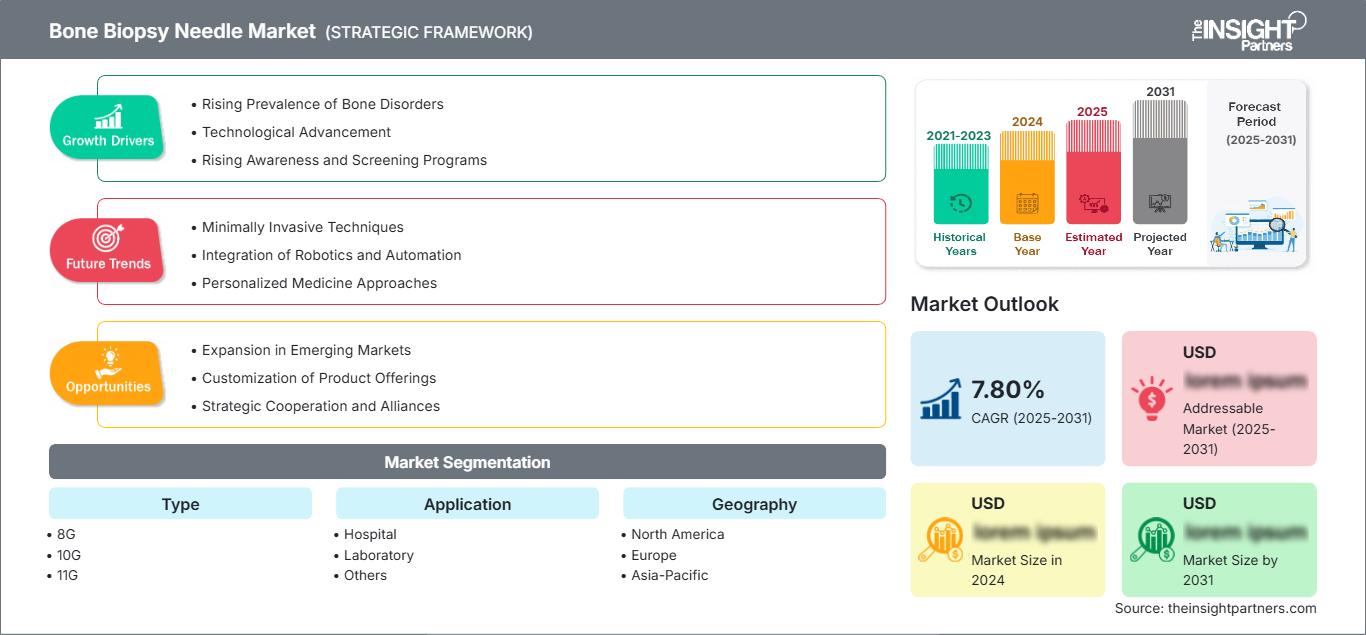
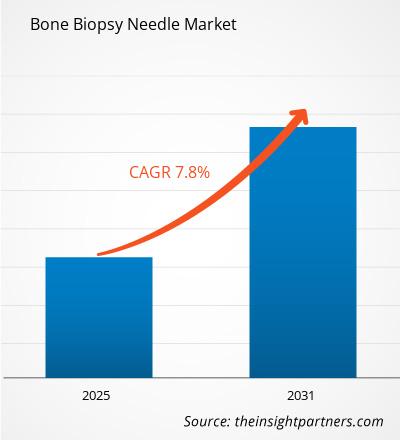
The Bone Biopsy Needle Market size is estimated to be valued at US$ 1.32 Billion in 2025 and further gain ground to reach a value of US$ 2.53 Billion by 2034, recording a CAGR of 7.48% during 2026-2034. This market will evolve due to the growing need for minimally invasive tissue sampling within the hematology, oncology, orthopedics, and interventional radiology processes. There will be high demand fueled by the increase in diagnostic numbers, greater use of CT guided biopsies, and preference for accurate core sampling over surgical intervention.
North America will be bolstered by existing cancer diagnostics capabilities, widespread adoption of imaging guided procedures, and stable insurance coverage of biopsy services provided in hospitals. North America will experience growth in a CAGR range of 6.9-7.4% during 2026-2034.
Bone Biopsy Needle Market Assessment and Insights
- North America accounted for 38–40% Bone Biopsy Needle Market share in 2025 and is growing at a CAGR range of 6.9–7.4% during 2026–2034, driven by CT-guided biopsy access, oncology procedure volumes, and strong hospital purchasing networks.
- US represented 82–86% of North America in 2025 and is growing at a CAGR range of 6.8–7.3% during 2026–2034, supported by interventional radiology adoption.
- Europe held 27–29% share in 2025 and is growing at a CAGR range of 6.6–7.1% during 2026–2034, with Germany, the UK, and France leading procedural demand.
- Asia Pacific captured 22–24% share in 2025 and is growing at a CAGR range of 8.5–9.2% during 2026–2034, led by China, Japan, India, South Korea, and Australia.
- Largest Segment: Hospital application held 58–62% market share in 2025 and is growing at a CAGR range of 7.3–7.8% during 2026–2034.
- High Growth Segment: Laboratory application held 24–28% market share in 2025 and is growing at a CAGR range of 8.0–8.7% during 2026–2034.
- Key companies analyzed in detail: Becton, Dickinson and Company, Mermaid Medical A/S, Meditech Devices Pvt. Ltd., Stryker Corporation, Müller Medical GmbH, Securos Surgical, Inc., Ranfac Corp., Argon Medical Devices, Inc., Remington Medical, Inc., and Merit Medical Systems, Inc.
Source: The Insight Partners' analysis based on proprietary research, government publications, company annual reports, investor presentations, industry databases, and expert interviews.
Evolution in the Bone Biopsy Needle Market has advanced from simple manual aspiration needles to ergonomic, coaxial, depth-measured, and drill aided needles. There is constant refinement in the choice of needle gauge, cannula sharpness, and stylets to minimize repeat needling. The manufacturing dynamics have also evolved to include sterilized single use trays, packaging validation, and regional distribution to better organize hospital stocks and regulatory controls.
Going forward, suppliers will be targeting emerging hospital networks in the Asia Pacific region and the Middle East, while sustaining their premium positioning in North America and Europe. Favorable regulatory winds are associated with more device documentation, adverse event reporting, and hospital infection control measures. Procurement considerations will increasingly tilt towards providers of training, standardization of procedure, and compatibility with guided biopsy procedures.
Bone Biopsy Needle Market Report Scope
| Report Attribute | Details |
|---|---|
| Market size in 2025 | US$ 1.32 Billion |
| Market Size by 2034 | US$ 2.53 Billion |
| Global CAGR (2026 - 2034) | 7.48% |
| Historical Data | 2021-2024 |
| Forecast period | 2026-2034 |
Bone Biopsy Needle Market Analysis
The development of the Bone Biopsy Needle market will be impacted by the rising need for cancer diagnostics, evaluation of hematologic diseases, and increasing dependence on minimally invasive sampling. The industry value chain comprises stainless-steel tube suppliers, precision parts manufacturers, sterilizers, packaging companies, device manufacturers, distributors, hospitals, and diagnostic laboratories. Continuous supply is essential as biopsy needles are high volume disposable instruments whose shortage may lead to delays in the workup and further planning of oncological treatment.
Imaging services and interventional radiology capabilities also affect the demand. More and more hospitals opt for kits that facilitate setting up and standardize procedure performance regardless of whether it is guided by CT, fluoroscopy, or ultrasound. Cancer burden in WHO and other statistics, aging populations, and increased rate of multiple myeloma evaluation make the need for biopsy even more relevant. Consequently, those suppliers who are capable of supplying various gauge sizes, efficient specimen collection, and sharp needles have good opportunities.
According to the Bone Biopsy Needle Market, the competitive environment is moderately concentrated, characterized by the presence of Becton, Dickinson and Company, Stryker Corporation, Argon Medical Devices, Inc., and Merit Medical Systems, Inc., which use broad procedural portfolio, physician awareness, and extensive distribution channels as competitive strategies. Specialty vendors such as Mermaid Medical A/S, Müller Medical GmbH, Ranfac Corp., and Meditech Devices Pvt. Ltd. cater to specific clinician preference and geographic partnerships.
Positioning in terms of training, customization of the kit, and adjacency to a larger biopsy or interventional oncology portfolio is gaining prominence. The oncology offerings are being enhanced by companies like Merit Medical Systems, Inc. and Argon Medical Devices, Inc. Stryker Corporation enjoys orthopedic and vertebral access platforms. Companies such as Remington Medical, Inc. and Securos Surgical, Inc. help in niche procedure instrumentations, especially those required by hospital customers.
● REPORT CUSTOMIZATION
Tailor This Report To Align With Your Specific Business Requirements
This report can be customized to align precisely with your business objectives, scope, and target markets. Customization options include tailored segmentation, geography, competitive analysis, and strategic insights to support informed decision-making.
Customize This Report →WHAT YOU CAN ADJUST
- ● Segmentations
- ● Geography
- ● Competitive Analysis
- ● Language Preferences
Bone Biopsy Needle Market: Strategic Insights
Regional Insights
North America Bone Biopsy Needle Market
North America continued to be the dominant regional market share provider accounting for 38-40% share in 2025 and CAGR of 6.9-7.4% in 2026-2034. Regional market share in bone biopsy needles market is driven by high penetration of diagnostic imaging, presence of interventional radiology departments within hospitals, and routine biopsy procedures in oncology, hematology, and spine diagnosis.
Growth is fueled by transition of outpatient guided biopsies, cancer center concentration, and rising demands for sterile disposable kits. North America is further favored by the presence of companies through direct distribution, GPO contracts, and specialty distribution channels. Increasing selection of devices is based on sample quality, operator experience, and compatibility with procedural trays.
U.S. Bone Biopsy Needle Market
In 2025, the U.S. constituted 82% to 86% of North America and is projected to exhibit a CAGR of 6.8% to 7.3% during 2026–2034. The market demand in this region will be driven by the high prevalence of diseases in hospitals, cancer centers, orthopedics, and radiology-driven outpatient centers.
The prominent players that have commercial relevance include Becton, Dickinson and Company, Stryker Corporation, Merit Medical Systems, Inc., Argon Medical Devices, Inc., Ranfac Corp., and Remington Medical, Inc. Trends in terms of applications demonstrate the leading role of hospitals in generating revenue in North America and the increasing role of laboratories in the standardization of pathologist throughput and specimen handling needs.
Europe Bone Biopsy Needle Market
The Europe region has 27-29% of the market share in 2025 and is expected to grow at a CAGR of 6.6-7.1% between 2026-2034. Germany has the highest share because of tertiary hospitals, high volumes of orthopedic interventions, and radiology infrastructure. The UK market is consistent due to the reforms of cancer diagnostic pathway and standardization of procedures in the public/private hospitals.
In Germany, there is a high usage due to the earlier adoption of image-guided procedures and need for highly precise core samples in the musculoskeletal oncology and hematology. In the UK market, the drivers include the reduction of waiting list, centralization of cancer networks, and preference for sterile kits that help increase efficiency in biopsy and radiology departments.
In France, Italy, and Spain, there are high volumes of hospital oncology services, reimbursable biopsy procedures, and purchase of balanced-cost devices. In France, there are the reforms of cancer centers; in Italy, there are regional hospitals; and in Spain, there are increasing procedure volumes in large public hospitals.
APAC Bone Biopsy Needle Market
Asia Pacific represented 22–24% share in 2025 and is growing at a CAGR range of 8.5–9.2% during 2026–2034, the fastest among major regions. China is the leading country due to expanding oncology infrastructure, rising diagnostic imaging deployment, and growing hospital investments in minimally invasive procedures.
Japan, South Korea, India, and Australia add differentiated demand. Japan and South Korea emphasize precision and device quality, India is expanding oncology access in tier-1 and tier-2 hospitals, and Australia benefits from strong radiology networks. Industrial policy supporting medical device localization is increasing regional manufacturing interest and distributor partnerships.
Middle East & Africa Bone Biopsy Needle Market
Middle East & Africa is growing at a CAGR range of 6.0–6.6% during 2026–2034, with Saudi Arabia leading regional demand. Saudi Arabia and the UAE are investing in oncology centers, specialty hospitals, and diagnostic imaging capacity, which supports higher biopsy procedure adoption.
South Africa remains the key sub-Saharan market, while the Rest of MEA depends on distributor-led procurement and public hospital funding cycles. Energy-linked government revenues in Gulf countries continue to support healthcare infrastructure investment, while broader access constraints temper adoption in lower-income markets.
Segmentation Analysis
Type
The Type segment is expected to grow at a CAGR range of 7.2–7.7% during 2026–2034. Bone Biopsy Needle Market scope across gauge categories is shaped by anatomical access, cortical density, sample volume requirements, and operator preference. Wider gauges support larger samples for histopathology, while smaller gauges are favored where access precision, patient comfort, or minimally invasive pathways are prioritized.
- 8G needles are strategically important for dense bone access and larger core retrieval, particularly in orthopedic, vertebral, and interventional settings where sample adequacy can reduce repeat procedures.
- 10G products serve balanced procedural needs, offering strong sample volume while maintaining manageable insertion control for image-guided biopsy workflows in hospitals and specialty centers.
- 11G needles are widely used because they provide a practical balance between penetration, core quality, and clinician familiarity across common bone marrow and vertebral biopsy procedures.
- 13G products address applications where smaller access diameter, controlled sampling, and patient tolerance are important, particularly in selected hematology and outpatient diagnostic workflows.
Application
The Application segment is expected to grow at a CAGR range of 7.5–8.0% during 2026–2034. Hospitals remain the anchor channel because biopsy procedures require imaging systems, sterile rooms, trained clinicians, and pathology coordination. Laboratories are gaining strategic influence as sample quality, turnaround time, and diagnostic concordance become more important in oncology care pathways.
- Hospital applications dominate demand due to procedure concentration in radiology, oncology, hematology, and orthopedic departments, where integrated imaging and emergency support enable complex biopsy cases.
- Laboratory applications are strategically relevant because pathology quality, tissue handling, and molecular testing readiness increasingly influence device selection and demand for consistent core sample integrity.
Opportunity Snapshot
| Segment Name | Revenue Contribution | Trend Tag | Adoption Stage |
| Hospital | High | Image Guidance | Mature |
| Laboratory | Medium | Sample Integrity | Scaling |
| Others | Low | Referral Access | Emerging |
Bone Biopsy Needle Market Growth Drivers and Impact Analysis
Rising Need for Minimally Invasive Cancer Diagnostics
The shift from an open biopsy to percutaneous tissue sampling is one of the key motivating factors for suppliers, as the requirement is for an accurate diagnosis while minimizing the post-procedural recovery process. Tumors and lesions of the bone in metastatic cancer cases, hematological cancers, and primary bone tumors usually need a histological diagnosis before proceeding further. The use of an image-guided needle biopsy offers the advantage of less operating time, shorter hospital stays, and quicker pathology. From an operational perspective, this will enhance the process and help hospitals cope with increasing numbers of oncology patients.
Expansion of Interventional Radiology Infrastructure
Growth in CT, fluoroscopy, and ultrasound-guided interventions is increasing addressable procedural volume for biopsy needles. Hospitals are investing in interventional radiology suites because the same infrastructure supports drainage, ablation, vascular access, embolization, and biopsy workflows. Bone biopsy benefits directly from this installed base, especially when radiologists can access vertebral, pelvic, and appendicular lesions with higher targeting accuracy. The market impact is stronger adoption of coaxial systems, depth markings, and needle kits compatible with image-guided protocols. Procurement teams are also standardizing product families to reduce training variation, which favors companies with broad portfolios and dependable distributor support.
Growing Hematology and Musculoskeletal Disease Workups
Rising evaluation of anemia, suspected marrow disorders, multiple myeloma, unexplained cytopenias, and metastatic skeletal involvement is increasing demand for bone marrow and bone lesion sampling. Aging populations are particularly important because hematologic malignancies and secondary bone disease become more common with age. Orthopedic oncology teams also rely on biopsy confirmation before surgical planning, systemic therapy, or radiation pathways. The commercial effect is steady hospital consumption of sterile needles and related biopsy accessories. Vendors that offer multiple gauges, ergonomic handles, and reliable sample retention are better positioned to support both routine marrow sampling and technically demanding cortical bone procedures.
Bone Biopsy Needle Market Future Trends
Integration of Biopsy Devices with Digital Procedure Planning
Bone Biopsy Needle Market trends include the convergence of device technology, imaging, and digital planning of procedures. Pre-procedural imaging, lesion localization, and standardization of access pathways will become common practices at hospitals in order to decrease needle sticks and achieve an optimal approach to difficult bone structures. Needle manufacturers can adapt to these changes by creating needles with high radiographic visibility, clear indication of depth, and kits that will correspond to the procedure step-by-step. Over time, differentiating products from each other would be achieved through the predictability of their performance within image guidance procedures.
Shift Toward Procedure-Ready Sterile Kits
Procedure-ready kits are expected to gain stronger adoption as hospitals seek fewer setup errors, lower inventory complexity, and faster room turnover. Instead of purchasing standalone needles, many facilities will favor configurations that include access cannulas, stylets, syringes, ejector pins, and compatible accessories. This trend supports higher average selling value while helping clinical teams standardize technique. Suppliers with flexible packaging, private-label capability, and validated sterilization capacity can serve both premium and cost-sensitive accounts. The trend may also improve demand visibility because hospitals can align kit consumption directly with scheduled oncology and orthopedic biopsy volumes.
Bone Biopsy Needle Market Opportunities
Localized Distribution in High-Growth Asian Hospital Networks
High-growth Asian markets create actionable opportunities for suppliers able to combine quality assurance with local availability. Bone Biopsy Needle Market Forecasts indicate that China, India, South Korea, and Southeast Asian hospital systems will continue expanding minimally invasive oncology diagnostics. Companies can improve penetration through regional warehousing, clinician education, distributor training, and tender-ready product documentation. Local partnerships may reduce lead times and strengthen public hospital access. The strongest opportunities will be in mid-tier hospitals upgrading CT-guided biopsy capacity, where purchasers seek dependable devices but remain sensitive to pricing, after-sales responsiveness, and regulatory compliance.
Specialized Products for Dense Bone and Vertebral Access
Dense cortical bone and vertebral lesions remain technically challenging, creating room for differentiated needles with drill-assisted access, stronger cannula design, and greater operator control. Companies can target orthopedic oncology, interventional spine, and musculoskeletal radiology teams with products designed for precise cannula placement and improved sample capture. Training programs, procedural videos, and evidence around first-pass adequacy can support adoption. This opportunity is commercially attractive because complex cases justify premium devices when they reduce repeat biopsy risk. Vendors with orthopedic or vertebral augmentation adjacency can use existing surgeon and radiologist relationships to accelerate uptake.
Recent Developments
- June 2026: Stryker Corporation launched the TPX HD power tool, a premium small-bone power platform intended to support demanding orthopedic procedures. Although not a biopsy needle launch, the development strengthens Stryker’s orthopedic procedural ecosystem and reinforces its ability to serve bone access environments where surgeons value precision, ergonomics, and procedural efficiency.
- April 2026: Merit Medical Systems, Inc. acquired View Point Medical, Inc., expanding its therapeutic oncology portfolio with the OneMark Detection Imaging System and OneMark tissue markers. The transaction supports Merit Medical Systems, Inc. in biopsy-adjacent localization workflows and strengthens its position in oncology care pathways where tissue identification, biopsy coordination, and procedural planning intersect.
- January 2026: Becton, Dickinson and Company received U.S. FDA 510(k) clearance for the EnCor EnCompass Breast Biopsy and Tissue Removal System. The multi-modality platform is designed for stereotactic, MRI, and ultrasound-guided breast biopsy procedures, reinforcing the company’s broader biopsy technology capabilities and procedural device strategy.
Frequently Asked Questions

- Comprehensive Market Sizing and Forecast Analysis
- Detailed Segmentation Analysis
- In-Depth Market Dynamics Assessment
- Regional and Country-Level Insights
- Competitive Landscape and Company Benchmarking
- Strategic Business Intelligence
Recent Reports
Testimonials

The Insight Partners' SCADA System Market report is comprehensive, with valuable insights on current trends and future forecasts. The team was highly professional, responsive, and supportive throughout. We are very satisfied and highly recommend their services.
RAN KEDEM Partner, Reali Technologies LTDs
I requested a report on a very specific software market and the team produced the report in a few days. The information was very relevant and well presented. I then requested some changes and additions to the report. The team was again very responsive and I got the final report in less than a week.
JEAN-HERVE JENN Chairman, Future Analytica
We worked with The Insight Partners for an important market study and forecast. They gave us clear insights into opportunities and risks, which helped shape our plans. Their research was easy to use and based on solid data. It helped us make smart, confident decisions. We highly recommend them.
PIYUSH NAGPAL Sr. Vice President, High Beam Global
The Insight Partners delivered insightful, well-structured market research with strong domain expertise. Their team was professional and responsive throughout. The user-friendly website made accessing industry reports seamless. We highly recommend them for reliable, high-quality research services
YUKIHIKO ADACHI CEO, Deep Blue, LLC.
This is the first time I have purchased a market report from The Insight Partners.While I was unsure at first, I visited their web site and felt more comfortable to take the risk and purchase a market report.I am completely satisfied with the quality of the report and customer service. I had several questions and comments with the initial report, but after a couple of dialogs over email with their analyst I believe I have a report that I can use as input to our strategic planning process.Thank you so much for taking the extra time and making this a positive experience.I will definitely recommend your service to others and you will be my first call when we need further market data.
JOHN SUZUKI President and Chief Executive Officer, Board Director, BK Technologies
I wish to appreciate your support and the professionalism you displayed in the course of attending to my request for information regarding to infectious disease IVD market in Nigeria. I appreciate your patience, your guidance, and the fact that you were willing to offer a discount, which eventually made it possible for us to close a deal. I look forward to engaging The Insight Partners in the future, all thanks to the impression you have created in me as a result of this first encounter.
DR CHIJIOKE ONYIA MANAGING DIRECTOR, PineCrest Healthcare Ltd.Reason to Buy
- Informed Decision-Making
- Understanding Market Dynamics
- Competitive Analysis
- Identifying Emerging Markets
- Customer Insights
- Market Forecasts
- Risk Mitigation
- Boosting Operational Efficiency
- Strategic Planning
- Investment Justification
- Tracking Industry Innovations
- Aligning with Regulatory Trends





 Get Free Sample for