
Bone Grafts and Substitutes Market Size, Trends & Growth by 2034
Bone Grafts and Substitutes Market Size and Forecasts (2021 - 2034), Global and Regional Share, Trends, and Growth Opportunity Analysis Report Coverage : by Product (Allografts, Bone Graft Substitutes, Other Products); Application (Craniomaxillofacial, Dental, Joint Reconstruction, Spinal Fusion, Other Applications); and Geography (North America, Europe, Asia Pacific, and South and Central America)
- Status : Data Released
- Report Code : TIPRE00040729
- Category : Life Sciences
- No. of Pages : 150
- Available Report Formats :


- Last update date : July 29, 2026


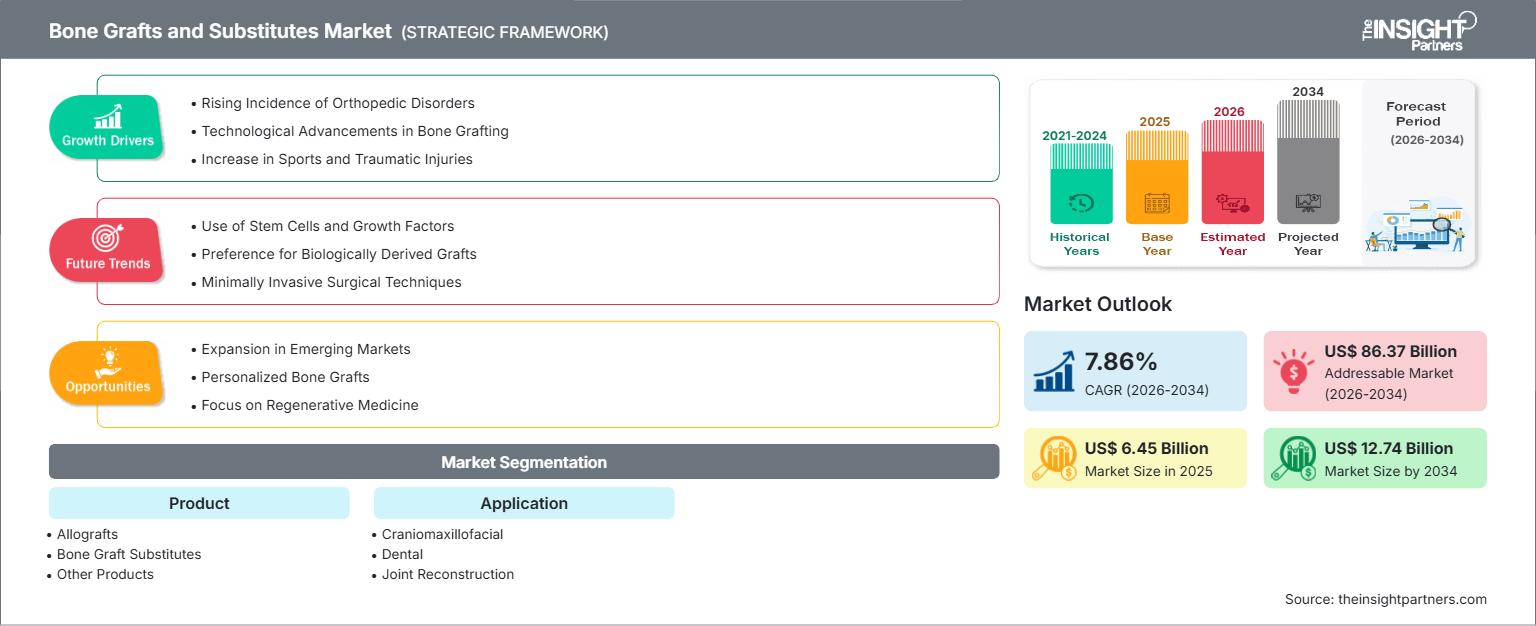
2025 Market Size
US$ 6.45 Bn
Base year value
2034 Forecast
US$ 12.74 Bn
Projected by 2034
CAGR 2026-2034
7.86 %
Growth rate
Addressable Market
US$ 86.37 Bn
(2026-2034)
The Bone Grafts and Substitutes Market size is expected to witness growth from US$ 6.45 Billion in 2025 to US$ 12.74 Billion in 2034, exhibiting a CAGR of 7.86% in the 2026–2034 period. Market growth is driven by growing volume of orthopedic surgeries, increasing spinal fusion, advancements in regenerative biomaterial technologies, and growing preference of hospitals for grafts materials, which offer low morbidity from donor sites with predictable bone healing.
North America continues to be one of the key regions generating revenue, where Bone Grafts and Substitutes Market growth is attributed to established spine surgery procedures, advanced trauma care centers, and rapid adoption of biological and synthetic graft platforms. North America is forecast to achieve CAGR of 7.2-7.7% during 2026-2034.
Bone Grafts and Substitutes Market Assessment and Insights
- North America held an estimated 39–42% share in 2025 and is expected to grow at a CAGR of 7.2–7.7% during 2026–2034, supported by spine centers, high trauma care capacity, and biologics access.
- US accounted for 82–85% of North America in 2025 and is projected to grow at a CAGR of 7.0–7.5% during 2026–2034, anchored by TLIF, ALIF, and dental reconstruction demand.
- Europe represented 27–30% share in 2025 and is expected to post a CAGR of 7.0–7.5% during 2026–2034, with Germany, the UK, France, Italy, and Spain leading adoption.
- Asia Pacific captured 20–23% share in 2025 and is projected to grow at a CAGR of 8.7–9.3% during 2026–2034, led by China, Japan, South Korea, India, and Australia.
- Largest Segment Bone Graft Substitutes held 46–49% market share in 2025 and is expected to grow at a CAGR of 8.4–8.9% during 2026–2034.
- High Growth Segment Dental accounted for 11–14% market share in 2025 and is projected to grow at a CAGR of 9.0–9.6% during 2026–2034.
- Key companies analyzed in detail: DePuy Synthes, Zimmer Biomet Holdings Inc., Medtronic plc, Stryker Corporation, Smith & Nephew plc, Medyx Surgical Inc., Orthofix Medical Inc., DePuy Mitek Sports Medicine, Bone Biologics Corporation, and Globus Medical, Inc.
Source: The Insight Partners' analysis based on proprietary research, government publications, company annual reports, investor presentations, industry databases, and expert interviews.
The technology evolution is now moving away from simple mineral fillers to be more bioactive, surgical process-dependent, and surgeon-oriented technologies. Ceramics, DBM composite bone products, viable cell matrix systems, and growth factor technologies are being increasingly picked depending on defect dimensions, mechanical properties, resorption kinetics, and regulatory pathway of approval. Manufacturing processes are also changing as companies ensure better donor tissue screening, sterilization, controlled porosity, and manufacturing logistics to supply products within spine and orthopedic product lines.
During the forecasted period, expansion of the market will move beyond the well-established spinal fusion products segment into dental implants, cranio-maxillofacial reconstruction, extremity trauma, and joint revisions. The emerging geographical regions will see better healthcare infrastructure support, whereas regulators will provide a better path for complex biologics devices. Investments will probably be made to generate proof points, local distribution relationships, and manufacturing processes providing repeatable graft performance and product availability.
Bone Grafts and Substitutes Market Report Scope
| Report Attribute | Details |
|---|---|
| Market size in 2025 | US$ 6.45 Billion |
| Market Size by 2034 | US$ 12.74 Billion |
| Global CAGR (2026 - 2034) | 7.86% |
| Historical Data | 2021-2024 |
| Forecast period | 2026-2034 |
Bone Grafts and Substitutes Market Analysis
Procedural uptake drives demand for Bone Grafts and Substitutes, especially where there is need for osteoconductive scaffolding, osteoinductive cues, or combinations of bone grafting materials. The aging population, sporting injuries, automobile trauma, degeneration of spinal disc, and dental prosthetic replacement via implants have been increasing the demand for bone grafting materials which facilitate bone regeneration without the risks that come from harvesting an autograft.
The ecosystem consists of tissue banks, biomaterial companies, contract sterilizers, hospital purchasing departments, surgeons, distributors and regulatory bodies. The supply environment has been increasingly favoring biomaterials with proven processing controls, diverse forms and wide procedural applications. Manufacturers have to take into account not only the biological efficacy of the materials but their storage life, ease of reimbursement and logistics considerations.
Competitive intensity is high, and Bone Grafts and Substitutes Market analysis shows that portfolio breadth is becoming as important as individual product performance. Medtronic plc remains influential in spine biologics, Stryker Corporation and Zimmer Biomet Holdings Inc. maintain broad orthopedic portfolios, while Orthofix Medical Inc. and Globus Medical, Inc. focus strongly on spine and regenerative solutions.
Strategic positioning increasingly depends on clinical evidence, surgeon training, and distribution reach. DePuy Synthes is expanding biologics access through partnerships, while Bone Biologics Corporation, Medyx Surgical Inc., and specialist innovators pursue differentiated regenerative approaches. Large companies are expected to use acquisitions, licensing, and co-development to secure technologies in rhBMP platforms, synthetic ceramics, DBM fibers, and cellular matrices.
● REPORT CUSTOMIZATION
Tailor This Report To Align With Your Specific Business Requirements
This report can be customized to align precisely with your business objectives, scope, and target markets. Customization options include tailored segmentation, geography, competitive analysis, and strategic insights to support informed decision-making.
Customize This Report →WHAT YOU CAN ADJUST
- ● Segmentations
- ● Geography
- ● Competitive Analysis
- ● Language Preferences
Bone Grafts and Substitutes Market: Strategic Insights
Regional Insights
North America Bone Grafts and Substitutes Market
North America held an estimated 39–42% share in 2025 and is projected to expand at a CAGR of 7.2–7.7% during 2026–2034. The regional Bone Grafts and Substitutes Market share is supported by mature hospital purchasing systems, advanced orthopedic centers, and high acceptance of premium biologics in spine, trauma, dental, and CMF procedures.
Regional demand is reinforced by surgeon access to clinical data, established reimbursement pathways, and strong participation from Medtronic plc, Stryker Corporation, Zimmer Biomet Holdings Inc., Orthofix Medical Inc., and DePuy Synthes. The market benefits from steady adoption of synthetic and allograft substitutes in fusion procedures, while ambulatory orthopedic settings expand usage in extremities, dental reconstruction, and revision surgeries.
U.S. Bone Grafts and Substitutes Market
In 2025, the U.S. represented 82-85% of North America and is projected to experience a CAGR of 7.0-7.5% between 2026 and 2034. High volumes of spine procedures, well-developed dental implants distribution networks, and the early release of the next-generation grafts will drive the steady demand from hospitals, specialized surgical centers, and educational orthopedic programs.
A significant number of companies operate in the market. Medtronic plc, DePuy Synthes, Stryker Corporation, Zimmer Biomet Holdings Inc., Orthofix Medical Inc., and Globus Medical, Inc. all maintain strong connections with surgeons. Main application areas include spinal fusions, dental bone regeneration, joint reconstruction and revision assistance, and craniofacial repair. Moreover, the growing need for evidence is promoting products with comparative information.
Europe Bone Grafts and Substitutes Market
In Europe, the share in 2025 was 27–30%, while the CAGR growth rate for 2026–2034 is expected to be 7.0–7.5%. The largest market share is observed in Germany due to high orthopedic specialization, hospital capacities, and wide application of certified biological and synthetic grafts in spine, trauma, and reconstructive surgeries.
The United Kingdom market is characterized by the effectiveness of NHS pathway, private orthopedic surgery numbers, and evidence-based procurement. Surgeons prefer substitutes that minimize the workload related to autograft collection and decrease the complexity of surgery. Steady growth can be observed in spinal fusion and dental reconstruction due to the factors mentioned above.
France, Italy, and Spain provide demand from dental implantology, trauma, and revision orthopedic surgery. There is an increasing demand because of better availability of advanced grafts, even though there is a certain impact of pricing control and tendering on products selection. European trends in the implementation of substitutes include the use of substitutes with confirmed handling, resorption characteristics, and compatibility with minimal invasive surgery methods.
APAC Bone Grafts and Substitutes Market
The market shares of APAC was 20–23% in 2025 and expected to witness a CAGR of 8.7–9.3% over 2026–2034. The prominent market countries include China owing to hospital construction, an increase in orthopedics case load, and increased availability of spine and dental implants in urban medical facilities.
The growth in Japan, South Korea, India, and Australia can be credited to premium orthopedic treatments, digitized dentistry, and increased trauma infrastructure. Policies favoring indigenous medical devices production, specialists’ training, and private health care investments have been helping to boost the market growth. The Bone Grafts and Substitutes Market is gaining due to regional collaborations enhancing surgeons' education and product availability.
Middle East & Africa Bone Grafts and Substitutes Market
Middle East & Africa is expected to grow at a CAGR of 6.4–7.0% during 2026–2034, with Saudi Arabia leading regional adoption. Hospital infrastructure programs, medical tourism, and investment in specialist orthopedic facilities are supporting demand for advanced graft materials in trauma, dental, and spine procedures.
The UAE is building premium surgical capacity, while South Africa anchors demand through established private orthopedic care. Rest of MEA remains more price-sensitive but is gradually improving access through distributor-led supply models. Energy-linked public investment and healthcare infrastructure modernization are expected to support procedural growth.
Segmentation Analysis
Product
The Product segment is expected to grow at a CAGR of 7.6–8.2% during 2026–2034, driven by surgeon preference for materials tailored to biological performance and procedural handling. Bone Grafts and Substitutes Market scope across product types is widening as hospitals evaluate substitutes based on osteoconductivity, bioactivity, resorption behavior, graft volume, and compatibility with complex spine, dental, trauma, and CMF workflows.
- Allografts remain strategically important because they provide biologic familiarity, multiple form factors, and broad relevance in spine, dental, trauma, and reconstructive procedures where donor-site morbidity reduction is prioritized.
- Bone Graft Substitutes lead adoption as synthetic ceramics, DBM composites, and bioactive materials provide consistent availability, controlled properties, and strong fit for high-volume orthopedic and dental procedures.
Application
The Application segment is projected to grow at a CAGR of 7.8–8.4% during 2026–2034, reflecting wider procedural adoption across musculoskeletal repair. Demand is shifting from single-use graft selection toward indication-specific planning, where surgeons match graft biology, defect geometry, mechanical demand, and patient risk profile to optimize fusion, regeneration, or reconstruction outcomes.
- Craniomaxillofacial applications require biocompatible, shapeable, and volume-stable graft materials for trauma repair, cranial defects, and facial reconstruction where aesthetics and structural restoration are both critical.
- Dental applications are accelerating with implant placement, ridge augmentation, sinus lifts, and periodontal regeneration, making graft substitutes strategically important for chairside workflows and predictable bone volume creation.
- Joint Reconstruction uses grafts in revision surgery, bone void management, and complex arthroplasty cases where structural support and biologic integration affect implant stability.
- Spinal Fusion remains a core application because fusion success depends on graft performance, cage compatibility, biologic activity, and surgeon confidence across lumbar, cervical, and deformity procedures.
Opportunity Snapshot
| Segment Name | Revenue Contribution | Trend Tag | Adoption Stage |
| Craniomaxillofacial | Medium | Facial Repair | Scaling |
| Dental | High | Implant Grafting | Scaling |
| Joint Reconstruction | Medium | Revision Support | Mature |
| Spinal Fusion | High | Fusion Biologics | Mature |
| Other Applications | Low | Defect Filling | Emerging |
Bone Grafts and Substitutes Market Growth Drivers and Impact Analysis
Rising Spine Fusion and Revision Procedure Demand
Spinal fusion remains one of the most influential demand drivers because it consumes meaningful graft volumes and requires reliable biologic performance. Degenerative disc disease, deformity correction, trauma stabilization, and revision surgery are increasing the need for substitutes that work with cages, fixation systems, and minimally invasive approaches. Hospitals are also scrutinizing fusion rates, reoperation risk, and procedural efficiency, which strengthens interest in validated biologics and synthetic scaffolds. The impact is most visible in premium products, where companies can differentiate through clinical evidence, indication expansion, and surgeon education. This dynamic supports higher-value purchasing and sustains product innovation in the Bone Grafts and Substitutes Market.
Shift Away from Autograft Harvesting Morbidity
Autograft remains clinically valuable, but donor-site pain, limited harvest volume, infection risk, and added operating time continue to encourage alternative graft adoption. Surgeons increasingly select allografts, synthetics, and biologic composites when procedural goals can be achieved without creating a second surgical site. This shift is especially relevant in dental, spine, trauma, and CMF settings, where predictability, availability, and ease of handling influence intraoperative decisions. The market impact is a broader purchasing base for off-the-shelf graft systems and a stronger role for materials with documented osteoconductive or osteoinductive characteristics. It also encourages manufacturers to improve form factors, sterility assurance, and defect-specific delivery formats.
Expansion of Dental Implantology and Bone Regeneration
Dental implantology is becoming a major graft consumption channel as clinicians manage ridge preservation, socket grafting, sinus elevation, and peri-implant bone defects. Growth is supported by aging populations retaining higher expectations for oral function, expanding private dental networks, and digital planning that enables more predictable reconstructive workflows. Graft substitutes are favoured because they offer standardized particle sizes, consistent handling, and compatibility with membranes and implant protocols. The commercial impact is a stronger opportunity for products tailored to dental practices, including xenograft alternatives, synthetic granules, and allograft particulates. This driver also broadens market participation beyond orthopaedic companies into specialist dental biomaterial suppliers.
Bone Grafts and Substitutes Market Future Trends
Procedure-Specific Bioactive and Composite Graft Platforms
Bone Grafts and Substitutes Market trends are moving toward procedure-specific platforms that combine scaffold architecture, biological signaling, and handling properties for defined surgical needs. Future products will likely emphasize controlled porosity, faster vascular integration, and predictable remodeling across spine, dental, CMF, and extremity defects. Manufacturers are expected to design grafts around cage geometry, minimally invasive delivery, and defect morphology rather than broad generic indications. This will increase the role of clinical evidence, imaging-based assessment, and surgeon feedback in product development. Companies with integrated biologics, implants, and digital planning capabilities could gain an advantage as treatment planning becomes more personalized and data-supported.
Stronger Evidence Standards and Regulatory Differentiation
Regulatory and hospital purchasing expectations are likely to become more evidence-driven, especially for biologically active grafts, cellular matrices, and growth-factor systems. Future differentiation will depend on randomized trials, post-market surveillance, registry data, and clear labeling for intended use. This trend will raise development costs but improve clinical confidence and reimbursement defensibility. Smaller innovators may seek partnerships with larger orthopedic companies to navigate evidence generation, regulatory submissions, and commercialization. The result will be a market where claims around osteoinduction, fusion performance, and defect healing are increasingly tied to transparent clinical data rather than material composition alone.
Bone Grafts and Substitutes Market Opportunities
Partnership-Led Expansion in High-Growth APAC Markets
Bone Grafts and Substitutes Market Forecasts indicate that APAC offers strong investment potential as procedure volumes rise and hospitals upgrade orthopedic and dental capabilities. Companies can accelerate penetration through distributor partnerships, surgeon training hubs, local regulatory expertise, and selective pricing strategies. China, India, Japan, South Korea, and Australia require distinct approaches, as reimbursement, private care intensity, and domestic manufacturing policies differ significantly. The strongest opportunity is in products that combine quality assurance with scalable availability, particularly synthetic grafts and dental biomaterials. Partnerships with local implant companies and academic hospitals can improve adoption while reducing market-entry friction.
Integrated Spine Biologics with Implant and Navigation Ecosystems
Spine biologics offer an investment opportunity when integrated with cages, fixation systems, navigation, robotics, and preoperative planning. Hospitals increasingly prefer comprehensive procedural solutions that simplify procurement and align surgeon workflows. Companies can differentiate by pairing grafts with compatible delivery instruments, interbody systems, and evidence packages for specific fusion approaches. This creates cross-selling potential for Medtronic plc, Globus Medical, Inc., DePuy Synthes, and Orthofix Medical Inc., while specialist biomaterial developers can secure licensing or distribution agreements. The opportunity is strongest where clinical data shows consistent fusion outcomes, reduced variability, and compatibility with minimally invasive and ambulatory spine procedures.
Recent Developments
- May 2026: DePuy Synthes entered an exclusive U.S., Canada, and Australia distribution agreement with CGBIO for NOVOSIS, an advanced growth-factor bone graft substitute across spine, CMF, trauma, and broader orthopedic applications. The deal includes commercialization rights and supports clinical development for U.S. regulatory approval pathways.
- February 2026: Medtronic plc announced U.S. FDA Premarket Approval for INFUSE Bone Graft in one- and two-level TLIF procedures from L2-S1 with PEEK and titanium interbody cages. The approval expanded INFUSE use across ALIF, OLIF, and TLIF spine fusion procedures.
- April 2025: BONESUPPORT AB submitted a U.S. FDA market authorization application for CERAMENT V, its vancomycin-eluting bone graft substitute for bone infection. The submission followed prior breakthrough device categorization and built on the company’s antibiotic-releasing bone graft platform.
Frequently Asked Questions

- Comprehensive Market Sizing and Forecast Analysis
- Detailed Segmentation Analysis
- In-Depth Market Dynamics Assessment
- Regional and Country-Level Insights
- Competitive Landscape and Company Benchmarking
- Strategic Business Intelligence
Recent Reports
Testimonials

The Insight Partners' SCADA System Market report is comprehensive, with valuable insights on current trends and future forecasts. The team was highly professional, responsive, and supportive throughout. We are very satisfied and highly recommend their services.
RAN KEDEM Partner, Reali Technologies LTDs
I requested a report on a very specific software market and the team produced the report in a few days. The information was very relevant and well presented. I then requested some changes and additions to the report. The team was again very responsive and I got the final report in less than a week.
JEAN-HERVE JENN Chairman, Future Analytica
We worked with The Insight Partners for an important market study and forecast. They gave us clear insights into opportunities and risks, which helped shape our plans. Their research was easy to use and based on solid data. It helped us make smart, confident decisions. We highly recommend them.
PIYUSH NAGPAL Sr. Vice President, High Beam Global
The Insight Partners delivered insightful, well-structured market research with strong domain expertise. Their team was professional and responsive throughout. The user-friendly website made accessing industry reports seamless. We highly recommend them for reliable, high-quality research services
YUKIHIKO ADACHI CEO, Deep Blue, LLC.
This is the first time I have purchased a market report from The Insight Partners.While I was unsure at first, I visited their web site and felt more comfortable to take the risk and purchase a market report.I am completely satisfied with the quality of the report and customer service. I had several questions and comments with the initial report, but after a couple of dialogs over email with their analyst I believe I have a report that I can use as input to our strategic planning process.Thank you so much for taking the extra time and making this a positive experience.I will definitely recommend your service to others and you will be my first call when we need further market data.
JOHN SUZUKI President and Chief Executive Officer, Board Director, BK Technologies
I wish to appreciate your support and the professionalism you displayed in the course of attending to my request for information regarding to infectious disease IVD market in Nigeria. I appreciate your patience, your guidance, and the fact that you were willing to offer a discount, which eventually made it possible for us to close a deal. I look forward to engaging The Insight Partners in the future, all thanks to the impression you have created in me as a result of this first encounter.
DR CHIJIOKE ONYIA MANAGING DIRECTOR, PineCrest Healthcare Ltd.Reason to Buy
- Informed Decision-Making
- Understanding Market Dynamics
- Competitive Analysis
- Identifying Emerging Markets
- Customer Insights
- Market Forecasts
- Risk Mitigation
- Boosting Operational Efficiency
- Strategic Planning
- Investment Justification
- Tracking Industry Innovations
- Aligning with Regulatory Trends





 Get Free Sample for