
Burner Management System Market Growth, Share & Trends by 2034
Coverage: By Component (Software, Hardware); Application (Single Burner, Multiple Burner); Fuel Type (Oil, Gas, Others); End-user (Oil and Gas, Power, Chemical, Others), and Geography (North America, Europe, Asia Pacific, and South and Central America)
- Status : Data Released
- Report Code : TIPRE00013790
- Category : Electronics and Semiconductor
- No. of Pages : 150
- Available Report Formats :


- Last update date : July 28, 2026


2025 Market Size
US$ 6.52 Bn
Base year value
2034 Forecast
US$ 10.83 Bn
Projected by 2034
CAGR 2026-2034
5.80 %
Growth rate
Addressable Market
US$ 78.62 Bn
(2026-2034)
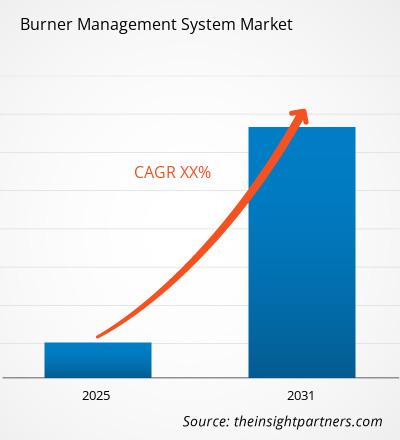
The Burner Management System Market size stood at US$ 6.52 Billion in 2025, which will further increase to US$ 10.83 Billion in 2034. Market growth is expected on account of safer burning operations, automatic burner shutdown mechanisms, flame detection and observation, and safe working practices in the oil and gas, power, and chemical sectors.
In North America, value of Burner Management System Market is driven by 5.4% to 5.9% compound annual growth rate until 2034, owing to refineries' modernization, safety improvements in boilers, and increasing use of SIL certified controllers. Growth of structural demand is backed by OSHA process safety requirements, NFPA fire safety standards, and retirement of older PLC-based installations in large thermal processes.
Burner Management System Market Assessment and Insights
- North America accounted for 35–37% share in 2025 and is expected to grow at a CAGR of 5.4–5.9% between 2026–2034, led by refinery retrofits and combustion safety compliance.
- US represented 72–75% of North America in 2025 and is projected to grow at a CAGR of 5.3–5.8% between 2026–2034, supported by petrochemical and utility upgrades.
- Europe held 24–26% share in 2025 and is forecast to grow at a CAGR of 4.9–5.4% between 2026–2034, with Germany, UK, France, Italy, and Spain leading regulated demand.
- Asia Pacific captured 27–30% share in 2025 and is projected to grow at a CAGR of 6.4–7.1% between 2026–2034, led by China, India, Japan, South Korea, and Australia.
- Largest Segment Hardware held 50–54% market share in 2025 and is expected to grow at a CAGR of 5.1–5.6% between 2026–2034 due to sensors, valves, and controllers.
- High Growth Segment Software held 46–50% market share in 2025 and is projected to expand at a CAGR of 6.3–6.9% between 2026–2034 as diagnostics and predictive maintenance scale.
- Key companies analyzed in detail: ABB Ltd., ACL Manufacturing Inc., Cimarron Energy Inc., Combustex Corp., Emerson Electric Co., Forney Corporation, Honeywell International Inc., Rockwell Automation, Inc., Schneider Electric SE, Siemens AG.
Source: The Insight Partners' analysis based on proprietary research, government publications, company annual reports, investor presentations, industry databases, and expert interviews.
The technology shift involves migration from relay-based panels to systems involving safety controllers, digital flame scanners, and distributed control systems interface technology. The current production trend requires modularity in the form of skid packages, pre-engineered logic, and services geared towards minimizing commissioning risks. Vendors have started to match their hardware with diagnostic software for the need for proof testing, fault isolation, and minimizing chances of unplanned shutdowns in furnaces, boilers, heaters, and incinerators.
According to the Burner Management System Market forecasts, future growth will be supported by the emergence of industrial corridors involving investments in LNG terminals, gas-powered plants, chemicals, and refining efficiency projects. Favorable regulation remains a key driver as combustion accidents have operational, environmental, and insurance ramifications. Adoption will be strongest when aged thermal assets face stringent safety audits and increased gas requirements along with budget for digitalization.
Burner Management System Market Report Scope
| Report Attribute | Details |
|---|---|
| Market size in 2025 | US$ 6.52 Billion |
| Market Size by 2034 | US$ 10.83 Billion |
| Global CAGR (2026 - 2034) | 5.80% |
| Historical Data | 2021-2024 |
| Forecast period | 2026-2034 |
Burner Management System Market Analysis
Industries' needs are driven by process safety, energy savings, and economics of uptime. Burner Management Systems Market has high potential where companies control processes of continuous burning in refineries, gas processing facilities, petrochemical crackers, thermal power stations, and specialty chemical plants. The supply chain includes flame detection, fuel train equipment, logic controller, burner management system control software, engineering, and certification.
Supply is driven by the availability of certified products, the capabilities of engineering of projects, and compatibility with already existing DCS or PLCs. Users are seeking for suppliers who can incorporate processes such as emergency shut down, fuel sequences, permissive sequences, purge cycles, and alarm rationalization without significant customization of code.
The competitive environment is made up of automation majors and combustion experts. The companies competing through their safety platforms, software ecosystems, and access to the installed base include ABB Ltd., Honeywell International Inc., Emerson Electric Co., Siemens AG, Schneider Electric SE, and Rockwell Automation, Inc., whereas Forney Corporation, ACL Manufacturing Inc., Cimarron Energy Inc., and Combustex Corp. emphasize application expertise.
Strategic investment initiatives have been shifting from compliance-focused projects to performance-driven initiatives. An analysis of the Burner Management System Market reveals that customers prefer lifecycle management, proof test documentation, cybersecurity compatibility, and an infrastructure for analytics. Consequently, strategic positioning requires domain expertise, regional availability, and the capability to retrofit legacy burners without interfering with plant operations.
● REPORT CUSTOMIZATION
Tailor This Report To Align With Your Specific Business Requirements
This report can be customized to align precisely with your business objectives, scope, and target markets. Customization options include tailored segmentation, geography, competitive analysis, and strategic insights to support informed decision-making.
Customize This Report →WHAT YOU CAN ADJUST
- ● Segmentations
- ● Geography
- ● Competitive Analysis
- ● Language Preferences
Burner Management System Market: Strategic Insights
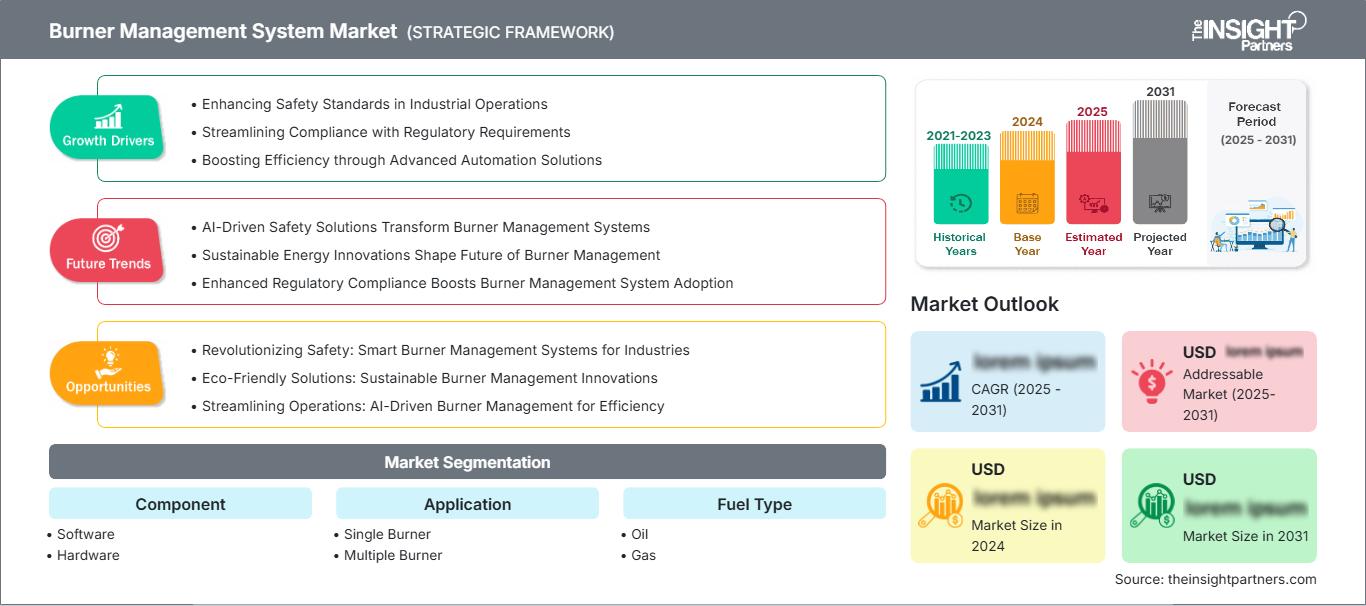
Regional Insights
North America Burner Management System Market
North America held 35–37% of 2025 revenue and is expected to grow at a 5.4–5.9% CAGR through 2034. The region benefits from a large installed base of refinery heaters, industrial boilers, gas turbines, and chemical furnaces that require periodic safety upgrades, documented interlocks, and reliable burner sequencing.
Modernization is being given priority by operators due to higher costs associated with combustion-related accidents due to increased use of natural gas, power reliability requirements, and insurance regulations. Burner Management System Market share in North America is also supported by a developed service infrastructure, NFPA engineering design guidelines, and the widespread use of SIL control equipment in brownfield applications.
U.S. Burner Management System Market
North America accounts for 72% to 75% of total sales made by the United States. The market in the U.S. is projected to grow at a rate of 5.3% to 5.8%. The applications of burner management systems include shale gas operations, refinery, petrochemical, district energy, and utility boiler units that require safe start up, flame failure protection, and isolation of fuels.
Market presence is strong since Emerson Electric Co., Honeywell International Inc., Rockwell Automation, Inc., Forney Corporation, Cimarron Energy Inc., ACL Manufacturing Inc., and Combustex Corp. provide engineering, field commissioning, and service needs. Multi-burner applications are popular in large furnaces while single burner packages have their application in packaged boilers.
Europe Burner Management System Market
The share of Europe was estimated to be 24% to 26%, and the CAGR growth rate is projected to be 4.9% to 5.4%. The leading contributor is Germany due to its chemical clusters, decarbonization of industrial heat, and safety in machines. The United Kingdom is actively engaged in refinement of oil, power, and energy infrastructure connected with the North Sea.
France, Italy, and Spain provide their contribution in terms of specialty chemicals, district heating, LNG terminal facilities, and industrial boilers' replacement. European customers pay attention to compliance, emissions reduction, and energy management system integration, which creates the demand for software-based diagnostic and certified hardware platforms in the market.
APAC Burner Management System Market
APAC held 27–30% share in 2025 and is projected to record a 6.4–7.1% CAGR, the fastest regional pace. China leads installed demand, while India adds growth through refining, chemicals, and power capacity additions.
Japan, South Korea, and Australia support advanced retrofit demand through LNG, petrochemicals, metals, and utility modernization. Policy emphasis on industrial safety, higher gas use, and efficiency programs encourages operators to adopt integrated combustion safeguards rather than isolated flame relays.
Middle East & Africa Burner Management System Market
Middle East & Africa is expected to grow at a 5.7–6.3% CAGR, led by Saudi Arabia and the UAE. Demand is linked to refinery complexes, gas processing, petrochemicals, and utility-scale thermal assets that require dependable fuel trip systems.
South Africa and Rest of MEA add opportunities through power plant rehabilitation, industrial boiler upgrades, and mining-linked heat processes. The region’s energy infrastructure programs favor rugged hardware, remote diagnostics, and service models suited to harsh operating environments.
Segmentation Analysis
Component
Component is projected to grow at a 5.6–6.1% CAGR from 2026–2034. The Burner Management System Market scope across components is broadening as operators combine certified controllers, flame scanners, valves, and supervisory software into auditable safety architectures. Replacement demand favors interoperable platforms that lower commissioning time and simplify lifecycle validation.
- Software supports alarm rationalization, diagnostics, trend visualization, and proof-test records, making it strategic for plants seeking predictive maintenance, operator guidance, and fewer unplanned burner shutdowns.
- Hardware remains essential because flame detectors, fuel valves, igniters, scanners, and safety controllers execute protective functions that determine combustion reliability and compliance readiness.
Application
Application is forecast to expand at a 5.7–6.2% CAGR from 2026–2034. Multiple burner assets require coordinated sequencing, purge management, fuel balancing, and fast trip logic, while single burner systems remain important in packaged industrial equipment. Application decisions are strongly influenced by asset criticality, burner count, and integration complexity.
- Single Burner demand is steady in smaller boilers, heaters, and process skids where compact controllers, simplified wiring, and standardized safety logic support cost-effective compliance.
- Multiple Burner systems carry strategic importance in refineries, power boilers, and large furnaces because synchronized interlocks, burner sequencing, and diagnostics reduce high-impact operational risk.
Fuel Type
Fuel Type is expected to grow at a 5.5–6.0% CAGR from 2026–2034. Gas-fired combustion is expanding with LNG, industrial heat, and power reliability investments, while oil-fired systems remain relevant in refineries and backup heat applications. Fuel switching increases demand for configurable safety logic and verified shutdown sequencing.
- Oil systems require robust atomization monitoring, pilot validation, and fuel shutoff arrangements, particularly in refinery heaters, backup boilers, and heavy industrial furnaces.
- Gas systems benefit from expanding industrial gas use, LNG infrastructure, and cleaner combustion priorities, making flame detection accuracy and valve train integrity central to adoption.
End-user
End-user demand is projected to rise at a 5.8–6.4% CAGR from 2026–2034. Oil and gas users prioritize hazardous-area reliability, power generators focus on boiler and turbine fuel safety, and chemical producers require repeatable combustion control for complex batch and continuous processes. Retrofit economics remain strongest where downtime costs are high.
- Oil and Gas adoption is driven by refinery heaters, gas processing trains, LNG facilities, and upstream production sites where safe fuel isolation protects high-value assets.
- Power users require burner safeguards for boilers, auxiliary burners, and thermal generation assets, with reliability, restart speed, and operator visibility shaping procurement priorities.
- Chemical facilities value precise heat input, documented permissives, and shutdown reliability because reactors, crackers, incinerators, and thermal oxidizers operate under strict safety conditions.
Opportunity Snapshot
| End-user | Revenue Contribution | Trend Tag | Adoption Stage |
| Oil and Gas | High | Refinery Retrofit | Mature |
| Power | Medium | Boiler Safety | Scaling |
| Chemical | Medium | Process Heat | Scaling |
Burner Management System Market Growth Drivers and Impact Analysis
Stricter Combustion Safety Compliance
Increasing demands are being placed on industrial plant owners in regards to documented burner permissives, purge cycles, flame monitoring, and automatic isolation of the fuel in an emergency. Programs based on NFPA, OSHA Process Safety Management, IEC Functional Safety, and insurance company audit requirements are turning safety modifications from a good-to-have initiative into a periodic capital expenditure. This trend is more prominent in older refineries, utility boilers, petrochemical furnaces, and thermal oxidizers that lack diagnostic data and electronic documentation due to outdated relay logic. Companies that provide certified logic, pre-verified libraries, and test solutions for the entire lifecycle can help save time and lower engineering risks.
Modernization of Aging Industrial Heat Assets
Many process plants still operate combustion assets built before current digital safety practices became standard. As boilers, fired heaters, kilns, and furnaces approach midlife or late-life overhaul, operators use planned turnarounds to replace obsolete scanners, relays, valves, and hardwired panels. Modern systems improve trip reliability, reduce nuisance shutdowns, and allow maintenance teams to identify failing instruments before a burner outage escalates. Retrofit projects also protect production margins because a single unplanned shutdown can affect downstream units, steam supply, or emissions compliance. This creates recurring demand for engineered migration packages, particularly in oil and gas, chemicals, and power generation.
Rising Gas Use and Thermal Process Reliability Needs
Global gas demand reached a new high in 2024, with industry and power generation accounting for around three-quarters of incremental gas demand, according to the International Energy Agency. Higher gas-fired activity increases the operating importance of valve integrity, flame stability, purge timing, and safe relight logic. Facilities adopting gas for efficiency or emissions reasons must also manage transient operating conditions, mixed-fuel capability, and tighter startup procedures. The commercial impact is broader adoption of advanced burner safeguards in LNG terminals, captive power plants, district heating, petrochemical units, and industrial boilers, where reliability and safety performance directly affect energy availability.
Burner Management System Market Future Trends
Analytics-Ready Burner Safety Platforms
The Burner Management System Market trends would revolve around analytics-ready platforms that integrate safety execution with condition monitoring, event replay, and predictive diagnostics. It is anticipated that plants would be able to link flame scanner status, valve cycle events, trip records, and purge efficiency to maintenance systems without jeopardizing the safety integrity. Such a trend would impact procurement practices in that buyers would be evaluating not just the trip logics, but also data availability, security measures, and operator usability. Suppliers offering validated analytics alongside SIL compliance would get the edge when doing brownfield installations under labor restrictions.
Modular Compliance Packages for Brownfield Plants
Upgrade solutions for brownfields are becoming more popular as the need to minimize downtime and eliminate engineering uncertainties associated with such installations grows. In the coming years, vendors are expected to streamline the design of templates for burners' logic, cabinets, field cabling kits, and documentation in the process of commissioning boilers, furnaces, and heaters with similar characteristics. It will allow users to replace the out-of-date relay systems or PLCs with the state-of-the-art safety controllers without re-engineering all interlocks from the ground up. There is a strong preference for companies with repeatable project delivery, regional services, and relevant domain libraries.
Burner Management System Market Opportunities
Retrofit Programs for Refineries and Petrochemical Complexes
Refineries and petrochemical complexes offer the most immediate investment opportunity because fired heaters, crackers, reformers, boilers, and thermal oxidizers operate continuously and carry high consequence risk. Suppliers can target turnaround-linked retrofit bundles that include site surveys, risk review, validated logic, replacement scanners, valve train upgrades, and operator training. The strongest commercial models will combine capital equipment with recurring testing, cybersecurity review, and spare parts support. This approach helps operators justify modernization through fewer nuisance trips, better compliance evidence, and reduced outage exposure. It also allows vendors to expand account penetration across multiple units after the first successful deployment.
Service-Led Expansion in Emerging Industrial Corridors
Emerging industrial corridors in Asia Pacific, the Middle East, and parts of Africa require combustion safety expertise as new LNG terminals, chemical plants, captive power units, and industrial boilers enter service. Market participants can create differentiation by pairing hardware sales with commissioning, operator competency programs, proof-test documentation, and remote support. This opportunity is action-oriented because many buyers lack specialized burner safety engineering teams and prefer vendors that reduce execution risk. Local partnerships, certified panels, and lifecycle service contracts can improve adoption while protecting margins. The model is particularly attractive where regulatory enforcement is strengthening but installed technical capability remains uneven.
Recent Developments
- December 2024: ClearSign Technologies expanded its partnership with Zeeco to launch a co-branded line of low-emission process burners. Powered by ClearSign Core technology, the burners can operate on 100% natural gas or hydrogen while maintaining ultra-low NOx emissions to help industries meet stringent environmental regulations.
- December 2024: Zeeco and ClearSign officially introduced their co-branded process burner portfolio, combining Zeeco's global combustion expertise with ClearSign's emissions-reduction technology. The new product line is designed to improve energy efficiency and support cleaner industrial operations.
- July 2026: Aterian Investment Partners completed the sale of Burner Systems International (BSI) to Robertshaw, marking a strategic ownership transition. The acquisition is expected to strengthen Robertshaw's portfolio of combustion and thermal management solutions for industrial and commercial markets.
Frequently Asked Questions

- Comprehensive Market Sizing and Forecast Analysis
- Detailed Segmentation Analysis
- In-Depth Market Dynamics Assessment
- Regional and Country-Level Insights
- Competitive Landscape and Company Benchmarking
- Strategic Business Intelligence
Recent Reports
Testimonials

The Insight Partners' SCADA System Market report is comprehensive, with valuable insights on current trends and future forecasts. The team was highly professional, responsive, and supportive throughout. We are very satisfied and highly recommend their services.
RAN KEDEM Partner, Reali Technologies LTDs
I requested a report on a very specific software market and the team produced the report in a few days. The information was very relevant and well presented. I then requested some changes and additions to the report. The team was again very responsive and I got the final report in less than a week.
JEAN-HERVE JENN Chairman, Future Analytica
We worked with The Insight Partners for an important market study and forecast. They gave us clear insights into opportunities and risks, which helped shape our plans. Their research was easy to use and based on solid data. It helped us make smart, confident decisions. We highly recommend them.
PIYUSH NAGPAL Sr. Vice President, High Beam Global
The Insight Partners delivered insightful, well-structured market research with strong domain expertise. Their team was professional and responsive throughout. The user-friendly website made accessing industry reports seamless. We highly recommend them for reliable, high-quality research services
YUKIHIKO ADACHI CEO, Deep Blue, LLC.
This is the first time I have purchased a market report from The Insight Partners.While I was unsure at first, I visited their web site and felt more comfortable to take the risk and purchase a market report.I am completely satisfied with the quality of the report and customer service. I had several questions and comments with the initial report, but after a couple of dialogs over email with their analyst I believe I have a report that I can use as input to our strategic planning process.Thank you so much for taking the extra time and making this a positive experience.I will definitely recommend your service to others and you will be my first call when we need further market data.
JOHN SUZUKI President and Chief Executive Officer, Board Director, BK Technologies
I wish to appreciate your support and the professionalism you displayed in the course of attending to my request for information regarding to infectious disease IVD market in Nigeria. I appreciate your patience, your guidance, and the fact that you were willing to offer a discount, which eventually made it possible for us to close a deal. I look forward to engaging The Insight Partners in the future, all thanks to the impression you have created in me as a result of this first encounter.
DR CHIJIOKE ONYIA MANAGING DIRECTOR, PineCrest Healthcare Ltd.Reason to Buy
- Informed Decision-Making
- Understanding Market Dynamics
- Competitive Analysis
- Identifying Emerging Markets
- Customer Insights
- Market Forecasts
- Risk Mitigation
- Boosting Operational Efficiency
- Strategic Planning
- Investment Justification
- Tracking Industry Innovations
- Aligning with Regulatory Trends





 Get Free Sample for