
Carcinoid Syndrome Management Market Trends, Demand & Growth by 2034
Coverage: By Organs ( Small Intestine, Rectum, Lungs, Appendix, Colon, Stomach, Pancreas, Liver, Others ); Treatment Type ( Chemotherapy, Biological Therapy, Hepatic Artery Embolization Agents ); End User ( Hospitals, Clinics, Cancer Institutions and Treatment Centers, Others ) , and Geography (North America, Europe, Asia Pacific, and South and Central America)
- Status : Data Released
- Report Code : TIPRE00020014
- Category : Life Sciences
- No. of Pages : 150
- Available Report Formats :


- Last update date : August 26, 2026


2025 Market Size
US$ 6.93 Bn
Base year value
2034 Forecast
US$ 15.61 Bn
Projected by 2034
CAGR 2026-2034
9.45 %
Growth rate
Addressable Market
US$ 100.65 Bn
(2026-2034)
The Carcinoid Syndrome Management Market is projected to grow from US$ 6.93 Billion in 2025 to US$ 15.61 Billion by 2034, registering a CAGR of 9.45% during 2026–2034. The market includes symptom control drugs, tumor-directed therapies, liver-directed interventions, and care pathways used for patients with functional neuroendocrine tumors that trigger flushing, diarrhea, wheezing, and cardiac complications.
Across North America, the Carcinoid Syndrome Management Market size is supported by specialist oncology networks, wider somatostatin analog use, and stronger access to interventional radiology. The region is expected to grow at an estimated CAGR range of 8.8–9.3% during 2026–2034, driven by neuroendocrine tumor registry expansion, reimbursement for long-acting injectable therapies, and higher adoption of multidisciplinary treatment protocols.
Carcinoid Syndrome Management Market Assessment and Insights
- North America held a 42–45% share in 2025 and is expected to grow at a CAGR between 8.8–9.3% during 2026–2034, supported by specialty cancer centers, advanced imaging, and reimbursement depth.
- U.S. represented 82–86% of North America in 2025 and is projected to grow at a CAGR between 8.9–9.4% during 2026–2034, led by hospital-based oncology pathways.
- Europe accounted for a 25–28% share in 2025 and is expected to grow at a CAGR between 8.2–8.7% during 2026–2034, with Germany, France, and the UK leading adoption.
- Asia Pacific held a 19–22% share in 2025 and is forecast to grow at a CAGR between 10.6–11.3% during 2026–2034, led by China, Japan, India, South Korea, and Australia.
- Largest Segment: Small Intestine held a market share of 34–38% in 2025 and is expected to grow at a CAGR range of 9.1–9.6% during 2026–2034.
- High Growth Segment: Hepatic Artery Embolization Agents held a market share of 15–18% in 2025 and is expected to grow at a CAGR range of 10.4–11.1% during 2026–2034.
- Key companies analyzed in detail: Teva Pharmaceutical Industries Ltd., AbbVie Inc., Novartis AG, Pharmascience Inc., Omega Laboratories Limited, Viatris Inc., Ipsen Biopharmaceuticals, Inc., Sirtex Medical Pty Ltd, Boston Scientific Corporation, and Wockhardt Limited.
Source: The Insight Partners' analysis based on proprietary research, government publications, company annual reports, investor presentations, industry databases, and expert interviews.
Clinical practice has moved from episodic symptom relief toward integrated management that combines long-acting somatostatin analogs, rescue therapy, biomarker testing, peptide receptor radionuclide therapy, and liver-directed interventions. Production dynamics are also changing as complex generic injectables improve supply options while branded biologic and radiopharmaceutical manufacturers invest in specialized manufacturing, cold-chain distribution, and nuclear medicine capacity, reshaping the Carcinoid Syndrome Management Market around continuity of care.
During the forecast period, the nascent centers of excellence in oncology in the Asia Pacific and Middle Eastern regions will be increasing procedural capabilities for the treatment of liver metastases and neuroendocrine tumors. A favorable regulatory environment includes increased real-world evidence acceptability, neuroendocrine tumor classification, and multidisciplinary oncology reimbursement. Such an environment will benefit players with the ability to marry up reliable supply, education, and positioning.
Carcinoid Syndrome Management Market Report Scope
| Report Attribute | Details |
|---|---|
| Market size in 2025 | US$ 6.93 Billion |
| Market Size by 2034 | US$ 15.61 Billion |
| Global CAGR (2026 - 2034) | 9.45% |
| Historical Data | 2021-2024 |
| Forecast period | 2026-2034 |
Carcinoid Syndrome Management Market Analysis
Rising diagnosis of neuroendocrine neoplasms is the core demand driver, as population-based cancer registries show increasing incidence and longer survival. Carcinoid Syndrome Management Market growth is also linked to greater use of chromogranin A, 5-HIAA testing, somatostatin receptor imaging, and referral to neuroendocrine tumor boards. Demand is strongest where late-stage liver metastases require both symptom suppression and disease control.
The ecosystem comprises providers of API, injectables, radiopharmaceuticals, interventional oncology devices, hospitals, nuclear medicine clinics, and specialty pharmacies. The supply chain is affected by the complex nature of depots, sterile injectable production, the means to transport yttrium-90, and payer regulations. Hospitals are favoring more predictable dosing, fewer adverse events, and fewer need for rescue medicines.
Competitive positioning is concentrated around differentiated mechanisms and dependable access. Carcinoid Syndrome Management Market analysis shows Novartis AG and Ipsen Biopharmaceuticals, Inc. occupying strong specialty positions, while Teva Pharmaceutical Industries Ltd. and Viatris Inc. strengthen affordability through complex generics. Sirtex Medical Pty Ltd and Boston Scientific Corporation support liver-directed treatment pathways, especially in patients with hepatic tumor burden.
Investments support injectable life cycle management systems, radioligand therapy facility, and targeted embolization technology. Competitive edge is provided by AbbVie Inc., Pharmascience Inc., Omega Laboratories Limited, and Wockhardt Limited through wider distribution channels for pharmaceuticals, while specialists concentrate on clinician education and a network of treatment centers. Increasingly, the strategic advantage lies in evidence-based delivery aligned with neuroendocrine tumor guidelines.
● REPORT CUSTOMIZATION
Tailor This Report To Align With Your Specific Business Requirements
This report can be customized to align precisely with your business objectives, scope, and target markets. Customization options include tailored segmentation, geography, competitive analysis, and strategic insights to support informed decision-making.
Customize This Report →WHAT YOU CAN ADJUST
- ● Segmentations
- ● Geography
- ● Competitive Analysis
- ● Language Preferences
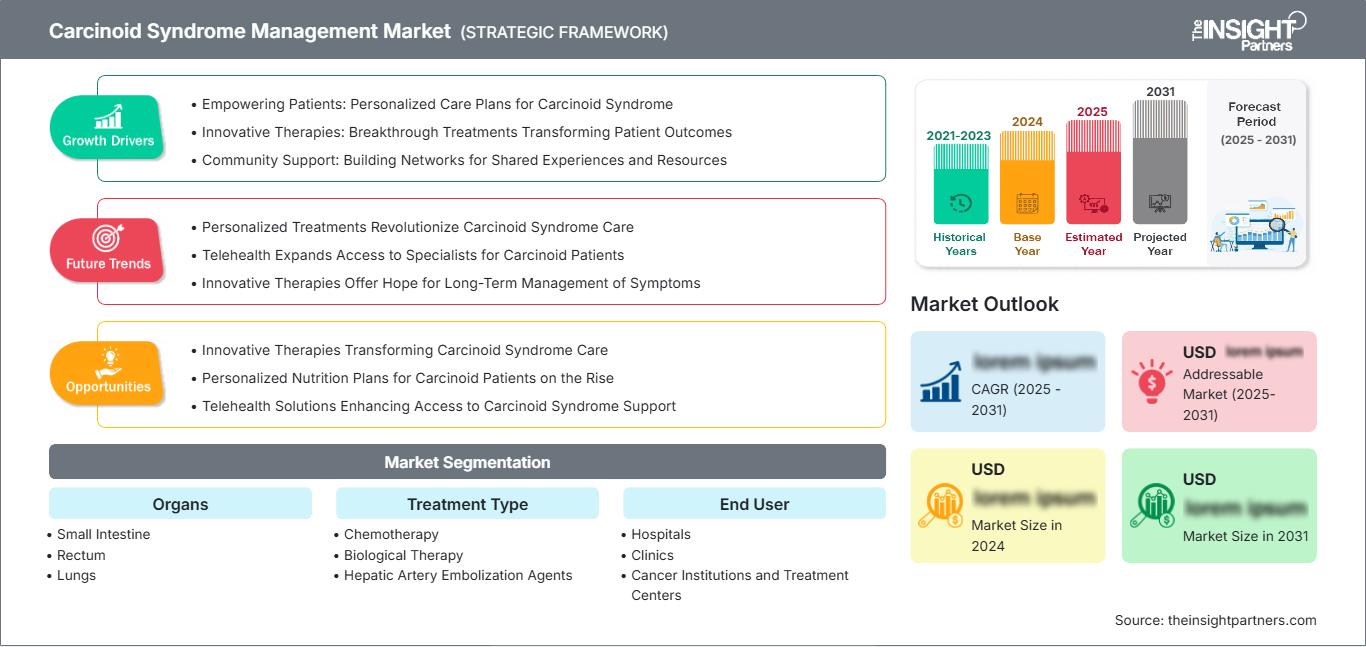
Carcinoid Syndrome Management Market: Strategic Insights
Regional Insights
North America Carcinoid Syndrome Management Market
North America accounted for a 42–45% share in 2025 and is expected to grow at a CAGR of 8.8–9.3% during 2026–2034. The region has strong specialist oncology density, established somatostatin analog prescribing, and wider access to interventional radiology for hepatic tumor burden. The Carcinoid Syndrome Management Market share is reinforced by U.S. hospital networks, payer coverage, and treatment-center concentration.
Regional demand is also supported by growing recognition of neuroendocrine tumor symptoms and expanded use of somatostatin receptor imaging. Canada contributes through public oncology pathways and provincial reimbursement, while the U.S. drives most procedural and pharmacologic revenue. Complex injectable competition is expected to improve access without materially reducing demand for premium specialist therapies.
U.S. Carcinoid Syndrome Management Market
The U.S. represented 82–86% of North America in 2025 and is projected to grow at a CAGR of 8.9–9.4% during 2026–2034. The demand is driven by widespread use of LARs, specialized pharmacies and major oncology centers that take care of functional neuroendocrine tumors. Presence is extensive, and some of the leading companies in different complementary treatment paths include Novartis AG, Ipsen Biopharmaceuticals, Inc., Teva Pharmaceutical Industries Ltd., and Sirtex Medical Pty Ltd.
There are changes in the application path towards earlier symptom control and sequencing in the case of metastatic patients. Hospitals are implementing protocols for diarrhea, flushing, screening for carcinoid heart disease and liver-directed therapy referrals. The U.S. is a leader in terms of complex generic launches, nuclear medicine and real-world evidence.
Europe Carcinoid Syndrome Management Market
Europe held a 25–28% share in 2025 and is expected to grow at a CAGR of 8.2–8.7% during 2026–2034. Germany holds the first position because of the nuclear medicine facilities, the availability of many specialist centers, and intervention radiology strength. The UK can boast of its cancer pathways and increasing referrals to the multidisciplinary teams treating the neuroendocrine tumors.
The leading countries driving regional growth are Germany and France, owing to the guidelines-based therapy and reimbursement for specialist oncology medicines. France is key to somatostatin analog legacy and radiopharmaceuticals, while Italy and Spain play an important role because of their public hospitals’ demand, access to liver-directed therapies, and improved diagnostics.
APAC Carcinoid Syndrome Management Market
APAC held a 19–22% share in 2025 and is forecast to grow at a CAGR of 10.6–11.3% during 2026–2034. China is the leading growth contributor, supported by cancer-center expansion, improved imaging access, and broader specialty pharmaceutical distribution. Japan and South Korea show mature diagnostic capability, while India and Australia add growth through referral networks.
Industrial policy is strengthening local oncology manufacturing and hospital infrastructure. Demand is rising as physicians identify more functional neuroendocrine tumors, especially gastrointestinal and pancreatic cases. Access gaps remain, but biosimilar, generic, and public procurement channels are expected to improve affordability across tiered healthcare systems.
Middle East & Africa Carcinoid Syndrome Management Market
The Middle East & Africa is expected to grow at a CAGR of 8.5–9.1% during 2026–2034. Saudi Arabia is the leading country, supported by tertiary hospital investment, oncology center expansion, and specialist physician recruitment. The UAE is building private oncology and diagnostic capacity, while South Africa remains the most developed sub-Saharan treatment hub.
Energy-linked healthcare investment continues to support advanced hospital infrastructure in Gulf markets. Adoption remains uneven because neuroendocrine tumor awareness and diagnostic access vary widely. The rest of MEA demand will depend on referral pathways, reimbursement clarity, and availability of long-acting injectables in public and private channels.
Segmentation Analysis
Organs
Organs are expected to register a CAGR of 9.0–9.6% during 2026–2034. The Carcinoid Syndrome Management Market scope across organ sites reflects differences in hormone secretion, metastatic pattern, surgical eligibility, and liver involvement. Small-intestine disease drives the largest clinical workload because midgut tumors frequently cause functional symptoms after hepatic spread.
- Small Intestine remains the leading organ sub-segment due to frequent midgut origin, metastatic presentation, and strong need for long-term somatostatin analog treatment plus liver burden control.
- Rectum shows rising detection through colonoscopy and incidental diagnosis, creating demand for surveillance, localized treatment decisions, and escalation strategies in advanced or functional cases.
- Lungs require differentiated diagnostic pathways because bronchial neuroendocrine tumors may cause hormone-related symptoms while also needing thoracic oncology and pulmonary evaluation.
- Appendix cases are often detected incidentally after appendectomy, but advanced presentations require risk stratification, surveillance, and specialist referral where hormone secretion develops.
- Colon represents a clinically important sub-segment because diagnosis may occur at advanced stages, increasing the need for systemic therapy, symptom control, and hospital-based oncology management.
- Stomach demand is linked to endoscopic diagnosis, gastrin-related evaluation, and individualized care based on tumor grade, size, multiplicity, and metastatic potential.
- The pancreas has strategic relevance because pancreatic neuroendocrine tumors may require targeted therapy, hormonal testing, and complex sequencing across medical oncology and surgery.
- Liver is central to syndrome expression because hepatic metastases allow bioactive amines to enter systemic circulation, supporting liver-directed interventions and embolization demand.
Treatment Type
Treatment Type is projected to grow at a CAGR of 9.2–9.8% during 2026–2034. Treatment selection depends on symptom severity, tumor burden, receptor expression, hepatic metastases, and prior therapy. Long-acting symptom control remains foundational, while chemotherapy and liver-directed agents address progressive or high-burden disease.
- Chemotherapy retains demand in aggressive, progressive, or poorly differentiated tumors where cytotoxic regimens remain necessary despite the wider availability of targeted and receptor-based options.
- Biological Therapy is strategically important because somatostatin analogs reduce flushing and diarrhea, lower rescue medication use, and support chronic disease management across care settings.
- Hepatic Artery Embolization Agents are gaining relevance for liver-dominant disease, where targeted delivery can reduce tumor burden, improve symptoms, and delay systemic therapy escalation.
End User
End User is expected to grow at a CAGR of 8.8–9.4% during 2026–2034. Treatment delivery is concentrated in hospitals and cancer institutions because carcinoid syndrome often requires imaging, injectable therapy, cardiac monitoring, nutrition support, and interventional procedures. Clinics remain important for follow-up injections, symptom assessment, and chronic care coordination.
- Hospitals dominate treatment delivery because they integrate oncology, gastroenterology, nuclear medicine, cardiology, interventional radiology, and emergency management for carcinoid crisis risk.
- Clinics support recurring injections, adverse-event monitoring, nutrition counseling, and routine symptom scoring, making them essential for continuity after specialist treatment initiation.
- Cancer Institutions and Treatment Centers provide multidisciplinary sequencing, clinical trial access, radioligand therapy pathways, and specialized neuroendocrine tumor expertise for complex patients.
Opportunity Snapshot
| Segment Name | Revenue Contribution | Trend Tag | Adoption Stage |
| Hospitals | High | Integrated Care | Mature |
| Clinics | Medium | Injection Follow-up | Scaling |
| Cancer Institutions and Treatment Centers | High | NET Boards | Scaling |
Carcinoid Syndrome Management Market Growth Drivers and Impact Analysis
Rising Neuroendocrine Tumor Detection
Germany holds the first position because of the nuclear medicine facilities, the availability of many specialist centers, and intervention radiology. The UK can boast of its cancer pathways and increasing referrals to the multidisciplinary teams treating the neuroendocrine tumors.
The leading countries driving regional growth are Germany and France, owing to the guidelines-based therapy and reimbursement for specialist oncology medicines. France is key to somatostatin analog legacy and radiopharmaceuticals, while Italy and Spain play an important role because of their public hospitals’ demand, access to liver-directed therapies, and improved diagnostics.
Expansion of Liver-Directed Treatment Capacity
Liver metastasis constitutes an important clinical stimulus for carcinoid syndrome since liver metastasis allows for the circulation of hormones as mediators of the syndrome throughout the body. With the rising potential in interventional radiology, procedures such as embolization of the hepatic artery, radioembolization, and others will become more available in the tertiary oncological facility. The effect will be more pronounced in patients who are not responding to treatment with somatostatin analogs. Treatment centers that can combine imaging, procedure planning, and post-procedure monitoring are positioned to capture higher-value cases within the Carcinoid Syndrome Management Market.
Complex Generic Entry and Access Improvement
Generic launches in the complex generics segment are driving down costs in a class dominated by branded depot medications. Generic octreotide acetate for injection suspension expands payer options and can extend access to patients who need chronic maintenance treatment. It does not negate the need for branded products since device design, patient assistance, and physician familiarity play key roles. But it alters the buying behavior, particularly among hospitals and public sector purchasers dealing with chronic costs of care. Wider access may lead to higher numbers of people being treated as a result.
Carcinoid Syndrome Management Market Future Trends
Personalized Symptom-Control Algorithms
Carcinoid Syndrome Management Market trends are moving toward individualized algorithms that combine biochemical markers, symptom diaries, imaging burden, and treatment response. Apart from the fixed dosing interval approach to administering drugs, physicians should escalate the pathway using rescue treatments, dose optimization, receptor-directed therapy, and liver-directed therapy. Digital symptom monitoring could aid in intervening when there is an escalation in the symptoms of diarrhea, flushing, and wheezing. Such a scenario will benefit manufacturers of the product and healthcare providers who monitor and coordinate care. Real-world evidence will become increasingly relevant for payers as there will be a reduction in hospitalization, crisis events, and persistence in therapy.
Greater Integration of Radiopharmaceutical Pathways
It seems that radio-pharmacological therapy would increasingly become an important component in neuroendocrine tumor management as the treatment facilities increase their capacity in nuclear medicine. The future potential is not restricted just to the problem of controlling the tumor, but also may consist of minimizing hormonal overload in certain patients through improved sequencing. Further adoption would require staffing, isotope provision, safety measures, and reimbursement support. Companies with prior experience in producing radioligands would be better positioned, but there needs to be investment by hospitals too. In the long term, the referral pattern would change such that eligible patients were evaluated earlier for receptor therapy.
Carcinoid Syndrome Management Market Opportunities
Specialist Center Partnerships in Emerging Markets
Emerging oncology hubs offer a clear investment pathway for companies that can support diagnosis, training, and treatment access. Carcinoid Syndrome Management Market Forecasts indicate that growth will be strongest where cancer centers add somatostatin receptor imaging, interventional radiology, and specialist neuroendocrine tumor clinics. Companies can build market presence through physician education, patient identification programs, and reliable injectable supply. Partnerships with public and private hospitals in China, India, Saudi Arabia, and the UAE can reduce diagnostic delays and improve therapy continuity. The opportunity is operational as much as commercial, requiring aligned distribution, reimbursement support, and clinical pathway development.
Care Models for Long-Term Disease Management
This represents a developing opportunity to create a care model based on the management of a chronic syndrome instead of an episodic treatment. The patients would need repeated injections, nutrition, cardiac monitoring, biochemistry, and a fast response to any changes in their condition. Care providers who will integrate all these components will enhance compliance and prevent unnecessary hospital visits. The pharmaceutical company could assist with this development by providing educational materials, education for nurses, planning for injections, and proper reimbursement. This is an opportunity most relevant to hospitals and oncology centers that provide care for metastatic neuroendocrine tumors.
Recent Developments
- April 2026: Sirtex Medical Pty Ltd announced 12-month results from the DOORwaY90 study of SIR-Spheres Y-90 resin microspheres in unresectable hepatocellular carcinoma, reporting 100% local tumor control. Although focused on HCC, the study strengthened evidence around Y-90 procedural planning, dosimetry, and interventional oncology infrastructure relevant to liver-directed cancer treatment pathways.
- October 2024: Teva Pharmaceutical Industries Ltd. launched the first and only generic version of Sandostatin LAR Depot in the U.S. The octreotide acetate injectable suspension is indicated for acromegaly, severe diarrhea and flushing episodes associated with metastatic carcinoid tumors, and VIP-secreting tumors, improving access to a complex long-acting injectable option.
- January 2024: Novartis AG presented Phase III NETTER-2 data showing Lutathera plus octreotide LAR reduced risk of disease progression or death by 72% versus high-dose octreotide LAR in newly diagnosed advanced gastroenteropancreatic neuroendocrine tumors, supporting earlier radioligand therapy consideration in eligible somatostatin receptor-positive patients.
Frequently Asked Questions

- Comprehensive Market Sizing and Forecast Analysis
- Detailed Segmentation Analysis
- In-Depth Market Dynamics Assessment
- Regional and Country-Level Insights
- Competitive Landscape and Company Benchmarking
- Strategic Business Intelligence
Recent Reports
Testimonials

The Insight Partners' SCADA System Market report is comprehensive, with valuable insights on current trends and future forecasts. The team was highly professional, responsive, and supportive throughout. We are very satisfied and highly recommend their services.
RAN KEDEM Partner, Reali Technologies LTDs
I requested a report on a very specific software market and the team produced the report in a few days. The information was very relevant and well presented. I then requested some changes and additions to the report. The team was again very responsive and I got the final report in less than a week.
JEAN-HERVE JENN Chairman, Future Analytica
We worked with The Insight Partners for an important market study and forecast. They gave us clear insights into opportunities and risks, which helped shape our plans. Their research was easy to use and based on solid data. It helped us make smart, confident decisions. We highly recommend them.
PIYUSH NAGPAL Sr. Vice President, High Beam Global
The Insight Partners delivered insightful, well-structured market research with strong domain expertise. Their team was professional and responsive throughout. The user-friendly website made accessing industry reports seamless. We highly recommend them for reliable, high-quality research services
YUKIHIKO ADACHI CEO, Deep Blue, LLC.
This is the first time I have purchased a market report from The Insight Partners.While I was unsure at first, I visited their web site and felt more comfortable to take the risk and purchase a market report.I am completely satisfied with the quality of the report and customer service. I had several questions and comments with the initial report, but after a couple of dialogs over email with their analyst I believe I have a report that I can use as input to our strategic planning process.Thank you so much for taking the extra time and making this a positive experience.I will definitely recommend your service to others and you will be my first call when we need further market data.
JOHN SUZUKI President and Chief Executive Officer, Board Director, BK Technologies
I wish to appreciate your support and the professionalism you displayed in the course of attending to my request for information regarding to infectious disease IVD market in Nigeria. I appreciate your patience, your guidance, and the fact that you were willing to offer a discount, which eventually made it possible for us to close a deal. I look forward to engaging The Insight Partners in the future, all thanks to the impression you have created in me as a result of this first encounter.
DR CHIJIOKE ONYIA MANAGING DIRECTOR, PineCrest Healthcare Ltd.Reason to Buy
- Informed Decision-Making
- Understanding Market Dynamics
- Competitive Analysis
- Identifying Emerging Markets
- Customer Insights
- Market Forecasts
- Risk Mitigation
- Boosting Operational Efficiency
- Strategic Planning
- Investment Justification
- Tracking Industry Innovations
- Aligning with Regulatory Trends





 Get Free Sample for