
Building Management System Market Share, Size & Demand by 2034
Building Management System Market Size and Forecasts (2021 - 2034), Global and Regional Share, Trends, and Growth Opportunity Analysis Report Coverage : By Component (Software, Services), System Type (Facility Management, Security Management, Energy Management, Emergency Management, Infrastructure), Application (Residential, Commercial, Industrial)
- Status : Data Released
- Report Code : TIPRE00039759
- Category : Technology, Media and Telecommunications
- No. of Pages : 150
- Available Report Formats :


- Last update date : July 28, 2026


2025 Market Size
US$ 25.81 Bn
Base year value
2034 Forecast
US$ 116.64 Bn
Projected by 2034
CAGR 2026-2034
18.25 %
Growth rate
Addressable Market
US$ 588.79 Bn
(2026-2034)
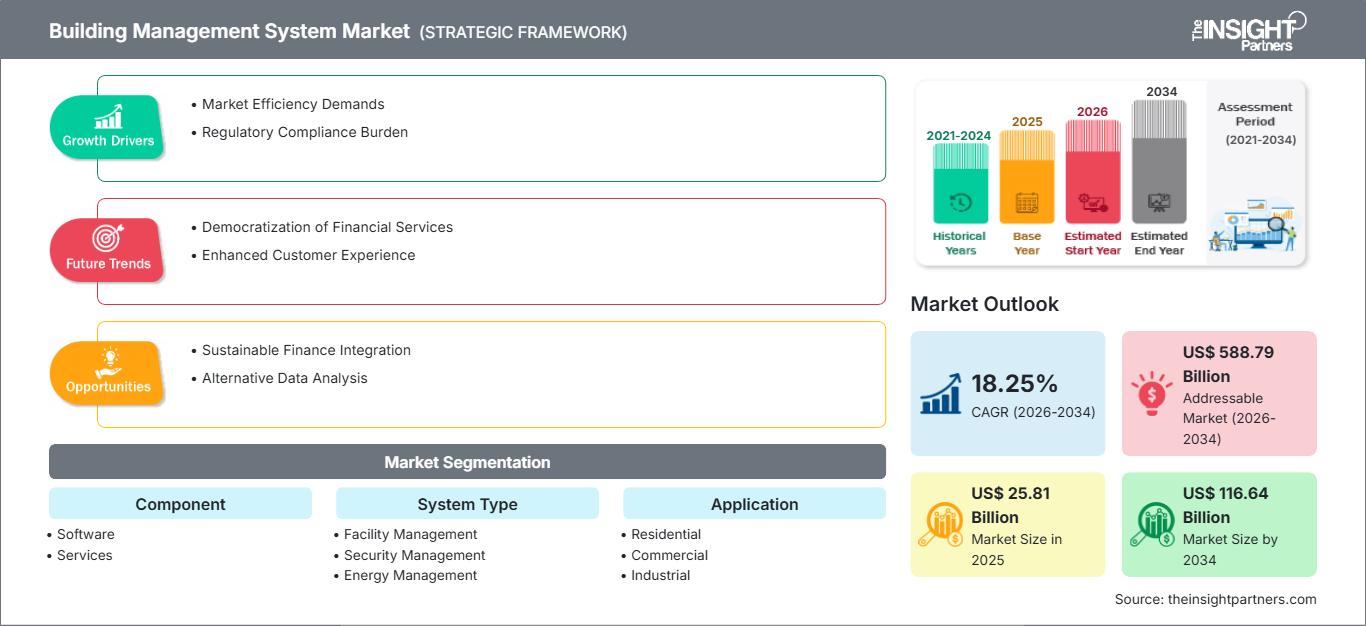
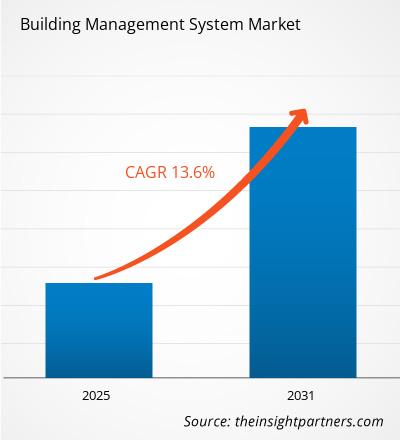
The building management system market was valued at US$ 25.81 Billion in 2025 and is projected to reach US$ 116.64 Billion by 2034, expanding at a CAGR of 18.25% during 2026–2034. The market is being influenced by increasing demand for intelligent infrastructure, energy optimization, automated facility operations, and integrated security solutions. Organizations across commercial, residential, and industrial sectors are adopting connected building technologies to improve efficiency and operational visibility.
North America remains a leading adoption region due to established smart building infrastructure, strong investments in energy-efficient facilities, and increasing deployment of IoT-enabled automation solutions. The building management system market size in the region is supported by the modernization of aging infrastructure, sustainability initiatives, and growing demand for centralized facility control platforms. North America accounted for an estimated 36–39% share in 2025 and is expected to grow at a CAGR of 17.2–18.1% between 2026–2034, supported by commercial building upgrades and regulatory emphasis on energy efficiency.
Building Management System Market Assessment and Insights
- North America: North America maintains a strong position due to smart building investments, energy management requirements, and adoption across commercial facilities. Share in 2025: 36–39%; CAGR between 2026–2034: 17.2–18.1%.
- US: The US represents the dominant regional contributor with demand from commercial real estate, government infrastructure, and industrial facilities adopting connected automation technologies. Share in 2025: 82–86% of North America; CAGR between 2026–2034: 17.4–18.3%.
- Europe: Europe demonstrates steady growth driven by sustainability regulations and smart infrastructure initiatives across Germany, the UK, France, Italy, and Spain. Share in 2025: 28–31%; CAGR between 2026–2034: 16.8–17.7%.
- Asia Pacific: Asia Pacific is expanding rapidly due to urbanization, smart city programs, and infrastructure investments across China, Japan, India, South Korea, and Australia. Share in 2025: 22–25%; CAGR between 2026–2034: 19.0–19.9%.
- Largest Segment: Software leads adoption due to increasing demand for analytics, automation platforms, and centralized building intelligence solutions. Market share in 2025: 54–57%; CAGR between 2026–2034: 18.0–18.9%.
- High Growth Segment: Energy Management is expanding quickly due to sustainability targets, energy optimization needs, and regulatory focus on reducing building consumption. Market share in 2025: 18–21%; CAGR between 2026–2034: 19.5–20.4%.
- Key companies analyzed in detail: Johnson Controls International PLC; Honeywell International Inc.; Siemens AG; Schneider Electric; IBM Corporation; Ingersoll Rand Inc.; D
Source: The Insight Partners' analysis based on proprietary research, government publications, company annual reports, investor presentations, industry databases, and expert interviews.
From being simple stand-alone control systems, building automation has grown into an integrated system that connects all components, such as sensors, analytics, cloud computing, and artificial intelligence, into a single platform. In today’s modern structures, building automation is becoming more and more integrated through controls for HVAC, lighting, security, and energy systems. This has been enabled due to increased demand for intelligent infrastructure that will provide predictive maintenance, optimize performance, and enhance occupants' experience.
Future development will be supported by smart city investments, green building initiatives, and regulatory efforts focused on reducing energy consumption. Emerging economies are increasing infrastructure modernization spending, creating opportunities for integrated building technologies. Investments in artificial intelligence, digital twins, and cloud-based facility platforms are expected to strengthen adoption and expand the Building Management System Market share, as organizations seek more efficient, sustainable, and data-driven building operations.
Building Management System Market Report Scope
| Report Attribute | Details |
|---|---|
| Market size in 2025 | US$ 25.81 Billion |
| Market Size by 2034 | US$ 116.64 Billion |
| Global CAGR (2026 - 2034) | 18.25% |
| Historical Data | 2021-2024 |
| Forecast period | 2026-2034 |
Building Management System Market Analysis
The building management system market growth is driven by increasing demand for energy-efficient buildings, automated facility management, and centralized operational control. The owners of buildings are implementing integrated systems to streamline HVAC systems, lighting, security, and infrastructure monitoring. With the increasing cost of energy and sustainability goals, organizations are increasingly investing in intelligent platforms that can analyze consumption and enhance the efficiency of resources.
The eco-system comprises hardware vendors, software vendors, system integrators, facility managers, and IT service providers. The sensor devices, controller devices, network communication, analytics platforms, and cloud services constitute modern building automation systems. The supply landscape is evolving as vendors develop interoperable platforms that connect multiple building systems while improving cybersecurity, scalability, and operational intelligence.
The building management system market analysis indicates a competitive environment involving global automation leaders and specialized technology providers. Johnson Controls International PLC, Honeywell International Inc., Siemens AG, Schneider Electric, IBM Corporation, Ingersoll Rand Inc., Delta Controls, Crestron Electronics Inc., BuildingIQ Inc., and GridPoint Inc. are reinforcing their competitive advantage via innovations in software, energy optimization abilities, and building integration solutions. Current strategies revolve around AI-driven analytics, cloud-based solutions, and sustainable management of infrastructure.
Investments tend to be concentrated in the field of smart buildings, digital transformations, and energy efficiency solutions. Businesses are developing new partnerships among automation companies, software providers, and infrastructure managers in order to achieve better systems integration. Focusing on decarbonization, resilient operation, and connectivity of facilities promotes the adoption of advanced management solutions with visible advantages for efficiency and performance of assets.
● REPORT CUSTOMIZATION
Tailor This Report To Align With Your Specific Business Requirements
This report can be customized to align precisely with your business objectives, scope, and target markets. Customization options include tailored segmentation, geography, competitive analysis, and strategic insights to support informed decision-making.
Customize This Report →WHAT YOU CAN ADJUST
- ● Segmentations
- ● Geography
- ● Competitive Analysis
- ● Language Preferences
Building Management System Market: Strategic Insights
Regional Insights
North America Building Management System Market
North America accounted for an estimated 36–39% share in 2025 and is expected to expand at a CAGR of 17.2–18.1% between 2026–2034. The area enjoys efficient business infrastructure, automation eco-systems and growing investments in energy-efficient buildings. Programs on sustainable living by the government and reduction in carbon footprints by businesses have led to more adoption of integrated management systems.
The US and Canada are key players owing to their efficient construction methods, upgrading of old structures and use of connected building systems. There is high demand for the product among office spaces, health care centers, education centers and industries looking for increased efficiency in operations. Technology players are developing technologies in areas such as cloud based monitoring, predictive maintenance and energy management.
U.S. Building Management System Market
The U.S. is projected to grow at a CAGR of 17.4–18.3% between 2026–2034, according to the Building Management System Market forecast. In 2025, the nation accounted for roughly 82-86% of North America’s share, whereby growth in the market will be aided by investments in commercial infrastructure, smart buildings, and efficient management of energy consumption within buildings.
Major technology firms such as Johnson Controls International PLC, Honeywell International Inc., Siemens AG, and Schneider Electric have robust operations within the nation owing to their automation platforms and building solutions. The demand for such solutions is growing in corporations, hospitals, data centers, and industrial buildings, which require centralization and automation for greater reliability.
Europe Building Management System Market
Europe accounted for an estimated 28–31% share in 2025 and is expected to register a CAGR of 16.8–17.7% between 2026–2034. The region’s growth is supported by strict energy efficiency standards, carbon reduction policies, and increasing adoption of smart infrastructure solutions. Germany remains a leading country due to its industrial automation capabilities and strong sustainable construction initiatives.
The UK market is supported by commercial building modernization and regulatory emphasis on energy performance improvements. Germany continues to benefit from industrial facilities adopting advanced automation and monitoring technologies. France, Italy, and Spain are expanding deployments through smart city projects, renewable energy integration, and renovation of aging commercial infrastructure. According to Building Management System Market reports, European building owners are increasingly prioritizing solutions that improve energy visibility and operational control.
APAC Building Management System Market
APAC accounted for approximately 22–25% share in 2025 and is projected to grow at a CAGR of 19.0–19.9% between 2026–2034. China leads regional adoption due to large-scale urban development, smart city programs, and infrastructure modernization. Japan and South Korea are advancing intelligent building deployments through automation and technology integration.
India and Australia are also contributing through commercial construction growth, energy efficiency initiatives, and digital infrastructure investments. Government-backed sustainability programs and industrial modernization efforts are increasing demand for connected facility solutions across the region. APAC’s expanding construction sector creates significant opportunities for integrated building management technologies.
Middle East & Africa Building Management System Market
The Middle East & Africa region is estimated to grow at a CAGR of 16.1–17.0% between 2026–2034, supported by infrastructure development, energy efficiency programs, and smart city investments. Saudi Arabia and the UAE are leading regional adoption through large-scale urban projects and advanced commercial developments. Building Management System Market trends indicate increasing demand for integrated solutions that enhance energy efficiency, automation, and operational performance across commercial and public infrastructure.
South Africa contributes through the modernization of commercial facilities and industrial infrastructure improvements. Energy optimization requirements across the region are encouraging the adoption of intelligent monitoring and automation systems. Investments in sustainable buildings, tourism infrastructure, and large-scale construction projects are expected to support long-term demand for integrated management platforms across MEA markets.
Segmentation Analysis
Component
The component segment is expected to expand with a CAGR of 18.0–18.9% between 2026–2034 as organizations increasingly require integrated platforms and professional support for intelligent facility operations. Software solutions are gaining importance through analytics, automation, and centralized control capabilities, while services support installation, maintenance, consulting, and system optimization. The building management system scope is expanding as enterprises prioritize scalable solutions that combine digital platforms with operational expertise.
- Software: Software solutions enable centralized monitoring, analytics, automation, and integration of multiple facility systems. Demand is increasing as organizations seek improved operational visibility, predictive maintenance capabilities, and energy optimization across connected buildings.
- Services: Services support system deployment, consulting, integration, and maintenance activities. Growing complexity of building automation infrastructure is increasing demand for specialized service providers that ensure reliable performance and lifecycle management.
System Type
The system type segment is projected to register a CAGR of 18.4–19.3% between 2026–2034 due to rising adoption of specialized management functions across modern facilities. Organizations are integrating security, energy, emergency, and infrastructure monitoring capabilities into unified platforms to improve safety, efficiency, and operational control. Growing regulatory focus on energy performance and building resilience is strengthening demand for comprehensive automation systems.
- Facility Management: Facility management solutions remain important for controlling HVAC, lighting, maintenance schedules, and operational processes. Adoption is supported by demand for improved asset utilization and streamlined facility performance monitoring.
- Security Management: Security management systems are increasingly deployed to strengthen access control, surveillance, and safety monitoring. Integration with broader platforms improves response capabilities and enables centralized management of critical building security functions.
- Energy Management: Energy management solutions are gaining adoption as organizations focus on reducing consumption, improving efficiency, and achieving sustainability goals through real-time monitoring and optimization capabilities.
- Emergency Management: Emergency management systems support safety through fire monitoring, alarm integration, and response coordination. Demand is increasing in commercial and industrial facilities requiring enhanced occupant protection and regulatory compliance.
- Infrastructure: Infrastructure management solutions enable monitoring of building networks, equipment, and connected assets. Adoption is supported by growing reliance on digital infrastructure and interconnected facility environments.
Application
The application segment is anticipated to achieve a CAGR of 18.2–19.1% between 2026–2034 as different end-use environments adopt intelligent building technologies. Commercial facilities represent a major adoption area, while residential and industrial applications are increasingly integrating automation for energy efficiency, security, and operational management. Rising construction of smart buildings is supporting broader implementation across multiple environments.
- Residential: Residential applications are expanding through smart home adoption, connected devices, and demand for efficient energy management. Developers are incorporating automation features to improve comfort, safety, and resource utilization.
- Commercial: Commercial buildings represent a significant adoption area due to demand for optimized operations, energy savings, occupant management, and improved facility performance across offices, retail spaces, and institutional buildings.
- Industrial: Industrial facilities are adopting integrated management platforms to improve operational reliability, monitor infrastructure, and optimize resource consumption within manufacturing and processing environments.
Opportunity Snapshot
| Application | Revenue Contribution (High/Medium/Low) | Trend Tag | Adoption Stage |
| Residential | Medium | Smart Homes | Scaling |
| Commercial | High | Smart Buildings | Mature |
| Industrial | Medium | Industrial IoT | Scaling |
Building Management System Market Growth Drivers and Impact Analysis
Increasing Focus on Energy Efficiency and Sustainability
As more attention is focused on reducing energy consumption, the deployment of intelligent building solutions becomes more widespread among companies. Automated systems for monitoring and controlling building processes, such as heating, ventilation and air conditioning (HVAC) system performance, lighting, and other equipment, are put into operation by organizations. International goals for sustainable development and regulations related to energy use impact business decisions, as companies strive to make their buildings more environmentally friendly in order to reduce their operating costs and emissions. According to the International Energy Agency, buildings are responsible for one-third of all energy consumption worldwide.
Expansion of Smart City and Connected Infrastructure Projects
The rise of smart cities has led to considerable demand for integrated building systems that will integrate infrastructure, data platforms, and automation systems. Local government bodies and private companies are increasingly adopting smart management systems in their construction projects. This is because such platforms allow the management and monitoring of buildings as well as better management of public infrastructure and improved coordination. The increase in investments in connected infrastructure in regions such as Asia Pacific, the Middle East, and North America has contributed to deployment opportunities.
Rising Adoption of IoT and Artificial Intelligence Technologies
The merging of IoT devices and artificial intelligence technology will revolutionize how buildings operate through predictive maintenance, automation, and analytics. Sensors capture data on how various systems within a building work in order for facility managers to pinpoint any inefficiencies that exist before any failure happens. Artificial intelligence is being used to enhance energy forecasting, optimization of equipment and occupant experience management. Businesses are spending more on intelligent infrastructure in an effort to improve their reliability and cut costs on maintenance. The growing number of digital transformation projects in the business world is likely to boost demand for building management systems.
Building Management System Market Future Trends
Integration of Digital Twins in Facility Operations
The application of digital twin technology is anticipated to be crucial in the coming years, as companies look to have digital representations of their physical buildings in order to monitor, simulate, and optimize the buildings. With digital twins, organizations can study and assess how well their buildings perform and what changes can be made to operations in terms of maintenance without making any actual changes in the physical building. Digital twins coupled with the use of sensors and analytics platforms will make it easier to see how buildings are performing in real time.
Growth of Cloud-Based Building Automation Platforms
The future cloud-based platforms will bring new changes to building automation through the provision of remote monitoring capabilities, scalability, and centralized management of multiple buildings. Businesses dealing with distributed buildings have a need for a solution that can provide them with unified visibility and management while requiring minimal infrastructure on-site. Cloud-based technologies offer quick updates, better access to information and integration with enterprise-level applications. In addition, future cloud-based platforms are going to include cybersecurity measures, AI functionalities and analytics tools.
Building Management System Market Opportunities
Expansion in Emerging Smart Infrastructure Markets
Emerging nations offer plenty of opportunities because there is an increased investment being made by government and private developers in smart cities, business centers, and sustainable infrastructure. Modern constructions are now being built in various countries across Asia-Pacific, the Middle East, and Latin America. This provides vendors with good opportunities to forge relationships with construction firms, facility managers, and technology integration services providers. According to the forecast, there will be an increasing demand for platforms that can handle multiple infrastructural needs. Those companies that offer localized products, energy-saving solutions, and flexible deployment systems are expected to benefit from this situation.
Adoption of AI-Enabled Energy Optimization Solutions
The use of AI technology in optimizing energy provides an excellent opportunity for technology companies interested in tackling emerging sustainability issues. Organizations need smart technology that can analyze energy consumption trends, optimize them, and increase efficiency in facilities. Companies that develop their capacity in areas such as machine learning, predictive analytics, and automation will be able to help their clients save money and meet environmental goals. The integration of renewable energy technology with smart grids presents other possibilities for advanced management technologies. In light of increasing emphasis on energy efficiency, companies providing optimization technology services have the chance of meeting new needs.
Frequently Asked Questions

- Comprehensive Market Sizing and Forecast Analysis
- Detailed Segmentation Analysis
- In-Depth Market Dynamics Assessment
- Regional and Country-Level Insights
- Competitive Landscape and Company Benchmarking
- Strategic Business Intelligence
Recent Reports
Testimonials

The Insight Partners' SCADA System Market report is comprehensive, with valuable insights on current trends and future forecasts. The team was highly professional, responsive, and supportive throughout. We are very satisfied and highly recommend their services.
RAN KEDEM Partner, Reali Technologies LTDs
I requested a report on a very specific software market and the team produced the report in a few days. The information was very relevant and well presented. I then requested some changes and additions to the report. The team was again very responsive and I got the final report in less than a week.
JEAN-HERVE JENN Chairman, Future Analytica
We worked with The Insight Partners for an important market study and forecast. They gave us clear insights into opportunities and risks, which helped shape our plans. Their research was easy to use and based on solid data. It helped us make smart, confident decisions. We highly recommend them.
PIYUSH NAGPAL Sr. Vice President, High Beam Global
The Insight Partners delivered insightful, well-structured market research with strong domain expertise. Their team was professional and responsive throughout. The user-friendly website made accessing industry reports seamless. We highly recommend them for reliable, high-quality research services
YUKIHIKO ADACHI CEO, Deep Blue, LLC.
This is the first time I have purchased a market report from The Insight Partners.While I was unsure at first, I visited their web site and felt more comfortable to take the risk and purchase a market report.I am completely satisfied with the quality of the report and customer service. I had several questions and comments with the initial report, but after a couple of dialogs over email with their analyst I believe I have a report that I can use as input to our strategic planning process.Thank you so much for taking the extra time and making this a positive experience.I will definitely recommend your service to others and you will be my first call when we need further market data.
JOHN SUZUKI President and Chief Executive Officer, Board Director, BK Technologies
I wish to appreciate your support and the professionalism you displayed in the course of attending to my request for information regarding to infectious disease IVD market in Nigeria. I appreciate your patience, your guidance, and the fact that you were willing to offer a discount, which eventually made it possible for us to close a deal. I look forward to engaging The Insight Partners in the future, all thanks to the impression you have created in me as a result of this first encounter.
DR CHIJIOKE ONYIA MANAGING DIRECTOR, PineCrest Healthcare Ltd.Reason to Buy
- Informed Decision-Making
- Understanding Market Dynamics
- Competitive Analysis
- Identifying Emerging Markets
- Customer Insights
- Market Forecasts
- Risk Mitigation
- Boosting Operational Efficiency
- Strategic Planning
- Investment Justification
- Tracking Industry Innovations
- Aligning with Regulatory Trends





 Get Free Sample for