
C Arm Market Growth, Share & Trends by 2034
C Arm Market Size and Forecasts (2021–2034), Global and Regional Share, Trends, and Growth Opportunity Analysis Report Coverage : by Type (Fixed and Mobile) ; Application (Orthopedics and Trauma, Cardiology, Neurology, Gastroenterology, Oncology) ; Detector (Flat Panel Detectors and Image Intensifier); End User (Hospitals, Diagnostic Centers, Specialty Clinics) ; and Geography (North America, Europe, Asia Pacific, and South and Central America)
- Status : Data Released
- Report Code : TIPRE00040079
- Category : Life Sciences
- No. of Pages : 150
- Available Report Formats :


- Last update date : August 12, 2026


2025 Market Size
US$ 2.27 Bn
Base year value
2034 Forecast
US$ 3.25 Bn
Projected by 2034
CAGR 2026-2034
4.59 %
Growth rate
Addressable Market
US$ 25.74 Bn
(2026-2034)
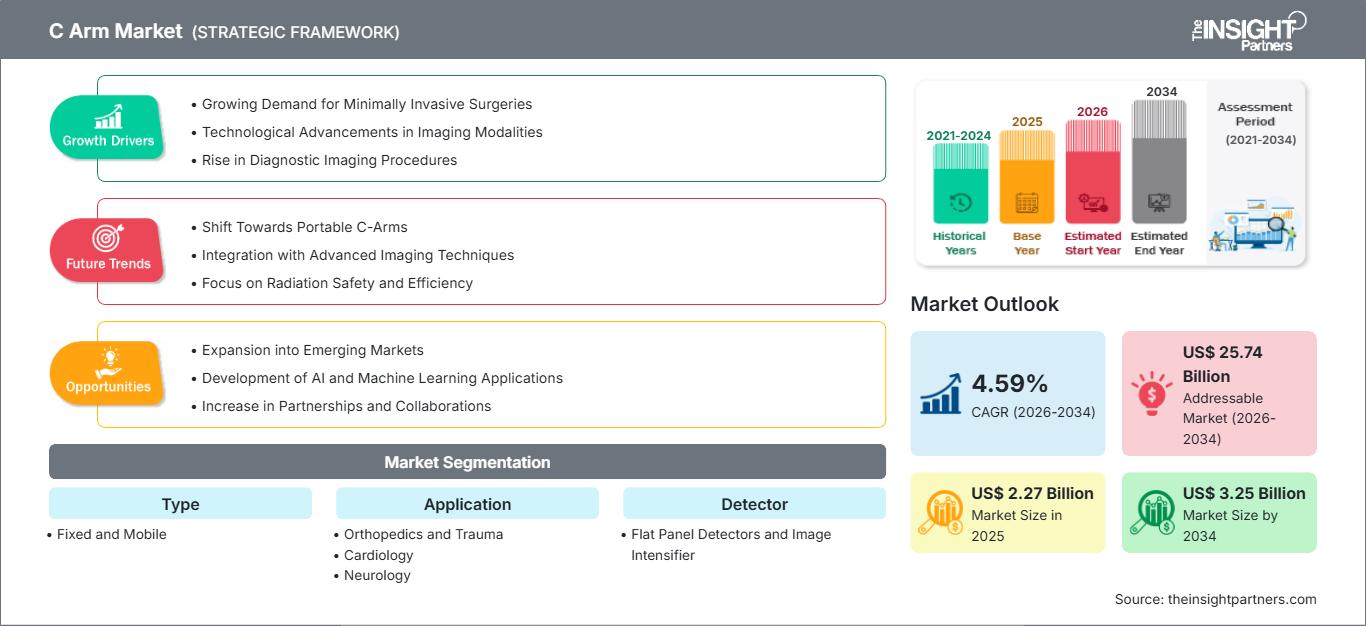
The C Arm Market is forecasted to reach US$ 3.25 billion in 2034 from an estimated value of US$ 2.27 billion in 2025 with a CAGR of 4.59% during 2026–2034. The demand is driven by adoption of intra-operative imaging, increase in minimally invasive procedures, and upgrade of image intensifier system into flat panel detector systems.
North America continues to be the high revenue market with the C Arm Market size aided by well-established imaging setup at hospitals, presence of ASCs, and volume of procedures performed in orthopedics, trauma, cardiology, and pain management. North America Market size is predicted to grow at a CAGR of 4.2–4.8% during 2026–2034.
C Arm Market Assessment and Insights
- North America accounted for 36–39% share in 2025 and is projected to grow at a CAGR of 4.2–4.8% during 2026–2034, supported by outpatient surgery migration, large installed bases, and reimbursement-backed image-guided procedures.
- US represented 82–86% of North America in 2025 and is expected to grow at a CAGR of 4.1–4.7% during 2026–2034, led by ASC adoption, trauma care, and spine surgery demand.
- Europe held 27–30% share in 2025 and is projected to grow at a CAGR of 3.8–4.4% during 2026–2034, with Germany, the UK, France, Italy, and Spain leading hospital replacement cycles.
- Asia Pacific captured 24–27% share in 2025 and is expected to grow at a CAGR of 5.3–6.0% during 2026–2034, driven by China, Japan, India, South Korea, and Australia.
- Largest Segment: Mobile systems held 63–67% market share in 2025 and are expected to grow at a CAGR of 4.7–5.3% during 2026–2034 due to procedural flexibility.
- High Growth Segment: Flat panel detectors held 54–58% market share in 2025 and are expected to grow at a CAGR of 5.4–6.1% during 2026–2034 as facilities replace legacy platforms.
- Key companies analyzed in detail: GE HealthCare Technologies Inc., Siemens Healthineers AG, Koninklijke Philips N.V., Canon Medical Systems Corporation, Shimadzu Corporation, Hologic, Inc., Varian Medical Systems, Inc., Ziehm Imaging GmbH, Agfa-Gevaert N.V., FUJIFILM Holdings Corporation.
Source: The Insight Partners' analysis based on proprietary research, government publications, company annual reports, investor presentations, industry databases, and expert interviews.
Technology migration is driving the procurement of conventional fluoroscopy systems towards digital mobile systems that use flat panel detectors, automated positioning, dose optimization, and specific procedure software. The production aspects have also become relevant as the availability of detectors, generator performance, cybersecurity, and uptime have become factors in determining whether hospitals will award tenders. This means that the Market is evolving from replacement of hardware to imaging ecosystems that minimize room turnover times.
Future adoption will be driven by the availability of surgical capabilities in Asia Pacific, replacement in Europe, and procedural growth in North America. Favorable regulatory winds around radiation safety, documentation, and connectivity of medical devices will benefit players with compliant products and services infrastructure. Investments will focus on mobile systems, detector updates, and navigation for orthopedics, vascular, and pulmonology procedures.
C Arm Market Report Scope
| Report Attribute | Details |
|---|---|
| Market size in 2025 | US$ 2.27 Billion |
| Market Size by 2034 | US$ 3.25 Billion |
| Global CAGR (2026 - 2034) | 4.59% |
| Historical Data | 2021-2024 |
| Forecast period | 2026-2034 |
C Arm Market Analysis
Market growth is based on the growing demand for real-time imaging during orthopedic fixations, trauma repairs, vascular procedures, cardiac electrophysiology, and gastrointestinal interventions. While hospitals continue to be the core buyers of the C arm products, ambulatory surgery centers and specialized clinics are buying more portable systems to decrease their referrals and the time needed for procedures. Value chain includes suppliers of detectors, X-ray generators, software providers, system integrators, distributors, service providers, and biomed departments of hospitals.
Supplier dynamics are in favor of firms with wide portfolio of products, local services, and financing options. Mobile systems dominate repeat purchases as they can be used in multiple operating theaters, while fixed ones are used only in high acuity interventional theaters. Image quality, dosimetry, field of view, system size, reliability, training, cybersecurity, and integration with PACS, navigation, and robotic procedures are being evaluated by buyers.
C Arm Market Report shows that the competition is dominated by diversified medical imaging companies and mobile imaging companies. Companies like GE HealthCare Technologies Inc., Siemens Healthineers AG, Koninklijke Philips N.V., Canon Medical Systems Corporation, and Shimadzu Corporation engage in advanced imaging chain and network competitions, whereas Ziehm Imaging GmbH and Hologic, Inc. are involved in intraoperative and extremity imaging.
Investments are made in the following areas of flat panel detector upgrade, mobile platform, robotic positioner, and software applications. Companies like Agfa-Gevaert N.V. and FUJIFILM Holdings Corporation reinforce their adjacency in digital imaging and informatics, while Varian Medical Systems, Inc. provides expertise in imaging workflows for oncology. The strategic positioning is becoming more of reducing dose, automating workflow, maintenance, and clinical scope.
● REPORT CUSTOMIZATION
Tailor This Report To Align With Your Specific Business Requirements
This report can be customized to align precisely with your business objectives, scope, and target markets. Customization options include tailored segmentation, geography, competitive analysis, and strategic insights to support informed decision-making.
Customize This Report →WHAT YOU CAN ADJUST
- ● Segmentations
- ● Geography
- ● Competitive Analysis
- ● Language Preferences
C Arm Market: Strategic Insights
Regional Insights
North America C Arm Market
North America accounted for 36–39% share in 2025 and is projected to grow at a CAGR of 4.2–4.8% during 2026–2034. The region benefits from high procedural intensity in orthopedics, trauma, cardiology, and pain management, along with hospital investment in mobile imaging fleets. The C Arm Market share is reinforced by ASC expansion and replacement of aging image intensifier systems.
The procurement process in the region focuses on quality of detectors, dose optimization, cybersecurity, uptime, and user-friendliness to enable the rotation of clinical teams. Mobile units are being utilized by hospitals in assisting orthopedic and spine surgery, while fixed units have been incorporated in intervention rooms. The vendors are strongly represented in the region, among them being GE HealthCare Technologies Inc., Siemens Healthineers AG, Koninklijke Philips N.V., Hologic, Inc., and Ziehm Imaging GmbH.
U.S. C Arm Market
The U.S. accounted for 82–86% of North America in 2025 and is forecast to witness a CAGR of 4.1–4.7% in the period between 2026 and 2034. Factors influencing the demand include the penetration rate of ambulatory surgery centers, high volume of orthopedic surgeries, and investments in guided care. The nation provides regional capabilities in services, training, and adoption of workflow automation.
There is a presence of various companies including GE HealthCare Technologies Inc., Siemens Healthineers AG, Koninklijke Philips N.V., Hologic, Inc., FUJIFILM Holdings Corporation, and Ziehm Imaging GmbH catering to hospitals, ASCs, and specialty centers. In terms of application, orthopedics and trauma will continue to dominate, while cardiology, oncology, neurology, and gastrointestinal procedures will drive demand for high-resolution, navigation compatible, and low dose fluoroscopy systems.
Europe C Arm Market
The European market accounted for 27-30% in 2025 and expected to have a CAGR of 3.8-4.4% in 2026-2034. Germany leads the European countries due to its state-of-the-art hospital setup, surgical imaging procurements, and presence of niche manufacturers. United Kingdom sees constant demand from NHS modernization, private hospitals, and orthopedic waiting list management programs.
Germany continues to set standards from a technical perspective where purchases will depend on image quality during surgery, radiation dosage management, and reliability of services. Siemens Healthineers AG and Ziehm Imaging GmbH are responsible for maintaining innovative depths in the region, while multinationals operate in mobile and stationary platforms. Trauma surgery, vascular surgery, and high volume musculoskeletal surgeries drive demand.
France, Italy, and Spain account for their share through public hospital renovations, increase in day surgeries, and operating room efficiency projects. Purchase cycles in the region are often budget driven but there is a trend towards increasing purchases of flat panel detectors as image intensifier units are being replaced.
APAC C Arm Market
In 2025, APAC accounted for a market share of 24–27%, and is expected to expand with a CAGR of 5.3–6.0% over 2026–2034. China leads the market due to growth in hospitals, development in surgical facilities, and local procurements of orthopedic & trauma imaging equipment. Japan & South Korea focus on precision imaging, whereas India and Australia are gaining momentum from private hospitals and outpatients.
Policies promoting infrastructure development, localization of medical devices, and increased access to surgical services are boosting adoption. Opportunities in APAC region are uneven as premium systems are used in urban hospitals, while mid-range mobile units play a significant role in increasing access to such technology. Canon Medical Systems Corporation, Shimadzu Corporation, Koninklijke Philips N.V., and GE HealthCare Technologies Inc. are strategically placed.
Middle East & Africa C Arm Market
MEA is forecasted to see CAGR growth between 4.6–5.2% from 2026 to 2034, and Saudi Arabia will be the largest nation in this region. Hospitals of UAE are spending on surgical upgrades, but South Africa is helping the regional demand through private healthcare facilities. The RoMEA region is selective about the market, as their procurement is linked with infrastructure and staffs.
Demand is being created due to the healthcare infrastructure initiatives, medical tourism, and hospitals being constructed. Energy-related public investments help with capacity expansion in the GCC nations; however, affordability and accessibility are challenges for some of the nations in Africa. Companies with financing, training, and equipment offerings are likely to fare well in this market..
Segmentation Analysis
Type
The type segment is expected to grow at a CAGR of 4.6–5.2% during 2026–2034. The C Arm Market scope across type is shaped by procedural flexibility, operating room design, and capital budget allocation. Mobile systems lead because facilities can move equipment across surgical rooms, while fixed platforms remain critical for interventional procedures requiring stable imaging geometry and advanced workflow integration.
- Fixed systems are strategically important in hybrid operating rooms and interventional suites where imaging precision, room integration, and procedure complexity justify higher capital spending and dedicated infrastructure.
- Mobile systems hold the largest installed-base relevance because hospitals, ASCs, and specialty clinics use them across orthopedics, trauma, pain management, and general surgical imaging workflows.
Application
The application segment is expected to grow at a CAGR of 4.4–5.0% during 2026–2034. Orthopedics and trauma remain the core demand base, while cardiology, neurology, gastroenterology, and oncology support higher-value imaging requirements. Procedure complexity is pushing vendors to deliver better contrast, lower dose, wider fields of view, and software-assisted positioning.
- Orthopedics and Trauma represent the largest use case, as fracture fixation, spine procedures, joint repair, and extremity surgery require immediate fluoroscopic confirmation during operating room workflows.
- Cardiology demand is linked to electrophysiology, vascular access, and interventional imaging, with fixed systems preferred for complex procedures and advanced mobile platforms used selectively.
- Neurology applications require precise visualization in spine, cranial, and neurovascular procedures, making image clarity, stability, and integration with navigation systems important purchasing considerations.
- Gastroenterology adoption is supported by endoscopic, biliary, and interventional procedures that require real-time imaging in specialized suites and procedure rooms.
- Oncology applications are emerging through biopsy guidance, interventional pulmonology, and image-guided treatment workflows where mobile cone-beam imaging can improve lesion localization.
Detector
The detector segment is expected to grow at a CAGR of 5.0–5.7% during 2026–2034. Flat panel detectors are increasingly becoming the preferred technology because they provide distortion-free images, larger dynamic range, and better compatibility with digital workflows. Image intensifiers remain relevant in cost-sensitive environments, but replacement cycles are steadily moving toward flat panel platforms.
- Flat Panel Detectors are strategically important because hospitals prioritize lower distortion, improved image consistency, compact form factors, and compatibility with software-driven dose management.
- Image Intensifier systems remain active in lower-cost procurement settings and legacy fleets, although their long-term position is weakening as digital detector economics improve.
End User
The end user segment is expected to grow at a CAGR of 4.5–5.1% during 2026–2034. Hospitals remain the primary C Arm purchasing base because they handle complex trauma, orthopedic, cardiology, neurology, and oncology procedures. Diagnostic centers and specialty clinics are increasing demand for compact systems as more image-guided interventions shift outside inpatient operating rooms.
- Hospitals contribute the highest revenue because they require high-performance systems, service contracts, multiple units, and application breadth across operating rooms and interventional departments.
- Diagnostic Centers adopt systems for fluoroscopy-enabled procedures, referrals, and outpatient imaging services where compact design and operational efficiency influence purchasing decisions.
- Specialty Clinics are increasingly important in orthopedics, pain management, and extremity imaging, as procedure ownership shifts toward physician-led and ambulatory care environments.
Opportunity Snapshot
| End User | Revenue Contribution | Trend Tag | Adoption Stage |
| Hospitals | High | OR Modernization | Mature |
| Diagnostic Centers | Medium | Procedure Expansion | Scaling |
| Specialty Clinics | Medium | Deskilled Imaging | Scaling |
C Arm Market Growth Drivers and Impact Analysis
Expansion of Minimally Invasive and Image-Guided Procedures
Minimally invasive care is increasing the need for intraoperative visualization that can confirm anatomy, implant position, catheter placement, and lesion access without delaying procedures. The impact is strongest in orthopedics, trauma, spine, cardiology, gastroenterology, and oncology-related interventions, where fluoroscopy supports faster decisions and fewer repeat steps. Hospitals are therefore prioritizing systems with better image quality, lower dose, and easier positioning. This driver also supports mobile procurement because many facilities want equipment that can be redeployed across rooms. For manufacturers, the practical market impact is wider application coverage, demand for procedure-specific software, and stronger service attachment rates across the installed base.
Replacement of Image Intensifier Platforms with Digital Detectors
Flat panel detector migration is one of the most visible procurement drivers because it improves image consistency, reduces distortion, and supports more compact system architecture. Facilities replacing legacy image intensifier systems are not only upgrading image quality, but also aligning with digital archiving, cybersecurity, radiation documentation, and workflow automation requirements. This replacement cycle benefits vendors that can offer multiple detector sizes, dose control, and dependable uptime. The Market is therefore seeing capital spending move from basic fluoroscopy toward digitally integrated platforms. The commercial impact includes higher average selling prices, stronger software differentiation, and broader demand for training and lifecycle support.
Growth of Ambulatory Surgery and Specialty Procedure Settings
Surgical migration into ambulatory surgery centers and specialty clinics is changing purchasing behavior. These facilities typically require compact, reliable, easy-to-operate C-arm systems that can support orthopedics, pain management, extremity imaging, and selected vascular or gastrointestinal procedures. The market impact is a widening customer base beyond large tertiary hospitals, especially for mobile and mini C-arm systems. Buyers in these settings focus on room footprint, staff training time, image quality, service responsiveness, and financing flexibility. Vendors with simplified user interfaces and scalable service models can capture recurring demand as outpatient procedure volumes expand and physicians seek greater control over imaging workflows.
C Arm Market Future Trends
Robotic Positioning and Autonomous Workflow Assistance
The most important C Arm Market trends will center on robotic movement, position memory, and autonomous workflow support that reduce manual handling in crowded operating rooms. Future systems will increasingly store procedure-specific positions, support remote adjustments from sterile areas, and limit staff exposure during fluoroscopy-intensive cases. This will matter as hospitals face staffing constraints and seek consistent imaging from mixed-experience teams. Vendors able to combine safety sensors, intuitive controls, and repeatable positioning will strengthen differentiation in complex orthopedic, spine, vascular, and interventional procedures without relying solely on detector specifications.
Software-Defined Imaging and Connected Service Models
C-arm systems are moving toward software-defined performance, where image processing, dose optimization, cybersecurity, remote diagnostics, and application packages influence long-term value. Future procurement will consider whether platforms can receive updates, integrate with PACS and navigation systems, and provide fleet-level service data. This trend favors vendors with digital infrastructure and installed-base analytics. Hospitals will increasingly expect uptime guarantees, predictive maintenance, and standardized user experiences across departments. As a result, system differentiation will shift from standalone fluoroscopy hardware toward connected imaging ecosystems that support safer, more efficient, and easier-to-document procedures.
C Arm Market Opportunities
Premium Mobile Platforms for Multi-Specialty Operating Rooms
Premium mobile platforms present an actionable opportunity because hospitals need systems that can serve orthopedics, spine, vascular, pain management, pulmonology, and general surgery without requiring separate equipment pools. C Arm Market Forecasts indicate that investment will favor systems combining flat panel detectors, large monitors, automated positioning, strong cooling, and procedure-specific software. Vendors can improve capture by offering modular configurations that let hospitals start with core imaging and add vascular, 3D, or navigation capability over time. Financing, staff training, and service guarantees will be decisive because buyers want measurable productivity gains rather than only incremental image quality.
Mid-Tier Systems for Emerging Hospital Networks
Emerging hospital networks in Asia Pacific, the Middle East, Latin America, and selected African markets form a clear opportunity for durable mid-tier systems. These buyers need reliable imaging for orthopedics, trauma, and general surgery, but often operate under capital constraints and variable service coverage. Suppliers can win by balancing flat panel performance, simplified controls, dose efficiency, and locally available maintenance. Partnerships with distributors, training centers, and public procurement agencies can reduce adoption barriers. The strongest opportunity lies in platforms that offer upgrade paths, enabling facilities to begin with essential fluoroscopy and later add more advanced application capabilities.
Recent Developments
- November 2025: Shimadzu Medical Systems USA released the SC15 mobile C-arm in the United States, featuring flat panel detector technology, a 43-inch monitor, a 15 kW generator, intuitive controls, auto-collimation, and an optional vascular package for orthopedics, pain management, general surgery, and vascular applications.
- October 2025: Koninklijke Philips N.V. announced the 5,000th installation of its Zenition mobile C-arm system at Kolín Regional Hospital in the Czech Republic, highlighting adoption across more than 170 countries and annual support for more than 15 million patients worldwide.
- March 2025: Ziehm-Orthoscan, Inc. introduced Orthoscan VERSA at the American Academy of Orthopaedic Surgeons annual meeting, positioning the portable mini C-arm for clinical imaging with touchscreen operation, compact design, 180-degree orbital rotation, and enhanced workflow for extremity procedures.
Frequently Asked Questions

- Comprehensive Market Sizing and Forecast Analysis
- Detailed Segmentation Analysis
- In-Depth Market Dynamics Assessment
- Regional and Country-Level Insights
- Competitive Landscape and Company Benchmarking
- Strategic Business Intelligence
Recent Reports
Testimonials

The Insight Partners' SCADA System Market report is comprehensive, with valuable insights on current trends and future forecasts. The team was highly professional, responsive, and supportive throughout. We are very satisfied and highly recommend their services.
RAN KEDEM Partner, Reali Technologies LTDs
I requested a report on a very specific software market and the team produced the report in a few days. The information was very relevant and well presented. I then requested some changes and additions to the report. The team was again very responsive and I got the final report in less than a week.
JEAN-HERVE JENN Chairman, Future Analytica
We worked with The Insight Partners for an important market study and forecast. They gave us clear insights into opportunities and risks, which helped shape our plans. Their research was easy to use and based on solid data. It helped us make smart, confident decisions. We highly recommend them.
PIYUSH NAGPAL Sr. Vice President, High Beam Global
The Insight Partners delivered insightful, well-structured market research with strong domain expertise. Their team was professional and responsive throughout. The user-friendly website made accessing industry reports seamless. We highly recommend them for reliable, high-quality research services
YUKIHIKO ADACHI CEO, Deep Blue, LLC.
This is the first time I have purchased a market report from The Insight Partners.While I was unsure at first, I visited their web site and felt more comfortable to take the risk and purchase a market report.I am completely satisfied with the quality of the report and customer service. I had several questions and comments with the initial report, but after a couple of dialogs over email with their analyst I believe I have a report that I can use as input to our strategic planning process.Thank you so much for taking the extra time and making this a positive experience.I will definitely recommend your service to others and you will be my first call when we need further market data.
JOHN SUZUKI President and Chief Executive Officer, Board Director, BK Technologies
I wish to appreciate your support and the professionalism you displayed in the course of attending to my request for information regarding to infectious disease IVD market in Nigeria. I appreciate your patience, your guidance, and the fact that you were willing to offer a discount, which eventually made it possible for us to close a deal. I look forward to engaging The Insight Partners in the future, all thanks to the impression you have created in me as a result of this first encounter.
DR CHIJIOKE ONYIA MANAGING DIRECTOR, PineCrest Healthcare Ltd.Reason to Buy
- Informed Decision-Making
- Understanding Market Dynamics
- Competitive Analysis
- Identifying Emerging Markets
- Customer Insights
- Market Forecasts
- Risk Mitigation
- Boosting Operational Efficiency
- Strategic Planning
- Investment Justification
- Tracking Industry Innovations
- Aligning with Regulatory Trends





 Get Free Sample for