
C-Reactive Protein Testing Market Demand, Share & Growth by 2034
Coverage: By Assay Type (Immunoturbidimetric Assay, ELISA, Chemiluminescence Immunoassay, Others); Detection Range (Hs-CRP, Conventional CRP, CCRP); Disease Area (Cardiovascular Diseases, Cancer, Rheumatoid Arthritis, Endometriosis, Inflammatory Bowel Disease, Others); End-Use (Clinics, Hospitals, Laboratories, Others) , and Geography (North America, Europe, Asia Pacific, and South and Central America)
- Status : Data Released
- Report Code : TIPRE00006954
- Category : Life Sciences
- No. of Pages : 150
- Available Report Formats :


- Last update date : August 17, 2026


2025 Market Size
US$ 6.08 Bn
Base year value
2034 Forecast
US$ 6.75 Bn
Projected by 2034
CAGR 2026-2034
1.32 %
Growth rate
Addressable Market
US$ 58.46 Bn
(2026-2034)
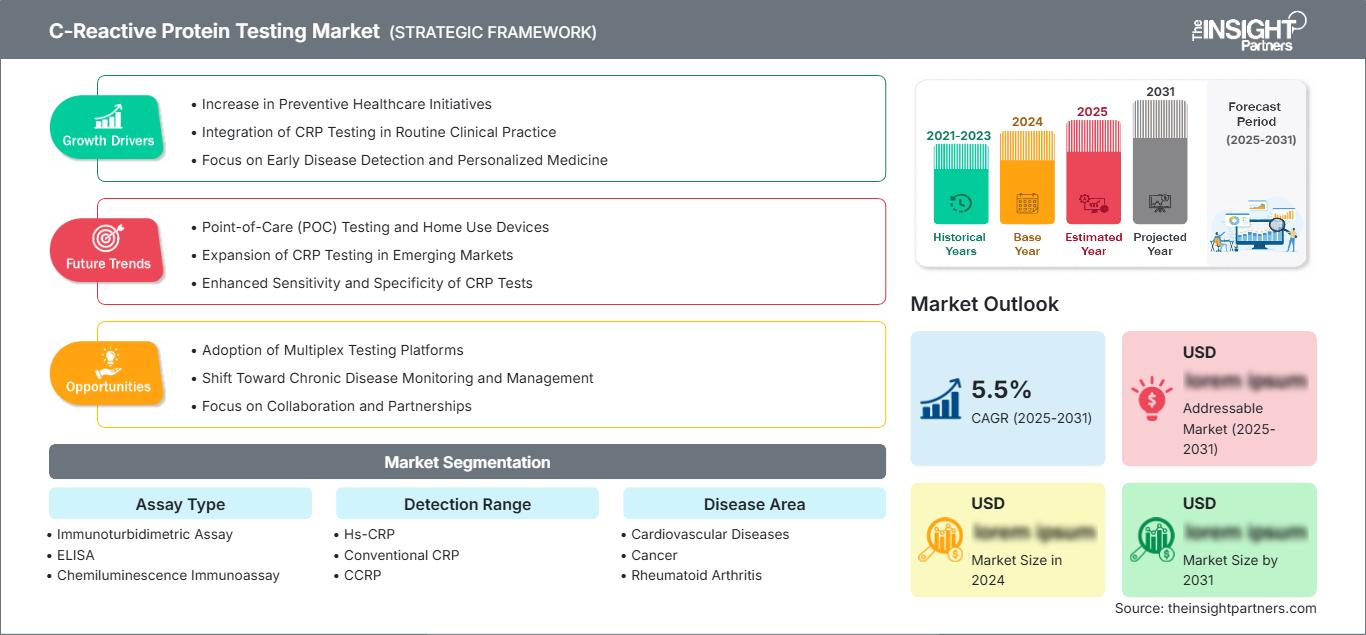
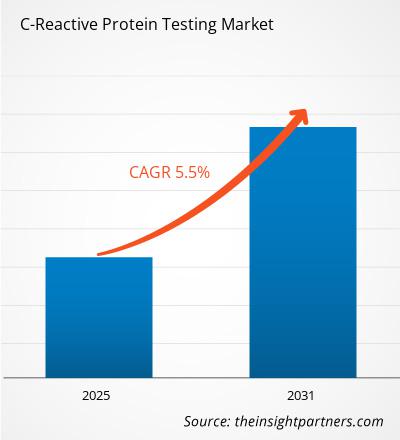
The C-Reactive Protein Testing Market was valued at US$ 6.08 billion in 2025 and is projected to reach US$ 6.75 billion by 2034, registering a CAGR of 1.32% during 2026–2034. The market reflects steady diagnostic utilization across inflammation assessment, cardiovascular risk evaluation, autoimmune disease monitoring, and hospital-based acute care workflows.
Across North America, clinical chemistry automation, high testing volumes, and payer-supported preventive screening keep adoption structurally resilient. The C-Reactive Protein Testing Market size in the region is expected to advance within a 0.6–0.9% CAGR range, supported by integrated health systems, chronic disease surveillance, and expanding use of hs-CRP in cardiometabolic risk panels.
C-Reactive Protein Testing Market Assessment and Insights
- North America held a 38–40% share in 2025 and is growing at a CAGR between 0.6–0.9% during 2026–2034, supported by mature laboratory networks, preventive testing, and wide use of automated analyzers.
- US accounted for 84–86% of North America in 2025 and is growing at a CAGR between 0.5–0.8% during 2026–2034, led by high outpatient testing density.
- Europe represented 27–29% share in 2025 and is growing at a CAGR between 0.4–0.7% during 2026–2034, with Germany, the UK, and France leading routine clinical chemistry demand.
- Asia Pacific held 22–24% share in 2025 and is growing at a CAGR between 1.2–1.6% during 2026–2034, driven by China, Japan, India, South Korea, and Australia.
- Largest Segment: Immunoturbidimetric Assay held 43–45% market share in 2025, with CAGR between 0.5–0.8% during 2026–2034, due to automation compatibility.
- High Growth Segment: Hs-CRP held 31–33% share in 2025, with CAGR between 1.1–1.5% during 2026–2034, reflecting preventive cardiology adoption.
- Key companies analyzed in detail: Abcam Limited, Bio-Techne Corporation, F. Hoffmann-La Roche Ltd, Randox Laboratories Ltd., Merck KGaA, Thermo Fisher Scientific Inc., LifeSpan BioSciences, Inc., Abaxis, Inc., Quest Diagnostics Incorporated, Abbott Laboratories, Siemens Healthineers AG.
Source: The Insight Partners' analysis based on proprietary research, government publications, company annual reports, investor presentations, industry databases, and expert interviews.
Automation has transformed the workflow of testing for inflammatory markers, allowing large laboratories to adopt CRP testing within their chemistry menu through automation, thus improving efficiency and providing more predictable turnaround times. Competing manufacturers have to provide stability, compatibility, calibration precision, and larger menu options. The market for C-Reactive Protein Testing has expanded from infection diagnostics to cardiovascular disease prevention, autoimmune disease management, and chronic inflammation diagnosis, creating continuous demand at hospitals and reference labs.
The demand is expected to be driven by healthcare growth in Asia Pacific, laboratory modernization in the Middle East, and increased screening for chronic diseases among general practice clinics. Focusing on traceability and laboratory accreditation should drive demand towards major assay providers. The market for C-Reactive Protein Testing will continue to follow a volume-led strategy instead of pricing-led strategy due to limited global growth potential.
C-Reactive Protein Testing Market Report Scope
| Report Attribute | Details |
|---|---|
| Market size in 2025 | US$ 6.08 Billion |
| Market Size by 2034 | US$ 6.75 Billion |
| Global CAGR (2026 - 2034) | 1.32% |
| Historical Data | 2021-2024 |
| Forecast period | 2026-2034 |
C-Reactive Protein Testing Market Analysis
The demand is driven by CRP as an acute-phase protein, a nonspecific marker of inflammation. The CRP Testing Market growth profile is stable since CRP is used in hospitals to diagnose infections, assess rheumatological conditions, monitor inflammatory bowel diseases, and conduct cardiological risk stratification. The value chain includes antibodies and antigens vendors, reagents vendors, calibrators vendors, analyzer platforms, hospital labs, clinics, and referral testing laboratories.
The supply side favors vendors with wide installed base of analyzers and clinically validated reagent panels. Immunoturbidimetric tests dominate high-throughput routine diagnostics as these tests can be run on automated chemistry analyzers, while ELISA and chemiluminescence tests are used for research and specific diagnostics purposes. Point-of-Care CRP testing has its place in primary care and urgent care settings.
Positioning is influenced by the diversity of menu products, testing precision, distribution power, and instruments’ integration. As stated in the C-Reactive Protein Testing Market report, F. Hoffmann-La Roche Ltd, Abbott Laboratories, Siemens Healthineers AG, Randox Laboratories Ltd., and Thermo Fisher Scientific Inc. work in the analyzers environment while Abcam Limited, Bio-Techne Corporation, Merck KGaA, and LifeSpan BioSciences, Inc. are engaged in reagents, antibodies, and research workflow solutions.
Funding goes towards developing high sensitivity formats, connectivity in the lab and efficient workflows. Quest Diagnostics Incorporated drives the demand through clinical test availability in large volumes, while Abaxis, Inc. facilitates decentralized testing in chemistry labs. Participants of this market will focus on standardization of assays, laboratory efficiency, and assistance in clinical interpretation, but not on aggressive capacity growth.
● REPORT CUSTOMIZATION
Tailor This Report To Align With Your Specific Business Requirements
This report can be customized to align precisely with your business objectives, scope, and target markets. Customization options include tailored segmentation, geography, competitive analysis, and strategic insights to support informed decision-making.
Customize This Report →WHAT YOU CAN ADJUST
- ● Segmentations
- ● Geography
- ● Competitive Analysis
- ● Language Preferences
C-Reactive Protein Testing Market: Strategic Insights
Regional Insights
North America C-Reactive Protein Testing Market
The market share of North America was estimated at 38-40%, growing at a CAGR of 0.6-0.9% during the forecast period of 2026-2034. The region enjoys benefits like high levels of chronic disease screening intensity, automation of hospitals, and high penetration rate of clinical chemistry analyzers. North America C-Reactive Protein Testing Market share is highly concentrated in the US due to reference laboratories and integrated delivery networks with a huge outpatient and inpatient volume.
Canada provides its contribution due to public laboratory services and preventive care pathways, whereas Mexico will be contributing through growth in the number of private hospitals. The structural advantage that North America holds includes standardization of reimbursements, cardiovascular testing pathway, and availability of hs-CRP tests. The growth is moderate since CRP is an integral part of diagnostics; nevertheless, test utilization is resilient.
U.S. C-Reactive Protein Testing Market
In 2025, the US accounted for 84-86% of North America and will experience growth at a rate of CAGR of 0.5-0.8% between 2026 and 2034. There is high testing demand due to the high cardiovascular disease incidence, inflammatory markers associated with obesity, and the high usage of outpatient diagnostic panels. Reference labs, hospital outreach efforts, and general practitioners provide recurring CRP and hs-CRP test volumes in preventive and acute care scenarios.
There is extensive presence of companies in the region, with Quest Diagnostics Incorporated, Abbott Laboratories, F. Hoffmann-La Roche Ltd, Siemens Healthineers AG, Thermo Fisher Scientific Inc. and Bio-Techne Corporation present at different stages in the diagnostic pipeline. The new areas of application include cardiometabolic evaluation, rheumatoid disease activity evaluation and triage of infection suspects. The United States is the indicator for business feasibility and lab digitalization.
Europe C-Reactive Protein Testing Market
The market share was 27–29% for Europe in 2025 and expected to have a CAGR of 0.4-0.7% from 2026 to 2034. Germany is the largest in Europe because of the wide automation in clinical chemistry, high capacity of hospitals in laboratory analysis, and constant usage of inflammatory biomarkers in internal medicine, cardiology, and rheumatology.
In the case of the United Kingdom, primary care diagnostics and the focus on antimicrobial stewardship in the National Health Service drive the market. Other European countries such as France, Italy, and Spain are supported by hospital diagnostics, aged populations, and chronic diseases management programs. In Southern Europe, there is a constant utilization of inflammatory bowel disease and rheumatoid arthritis. France has a good laboratory network system.
APAC C-Reactive Protein Testing Market
APAC held 22–24% market share in 2025 and is estimated to witness 1.2–1.6% CAGR during 2026–2034. In APAC, China leads owing to expansion of hospitals, need for infection diagnosis, and growing preventive cardiovascular screenings. Countries like Japan and South Korea benefit from the usage of analyzers, whereas India benefits from private diagnostics and tertiary care hospitals.
Australia benefits from high laboratory standards and monitoring of chronic diseases. Hospital infrastructure upgrade driven by government policies, increase in health insurance penetration, and urban laboratories are driving demand in the region. The C-Reactive Protein Testing Market in APAC is also driven by local production of reagents and widespread clinical chemistry testing in secondary cities.
Middle East & Africa C-Reactive Protein Testing Market
The Middle East & Africa region is expected to register a CAGR of 0.9–1.3% between 2026 and 2034. Saudi Arabia and UAE are early adopters via investments in hospital infrastructure, specialty care, and digital healthcare solutions. South Africa has been a strong sub-Saharan market driven by private laboratories and inflammation diagnostics at hospitals.
The Demand in the Rest of MEA Region has been inconsistent but has seen growth as the procurement has shifted from individual tests to analyzers. Investment in healthcare by oil money in the Gulf region will enable upgrading of labs and the introduction of tests. Factors such as infrastructure issues, staffing, and reimbursement issues have limited their use, but regional demand is increasingly gravitating toward quality laboratory solutions.
Segmentation Analysis
Assay Type
Assay Type is expected to grow at a CAGR of 0.6–0.9% during 2026–2034. The C-Reactive Protein Testing Market scope across assay technologies is shaped by throughput, sensitivity, analyzer compatibility, and cost per result. Routine laboratories prefer automated methods, while specialized and research settings continue to use highly sensitive platforms for lower concentration detection and biomarker validation.
- Immunoturbidimetric Assay remains the largest format because it integrates efficiently with automated chemistry systems, offers rapid processing, and supports consistent hospital and reference laboratory workflows.
- ELISA serves research, biomarker validation, and specialized testing needs where sensitivity, assay customization, and batch-based analysis are more important than immediate turnaround.
- Chemiluminescence Immunoassay supports high-sensitivity detection in advanced laboratories, particularly where precision, automation, and low-level inflammatory biomarker measurement are prioritized.
Detection Range
Detection Range is expected to grow at a CAGR of 0.8–1.1% during 2026–2034. The segment reflects differing clinical thresholds, from low-grade inflammation assessment to acute inflammatory response evaluation. High-sensitivity CRP is gaining relevance in cardiometabolic screening, while conventional CRP continues to support infection, inflammatory disease, and inpatient monitoring across hospital systems.
- Hs-CRP is strategically important in preventive cardiology because it measures low-grade inflammation and supports risk stratification alongside lipid, glucose, and metabolic markers.
- Conventional CRP remains widely used in acute care, infection evaluation, and inflammatory disease monitoring, where clinicians require fast evidence of systemic inflammatory response.
- CCRP supports specialized inflammatory assessment, with demand linked to laboratories seeking broader interpretive ranges and consistency across clinical and research workflows.
Disease Area
Disease Area is expected to grow at a CAGR of 0.7–1.0% during 2026–2034. CRP testing demand is strongest where inflammatory activity influences diagnosis, treatment adjustment, or patient follow-up. Cardiovascular disease and rheumatoid arthritis drive recurring use, while oncology, endometriosis, and inflammatory bowel disease create demand for adjunctive inflammation monitoring rather than standalone diagnosis.
- Cardiovascular Diseases represent a major clinical use case, with hs-CRP supporting risk assessment, residual inflammatory risk evaluation, and preventive care discussions.
- Cancer applications are adjunctive, with CRP used to assess systemic inflammation, treatment response context, and patient status in selected oncology workflows.
- Rheumatoid Arthritis uses CRP as a marker of disease activity and treatment response, supporting rheumatology follow-up alongside clinical scoring and other inflammatory indicators.
- Endometriosis demand is emerging, as inflammatory biomarkers are evaluated to support disease characterization, pain-related assessment, and research into non-invasive diagnostic pathways.
- Inflammatory Bowel Disease relies on CRP for monitoring inflammatory burden, supporting escalation decisions, and complementing stool markers, imaging, and endoscopic evaluation.
End-Use
End-Use is expected to grow at a CAGR of 0.6–0.9% during 2026–2034. Hospitals remain volume anchors, but clinics and laboratories play distinct roles in access and specialization. The segment is influenced by outpatient care growth, laboratory consolidation, and demand for faster inflammatory assessment in both chronic disease management and acute triage.
- Clinics use CRP testing to support early inflammation assessment, infection triage, and chronic disease monitoring, particularly where point-of-care or rapid referral workflows are available.
- Hospitals generate high testing volumes through emergency departments, inpatient wards, rheumatology, cardiology, oncology, and intensive care workflows requiring timely inflammatory marker results.
- Laboratories remain strategically important because centralized platforms deliver high throughput, quality control, menu breadth, and scalable access for outpatient and specialist testing.
Opportunity Snapshot
| Segment Name | Revenue Contribution | Trend Tag | Adoption Stage |
| Clinics | Medium | Rapid Triage | Scaling |
| Hospitals | High | Acute Care | Mature |
| Laboratories | High | Automation | Mature |
C-Reactive Protein Testing Market Growth Drivers and Impact Analysis
Rising chronic inflammatory disease monitoring
Chronic diseases management can be considered one of the most stable sources of demand due to the fact that the CRP test is a reliable method for measuring inflammation levels in various medical specializations including cardiology, rheumatology, gastroenterology, and oncology. It is used by hospitals and clinics in follow-up situations where symptoms are not enough for making a decision. The biggest effect will be generated in the case of retests of patients suffering from such chronic diseases like rheumatoid arthritis, inflammatory bowel disease, and cardiometabolic risks. The reagent consumption will be stable and laboratories will have an incentive to continue using the CRP test in routine chemistry panels.
Laboratory automation and analyzer menu consolidation
There is an increasing need for more sample processing using less manual steps, which makes assay compatibility with automated analyzers crucial when choosing products to purchase. CRP will benefit from this trend since the immunoturbidimetric and chemiluminescence formats of this biomarker allow inclusion into high-throughput systems utilized for routine chemistry and immunoassays. The effects include increased speed of testing, reduced dependence on manual labor, better calibration management, and easier procurement. Vendors of analyzers with diverse ecosystem have the possibility of offering CRP in combination with biomarkers of inflammation, cardiac, metabolic, and infectious diseases in order to increase customer retention.
Preventive cardiology adoption of hs-CRP
Preventive cardiology is expanding the clinical relevance of hs-CRP because low-grade inflammation is increasingly considered alongside lipids, glucose, blood pressure, and lifestyle risk factors. The market impact is visible in outpatient panels and risk evaluation programs where hs-CRP helps clinicians identify residual inflammatory risk even when traditional markers appear controlled. Although hs-CRP does not replace established cardiovascular tests, it adds interpretive value for selected patients and supports broader preventive health discussions. Growth is strongest in systems with wellness screening, employer health programs, and cardiometabolic clinics. This driver favors suppliers with validated high-sensitivity assays, strong quality control materials, and clear analytical performance documentation.
C-Reactive Protein Testing Market Future Trends
Wearable-linked inflammatory biomarker monitoring
The most forward-looking C-Reactive Protein Testing Market trends center on minimally invasive and digitally connected inflammatory biomarker monitoring. Research into microneedle sampling, biosensors, and near-patient analytics could shift selected CRP applications from episodic laboratory testing toward more continuous or semi-continuous assessment. Adoption will likely begin in research, chronic inflammatory disease studies, and high-risk cardiovascular cohorts before broader clinical use. The commercial opportunity depends on analytical reliability, regulatory acceptance, reimbursement clarity, and integration with physician dashboards. If validated, these technologies could create new demand beyond conventional venous blood testing, especially for patients requiring frequent inflammatory status monitoring.
Clinical decision support around inflammation panels
Laboratories are expected to package CRP with broader interpretation tools that combine inflammatory, metabolic, cardiac, and immune markers. This trend will be driven less by the test itself and more by the need to translate recurring biomarker results into actionable care pathways. Decision support can help clinicians distinguish acute inflammation, chronic low-grade risk, and treatment response patterns. Vendors and laboratories that provide validated reference ranges, longitudinal result visualization, and EHR-integrated interpretation may strengthen customer retention. The trend also aligns with value-based care because it can reduce unnecessary follow-up testing and improve consistency in chronic disease monitoring.
C-Reactive Protein Testing Market Opportunities
Expansion of decentralized testing in primary care
Primary care networks offer a practical expansion route for CRP testing where rapid inflammation assessment can influence referral, antibiotic stewardship, and chronic disease follow-up. The C-Reactive Protein Testing Market Forecasts suggest that decentralized demand will grow selectively rather than uniformly, with strongest uptake in clinics managing respiratory symptoms, rheumatology follow-up, and cardiometabolic screening. Suppliers can pursue this opportunity through compact analyzers, quality-control support, connectivity with laboratory information systems, and training modules for non-laboratory staff. Commercial success will depend on proving that decentralized testing improves clinical decisions without increasing inappropriate test frequency or weakening quality assurance.
Emerging-market laboratory standardization
Emerging healthcare systems are moving from fragmented manual testing toward standardized laboratory platforms, creating an opportunity for CRP assay suppliers with scalable reagent supply and analyzer partnerships. India, China’s secondary cities, Gulf healthcare systems, and selected African private laboratory networks are attractive because they combine rising chronic disease burden with ongoing diagnostic infrastructure investment. Companies can gain share by offering stable reagents, calibrators, controls, and service support rather than competing only on unit price. The opportunity is strongest where hospitals are consolidating procurement across chemistry menus and seeking internationally aligned quality standards for routine inflammatory marker testing.
Recent Developments
- July 2026: F. Hoffmann-La Roche Ltd showcased intelligent laboratory solutions and high-precision instruments at ADLM 2026, emphasizing workflow support for laboratories facing staffing shortages and rising complexity. The development is relevant for CRP testing because automated chemistry and immunoassay ecosystems influence throughput, turnaround time, and assay menu consolidation across hospital and reference laboratory settings.
- March 2026: Quest Diagnostics Incorporated introduced an AI companion to help patients understand and act on laboratory test results. The initiative supports diagnostic engagement by improving patient comprehension of routine laboratory findings, including inflammatory markers. Better result navigation can strengthen follow-up adherence, especially for chronic disease monitoring and preventive health programs involving repeated blood testing.
- January 2026: Thermo Fisher Scientific Inc. reported its 2025 results and highlighted multiple product launches, laboratory automation advances, and diagnostic platform approvals. Although the update covered broad life science and clinical diagnostics activity, the company’s continued investment in automated laboratory systems, reagents, and analytical workflows supports the infrastructure used across inflammatory biomarker testing.
Frequently Asked Questions

- Comprehensive Market Sizing and Forecast Analysis
- Detailed Segmentation Analysis
- In-Depth Market Dynamics Assessment
- Regional and Country-Level Insights
- Competitive Landscape and Company Benchmarking
- Strategic Business Intelligence
Recent Reports
Testimonials

The Insight Partners' SCADA System Market report is comprehensive, with valuable insights on current trends and future forecasts. The team was highly professional, responsive, and supportive throughout. We are very satisfied and highly recommend their services.
RAN KEDEM Partner, Reali Technologies LTDs
I requested a report on a very specific software market and the team produced the report in a few days. The information was very relevant and well presented. I then requested some changes and additions to the report. The team was again very responsive and I got the final report in less than a week.
JEAN-HERVE JENN Chairman, Future Analytica
We worked with The Insight Partners for an important market study and forecast. They gave us clear insights into opportunities and risks, which helped shape our plans. Their research was easy to use and based on solid data. It helped us make smart, confident decisions. We highly recommend them.
PIYUSH NAGPAL Sr. Vice President, High Beam Global
The Insight Partners delivered insightful, well-structured market research with strong domain expertise. Their team was professional and responsive throughout. The user-friendly website made accessing industry reports seamless. We highly recommend them for reliable, high-quality research services
YUKIHIKO ADACHI CEO, Deep Blue, LLC.
This is the first time I have purchased a market report from The Insight Partners.While I was unsure at first, I visited their web site and felt more comfortable to take the risk and purchase a market report.I am completely satisfied with the quality of the report and customer service. I had several questions and comments with the initial report, but after a couple of dialogs over email with their analyst I believe I have a report that I can use as input to our strategic planning process.Thank you so much for taking the extra time and making this a positive experience.I will definitely recommend your service to others and you will be my first call when we need further market data.
JOHN SUZUKI President and Chief Executive Officer, Board Director, BK Technologies
I wish to appreciate your support and the professionalism you displayed in the course of attending to my request for information regarding to infectious disease IVD market in Nigeria. I appreciate your patience, your guidance, and the fact that you were willing to offer a discount, which eventually made it possible for us to close a deal. I look forward to engaging The Insight Partners in the future, all thanks to the impression you have created in me as a result of this first encounter.
DR CHIJIOKE ONYIA MANAGING DIRECTOR, PineCrest Healthcare Ltd.Reason to Buy
- Informed Decision-Making
- Understanding Market Dynamics
- Competitive Analysis
- Identifying Emerging Markets
- Customer Insights
- Market Forecasts
- Risk Mitigation
- Boosting Operational Efficiency
- Strategic Planning
- Investment Justification
- Tracking Industry Innovations
- Aligning with Regulatory Trends





 Get Free Sample for