
Cannabis Pharmaceuticals Market Trends, Size & Growth by 2034
Coverage: By Product (Epidiolex, Sativex); Distribution Channel (Hospital Pharmacies, Online Pharmacies, Retail Pharmacies), and Geography (North America, Europe, Asia Pacific, and South and Central America)
- Status : Data Released
- Report Code : TIPRE00013755
- Category : Life Sciences
- No. of Pages : 150
- Available Report Formats :


- Last update date : August 24, 2026


2025 Market Size
US$ 4.81 Bn
Base year value
2034 Forecast
US$ 19.90 Bn
Projected by 2034
CAGR 2026-2034
17.09 %
Growth rate
Addressable Market
US$ 103.38 Bn
(2026-2034)
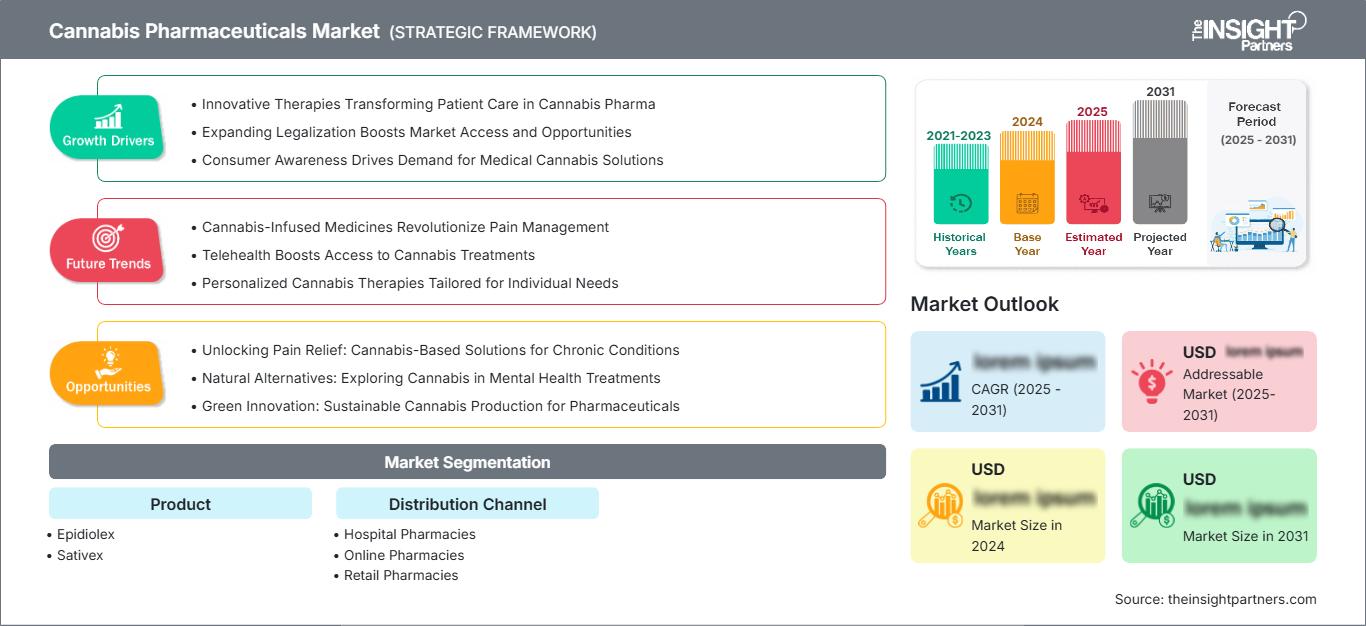
The Cannabis Pharmaceuticals Market is projected to grow from US$ 4.81 Billion in 2025 to US$ 19.90 Billion by 2034, registering a CAGR of 17.09% during 2026–2034. The market reflects rising clinical use of cannabinoid-derived medicines, expanding regulatory acceptance of prescription cannabis-based therapies, and growing adoption in neurological conditions where conventional treatment pathways deliver limited therapeutic response.
Across North America, the Cannabis Pharmaceuticals Market size is supported by mature prescription infrastructure, specialist neurology networks, and wider payer familiarity with cannabinoid-based medicines. The region is estimated to grow at a CAGR of 15.8–17.2% through 2026–2034, with the U.S. driving demand through rare epilepsy prescriptions, hospital pharmacy dispensing, and increasing clinical evidence around standardized cannabidiol formulations.
Cannabis Pharmaceuticals Market Assessment and Insights
- North America accounted for 43–46% share in 2025 and is growing at a CAGR of 15.8–17.2% during 2026–2034, supported by rare-disease prescribing, established reimbursement pathways, and regulated cannabinoid drug distribution.
- US represented 78–82% of North America in 2025 and is growing at a CAGR of 15.5–16.8% during 2026–2034, led by specialty neurology adoption and branded prescription access.
- Europe held 24–27% share in 2025 and is growing at a CAGR of 14.6–16.0% during 2026–2034, with the UK, Germany, France, Italy, and Spain supporting regulated MS spasticity and epilepsy treatment pathways.
- Asia Pacific captured 18–21% share in 2025 and is growing at a CAGR of 18.8–20.5% during 2026–2034, driven by Japan, Australia, South Korea, China, and India through controlled medical cannabis reforms.
- Largest Segment: Epidiolex held 72–76% market share in 2025 and is growing at a CAGR of 16.1–17.4% during 2026–2034 because of approved rare epilepsy indications and physician familiarity.
- High Growth Segment: Online Pharmacies held 10–13% market share in 2025 and is growing at a CAGR of 19.4–21.2% during 2026–2034 as e-prescription practices expand.
- Key companies analyzed in detail: AbbVie Inc., Insys Therapeutics, Inc., Jazz Pharmaceuticals plc, Bausch Health Companies Inc., Tilray Brands, Inc., Cardiol Therapeutics Inc., CURE Pharmaceutical Holding Corp., Harmony Biosciences Holdings, Inc., Abbott Laboratories, Endo International plc.
Source: The Insight Partners' analysis based on proprietary research, government publications, company annual reports, investor presentations, industry databases, and expert interviews.
Prescription-strength cannabinoid medications have gone through the transition from herbal extracts to manufactured items with known active components, reliable production control, and disease-specific dosing recommendations. The Cannabis Pharmaceuticals Market now sees a trend towards clinical research, oral liquids, mucosal sprays, and hospital-based administration. Production characteristics have become focused on GMP-approved cultivation, extraction reliability, purity analysis, and batch tracking, which distinguish prescription drugs from other cannabis-related categories.
In the future, regulatory certainty in select Asia-Pacific and European markets will increase patients' access, although strictly controlled from a medical standpoint. Investment will be allocated to pediatric neurology, multiple sclerosis, spasticity, inflammation treatment, and orphan diseases. The priority of pharmaceutical firms will be on the production of scientific evidence, physicians' training, and collaboration with specialty pharmacies, while governmental bodies are slowly incorporating cannabinoid medicines into controlled substances legislation.
Cannabis Pharmaceuticals Market Report Scope
| Report Attribute | Details |
|---|---|
| Market size in 2025 | US$ 4.81 Billion |
| Market Size by 2034 | US$ 19.90 Billion |
| Global CAGR (2026 - 2034) | 17.09% |
| Historical Data | 2021-2024 |
| Forecast period | 2026-2034 |
Cannabis Pharmaceuticals Market Analysis
Demand is being shaped by treatment-resistant epilepsy, MS-related spasticity, chronic neurological symptoms, and physician preference for approved dosage forms over unregulated cannabis products. Cannabis Pharmaceuticals Market growth is strongest where prescribers can rely on validated safety data, controlled labeling, and predictable reimbursement. The value chain spans cannabinoid sourcing, API processing, clinical development, regulatory approval, pharmacovigilance, and specialty distribution.
There are no supply discipline concerns since cannabinoid-based prescription drugs have a stricter adherence requirement compared to recreational or medical cannabis flowers. The manufacturers should maintain ratio control, solvent residuals, stability, packaging, and childproof dispensing in the cannabinoid products. Hospitals play a pivotal role in dispensing prescription drugs in high acuity cases, while retail and e-pharmacies are becoming relevant in other situations.
Competition intensity centers on clinically-proven products, intellectual property rights, and reach into the prescriber network. Cannabis Pharmaceuticals Market analysis shows that Jazz Pharmaceuticals plc has a significant market share because of its Epidiolex, whereas Tilray Brands, Inc. uses regulated medical cannabis expertise in foreign markets. Cardiol Therapeutics Inc., CURE Pharmaceutical Holding Corp., and Harmony Biosciences Holdings, Inc. provide the pipeline and formulation expertise.
Positioning becomes based more and more on trial data, label broadening, and supply chain stability than on the scale of cannabis manufacturing alone. AbbVie Inc., Abbott Laboratories, Bausch Health Companies Inc., Endo International plc, and Insys Therapeutics, Inc. represent the pharmaceutical or legacy adjacent competitors and set up competitive benchmarking. The investment community likes to back companies with cannabinoid research and neurological, cardiovascular, or drug delivery competencies.
● REPORT CUSTOMIZATION
Tailor This Report To Align With Your Specific Business Requirements
This report can be customized to align precisely with your business objectives, scope, and target markets. Customization options include tailored segmentation, geography, competitive analysis, and strategic insights to support informed decision-making.
Customize This Report →WHAT YOU CAN ADJUST
- ● Segmentations
- ● Geography
- ● Competitive Analysis
- ● Language Preferences
Cannabis Pharmaceuticals Market: Strategic Insights
Regional Insights
North America Cannabis Pharmaceuticals Market
North America led the industry with 43–46% share in 2025 and is projected to grow at a CAGR of 15.8–17.2% during 2026–2034. The Cannabis Pharmaceuticals Market share is anchored by U.S. rare epilepsy prescribing, specialty pharmacies, and physician familiarity with FDA-approved cannabidiol therapy. Regulated access programs are developed for Canada, whereas Mexico still seems to be at an early stage.
There are certain advantages, such as the presence of sizable patient bases for neurology, clinical trial facilities, and pharmacovigilance guidelines in the region. The use of cannabis-based drugs is being observed in hospitals and specialized clinics in situations where traditional antiseizure treatments and treatment for spasticity prove inadequate.
U.S. Cannabis Pharmaceuticals Market
The U.S. accounted for 78–82% of North America in 2025 and is expected to grow at a CAGR of 15.5–16.8% during 2026–2034. The demand is highly localized to pediatric neurology, rare epilepsy clinics, and specialty pharmacy routes. Jazz Pharmaceuticals plc ensures robust physician reach via Epidiolex, but broader regulatory reform may help drive research efforts.
Commercial success relies on indication label, insurance coverage, and physician comfort with standardized dosing of cannabinoids. Hospital pharmacies assist with initiation for complicated patients, whereas retail pharmacies handle maintenance dosing when allowed. Market application trends show growing favor for adjunct treatment, burden reduction of seizures, caregiver-based outcomes, and patient compliance assistance programs.
Europe Cannabis Pharmaceuticals Market
Europe held 24–27% share in 2025 and is forecast to grow at a CAGR of 14.6–16.0% during 2026–2034. The UK continues to be an advanced country thanks to its earlier experience in regulated cannabis-based medicines and MS spasticity prescribing. Germany provides the conditions for growth owing to medical cannabis reforms, pharmacy compounding experience, and physician participation.
France, Italy, and Spain are creating prudent approaches to development in terms of clinical evidence, reimbursement evaluation, and controlled product availability. Italy is becoming notable with regard to the activities related to therapeutic cannabis authorization, whereas Spain keeps its special approach to prescribing. Demand in Europe is less aggressive than in North America due to health technology assessment, cost control, and prescribing regulations.
APAC Cannabis Pharmaceuticals Market
APAC accounted for 18–21% share in 2025 and is expected to expand at a CAGR of 18.8–20.5% during 2026–2034. Australia is the leading country because of structured medical cannabis access, active prescribing systems, and patient registry experience. Japan and South Korea remain cautious but clinically sophisticated markets.
China and India offer long-term potential through pharmaceutical manufacturing capability, large neurological patient bases, and policy experimentation under strict oversight. Growth is tied to physician education, import permissions, domestic clinical trials, and quality certification. Industrial strengths in API production and digital pharmacy infrastructure could support future scale once regulatory approvals broaden.
Middle East & Africa Cannabis Pharmaceuticals Market
The Middle East & Africa is projected to grow at a CAGR of 16.0–17.6% during 2026–2034. South Africa leads regional adoption because of medical cannabis cultivation, export capability, and a comparatively advanced regulatory pathway. The UAE and Saudi Arabia remain highly controlled but are expanding healthcare infrastructure and specialist neurology capacity.
Energy-linked diversification programs are improving hospital networks, cold-chain logistics, and pharmaceutical investment across Gulf markets. Adoption will remain selective, focused on approved medicines rather than broad cannabis access. The rest of MEA demand is expected to develop through imported therapies, physician training, and regulatory pilots aligned with controlled-substance compliance.
Segmentation Analysis
Product
Product is projected to grow at a CAGR of 16.5–17.8% during 2026–2034. The Cannabis Pharmaceuticals Market scope by product is defined by approved cannabinoid medicines with clear indications, dosage controls, and clinical monitoring requirements. Product competition is shaped by label breadth, real-world evidence, manufacturing quality, and physician comfort with cannabinoid mechanisms in neurological disorders.
- Epidiolex dominates product demand because it is associated with approved cannabidiol therapy for rare epilepsies, strong specialist awareness, and growing real-world evidence supporting durable use in complex seizure disorders.
- Sativex maintains strategic relevance in MS spasticity treatment, particularly in European and international markets where nabiximols is prescribed after inadequate response to standard anti-spasticity medicines.
Distribution Channel
Distribution Channel is projected to grow at a CAGR of 17.3–18.6% during 2026–2034. Dispensing channels differ by prescription complexity, controlled-substance rules, and payer requirements. Hospitals support initiation and monitoring, retail pharmacies provide chronic therapy access, and online pharmacies are becoming more relevant where e-prescribing and regulated home delivery are permitted.
- Hospital Pharmacies remain essential for specialist initiation, complex case review, and coordination with neurologists, especially when pediatric epilepsy or MS spasticity patients require close therapeutic monitoring.
- Online Pharmacies are gaining strategic importance through refill convenience, digital prescription workflows, and chronic therapy adherence support in markets allowing regulated distribution of approved cannabinoid medicines.
- Retail Pharmacies support broader patient access after diagnosis and prescription stabilization, particularly in markets where pharmacists can manage repeat dispensing, counseling, and reimbursement documentation.
Opportunity Snapshot
| Segment Name | Revenue Contribution (High/Medium/Low) | Trend Tag (MAX 2 words, specific) | Adoption Stage (Emerging/Scaling/Mature) |
| Epidiolex | High | Rare Epilepsy | Mature |
| Sativex | Medium | MS Spasticity | Scaling |
Cannabis Pharmaceuticals Market Growth Drivers and Impact Analysis
Rising Clinical Acceptance of Cannabinoid-Based Neurology Drugs
Neurology remains the strongest demand engine because cannabinoid pharmaceuticals address defined gaps in seizure and spasticity management. Physicians are increasingly differentiating approved medicines from nonstandard cannabis products, which improves confidence in dosing, drug interaction monitoring, and safety reporting. In epilepsy, chronic disease burden and caregiver demand for better seizure control support specialist adoption. In MS spasticity, patients who do not respond adequately to conventional anti-spasticity medicines create a targeted prescribing pool. The practical impact is higher conversion from compassionate or off-label interest into structured prescription use, particularly through hospital pharmacies. Cannabis Pharmaceuticals Market adoption also benefits when clinical guidelines, payer reviews, and real-world evidence converge around measurable outcomes such as seizure frequency, muscle stiffness, and functional improvement.
Regulatory Pathways Favor Standardized Prescription Products
Regulatory bodies are starting to distinguish pharmaceutical cannabis products from those in consumer cannabis categories, thus creating a better business pathway for organizations with skills in clinical studies, manufacturing processes, and pharmacovigilance. Regulatory approval involves the demonstration of product consistency, safety, stability, and efficacy, which sets hurdles for any product produced using less-stringent regulations. Such an environment works to the advantage of businesses with the capability to produce products under GMP conditions, file clinical documents, and conduct post-market monitoring. This trend has a double effect on the market, in that there will be increased confidence from both prescribers and payers. Even countries with conservative cannabis policies will approve the use of cannabinoid-based medicines when they conform to conventional drug regulations.
Specialty Pharmacy Expansion Improves Patient Access
Specialty pharmacy capabilities are helping expand access to treatments requiring prior authorizations, patient education, refills, and adverse event reporting. Cannabinoid-based therapies require extra counseling as there are uncertainties related to psychoactivity, being a controlled substance, and interaction with anti-seizure drugs. Specialty pharmacy resources could help facilitate documentation, adherence, dose escalation, and communication with the prescribing doctors. This is highly relevant for epilepsy among children and neurodegenerative disorders, where drug adherence affects patient outcomes. Online and retail availability is growing post-stabilization, but specialty pharmacy still plays an important role in patient onboarding. The commercial benefit here is higher persistence and lower abandonment when starting the treatment, increasing payer adherence as well.
Cannabis Pharmaceuticals Market Future Trends
Evidence-Linked Label Expansion
Future Cannabis Pharmaceuticals Market trends will be shaped by companies using real-world datasets and controlled trials to expand beyond initial indications. Instead of relying on general cannabinoid enthusiasm, the developers should focus on targeting disease mechanisms, responders, and endpoints. Pediatric neurological diseases, rare genetic epilepsy, neurobehavioral manifestations, and inflammation in cardiopathy are areas where structured programs can be developed. This will definitely help with reimbursement due to the connection between evidence and outcomes/healthcare utilization. The companies designing studies for minimizing the burden on caregivers, improving QoL, and avoiding polypharmacy will achieve greater differentiation than those developing symptom stories.
Shift Toward Precision Formulations
Future product iterations are expected to focus on defined ratios of cannabinoids, enhanced bioavailability, and targeted delivery mechanisms. Oils and sprays may continue to be utilized; however, formulation science may help overcome problems related to onset time, tolerance, and consistent dosing. Transdermal, buccal, and extended-release systems are being developed to minimize the variability inherent to oils and botanical products. Advanced formulations may prove useful in managing drug interactions and patient compliance. In the long run, such trends may play into the hands of pharmaceutical manufacturers possessing delivery technology and analytical skills rather than cannabis growers.
Cannabis Pharmaceuticals Market Opportunities
Building Specialist Access in Emerging Regulated Markets
Emerging regulated markets offer a practical route for Cannabis Pharmaceuticals Market Forecasts to outperform if companies invest early in physician education, distributor licensing, and local evidence generation. Australia, Germany, Italy, South Korea, and certain Gulf nations are examples of the potential to increase controlled distribution while remaining conservative on cannabis policy. It is important for companies to form relationships with neurology departments, hospital pharmacies, and medical affairs personnel who can articulate patient selection criteria and follow-up needs. Investment in building out pharmacovigilance capabilities will also enhance regulatory confidence. The play is not market penetration at launch, but sustained specialty adoption and eventual scaling as policy-makers gain comfort with authorized cannabinoid drugs.
Leveraging Digital Pharmacy for Chronic Therapy Continuity
There is a chance of utilizing digital pharmacy models to enhance adherence, patient services, and documentation when it comes to using cannabinoid pharmaceuticals on a long-term basis. Missing a refill in chronic epilepsy and MS spasticity may impact how symptoms are managed and may impact the confidence level of caregivers. A regulated online pharmacy may be able to offer reminder services, manage insurance, provide delivery, and even conduct counseling provided by pharmacists. Companies need to develop patient service programs that comply with regulations and fit into the workflow of prescribers instead of being a consumer-based cannabis site.
Recent Developments
- December 2025: Tilray Brands, Inc. announced the formation of Tilray Medical USA, Inc. to prepare for regulated U.S. medical cannabis expansion following federal rescheduling developments. The company positioned the unit around medical-grade products, clinical research, compliance infrastructure, and healthcare partnerships, reflecting a strategy to translate international regulated-market experience into U.S. pharmaceutical cannabis operations.
- December 2025: Jazz Pharmaceuticals plc announced new Epidiolex data presentations at the American Epilepsy Society 2025 Annual Meeting, including real-world evidence and interim findings from the EpiCom study in tuberous sclerosis complex-associated seizures. The update reinforced the company’s focus on rare epilepsy evidence generation and broader clinical understanding beyond seizure-frequency endpoints.
- November 2025: CNX Therapeutics acquired the global Sativex business from Jazz Pharmaceuticals plc, including marketing authorizations, commercial partnerships, and manufacturing and supply arrangements. The transaction expanded CNX Therapeutics’ CNS portfolio across European and international markets while Jazz provided transition support to maintain continuity of access for patients and healthcare professionals.
Frequently Asked Questions

- Comprehensive Market Sizing and Forecast Analysis
- Detailed Segmentation Analysis
- In-Depth Market Dynamics Assessment
- Regional and Country-Level Insights
- Competitive Landscape and Company Benchmarking
- Strategic Business Intelligence
Recent Reports
Testimonials

The Insight Partners' SCADA System Market report is comprehensive, with valuable insights on current trends and future forecasts. The team was highly professional, responsive, and supportive throughout. We are very satisfied and highly recommend their services.
RAN KEDEM Partner, Reali Technologies LTDs
I requested a report on a very specific software market and the team produced the report in a few days. The information was very relevant and well presented. I then requested some changes and additions to the report. The team was again very responsive and I got the final report in less than a week.
JEAN-HERVE JENN Chairman, Future Analytica
We worked with The Insight Partners for an important market study and forecast. They gave us clear insights into opportunities and risks, which helped shape our plans. Their research was easy to use and based on solid data. It helped us make smart, confident decisions. We highly recommend them.
PIYUSH NAGPAL Sr. Vice President, High Beam Global
The Insight Partners delivered insightful, well-structured market research with strong domain expertise. Their team was professional and responsive throughout. The user-friendly website made accessing industry reports seamless. We highly recommend them for reliable, high-quality research services
YUKIHIKO ADACHI CEO, Deep Blue, LLC.
This is the first time I have purchased a market report from The Insight Partners.While I was unsure at first, I visited their web site and felt more comfortable to take the risk and purchase a market report.I am completely satisfied with the quality of the report and customer service. I had several questions and comments with the initial report, but after a couple of dialogs over email with their analyst I believe I have a report that I can use as input to our strategic planning process.Thank you so much for taking the extra time and making this a positive experience.I will definitely recommend your service to others and you will be my first call when we need further market data.
JOHN SUZUKI President and Chief Executive Officer, Board Director, BK Technologies
I wish to appreciate your support and the professionalism you displayed in the course of attending to my request for information regarding to infectious disease IVD market in Nigeria. I appreciate your patience, your guidance, and the fact that you were willing to offer a discount, which eventually made it possible for us to close a deal. I look forward to engaging The Insight Partners in the future, all thanks to the impression you have created in me as a result of this first encounter.
DR CHIJIOKE ONYIA MANAGING DIRECTOR, PineCrest Healthcare Ltd.Reason to Buy
- Informed Decision-Making
- Understanding Market Dynamics
- Competitive Analysis
- Identifying Emerging Markets
- Customer Insights
- Market Forecasts
- Risk Mitigation
- Boosting Operational Efficiency
- Strategic Planning
- Investment Justification
- Tracking Industry Innovations
- Aligning with Regulatory Trends





 Get Free Sample for