
Capillary Blood Collection Tubes Market Share, Growth & Demand by 2034
Coverage: By Type (Plastic Blood Collection Tubes, Glass Blood Collection Tubes, Stainless Steel Blood Collection Tubes, Ceramic Blood Collection Tubes) ; End User (Hospitals, Ambulatory Care Facilities, Blood Donation Facilities, Blood Testing Centers, Others), and Geography (North America, Europe, Asia Pacific, and South and Central America)
- Status : Data Released
- Report Code : TIPRE00008629
- Category : Life Sciences
- No. of Pages : 150
- Available Report Formats :


- Last update date : August 21, 2026


2025 Market Size
US$ 2.57 Bn
Base year value
2034 Forecast
US$ 4.19 Bn
Projected by 2034
CAGR 2026-2034
5.57 %
Growth rate
Addressable Market
US$ 30.63 Bn
(2026-2034)
The Capillary Blood Collection Tubes Market is projected to grow from US$ 2.57 Billion in 2025 to US$ 4.19 Billion by 2034, registering a CAGR of 5.57% during 2026–2034. Demand is supported by rising low-volume diagnostics, pediatric and geriatric testing requirements, chronic disease monitoring, and laboratory workflows that require reliable sample integrity across decentralized and hospital-based collection settings.
Across North America, the Capillary Blood Collection Tubes Market size is supported by mature diagnostics infrastructure, pharmacy-linked testing models, and higher adoption of microcollection systems in outpatient care. The region is expected to advance at a CAGR range of 5.2–5.6% during 2026–2034 as providers prioritize lower-volume sampling, patient comfort, and standardized specimen handling under CLIA-aligned quality requirements.
Capillary Blood Collection Tubes Market Assessment and Insights
- North America held a 34–36% share in 2025 and is expected to grow at a CAGR of 5.2–5.6% during 2026–2034, supported by high testing intensity, outpatient diagnostics, and strong procurement by hospital networks.
- US accounted for 82–86% of North America in 2025 and is expected to grow at a CAGR of 5.3–5.7% during 2026–2034, led by clinical laboratory automation and retail testing expansion.
- Europe held a 27–29% share in 2025 and is expected to grow at a CAGR of 4.9–5.3% during 2026–2034, with Germany, France, the UK, Italy, and Spain leading demand.
- Asia Pacific held a 22–24% share in 2025 and is expected to grow at a CAGR of 6.2–6.7% during 2026–2034, driven by China, Japan, South Korea, India, and Australia.
- Largest Segment: Plastic Blood Collection Tubes held a market share of 61–64% in 2025 and are expected to grow at a CAGR of 5.8–6.2% during 2026–2034.
- High Growth Segment: Blood Testing Centers held a market share of 18–21% in 2025 and are expected to grow at a CAGR of 6.4–6.9% during 2026–2034.
- Key companies analyzed in detail: Allegro Medical Supplies Inc., Becton, Dickinson and Company, Greiner Bio-One International GmbH, Improve Medical Technology (Nanxiong) Co., Ltd., KABE LABORTECHNIK GmbH, Medtronic plc, Radiometer Medical ApS, SARSTEDT AG & Co. KG, Terumo Medical Corporation, Thermo Fisher Scientific Inc.
Source: The Insight Partners' analysis based on proprietary research, government publications, company annual reports, investor presentations, industry databases, and expert interviews.
Market developments have shifted from traditional glass capillary collection to a safer version made out of plastic materials, along with pre-heparinization of the tubes, addend specific tubes, and closure designs minimizing spillage and aerosol risks. Production considerations will increasingly become more influenced by the availability of polypropylene and PET material, the molding of closures, the validation of anticoagulant coating, and packaging. Additionally, manufacturers will adapt tube design for use with automated analyzers, reducing manual handling processes and increasing traceability.
Demand will likely continue moving towards novel networks of diagnostics within APAC, the Middle East, and selected LATAM countries, as well as primary care and outpatient diagnosis. Regulatory headwinds will emerge from quality programs of laboratories, newborn screening, decentralized chronic disease testing, and patient blood management programs. Investments will likely focus on plastic safe designs, small draw volumes, label compatibility, and continuity of supplies through hospital and non-hospital distribution channels.
Capillary Blood Collection Tubes Market Report Scope
| Report Attribute | Details |
|---|---|
| Market size in 2025 | US$ 2.57 Billion |
| Market Size by 2034 | US$ 4.19 Billion |
| Global CAGR (2026 - 2034) | 5.57% |
| Historical Data | 2021-2024 |
| Forecast period | 2026-2034 |
Capillary Blood Collection Tubes Market Analysis
The Capillary Blood Collection Tubes Market growth is mainly tied to higher use of low-volume sampling in pediatrics, geriatrics, oncology follow-up, diabetes monitoring, and point-of-care-linked diagnostics. WHO reports that noncommunicable diseases account for 74% of global deaths, keeping recurring blood testing central to chronic care pathways. Demand is also influenced by laboratory need for stable analyte recovery, controlled additive ratios, and tubes compatible with centrifugation, transport, and analyzer loading.
Supply chains depend on resin procurement, additive formulation, precision molding, sterilization partners, distributors, and clinical laboratory purchasing groups. The Capillary Blood Collection Tubes Market analysis shows that suppliers with validated filling accuracy, lot traceability, and broad additive portfolios are better positioned as laboratories standardize pre-analytical workflows. CMS CLIA guidance continues to reinforce reliable specimen testing and quality oversight in the US.
Positioning in the competitive landscape revolves mainly around issues such as reliability, tube safety, small quantity fill accuracy, and distribution through laboratories. Becton, Dickinson and Company, Greiner Bio-One International GmbH, SARSTEDT AG & Co. KG, and Radiometer Medical ApS engage in differentiation of their capillary collection systems, whereas Thermo Fisher Scientific Inc. enhances its market channel through product offerings by Fisher Scientific.
Investment strategy is now focusing on automation of microtubes, neonatal blood gas sampling, retail availability, and plastics, which are less breakable than glass. Improve Medical Technology (Nanxiong) Co., Ltd., KABE LABORTECHNIK GmbH, Terumo Medical Corporation, Medtronic plc, and Allegro Medical Supplies Inc. facilitate competition through distinct product lines, extensive distribution, and adjacent clinical consumables.
● REPORT CUSTOMIZATION
Tailor This Report To Align With Your Specific Business Requirements
This report can be customized to align precisely with your business objectives, scope, and target markets. Customization options include tailored segmentation, geography, competitive analysis, and strategic insights to support informed decision-making.
Customize This Report →WHAT YOU CAN ADJUST
- ● Segmentations
- ● Geography
- ● Competitive Analysis
- ● Language Preferences
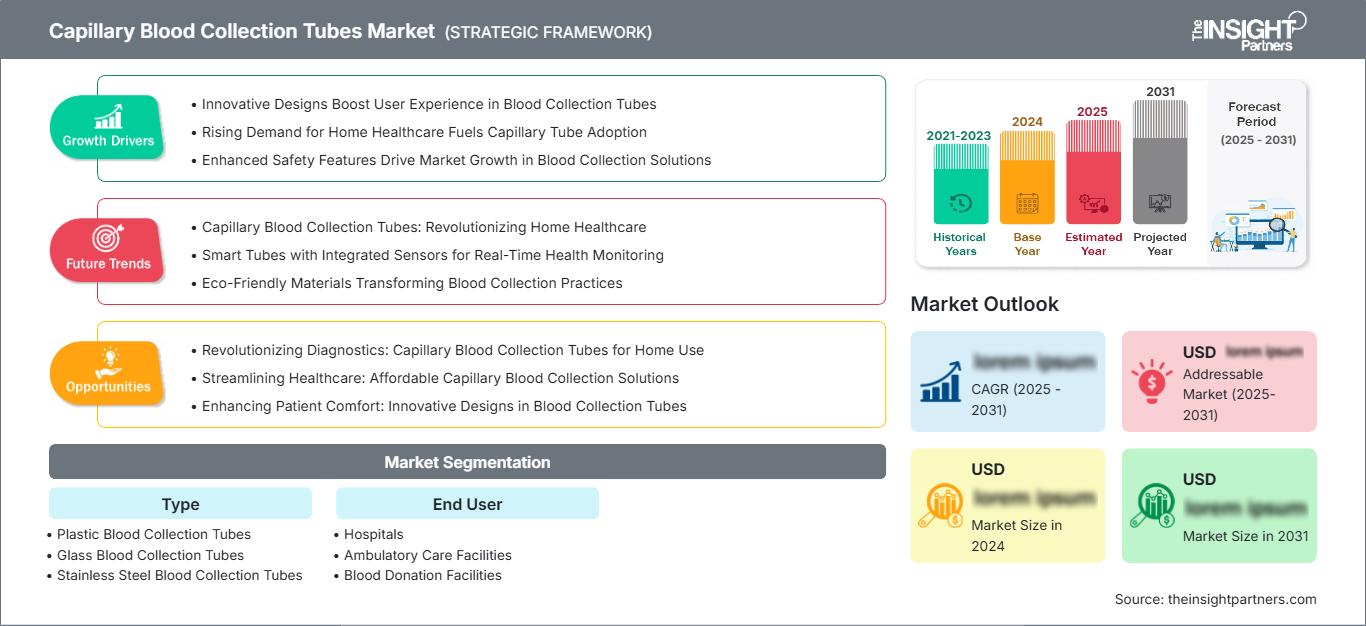
Capillary Blood Collection Tubes Market: Strategic Insights
Regional Insights
North America Capillary Blood Collection Tubes Market
North America accounted for 34–36% of the Capillary Blood Collection Tubes Market share in 2025 and is expected to grow at a CAGR of 5.2–5.6% during 2026–2034. The demand will arise from the testing for chronic diseases, neonatal screening, emergency care, and decentralized specimen collection. The CLIA regulations of the US provide a strong foundation for the importance of specimen quality and thereby make premium tubes a viable option in certified laboratories.
High use of plastic microcollection tubes, blood gas capillaries, and pediatric-friendly collection systems is also a key strength of the region. Increasing use of retail and ambulatory care testing drives the demand for a collection method in small volumes, which does not necessarily have to be carried out in a phlebotomy room.
U.S. Capillary Blood Collection Tubes Market
The US represented 82–86% of North America in 2025 and is expected to grow at a CAGR of 5.3–5.7% during 2026–2034. Growth drivers include CLIA-registered lab density, Medicare reimbursement for clinical diagnosis, migration to OPD care, and extensive application of pediatric and geriatric microsampling. According to CMS, there was no CLFS cut for non-ADLT clinical diagnostic lab tests in CY2025, thus helping maintain the short-term stability of lab operations.
Company penetration is relatively high as Becton, Dickinson and Company, Thermo Fisher Scientific Inc., Greiner Bio-One International GmbH, and SARSTEDT AG & Co. KG operate through direct and distributor routes. Applications include wellness testing, follow-ups of chronic diseases, neonatal care, and sampling of blood gases. The country is the largest market for superior capillary systems.
Europe Capillary Blood Collection Tubes Market
Europe held a 27–29% share in 2025 and is expected to grow at a CAGR of 4.9–5.3% during 2026–2034. The top-ranked market is Germany, fueled by well-developed diagnostics manufacturing, hospital labs, and the use of PET and polypropylene microcollection devices. The United Kingdom continues to develop through outpatient diagnostics within the NHS framework and community phlebotomy practices.
Germany features SARSTEDT AG & Co. KG and KABE LABORTECHNIK GmbH; Greiner Bio-One International GmbH is associated with Austria. Regional coverage in France and Italy stems from regular demand from hospital labs, neonatal units, and private diagnostic chains. Spain gains from the modernization of healthcare and an increase in routine testing volumes.
The WHO Europe estimated 1.8 million preventable deaths due to noncommunicable diseases each year for the region. The preventive testing and chronic disease diagnostics remain long-term growth factors. The regional market also considers EU requirements for medical devices, safety-engineered collection solutions, and laboratory sustainability needs, benefiting plastic options.
APAC Capillary Blood Collection Tubes Market
APAC held a 22–24% share in 2025 and is expected to grow at a CAGR of 6.2–6.7% during 2026–2034. China is the leading country, supported by hospital expansion, domestic device manufacturing, and larger diagnostic networks. Japan and South Korea emphasize high-quality laboratory consumables, while India expands through private pathology chains.
Australia contributes through standardized hospital procurement and rural diagnostic access. Policy emphasis on universal health coverage, maternal-child health, and chronic disease screening supports adoption across emerging APAC markets. Local manufacturing by Improve Medical Technology (Nanxiong) Co., Ltd. also improves regional cost competitiveness and supply resilience.
Middle East & Africa Capillary Blood Collection Tubes Market
The Middle East & Africa is expected to grow at a CAGR of 5.5–6.0% during 2026–2034, with Saudi Arabia leading regional demand. Saudi Arabia and the UAE are investing in healthcare infrastructure, laboratory networks, and preventive care capacity, while South Africa remains the largest sub-Saharan diagnostic hub.
The rest of MEA demand is linked to public hospital upgrades, donor screening, diabetes testing, and pediatric care access. Energy-funded healthcare investment in Gulf countries supports higher-quality consumables, whereas African markets prioritize affordable plastic tubes and reliable supply through distributors serving centralized laboratories.
Segmentation Analysis
Type
The Type segment is expected to grow at a CAGR of 5.4–5.9% during 2026–2034. The Capillary Blood Collection Tubes Market scope across materials is shifting toward plastic due to breakage resistance, easier transport, and compatibility with automated processing. Glass remains relevant for specific hematocrit and gas-tight applications, while stainless steel and ceramic serve narrower, specialized use cases.
- Plastic Blood Collection Tubes dominate demand because they reduce breakage risk, support molded safety closures, and fit high-throughput laboratory workflows where standardized handling and transport durability are essential.
- Glass Blood Collection Tubes retain demand in selected microhematocrit, blood gas, and laboratory applications where material clarity, capillary action, and legacy protocol familiarity remain important.
- Stainless Steel Blood Collection Tubes serve specialized environments requiring durability, controlled sampling tools, or reusable-compatible workflows, though adoption is limited by cost and narrower clinical suitability.
- Ceramic Blood Collection Tubes address niche analytical needs where chemical resistance, sample stability, or specialty research use provides value, but commercial volume remains lower than plastic and glass.
End User
The End User segment is expected to grow at a CAGR of 5.7–6.2% during 2026–2034. Hospitals remain the principal buyers because they manage neonatal, emergency, inpatient, and specialty testing workflows. Ambulatory facilities and testing centers are expanding faster as care delivery moves closer to patients and requires standardized microcollection products with reliable labeling, transport, and processing features.
- Hospitals remain the highest revenue contributors because intensive care, pediatrics, oncology, and emergency departments frequently require low-volume sampling for vulnerable patients and rapid clinical decisions.
- Ambulatory Care Facilities are increasing adoption as outpatient diagnostics, physician offices, and retail care sites seek convenient sampling products for routine screening and chronic disease monitoring.
- Blood Donation Facilities use related collection and testing consumables for donor eligibility, hemoglobin checks, and safety screening, making reliability and procedural consistency important procurement criteria.
- Blood Testing Centers are scaling rapidly as independent laboratories and diagnostic chains expand walk-in testing, preventive panels, and home-collection-linked sample processing models.
Opportunity Snapshot
| Segment Name | Revenue Contribution | Trend Tag | Adoption Stage |
| Hospitals | High | Neonatal Testing | Mature |
| Ambulatory Care Facilities | Medium | Retail Diagnostics | Scaling |
| Blood Donation Facilities | Medium | Donor Screening | Mature |
| Blood Testing Centers | High | Lab Networks | Scaling |
Capillary Blood Collection Tubes Market Growth Drivers and Impact Analysis
Expansion of Low-Volume Testing in Vulnerable Patient Groups
Low-volume blood draws are gaining increasing importance in neonatal, pediatric, geriatric, oncology, and critical care environments where repeated venipunctures may cause pain, bleeding, or even failures in sample collection. Radiometer says that capillary samples are preferred in neonates, as repeated sampling of blood from patients having low blood volumes can increase the risk of developing anemia. This medical need is a clear indication of the rising demand for pre-heparinized, plastic, small-volume capillary tubes suitable for blood gases/metabolites tests. As healthcare facilities concentrate on blood conservation and minimal invasive sampling of blood, it is expected that procurement units would prefer tubes having low volume draw, quick fill, sealable and analyzer-friendly characteristics.
Shift Toward Decentralized and Ambulatory Diagnostics
Diagnostic access is being brought into outpatient clinics, retail locations, urgent care facilities, and patient service centers in healthcare systems. This trend results in the need for a simple-to-use capillary system that can be managed by health professionals without compromising pre-analytical quality. It was reported by BD and Babson Diagnostics that certain general chemistry analyte measurements from fingertip samples using BD MiniDraw were equivalent clinically to traditional methods. The significance of this development is seen through an increase in the points of collections, consumables pull-through, and increased demand for tubes with stability, transportability, label, and convenient closure features.
Laboratory Quality Standards and Automation Compatibility
The clinical laboratories are increasingly facing the need to minimize rejection due to clots, sample underfilling, hemolysis, and incorrect sample labeling. Capillary tubes, which ensure the correct additive ratio, fill lines, barcode labels, and automation, are useful in the reduction of pre-analytical variation. BD Microtainers have the fill lines, lot numbers, expiry dates, and closures, which are useful in the process of collecting and mixing samples, while Greiner Bio-One offers its VACUETTE and MiniCollect products, which focus on the use of PET plastic and small-volume tubes.
Capillary Blood Collection Tubes Market Future Trends
Integrated Microcollection Systems for Automated Processing
Capillary Blood Collection Tubes Market trends are moving toward integrated systems that reduce manual transfers and improve analyzer compatibility. Future products will include microcollection tubes, safety lancets, closures, labeling, and transportation-ready packaging, integrated into an integrated kit for use in decentralized locations. The need to reduce manual effort and pre-analytical error will increase the relevance of automated processing tubes like microtubes meant for direct loading. This will enhance product differentiation among suppliers as the value of the product will not only be in the tube material but in the integration process, stability data, traceability, and automation capabilities.
Sustainable Plastic Designs and Safer Materials
Sustainability considerations will play an ever-larger role as healthcare institutions consider issues such as the use of plastics, packaging weight, and efficient transport. This change will not merely involve reducing the use of plastic; rather, sustainable considerations will include materials that are safer, lighter, easily recyclable, and resistant to breaking. The wider Greiner Bio-One communication regarding sustainability through its ACT Ecolabel certification on other laboratory products indicates an increasing importance placed by buyers on environmental attributes. In the area of capillary blood sampling, future innovations may involve material reduction, better secondary packaging, and glass alternatives.
Capillary Blood Collection Tubes Market Opportunities
Expansion of Testing Networks in Emerging Economies
Emerging economies offer actionable opportunities for manufacturers that can balance affordability, quality, and distribution reach. The Capillary Blood Collection Tubes Market Forecasts indicate that APAC will outpace mature regions, making local partnerships, in-country registration, and distributor education critical. Manufacturers can target diagnostic chains, maternal-child health programs, and diabetes screening initiatives with plastic microcollection tubes that reduce breakage and simplify logistics. A tiered portfolio strategy can help suppliers serve public hospitals with cost-effective tubes while offering premium safety closures and analyzer-ready formats to private laboratories.
Specialized Tubes for Blood Gas and Chronic Monitoring
Blood gas testing, electrolyte monitoring, glucose surveillance, and chronic care panels create opportunities for specialized tubes with dry heparin, controlled fill volumes, and analyzer-specific performance. Radiometer’s safeCLINITUBES portfolio demonstrates how neonatal and blood gas workflows require low-volume tubes with mixing features and clot-reduction design. Suppliers can invest in clinical validation, compatibility data, and training materials that help laboratories reduce sample rejection. This opportunity is strongest where intensive care units, neonatal wards, and decentralized chronic disease programs need reliable capillary sampling without compromising analytical quality.
Recent Developments
- March 2025: Becton, Dickinson and Company announced with Babson Diagnostics that studies showed selected common blood tests using the BD MiniDraw Capillary Blood Collection System and BD MiniDraw SST Capillary Blood Collection Tube were clinically equivalent to conventional venous and capillary methods, supporting fingertip collection in nontraditional care settings.
- July 2025: Greiner Bio-One International GmbH showcased VACUETTE Blood Collection Tubes at the 2025 ADLM exhibition, emphasizing PET plastic construction, low-volume tube availability, additive-specific formats, and safety caps designed to support blood collection, transport, and processing in clinical laboratories.
- April 2026: Greiner Bio-One International GmbH announced that an additional 101 laboratory products received ACT Ecolabel certification, extending its sustainability transparency program. Although broader than capillary tubes, the development reflects supplier investment in environmental disclosure that increasingly influences laboratory consumables procurement.
Frequently Asked Questions

- Comprehensive Market Sizing and Forecast Analysis
- Detailed Segmentation Analysis
- In-Depth Market Dynamics Assessment
- Regional and Country-Level Insights
- Competitive Landscape and Company Benchmarking
- Strategic Business Intelligence
Recent Reports
Testimonials

The Insight Partners' SCADA System Market report is comprehensive, with valuable insights on current trends and future forecasts. The team was highly professional, responsive, and supportive throughout. We are very satisfied and highly recommend their services.
RAN KEDEM Partner, Reali Technologies LTDs
I requested a report on a very specific software market and the team produced the report in a few days. The information was very relevant and well presented. I then requested some changes and additions to the report. The team was again very responsive and I got the final report in less than a week.
JEAN-HERVE JENN Chairman, Future Analytica
We worked with The Insight Partners for an important market study and forecast. They gave us clear insights into opportunities and risks, which helped shape our plans. Their research was easy to use and based on solid data. It helped us make smart, confident decisions. We highly recommend them.
PIYUSH NAGPAL Sr. Vice President, High Beam Global
The Insight Partners delivered insightful, well-structured market research with strong domain expertise. Their team was professional and responsive throughout. The user-friendly website made accessing industry reports seamless. We highly recommend them for reliable, high-quality research services
YUKIHIKO ADACHI CEO, Deep Blue, LLC.
This is the first time I have purchased a market report from The Insight Partners.While I was unsure at first, I visited their web site and felt more comfortable to take the risk and purchase a market report.I am completely satisfied with the quality of the report and customer service. I had several questions and comments with the initial report, but after a couple of dialogs over email with their analyst I believe I have a report that I can use as input to our strategic planning process.Thank you so much for taking the extra time and making this a positive experience.I will definitely recommend your service to others and you will be my first call when we need further market data.
JOHN SUZUKI President and Chief Executive Officer, Board Director, BK Technologies
I wish to appreciate your support and the professionalism you displayed in the course of attending to my request for information regarding to infectious disease IVD market in Nigeria. I appreciate your patience, your guidance, and the fact that you were willing to offer a discount, which eventually made it possible for us to close a deal. I look forward to engaging The Insight Partners in the future, all thanks to the impression you have created in me as a result of this first encounter.
DR CHIJIOKE ONYIA MANAGING DIRECTOR, PineCrest Healthcare Ltd.Reason to Buy
- Informed Decision-Making
- Understanding Market Dynamics
- Competitive Analysis
- Identifying Emerging Markets
- Customer Insights
- Market Forecasts
- Risk Mitigation
- Boosting Operational Efficiency
- Strategic Planning
- Investment Justification
- Tracking Industry Innovations
- Aligning with Regulatory Trends





 Get Free Sample for