
Carbon Fiber in Automotive Composites Market Size, Trends & Growth by 2034
Coverage: By Production Type (Hand Layup, Resin Transfer Molding, Vacuum Infusion Processing, Injection Molding, Compression Molding); Application (Structural Assembly, Power Train Components, Interior, Exterior, Others), and Geography (North America, Europe, Asia Pacific, and South and Central America)
- Status : Data Released
- Report Code : TIPRE00015613
- Category : Chemicals and Materials
- No. of Pages : 150
- Available Report Formats :


- Last update date : July 27, 2026


2025 Market Size
US$ 8.88 Bn
Base year value
2034 Forecast
US$ 21.99 Bn
Projected by 2034
CAGR 2026-2034
10.60 %
Growth rate
Addressable Market
US$ 136.78 Bn
(2026-2034)
The Carbon Fiber in Automotive Composites Market size was worth US$ 8.88 billion in 2025 and will be estimated to be at US$ 21.99 billion by 2034, with a CAGR of 10.60% from 2026 to 2034. The market is driven by the changing dynamics within the automobile industry towards lightweight structural material that improves efficiency and enhances the vehicles' safety and capability for electrification. Carbon fiber composite materials will keep finding its applications in passenger vehicles as well as commercial vehicles due to their low life cycle emissions and high-performance characteristics.
In North America region, the Carbon Fiber in Automotive Composites market size is rising gradually due to the investment made by the vehicle manufacturers in lightweight electric vehicles and local composite manufacturing facilities. This market is anticipated to grow at a CAGR of 9.8-10.4% between 2026 and 2034 due to the tough regulations on fuel efficiency, increasing use of carbon fiber battery cases, and growing collaborations between suppliers of composite material and automobile manufacturers.
Carbon Fiber in Automotive Composites Market Assessment and Insights
- North America: Accounted for an estimated 31–33% share in 2025 and is anticipated to grow at a CAGR of 9.8–10.4% during 2026–2034. Demand is supported by premium vehicle manufacturing, electric vehicle production, and investments in advanced composite manufacturing capacity.
- U.S.: Represented approximately 74–77% of the North American market in 2025 and is projected to expand at a CAGR of 9.9–10.5% during 2026–2034. Domestic OEMs continue integrating lightweight structural composites to improve vehicle range and crash performance.
- Europe: Held approximately 27–29% of the Carbon Fiber in Automotive Composites Market share in 2025 and is expected to record a CAGR of 10.2–10.8% during 2026–2034. Germany remains the regional leader, followed by France, Italy, and the UK, owing to premium automotive production and carbon-neutral mobility initiatives.
- Asia Pacific: Accounted for approximately 36–39% share in 2025 while registering the fastest industrial expansion with a CAGR of 11.3–11.9% during 2026–2034. China, Japan, South Korea, and India continue investing in EV manufacturing and advanced materials production.
- Largest Segment: Structural Assembly represented an estimated 42–45% market share in 2025 and is projected to expand at a CAGR of 10.7–11.2% during 2026–2034, supported by increasing deployment in body structures, battery housings, and crash-resistant components.
- High Growth Segment: Resin Transfer Molding is expected to record the highest growth, with an estimated 18–22% of the Carbon Fiber in Automotive Composites market share in 2025 and a CAGR of 11.8–12.5% during 2026–2034, reflecting growing preference for scalable, high-volume composite manufacturing.
- Key companies analyzed in detail: Aksa Akrilik Kimya Sanayii A.Ş., Cytec Industries Incorporated, Hexcel Corporation, Hyosung Corporation, Mitsubishi Chemical Carbon Fiber and Composites, SABIC, SGL Carbon SE, Teijin Limited, Toray Industries, Inc., ZOLTEK Corporation.
Source: The Insight Partners' analysis based on proprietary research, government publications, company annual reports, investor presentations, industry databases, and expert interviews.
Automation in manufacturing processes, developments in the use of recyclable thermoplastic matrices, as well as faster molding processes have resulted in shorter production cycles, better efficiency, and enhanced mechanical properties of the resulting products. Automakers are increasingly using carbon fiber and hybrid composite materials in an effort to minimize costs while achieving lightweight design objectives.
Further growth is expected to emanate from manufacturing sites located in the Asia-Pacific region, North America, and Europe. Investment in electric mobility solutions, tighter emission regulations on car fleets, and continued funding for innovations in manufacturing processes are expected to spur further adoption of lightweight materials in the future. Commercialization of recyclable composite materials and digital manufacturing platforms will enhance competitiveness and expand opportunities in the industry.
Carbon Fiber in Automotive Composites Market Report Scope
| Report Attribute | Details |
|---|---|
| Market size in 2025 | US$ 8.88 Billion |
| Market Size by 2034 | US$ 21.99 Billion |
| Global CAGR (2026 - 2034) | 10.60% |
| Historical Data | 2021-2024 |
| Forecast period | 2026-2034 |
Carbon Fiber in Automotive Composites Market Analysis
Increasing electrification of automobiles continues to fuel the expansion of Carbon Fiber in Automotive Composites market because manufacturers have been looking for lightweight materials that can increase driving range and maintain rigidity. The carbon fiber reinforced composite material is very strong, corrosion resistant, and can withstand crashes, thus making it ideal for use in battery enclosures, chassis, roofs, and energy absorbing parts. Improvements in manufacturing techniques are helping in lowering costs and increasing feasibility of larger volumes of vehicles.
The supply chain is made up of manufacturers of precursors, carbon fibers, resins, composite fabricators, Tier-1 automotive suppliers, and vehicle OEMs. Partnerships within the value chain are becoming prevalent among the manufacturers as they try to optimize their fiber efficiency, minimize waste and develop composite structures that can be recycled and used for circular manufacturing goals. Localizing the supply chain has also become very critical.
The competitive analysis of the Automotive Composites - Carbon Fiber in Automotive Composites market report highlights the growing dominance of competition based on technological capability as against production capabilities alone. The major players like Toray Industries, Inc., Teijin Limited, Hexcel Corporation, Mitsubishi Chemical Carbon Fiber and Composites, SGL Carbon SE, Hyosung Corporation, SABIC, and ZOLTEK Corporation are making continued investments in thermoplastic composite systems, automated technology, and alliances with leading auto makers.
Increasing focus areas include resin transfer molding, automated compression molding, digital process control, and sustainable carbon fiber technologies. Companies are also increasing their manufacturing footprint across regions to improve their supply chain reliability in addition to fostering local electric vehicle manufacturing ecosystem. Such investments will be instrumental in scaling up production and faster commercialization of next-generation automotive composites.
● REPORT CUSTOMIZATION
Tailor This Report To Align With Your Specific Business Requirements
This report can be customized to align precisely with your business objectives, scope, and target markets. Customization options include tailored segmentation, geography, competitive analysis, and strategic insights to support informed decision-making.
Customize This Report →WHAT YOU CAN ADJUST
- ● Segmentations
- ● Geography
- ● Competitive Analysis
- ● Language Preferences
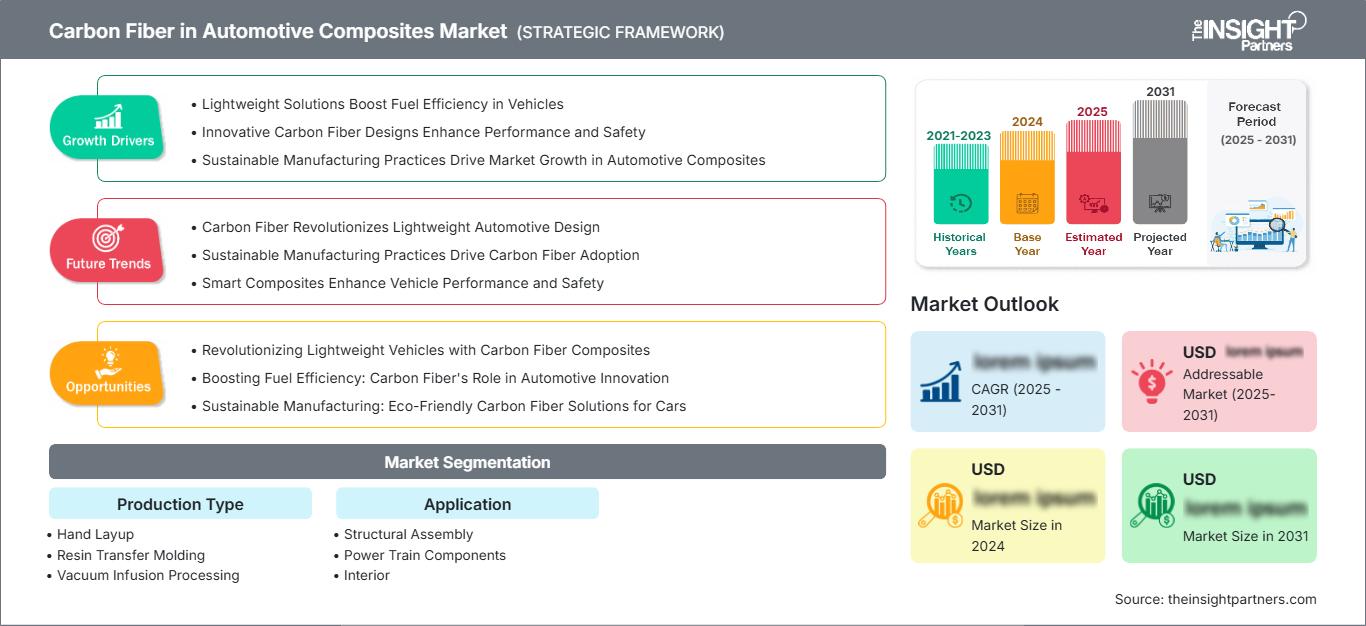
Carbon Fiber in Automotive Composites Market: Strategic Insights
Regional Insights
North America Carbon Fiber in Automotive Composites Market
The North American share of the Global Carbon Fiber in Automotive Composites market was estimated to be 31–33% in 2025, and is expected to grow at a CAGR of 9.8–10.4% during 2026–2034. The region offers a developed automotive industry base, advances in composite materials, and increasing investments in EVs production. CAFE standards and vehicle emission reduction regulations continue to promote the use of lightweight materials in the construction of automotive parts. Production capacity expansion of the major composite material suppliers is also driven by the rising domestic demand for performance automotive materials.
Increasing partnerships between OEMs, Tier-1 automotive suppliers, and advanced materials manufacturers to develop economical composite manufacturing processes in the region is observed. The processes of resin transfer molding, compression molding, and thermoplastic composites are gaining importance in high volume automotive production. Long-term demand growth for carbon fiber composites is expected to be supported by the government incentives for domestic manufacturing, along with continued investment in batteries production and infrastructure development for electric mobility.
U.S. Carbon Fiber in Automotive Composites Market
North America constitutes approximately 74-77% of the United States market, which is estimated to grow at a CAGR of 9.9-10.5% over 2026-2034. Some of the prominent global composite producers, automotive OEMs, and research facilities for advanced materials exist within the country, thereby forming an advanced innovation ecosystem. Increasing investments in domestic electric vehicle manufacturing, production of batteries, and lightweight vehicles have further contributed toward increased demand for carbon fiber reinforced composite parts.
Increased adoption of carbon fiber in premium electric vehicles along with developing cost-effective manufacturing process for mass production of carbon fiber composites is becoming more prominent. With federal incentives provided in favor of domestic manufacturing along with increasing investment on advanced manufacturing program, increased local composite production is becoming a reality. Partnerships between material suppliers, research institutes, and vehicle makers are anticipated to expedite development of recyclable carbon fiber composites and manufacturing technologies in the forecast period.
Europe Carbon Fiber in Automotive Composites Market
Europe accounted for an estimated 27–29% share of the global market in 2025 and is forecast to grow at a CAGR of 10.2–10.8% during 2026–2034. Germany remains the leading regional market owing to its strong automotive manufacturing base, extensive engineering capabilities, and significant investments in lightweight vehicle technologies. European Union climate policies and increasingly stringent fleet emission regulations continue driving demand for advanced composite materials throughout the automotive value chain.
The UK is continuing with innovations in lightweight manufacturing through collaboration between automotive manufacturers, universities, and advanced materials firms. There is an increase in demand in luxury car manufacturing and new-age electric vehicles, driven by industrial decarbonization policies backed by the government.
Germany holds its position through the presence of premium automotive manufacturers as well as advanced composite manufacturers. Investments in automated resin transfer molding technology, thermoplastic composites, and sustainable carbon fiber recycling technologies have helped to enhance the competitive advantage of the country along with the large-scale manufacture of automobiles.
There is increasing use of carbon fiber composites in electric vehicles, motor sports, and transportation sectors in France, Italy, and Spain. Industrial modernization in these countries along with investments in sustainable manufacturing is creating a conducive environment for advanced automotive composites in Southern Europe.
APAC Carbon Fiber in Automotive Composites Market
Asia Pacific accounted for approximately 36–39% of the global Carbon Fiber in Automotive Composites market in 2025 and is projected to register the fastest regional expansion at a CAGR of 11.3–11.9% during 2026–2034. China leads regional demand, followed by Japan, South Korea, and India, supported by expanding electric vehicle manufacturing and increasing domestic carbon fiber production capacity.
Government incentives promoting new energy vehicles, localized supply chains, and advanced manufacturing continue to encourage the adoption of lightweight composite materials. Japan remains a global technology leader in carbon fiber production, while South Korea and India are strengthening investments in automotive composites to improve vehicle efficiency and export competitiveness.
Middle East & Africa Carbon Fiber in Automotive Composites Market
MEA will grow at a rate of 8.8% to 9.4% CAGR from 2026 to 2034. In terms of investments, Saudi Arabia and UAE will drive the region due to their industrial diversification policies and development in the production of advanced materials and automotive innovations and mobility infrastructure, respectively.
The country of South Africa stands out as the leader in automobile manufacturing in Sub-Saharan Africa; hence, it is driving the use of composite materials in automobiles. The rest of MEA is forecasted to grow moderately owing to infrastructural investment, industrial diversification plans, and increasing need for efficient transportation in the region.
Segmentation Analysis
Production Type
The Production Type segment is expected to register a CAGR of 10.9–11.4% during 2026–2034. The Carbon Fiber in Automotive Composites Market scope continues to broaden as automotive manufacturers increasingly adopt advanced processing technologies that improve production efficiency, dimensional accuracy, and structural performance. The transition from labor-intensive manufacturing toward automated composite fabrication supports higher production volumes while reducing material waste and manufacturing costs. Continuous improvements in resin chemistry, curing cycles, and automation are expected to strengthen adoption across both passenger and commercial vehicle platforms.
- Hand Layup – Primarily utilized for prototype development, low-volume luxury vehicles, and specialty automotive components where design flexibility and complex geometries are prioritized over production speed.
- Resin Transfer Molding – Increasingly preferred for medium- and high-volume automotive production because it delivers consistent part quality, reduced cycle times, and excellent structural performance for lightweight vehicle assemblies.
- Vacuum Infusion Processing – Widely adopted for manufacturing large composite structures requiring uniform resin distribution, lower void content, and improved mechanical properties while maintaining efficient material utilization.
- Injection Molding – Supports large-scale production of thermoplastic carbon fiber composite components with excellent dimensional consistency, making it suitable for automotive manufacturers pursuing high-volume lightweight component manufacturing.
- Compression Molding – Gains traction due to rapid processing capability, repeatable quality, and compatibility with automated production lines used for structural vehicle components and electric vehicle battery enclosures.
Application
The Application segment is projected to expand at a CAGR of 10.8–11.3% during 2026–2034. Vehicle manufacturers continue increasing the integration of carbon fiber composites across structural and functional systems to improve energy efficiency, crash performance, durability, and overall vehicle weight reduction. Electrification trends, premium vehicle production, and stricter emission regulations are encouraging broader utilization of advanced composite materials across multiple automotive applications throughout the forecast period.
- Structural Assembly – The leading application owing to extensive utilization in chassis structures, monocoques, roof systems, crash structures, and battery protection assemblies where superior stiffness-to-weight performance is essential.
- Power Train Components – Growing adoption is supported by increasing demand for lightweight drive shafts, transmission components, and electric powertrain structures that improve vehicle efficiency while maintaining mechanical durability.
- Interior – Carbon fiber composites are increasingly incorporated into dashboards, seat frames, center consoles, and decorative trim to reduce vehicle weight while enhancing premium aesthetics and occupant safety.
- Exterior – Manufacturers continue utilizing carbon fiber materials for hoods, doors, trunk lids, bumpers, spoilers, and aerodynamic components to improve fuel efficiency, structural rigidity, and vehicle performance.
Opportunity Snapshot
| Application | Revenue Contribution | Trend Tag | Adoption Stage |
|---|---|---|---|
| Structural Assembly | High | Battery Housing | Mature |
| Power Train Components | Medium | E-Drivetrain | Scaling |
| Interior | Medium | Lightweight Cabin | Scaling |
| Exterior | High | Aero Panels | Mature |
Carbon Fiber in Automotive Composites Market Growth Drivers and Impact Analysis
Accelerating Electric Vehicle Production and Lightweighting Requirements
Global automotive manufacturers are increasing the use of lightweight materials to improve vehicle efficiency, battery range, and compliance with tightening emission regulations. Carbon fiber composites provide high specific strength, exceptional stiffness, and corrosion resistance while significantly reducing vehicle mass compared with conventional steel components. Electric vehicle platforms particularly benefit from lightweight battery enclosures, structural floor systems, roof panels, and crash structures that offset battery weight without compromising safety. Governments across North America, Europe, China, Japan, and South Korea continue supporting zero-emission vehicle adoption through regulatory mandates and manufacturing incentives. As production volumes of battery electric vehicles continue expanding, suppliers are investing in automated composite manufacturing technologies capable of delivering higher output with improved cost efficiency. These developments are expected to substantially strengthen long-term demand for automotive carbon fiber composites across both premium and increasingly mainstream vehicle platforms.
Advancements in Automated Composite Manufacturing Technologies
The commercialization of advanced manufacturing processes is making carbon fiber composites increasingly viable for large-scale automotive production. Resin transfer molding, compression molding, automated fiber placement, and thermoplastic composite processing have significantly reduced manufacturing cycle times while improving product consistency and material utilization. Digital manufacturing systems equipped with real-time quality monitoring and process automation are further enhancing production efficiency across automotive supply chains. Continuous innovation in resin chemistry and recyclable thermoplastic matrices is enabling faster curing, improved repairability, and greater sustainability throughout product lifecycles. These technological advancements reduce manufacturing costs while supporting higher production volumes, allowing automotive OEMs to integrate carbon fiber components into a broader range of vehicle models rather than limiting their use to premium performance vehicles.
Stringent Fuel Economy and Carbon Emission Regulations Worldwide
Governments continue implementing stricter fuel economy standards and vehicle emission regulations to reduce greenhouse gas emissions from road transportation. Regulatory frameworks across North America, the European Union, China, Japan, and several emerging economies encourage manufacturers to improve fleet efficiency through lightweight vehicle design. Carbon fiber composites play an increasingly important role by enabling substantial weight reductions without sacrificing structural integrity or occupant safety. Automakers are therefore expanding investments in advanced materials alongside vehicle electrification strategies to meet long-term environmental objectives. Regulatory support for low-carbon manufacturing, combined with growing investments in recyclable composite technologies and circular economy initiatives, is expected to further strengthen the adoption of carbon fiber composites throughout the automotive industry over the coming decade.
Carbon Fiber in Automotive Composites Market Future Trends
Expansion of Recyclable Thermoplastic Carbon Fiber Composite Solutions
The Carbon Fiber in Automotive Composites Market trends increasingly emphasize recyclable thermoplastic composite systems that support circular manufacturing objectives and improve lifecycle sustainability. Automotive manufacturers are investing in thermoplastic materials because they offer faster processing, improved impact resistance, easier recycling, and compatibility with automated high-volume manufacturing. Material suppliers are simultaneously developing recycled carbon fiber feedstocks capable of maintaining mechanical performance while lowering environmental impact and production costs. As sustainability requirements become more stringent, recyclable composite technologies are expected to become an increasingly important differentiator across global automotive manufacturing.
Artificial Intelligence and Digital Manufacturing Integration
Artificial intelligence, digital twins, and advanced process monitoring are transforming composite manufacturing operations across the automotive industry. Machine learning algorithms are increasingly used to optimize fiber orientation, curing conditions, production scheduling, and predictive maintenance while minimizing defects and material waste. Digital quality assurance enables manufacturers to improve production consistency and accelerate the commercialization of complex structural components. As Industry 4.0 technologies continue maturing, automotive composite manufacturers are expected to achieve greater manufacturing flexibility, improved productivity, and lower production costs while supporting increasingly sophisticated lightweight vehicle architectures.
Carbon Fiber in Automotive Composites Market Opportunities
Expansion into High-Volume Electric Vehicle Manufacturing Platforms
The Carbon Fiber in Automotive Composites Market Forecasts indicate significant investment opportunities as carbon fiber technologies become increasingly economical for higher-volume electric vehicle production. Continuous reductions in precursor costs, manufacturing automation, and improved resin systems are enabling suppliers to expand beyond luxury vehicle applications into mainstream passenger cars and commercial vehicles. Companies capable of developing scalable production technologies, localized manufacturing facilities, and strategic OEM partnerships are well-positioned to capture future market demand. Investments focused on battery enclosure systems, crash structures, and integrated body architectures are expected to generate attractive long-term returns as global EV production continues expanding.
Growth Opportunities Through Sustainable Carbon Fiber Supply Chains
Growing emphasis on sustainability is creating new opportunities for manufacturers developing low-carbon production methods, recycled carbon fiber materials, and circular economy solutions. Automotive OEMs increasingly prioritize suppliers capable of demonstrating lower lifecycle emissions, responsible raw material sourcing, and improved recyclability. Investment in renewable energy-powered production facilities, advanced recycling technologies, and bio-based precursor materials can strengthen competitive positioning while addressing evolving regulatory requirements. Companies establishing integrated recycling ecosystems and strategic collaborations throughout the automotive value chain are expected to gain long-term commercial advantages as sustainability becomes a core purchasing criterion for global vehicle manufacturers.
Recent Developments
- March 2026: Hexcel Corporation announced at JEC World 2026 that it would showcase new composite solutions for automotive, aerospace, and defense applications, including the HexPly® M51 rapid-cure prepreg, advanced HexTow® IM11-R carbon fiber, and new manufacturing collaborations. The developments are designed to accelerate high-rate composite production and support lightweight automotive structures for next-generation electric vehicles.
- February 2026: Teijin Carbon Europe GmbH expanded its Tenax Next™ sustainable carbon fiber portfolio and announced new product demonstrators and industry collaborations ahead of JEC World 2026. The company also highlighted its improved EcoVadis sustainability rating and continued CDP climate reporting, reinforcing its strategy to commercialize lower-carbon composite materials suitable for automotive and industrial applications.
- March 2026: SABIC introduced a portfolio of specialty materials for enhanced automotive design, functionality, and circularity at PIAE 2026. The launch included new LNP ELCRIN™ SLX compounds containing up to 45% post-consumer recycled content, LNP KONDUIT™ WTF2C thermally conductive compounds for ADAS radar and ECU housings, EXTEM™ RH1017UCL resin for optical sensors, and NORYL GTX™ resin for lightweight EV battery energy absorbers. The innovations support vehicle lightweighting, improved recyclability, and advanced electric vehicle architectures.
Frequently Asked Questions

- Comprehensive Market Sizing and Forecast Analysis
- Detailed Segmentation Analysis
- In-Depth Market Dynamics Assessment
- Regional and Country-Level Insights
- Competitive Landscape and Company Benchmarking
- Strategic Business Intelligence
Recent Reports
Testimonials

The Insight Partners' SCADA System Market report is comprehensive, with valuable insights on current trends and future forecasts. The team was highly professional, responsive, and supportive throughout. We are very satisfied and highly recommend their services.
RAN KEDEM Partner, Reali Technologies LTDs
I requested a report on a very specific software market and the team produced the report in a few days. The information was very relevant and well presented. I then requested some changes and additions to the report. The team was again very responsive and I got the final report in less than a week.
JEAN-HERVE JENN Chairman, Future Analytica
We worked with The Insight Partners for an important market study and forecast. They gave us clear insights into opportunities and risks, which helped shape our plans. Their research was easy to use and based on solid data. It helped us make smart, confident decisions. We highly recommend them.
PIYUSH NAGPAL Sr. Vice President, High Beam Global
The Insight Partners delivered insightful, well-structured market research with strong domain expertise. Their team was professional and responsive throughout. The user-friendly website made accessing industry reports seamless. We highly recommend them for reliable, high-quality research services
YUKIHIKO ADACHI CEO, Deep Blue, LLC.
This is the first time I have purchased a market report from The Insight Partners.While I was unsure at first, I visited their web site and felt more comfortable to take the risk and purchase a market report.I am completely satisfied with the quality of the report and customer service. I had several questions and comments with the initial report, but after a couple of dialogs over email with their analyst I believe I have a report that I can use as input to our strategic planning process.Thank you so much for taking the extra time and making this a positive experience.I will definitely recommend your service to others and you will be my first call when we need further market data.
JOHN SUZUKI President and Chief Executive Officer, Board Director, BK Technologies
I wish to appreciate your support and the professionalism you displayed in the course of attending to my request for information regarding to infectious disease IVD market in Nigeria. I appreciate your patience, your guidance, and the fact that you were willing to offer a discount, which eventually made it possible for us to close a deal. I look forward to engaging The Insight Partners in the future, all thanks to the impression you have created in me as a result of this first encounter.
DR CHIJIOKE ONYIA MANAGING DIRECTOR, PineCrest Healthcare Ltd.Reason to Buy
- Informed Decision-Making
- Understanding Market Dynamics
- Competitive Analysis
- Identifying Emerging Markets
- Customer Insights
- Market Forecasts
- Risk Mitigation
- Boosting Operational Efficiency
- Strategic Planning
- Investment Justification
- Tracking Industry Innovations
- Aligning with Regulatory Trends





 Get Free Sample for