
Cardiac Pacing Market Size, Trends & Demand by 2034
Coverage: By Product Type (Implantable Pacemakers, External Pacemakers.); End User (Hospitals, Ambulatory Surgical Centers) , and Geography (North America, Europe, Asia Pacific, and South and Central America)
- Status : Data Released
- Report Code : TIPRE00027677
- Category : Life Sciences
- No. of Pages : 150
- Available Report Formats :


- Last update date : September 07, 2026


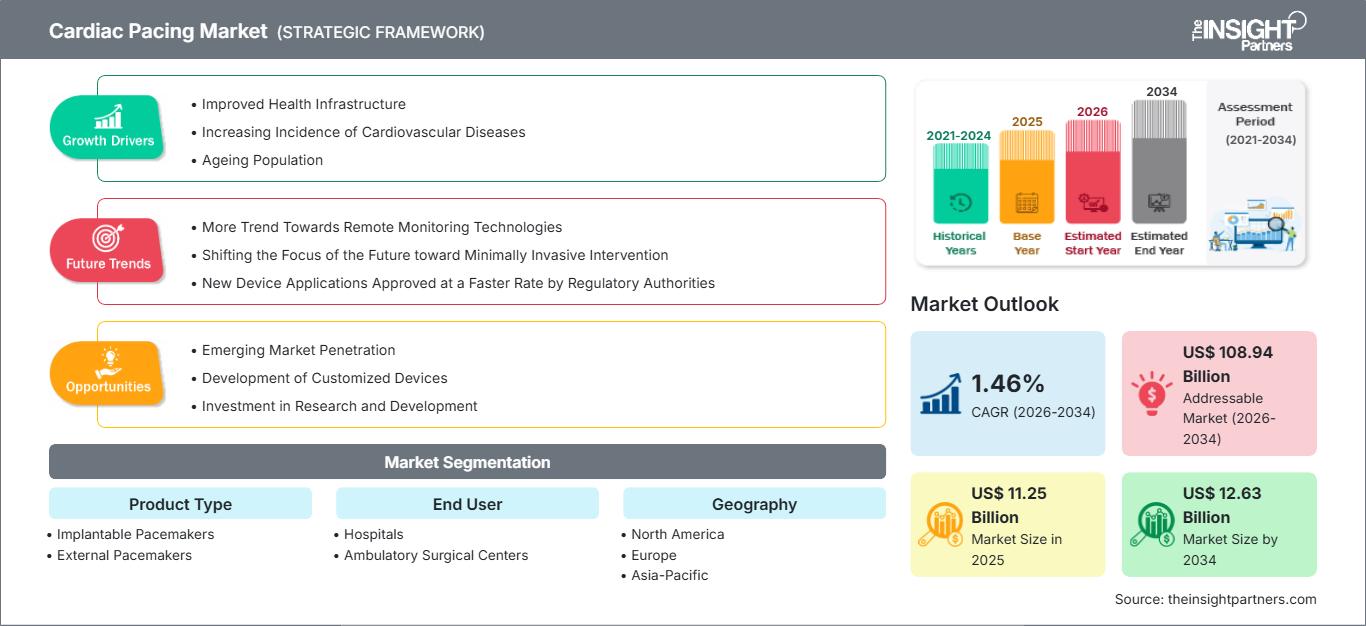
2025 Market Size
US$ 11.25 Bn
Base year value
2034 Forecast
US$ 12.63 Bn
Projected by 2034
CAGR 2026-2034
1.46 %
Growth rate
Addressable Market
US$ 108.94 Bn
(2026-2034)
The Cardiac Pacing Market was valued at US$ 11.25 Billion in 2025 and is projected to reach US$ 12.63 Billion by 2034, registering a CAGR of 1.46% during 2026–2034. Demand remains anchored in the clinical management of bradyarrhythmias, atrioventricular block, sinus node dysfunction, and selected heart failure cases. Market expansion is moderate because replacement procedures, pricing controls, and mature implantation rates balance increasing cardiovascular disease prevalence and technological advancement.
North America continues to represent the principal commercial center, with an estimated CAGR range of 1.2–1.6% through 2034. The Cardiac Pacing Market size in the region is supported by established electrophysiology infrastructure, broad reimbursement for medically necessary implantations, and rapid adoption of leadless and conduction-system pacing. The availability of specialist implantation centers and connected follow-up platforms also supports recurring revenue from replacement devices, programmers, leads, and monitoring services.
Cardiac Pacing Market Assessment and Insights
- North America: The region accounted for a 42–44% share in 2025 and is expected to record a CAGR between 1.2–1.6% during 2026–2034, supported by specialist capacity, reimbursement coverage, replacement demand, and early technology adoption.
- US: The country represented 82–84% of North American revenue in 2025 and is projected to grow at a CAGR between 1.1–1.5% during 2026–2034, reflecting high procedural access and installed-device replacements.
- Europe: Europe held a 30–32% share in 2025 and is anticipated to expand at a CAGR between 1.0–1.4% during 2026–2034. Germany leads regional demand, while the UK, France, Italy, and Spain maintain substantial implantation volumes.
- Asia Pacific: The region represented 19–21% of revenue in 2025 and is forecast to register a CAGR between 2.2–2.8% during 2026–2034. China leads by volume, while Japan, India, South Korea, and Australia broaden advanced pacing access.
- Largest Segment: Implantable Pacemakers held an estimated 89–91% market share in 2025 and are projected to expand at a CAGR between 1.3–1.7% during 2026–2034, reflecting permanent rhythm-management requirements.
- High Growth Segment: External Pacemakers accounted for an estimated 9–11% market share in 2025 and are expected to register a CAGR between 2.0–2.6% during 2026–2034, supported by emergency and temporary pacing applications.
- Key companies analyzed in detail: BIOTRONIK SE & Co. KG, Boston Scientific Corporation, Medtronic plc, Abbott Laboratories, LivaNova PLC, Lepu Medical Technology (Beijing) Co., Ltd., Osypka Medical GmbH, Shree Pacetronix Ltd., Medicoweb, and MicroPort CardioFlow Medtech Corporation.
Source: The Insight Partners' analysis based on proprietary research, government publications, company annual reports, investor presentations, industry databases, and expert interviews.
Cardiac pacing technology has advanced from fixed rate pulsing to sophisticated, programmable systems that feature diagnostic capability, MRI capability, telemetry capabilities, and software that reduces unnecessary ventricular stimulation. The manufacturing process has accordingly developed from larger circuits, hermetically sealed systems, batteries, electrode material, and software development. Leadless pacing devices and conduction system pacing instruments are driving product innovation, yet traditional transvenous pacing devices continue to be critical due to doctor comfort levels, increased indications, existing infrastructure, and proven procedures in key cardiac centers.
The Cardiac Pacing Market forecast shows that future growth opportunities will continue to develop in the Asia Pacific region, select Middle Eastern countries, and underserved urban environments where electrophysiology expertise is growing. Investments will continue to focus on catheter-based systems, physiologic pacing, long-lasting batteries, and interoperable monitoring. MRI conditional approval and expanded pacing lead approval can support adoption rates, but public funding for tertiary care hospitals expands the procedure volume opportunity. Nonetheless, successful supplier performance depends on education, evidence development, post-market surveillance, and sustainable pricing strategies.
Cardiac Pacing Market Report Scope
| Report Attribute | Details |
|---|---|
| Market size in 2025 | US$ 11.25 Billion |
| Market Size by 2034 | US$ 12.63 Billion |
| Global CAGR (2026 - 2034) | 1.46% |
| Historical Data | 2021-2024 |
| Forecast period | 2026-2034 |
Cardiac Pacing Market Analysis
Cardiac Pacing Market growth drivers include ageing populations, better rhythm-disorder detection, and cumulative replacement needs of patients who have had pacemakers before. Cardiovascular diseases were responsible for an estimated 19.8 million deaths around the world in 2022, accounting for about 32% of global deaths.
The value chain consists of hospitals, electrophysiologists, manufacturers of devices, component suppliers, distributors, and remote monitoring companies. Manufacturing requires access to special batteries, semiconductors, leads, electrodes, sterilization processes, and validated software. Long qualification periods do not allow fast supplier switching, while requirements to documentation and traceability create advantage for those manufacturers which can ensure high quality throughout the whole device lifetime.
Competitive rivalry is based on reliability of products, longevity of batteries, compatibility with MRIs, physiological pacing abilities, and connectivity for follow-up. Medtronic plc, Abbott Laboratories, Boston Scientific Corporation, and BIOTRONIK SE & Co. KG protect their positions in the hospital markets through the help of cardiac-rhythm portfolios and clinical networks. Specialists compete through cost positioning, local presence, or pacemaker components.
In addition, Cardiac Pacing Market analysis highlights growing importance for such players as MicroPort CardioFlow Medtech Corporation, Lepu Medical Technology (Beijing) Co., Ltd., Shree Pacetronix Ltd., Osypka Medical GmbH, Medicoweb, and LivaNova PLC in particular regions. Development priorities of companies include leadless systems, left bundle branch area pacing, remote data transfer, and partnerships for manufacturing in emerging markets. Abbott reported 10% growth in Q2 of 2025 of its cardiac rhythm management segment.
● REPORT CUSTOMIZATION
Tailor This Report To Align With Your Specific Business Requirements
This report can be customized to align precisely with your business objectives, scope, and target markets. Customization options include tailored segmentation, geography, competitive analysis, and strategic insights to support informed decision-making.
Customize This Report →WHAT YOU CAN ADJUST
- ● Segmentations
- ● Geography
- ● Competitive Analysis
- ● Language Preferences
Cardiac Pacing Market: Strategic Insights
Regional Insights
North America Cardiac Pacing Market
North America held a 42–44% Cardiac Pacing Market share in 2025 and is projected to expand at a CAGR of 1.2–1.6% during 2026–2034. Well-developed electrophysiology systems, reimbursement structuring, high intensity diagnostics, and frequent generator changes provide a steady income stream. The hospitals also implement MRI-compatible systems, remote monitoring, conduction system pacing leads, and leadless designs earlier than many other healthcare organizations being created.
Growth is still moderate due to the already well-established implantation procedures and price pressure coming from buyers. However, there is still room for gaining value by providing longer battery life, less complications, follow-up using software, and clinical education. Abbott found that there would be 12.1 million patients in the US suffering from arrhythmias by 2030, and thus ensuring a long-run capability of rhythm management is essential.
U.S. Cardiac Pacing Market
The US accounted for 82–84% of North American revenue in 2025 and is forecast to record a CAGR of 1.1–1.5% through 2034. High implantation rate, referral network, Medicare coverage, and fast adoption of techniques for specialists drive the demand. Replacements create a steady installed-base effect; the leadless pacemakers create options for patients at risk of pocket or lead complications.
Medtronic plc, Abbott Laboratories, Boston Scientific Corporation, and BIOTRONIK SE & Co. KG have a presence in both the clinical and commercial space. The application trend is increasingly in favor of dual-chamber leadless pacemakers and left bundle branch area pacing in cases where suitable for anatomy and indications. Abbott says that about 80% of patients with pacemakers need two-chamber pacing, and Boston Scientific’s INGEVITY+ in the US was indicated based on data of 400 patients.
Europe Cardiac Pacing Market
Europe represented 30–32% of 2025 revenue and is expected to post a CAGR of 1.0–1.4% during 2026–2034. Germany has its strengths in procedure capabilities, specialty centers, and structured reimbursement processes. The United Kingdom uses centralized purchasing and growing focus on physiological pacing, but there is an emphasis on lifecycle value analysis due to budget constraints. France fosters adoption by having well-established networks for cardiac care and generating clinical evidence. Italy and Spain have significant procedure volumes, but regional purchasing policies and hospital budgets are drivers of technology adoption. Boston Scientific gained European approval in September 2025 to expand the indications for INGEVITY+ for left bundle branch area pacing in more than 1,100 patients.
In all these countries, replacement need creates demand stability, while connected implants reduce the number of unnecessary clinical visits. MRI capability, remote monitoring, and conduction system pacing become important for tendering. The suppliers should comply with the European medical devices regulation, different reimbursement conditions in each country, and post-market evidence requirements while fostering clinician education.
APAC Cardiac Pacing Market
Asia Pacific accounted for a 19–21% share in 2025 and is projected to record a CAGR of 2.2–2.8% during 2026–2034. China leads regional volume through hospital expansion and domestic manufacturing, while Japan remains an advanced, ageing market. India offers substantial underpenetrated demand as tertiary cardiac services extend beyond major metropolitan centers.
South Korea and Australia support adoption of connected and MRI-compatible devices through developed clinical systems. Policy-led hospital investment, local production, and physician education improve access. MicroPort markets Bluetooth-enabled pacemakers with remote follow-up and physiological pacing capabilities, demonstrating increasing regional product sophistication.
Middle East & Africa Cardiac Pacing Market
The Middle East & Africa represented an estimated 4–6% share in 2025 and is expected to register a CAGR of 1.8–2.4% through 2034. Saudi Arabia leads regional spending as hospital modernization and specialist cardiac infrastructure increase procedure capacity. The UAE supports premium-device adoption through concentrated tertiary care and medical tourism.
South Africa remains the principal Sub-Saharan market, while the Rest of MEA faces affordability and electrophysiologist shortages. Investment in hospital infrastructure, reliable electricity, catheterization facilities, sterile supply chains, and digital patient records is necessary to expand safe implantation and follow-up beyond major cities.
Segmentation Analysis
Product Type
Product Type is projected to expand at a CAGR of 1.4–1.8% during 2026–2034. The Cardiac Pacing Market scope across this segment covers implantable and external pacemakers without altering their distinct clinical roles. Implantable systems dominate recurring revenue through permanent therapy, replacements, and associated leads, while external devices remain strategically important for temporary stabilization, postoperative management, emergency care, and bridging patients to definitive treatment.
- Implantable Pacemakers: These devices hold the dominant position because they offer long-term rhythm correction for clinically significant bradycardia and conduction disorders. Innovation focuses on leadless delivery, physiological pacing, remote diagnostics, MRI compatibility, and extended battery longevity.
- External Pacemakers: Demand is concentrated in emergency departments, critical care units, cardiac surgery, and temporary pacing pathways. Portable operation, rapid setup, dependable pulse delivery, and compatibility with institutional monitoring systems determine purchasing preferences.
End User
End User demand is forecast to register a CAGR of 1.3–1.7% during 2026–2034. Hospitals retain the primary role because implantation requires imaging, sterile procedure rooms, electrophysiology expertise, programming systems, and complication-management capacity. Ambulatory surgical centers represent a selective growth channel where reimbursement, patient risk, anesthesia protocols, and transfer arrangements support appropriate procedures. Vendor service models must therefore address both complex institutional accounts and efficiency-oriented outpatient facilities.
- Hospitals: Hospitals dominate purchasing because they manage diagnosis, implantation, acute complications, device programming, and long-term follow-up. Tertiary centers also lead adoption of leadless and conduction-system pacing through specialist teams and clinical research participation.
- Ambulatory Surgical Centers: These facilities offer lower-overhead procedural pathways for carefully selected patients. Strategic importance is increasing where regulations permit cardiac-device procedures and centers maintain suitable imaging, anesthesia, infection-control, emergency-transfer, and post-procedure monitoring capabilities.
Opportunity Snapshot
| End User | Revenue Contribution (High/Medium/Low) | Trend Tag | Adoption Stage (Emerging/Scaling/Mature) |
| Hospitals | High | Physiological Pacing | Mature |
| Ambulatory Surgical Centers | Medium | Outpatient Implantation | Scaling |
Cardiac Pacing Market Growth Drivers and Impact Analysis
Ageing Populations Expand the Treatable Rhythm-Disorder Base
The natural process of aging leading to degenerative changes in the conduction system of the heart contributes to an increased prevalence of sinus node dysfunction and atrioventricular block, thus ensuring continued need for pacemakers in developed and developing nations. Patients at an older age are also more prone to having their diagnosis of clinically significant bradyarrhythmia discovered through diagnostic tests. According to the WHO statistics, about 19.8 million people died of cardiovascular diseases in 2022, with almost 75% of these deaths happening in low- and middle-income countries. The commercial implications of this trend not only involve the need for initial implantation but also the longer life expectancy, which translates into battery changes and remote follow-up visits.
Leadless and Physiological Pacing Improve Clinical Differentiation
Leadless pacemakers eliminate the subcutaneous pocket of the generator and transvenous leads, solving problems such as lead breakage, infection, displacement, and pocketing. With dual chamber communication and retrievability, more patient populations can be considered for leadless pacemaker solutions. Abbott says the company's AVEIR devices are directly inserted to the heart through a catheter and do not need cardiac leads. Boston Scientific, on the other hand, has widened indications of pacing leads to include the left bundle branch area. Competitiveness is therefore not about providing a simple pulse, but the procedure, synchronization, battery performance, and outcomes. This has a bigger effect at specialty hospitals with the capability to train personnel in new processes. Adoption will depend on cost of service, evidence, retrievability, and total cost comparison.
Remote Monitoring Strengthens Lifetime Device Management
The ability to connect follow-up helps medical staff assess the condition of the device, battery life, rhythm episodes, and selected alerts, without necessarily waiting for a physical visit. The use of remote follow-up becomes very useful for aged people, rural areas, and large clinics dealing with larger groups of implanted devices. BIOTRONIK has been carrying out the home monitoring of cardiac implants since 2000, whereas MicroPort has remote follow-up available in its portfolio of pacemakers by using Bluetooth technology. Market implications are achieved by creating a competitive edge, efficiency in clinicians' workflow, and early detection of problems with the devices. Successful implementation requires interoperable data systems, secure transfer of data, reliable onboarding of the patients, and well-defined procedures in terms of alerts management.
Cardiac Pacing Market Future Trends
Modular Leadless Systems Will Broaden Personalized Therapy
The Cardiac Pacing Market trends indicate that modular intracardiac devices which will allow for pacing in atrium, ventricle, or dual chamber depending on rhythm needs are gaining popularity. Platforms of the future will focus on device-to-device communication, retrieval, upgradeability, and energy optimization. In May 2026, BIOTRONIK commenced the first European implants of the investigational LivIQ leadless system to examine the atrioventricular synchrony in resting state and under physical activity. With further evidence accumulating, procurement decision-making process will move beyond implantation success to chronic synchronization, replacement approach, retrievability, and total cost of ownership. The competition will reward firms that will ensure reliable communication of intracardiac devices and adequate physician training program.
Conduction-System Pacing Will Influence Portfolio Design
Pacing that engages the heart’s natural conduction pathways is expected to become a more prominent alternative to conventional right ventricular stimulation. Left bundle branch area pacing may improve ventricular synchrony for selected patients, directing investment toward compatible leads, delivery tools, programmers, and clinical education. Boston Scientific received European approval in September 2025 for an expanded INGEVITY+ indication covering conduction-system pacing and sensing in the left bundle branch area. Future portfolios will increasingly combine traditional, leadless, and physiological approaches rather than promoting a single architecture. Adoption will depend on standardized implantation techniques, comparative outcomes, lead durability, extraction considerations, and reimbursement recognition across national health systems.
Cardiac Pacing Market Opportunities
Localized Manufacturing and Training in Underserved Markets
Expansion in India, China, Southeast Asia, the Middle East, and Africa creates an opportunity to combine localized assembly, distributor development, clinician training, and tiered product portfolios. The addressable need is substantial because more than three quarters of cardiovascular deaths occur in low- and middle-income countries, although infrastructure and affordability restrict treatment access. Manufacturers should prioritize dependable conventional systems alongside advanced offerings rather than assuming uniform premium-device adoption. Actionable investment areas include regulatory capability, regional service centers, generator and lead inventory, programming equipment, and electrophysiology fellowships. Partnerships with tertiary hospitals can establish reference sites that support training, evidence generation, patient referrals, and safe geographic expansion.
Lifecycle Service Models Can Protect Recurring Revenue
Suppliers can build differentiated commercial models around device selection, implantation support, monitoring enrollment, alert triage, software updates, replacement planning, and documented performance. Connected platforms make lifecycle contracts increasingly feasible because providers need dependable data access and operational support throughout the implant period. The Cardiac Pacing Market Report should therefore be evaluated through total account value rather than initial generator pricing alone. Investment in cybersecurity, multilingual patient applications, automated clinic workflows, and field-service responsiveness can improve retention. Vendors should also create transparent protocols for product advisories and firmware deployment, as device corrections can materially affect purchasing confidence, clinical workloads, and long-term supplier relationships.
Recent Developments
- May 2026: BIOTRONIK SE & Co. KG announced the first European implants of its LivIQ leadless pacemaker system under the BIO-LivIQ clinical study. The investigation is evaluating safety, clinical effectiveness, and atrioventricular-synchronous pacing during rest and physical activity, with the objective of extending leadless therapy to broader patient profiles, including younger and more active individuals.
- September 2025: Boston Scientific Corporation received CE mark approval to expand the indication for INGEVITY+ pacing leads to include conduction-system pacing and sensing in the left bundle branch area. Supporting evidence included information from more than 1,100 patients, alongside bench testing and programming-system data, strengthening the company’s physiological pacing offering in Europe.
- September 2025: Medtronic plc initiated a global pivotal study evaluating cardiac pacing in patients with heart failure with preserved ejection fraction. The program examines whether a new pacing approach can improve outcomes for a patient population with limited treatment options, potentially extending pacing applications beyond established bradycardia and conduction-disorder pathways.
Frequently Asked Questions

- Comprehensive Market Sizing and Forecast Analysis
- Detailed Segmentation Analysis
- In-Depth Market Dynamics Assessment
- Regional and Country-Level Insights
- Competitive Landscape and Company Benchmarking
- Strategic Business Intelligence
Recent Reports
Testimonials

The Insight Partners' SCADA System Market report is comprehensive, with valuable insights on current trends and future forecasts. The team was highly professional, responsive, and supportive throughout. We are very satisfied and highly recommend their services.
RAN KEDEM Partner, Reali Technologies LTDs
I requested a report on a very specific software market and the team produced the report in a few days. The information was very relevant and well presented. I then requested some changes and additions to the report. The team was again very responsive and I got the final report in less than a week.
JEAN-HERVE JENN Chairman, Future Analytica
We worked with The Insight Partners for an important market study and forecast. They gave us clear insights into opportunities and risks, which helped shape our plans. Their research was easy to use and based on solid data. It helped us make smart, confident decisions. We highly recommend them.
PIYUSH NAGPAL Sr. Vice President, High Beam Global
The Insight Partners delivered insightful, well-structured market research with strong domain expertise. Their team was professional and responsive throughout. The user-friendly website made accessing industry reports seamless. We highly recommend them for reliable, high-quality research services
YUKIHIKO ADACHI CEO, Deep Blue, LLC.
This is the first time I have purchased a market report from The Insight Partners.While I was unsure at first, I visited their web site and felt more comfortable to take the risk and purchase a market report.I am completely satisfied with the quality of the report and customer service. I had several questions and comments with the initial report, but after a couple of dialogs over email with their analyst I believe I have a report that I can use as input to our strategic planning process.Thank you so much for taking the extra time and making this a positive experience.I will definitely recommend your service to others and you will be my first call when we need further market data.
JOHN SUZUKI President and Chief Executive Officer, Board Director, BK Technologies
I wish to appreciate your support and the professionalism you displayed in the course of attending to my request for information regarding to infectious disease IVD market in Nigeria. I appreciate your patience, your guidance, and the fact that you were willing to offer a discount, which eventually made it possible for us to close a deal. I look forward to engaging The Insight Partners in the future, all thanks to the impression you have created in me as a result of this first encounter.
DR CHIJIOKE ONYIA MANAGING DIRECTOR, PineCrest Healthcare Ltd.Reason to Buy
- Informed Decision-Making
- Understanding Market Dynamics
- Competitive Analysis
- Identifying Emerging Markets
- Customer Insights
- Market Forecasts
- Risk Mitigation
- Boosting Operational Efficiency
- Strategic Planning
- Investment Justification
- Tracking Industry Innovations
- Aligning with Regulatory Trends





 Get Free Sample for